Climbing vines go about their business in plant time slowly and methodically making their way to get a piece of open sky. In time lapse photography they appear to blindly seek their position with random motions before securing their hold. Their stems appear thin and weak, but are instead lithe and sinewy like a rock climbers arms. Their efforts are calculated and goal driven. They seek audience with the sun. We interrupt them in our time and can only see their determined effort as a freeze frame or a snap shot. I have a few stills to show you of one of the prettiest faces in the climbing vine bunch: the Field Bindweed.
The bindweed is indeed a handsome plant. Take a look here at one of the delicate pink funnel blooms of this common late summer bloomer. At first glance, the gardeners among you will notice how closely it resembles the domestic Morning Glory (those wonderful tendrils which wrap around rural mailboxes and porch rails). That resemblance is more that incidental. Both the field plant and the domestic one are in the so-called Morning Glory Family. You might be interested to know that the Sweet Potato is part of the family clan as well.
The sinewy wild plant, in fact, comes from Eurasia where the many varieties of cultured Morning Glory hail. It arrived here as an ornamental in the early 1800s but was shunned as a feral weed by the end of the century. Nobody plants them on purpose anymore, but they still inhabit the fringes of our living space like lonely orphans. In a weird sort of way this is like shunning the runner-ups on American Idol. Remember, we brought them here to start with. In the long run, like any good competitor, they can withstand about anything we throw at them.
Names like Small Flowered Morning Glory and Creeping Jenny are a few of the innocuous alternate names that we throw at them, but the term Possession Vine certainly indicates a negative trait. Like tough street orphans they climb all over lesser plants to gain the advantage of altitude. In a wild setting they have a harder time dominating their fellow plants and therefore are easier to enjoy.
Stop to take a sniff of the delicate bloom and notice the sweet vanilla scent and your enjoyment level will increase. The flower is made up of five petals, but they are fused together to form a continuous pink funnel called a corolla. True to their family name, they open up select blossoms just after the sun rises and close them up at sunset. Sometimes they retire early on cloudy days when Old Sol is bashful. The flowers track the sun when it is out a behavior which is termed Heliotropism. Oddly enough, all that flowering energy usually goes for naught and individual plants often fail to set seeds. These determined climbers carry on over the generations by sprouting exploratory stems from their rhizomes.
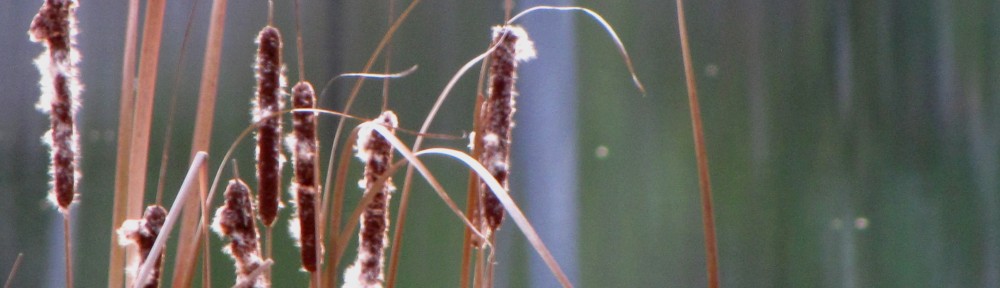
Their universal name Convolvulus arvensis means plant of the field that entwines and that is just what they do. Possessed of small leaves, it is important for the plants to gain open sun to carry on the business of photosynthesis. Take a look here at one of the vine sections and youll see how it is wrapped multiple times around a cat-tail leaf. What you may not have noticed is that the stem rotation is counter-clockwise around the cat-tail. You could say that Bindweeds are always left handed, except that they dont have hands. Lets just say they are left spiraled and leave it alone.
The growing tip of the vine is able to complete a rotation in about two hours according to one source. That is almost in the range of human observation time. Who knows, watching the bindweed grow may catch on as a sport to rival corn and grass watching and well stop persecuting it. Instead of super slow motion capture of a baseball swing, wed need to set up one of those time lapse cameras to see whats really going on.
As I mentioned before, the plant rotates as it extends upward. This motion insures that contact with the nearest surface a cat-tail leaf or a fence post is maintained. As long as the inner surface is there to climb, the plant senses it and sends out growth hormones to the opposite side of the stem. In this manner, the outer part of the vine grows faster than the inner portion and it spirals up to the gloryland. Maybe Im being a bit dramatic here, but somebody has to speak up for a lowly weed.
 Once Upon A Michigan
