
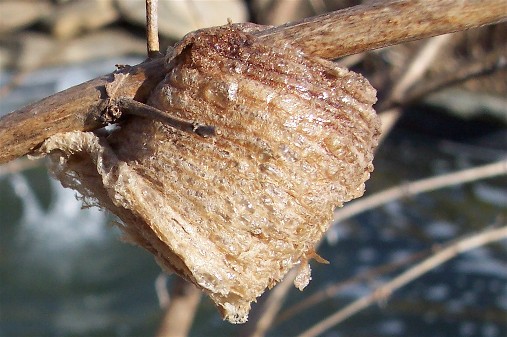
Although Praying Mantises have been around all summer, we humans dont usually encounter them until late September or October. This is both their mating season and their last hurrah on earth. The females will lure in males with a pungent perfume and, after mating, lay their characteristic seas foam egg masses (see here). The eggs will overwinter within their protective casing and this years mantids will slowly wither away before the snow flies.
Most folks are familiar with these distinctive insects but nurture a few falsehoods about them. Tell them that they are related to cockroaches and youll get a decided sneer believing they must be of nobler stock than that. Mention mantis mating and the perception usually is that the females always kill and eat the males. In the unnatural setting of a laboratory experiment, this is usually the case, but in nature the two sexes get along pretty well. In the wild, the female will chew the head off her mate less than 30% of the time. Besides, the female only eats her mate and skips the killing part (the male is too occupied to realize hes dead and continues on without his noggin as if nothing happened). The scary thing about this whole thing, speaking as a male myself, is that I have had my head chewed off many more times than your average mantis. I also have been accused of not using my head.
There is little confusion about the name, although some southerners have opted to call them Devils Horses for some mysterious reason. Mantids hold their specialized front grabbing legs in a prayerful pose while hunting. This meditative pose has earned them the name Mantes, which means soothsayer or prophet in the Greek tongue.
While the Greeks were reflecting on the gentle nature of the beast, a particular Chinese countryman was focusing on their defense skills. Encounter a mantis on the trail or sidewalk, and hell flare his wings and hold his pinching claws outward in order to appear bigger than he really is. Hell occasionally flash out with aggressive grabs as well. This tactic is meant to intimidate bird and mammal predators (like us). Pick him up by the thorax and these praying legs are extended back over the head in an attempt to spear you with those formidable spines (see here). Some 350 years ago, Wong Long a Chinese martial arts master, observed one of these insects doing battle with and eventually succeeding in defeating a cicada. He developed a series of Kung Fu moves that are known even today as the Praying Mantis style (take a look at one of the poses here). His footwork was derived from those of a monkey, but the hand work is pure insect.
Take a close look at a pair of those appendages that inspired Master Long (see here). They are folded like a pocket knife when not in use. Note that there is a double row of spines on the forearm matched by a double row on the hand portion acting like a backwards lobster claw of sorts. The insect prey is secured within the pincer grip of spine upon spine. Once immobilized, the predator proceeds to eat the head of the prey (and you thought that was a special thing just reserved for amorous males).
Praying mantises can fly, although they look ridiculous doing it. Night flight poses a hazard because bats can and will – feed upon them. Bats are much better flyers, so youd think the mantids would just avoid the night air altogether, but they have developed a fascinating bat detection system instead. Most mantids have a single ear (a Cyclops ear as one entomologist puts it) that can detect the ultrasonic emissions of a flying bat. This ear is located on the lower side of the thorax, or middle part of the body. When a bat is near, the mantis simply drops out of the sky to the safety of the ground. Perhaps a few of us could use just such a chest ear you know when we stop using our heads, for instance.
All insects are very fastidious about personal hygiene and this soothsaying member of the gang is no exception. To finish off our visit with the mantis, take a look at these two pictures (here and here) of one individual thoroughly engaged in pedicure. First the killer legs are picked clean and then the other four feet (regular type insect feet) are attended to. Id challenge anyone out there to try this last pose at home it resembles another Asian tradition called Yoga.
 Once Upon A Michigan

Pingback: Monkey » Mantis Kung Fu
Nice piece, Ger!