A few weeks ago I spotted a high four point buck crossing the parkway ahead of me. Seeing an antlered Whitetail deer in the middle of a Michigan November is not a newsworthy event, but it can be a form of religious experience for those who consider Nov. 15 a holiday. Im not a hunter (nor do I play one on T.V.), but I still experience the slight rise in respiration rate that usually occurs in such a situation. The bucks tend to be a secretive bunch and they limit their human exposure time. One has to make a concerted effort not to see -or run into -antlerless deer and does, but catching a glimpse of one of these crowned autumn beasts is not an everyday event.
The peculiar thing that really caught my eye was that the four point was dragging a ten foot section of Phragmites reed from its antlers. Actually the reed was artfully laid across his back with the dangling end arced down over his rump. The overall effect was quite graceful as the plumed deer hoofed across the road. He stopped briefly to give me an over-the-back glance and then vaporized into the brush with his décor in tow.
It was apparent that this buck had just been slogging through the wetland muck before his road crossing. His legs were coated with black mud nearly up to the belly line. I assumed that he had inadvertently snagged the reed while taking a shortcut (bucks almost always take the back way whenever possible.) Reed thickets are very dense. If I had antlers strapped to my head I know my tines would accumulate a veritable haymow full of the stuff. I, of course, am not a deer nor would I attempt the suicidal act of running through the wild with antlers during deer season. Well, as it turns out, my initial assumption in this regard was altered by an observation I made yesterday.
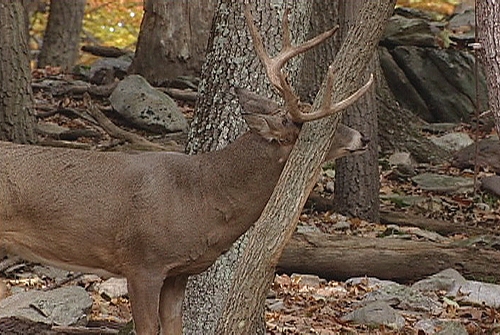
Bucks have only one thing on their mind during the rut that thing would be the feminine does. The males spend all summer regrowing their antlers with the goal of producing the biggest pair possible. Does dont pay too much attention to the individual antlers sported by their suitors, but the bucks themselves use the visual signal presented by a large rack to assert dominance over other bucks and to engage them in battle if necessary. Big antlers, in other words, clear away the dating competition. It takes a lot of energy to grow these things. Antler tissue grows very rapidly and the forked bony structures bloom by several inches a week. By the time fall rolls around the antlers are at full size and their owners go into an anti-bush phase. No, I dont mean anti-presidential, I mean that they begin to attack shrubbery, small trees and even a few large ones (heres a buck challenging a tree).
The initial idea for vegetative aggression is to knock off all the dried velvet skin that coated the antler as it grew, but eventually the activity becomes a one-sided sparring match of bone against bark. Like a boxer training for the big fight, the bucks are able to hone their left hooks and build up their neck muscles. Flora that has been attacked by a testosterone soaked warrior will bear the mark of combat in the form of shredded bark and exposed strips of inner wood (see here). Individual bucks will return to the same tree time after time and the damage becomes extensive. Such a damage mark is called a buck rub for obvious reasons.
Because rubs expose light colored inner layers of the stem, they can be spotted from quite a distance and apparently this is the idea. Each rub is also coated with an invisible layer of scent that comes from glands on the forehead of the rub maker. They act as both visual and smelly signposts to mark out the territory of a particular buck.
Yesterday I stopped to investigate one of these buck rub sites along the parkway. At this spot there are three red pines. Each tree bears the distinctive marks of Cervid abuse on their southeast side (see here). Take a look at this wider view of one of the trees (here) and youll notice some large reed stems lying on the ground at the base. Upon closer examination I found that each reed was bent at the center and in beat up condition.
Since there are no reed patches within 500 yards of this location, the combination of reed and rut site leads me to one conclusion: here is the rubbing site for my Phragmite clad buck. There are a half dozen reeds laying about, so apparently this animal makes a habit of snagging reeds before beating the snot out of them against these trees. His adornment is apparently no accident.
The only thing I can say is that maybe this buck, a mere four pointer, perceives that he has little chance of competing with the big boys so he employs a bit of theatre in order to enhance his image.
 Once Upon A Michigan