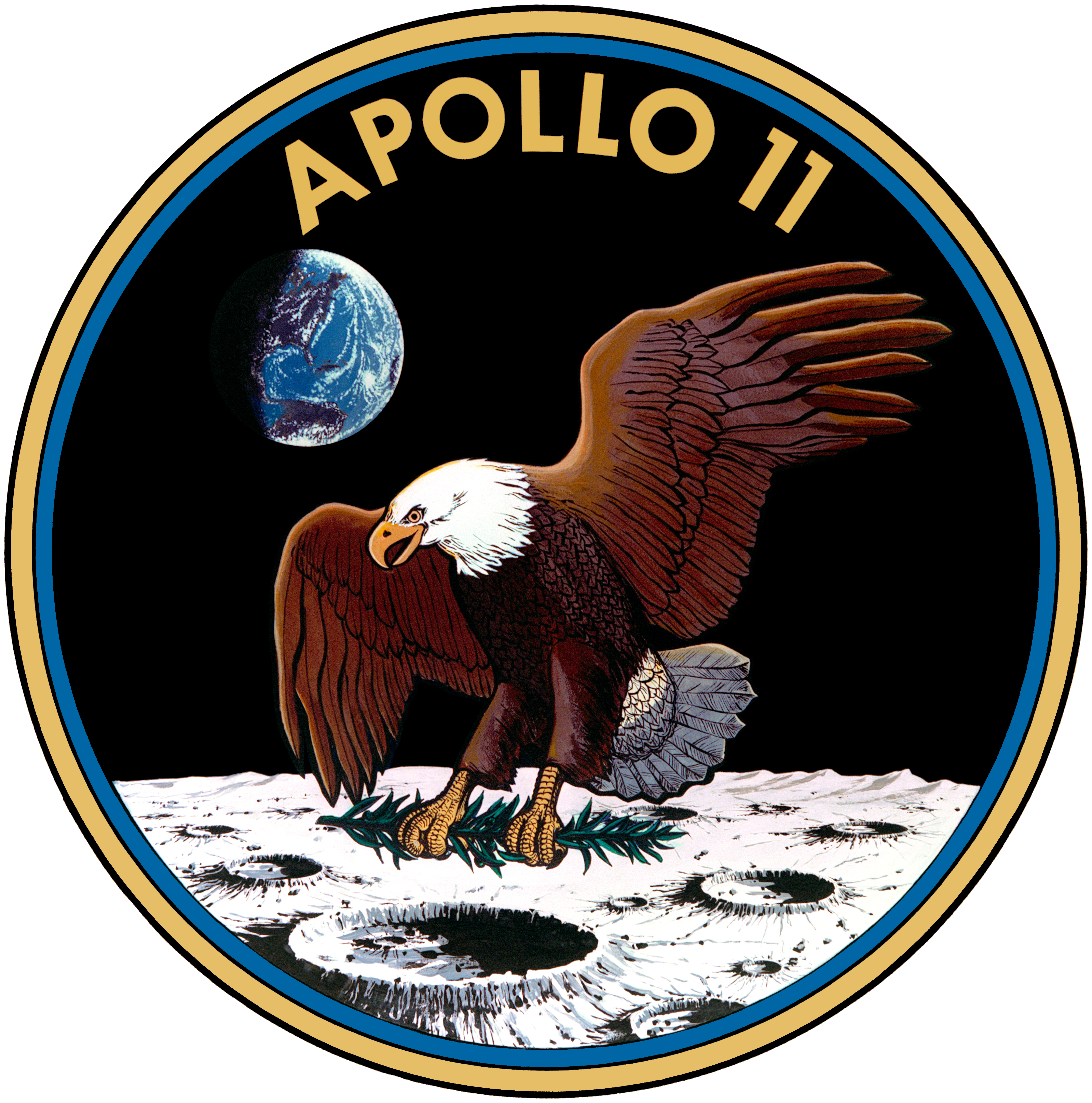
When the Eagle landed on Tranquility Base so many years ago, the eyes of a nation were looking up. The 1969 Apollo 11 mission resulted in the first human footprints on the moon and the launching of a new era of spaceflight. Eagle was the name of the lunar module and the mission patch reflected that with an image of an adult Bald Eagle descending down to the moon surface (see here).
America has always been proud of her earthbound eagles since the birth of the country, but as a human species we have admired eagles for thousands of years. These were the spirit beings able to touch the sun. In giving this honored name to the Apollo lander, NASA has allowed the bird to break the bounds of gravity and touch an extra-terrestrial body. The Bald Eagle is our chosen symbol and therefore an icon that tugs at our very soul. Anything bearing its name or image is held above the fray and human contact with the real bird has always been perceived as a nearly spiritual event.
Unfortunately, the uniqueness of such a contact here in the lower 48 has been the result of our own carelessness. We tried to poison the real thing out of existence. We tried to destroy the watery habitat required by the bird. We, unwittingly, tried as a society to make this bird only a symbol and not a reality. Fortunately in this particular mission we failed. The Bald Eagle is back and it is landing daily, thank you very much.
Seeing a Bald Eagle is now a regular event in S.E. Michigan and such a thing is no longer unusual. Nationwide the species has been de-listed from both the endangered and the threatened species list and is returning to haunts vacated a lifetime ago. Take a trip to Lake Erie Metropark and you will see eagles lots of them. This winter alone, for instance, there are at least 49 eagles wintering along the lower Detroit River. This resurgence means that we can now go beyond the fawning hero worship stage and appreciate them for what they are.
It is o.k. to admit that the birds are kleptoparasites which is a nice way to say that they are thieves. This is how they make their living as real animals and, despite what Ben Franklin says, this has nothing to do with their symbolic nature. The over wintering birds gather at the river mouth to feed on the abundant duck and fish life and will obtain them by any means possible.
Earlier in the winter, an observer spotted an immature Baldie swooping down to make a catch. It hoisted its sizable prey up out of the water and was immediately attacked by another immature bird (so immature!). The second bird forced the first to drop the fish and retrieved it as its own. No sooner had the second bird made head way towards the shoreline than an adult eagle entered the scene and harassed the second bird. You guessed it; the second thief yielded to the persuasions of the third and was forced to drop its ill-gotten fish onto the ice. The adult bird circled back and dipped down to pick up the newly won meal. This bird had the final say in this energy transfer and ended up eating the fish.
The major difference between an immature and an adult bird is not size. We are not talking about a big bully bird picking on a meek little weakling. Immature eagles are fully as large and powerful as the adults, but are classified as such if they are under five years old. A first year bird is dark brown all over, with a sprinkling of white. A second or third year eagle has a progressively higher concentration of white speckling (especially on the belly), but still no white head or tail. By the time the fourth winter rolls around, the sub-adult is endowed with a dirty white head and tail that almost makes it look like an adult. These white areas will clarify into the classic pattern upon obtaining the fifth year of plumage.
Take a look at this shot, and youll see a picture of a four year old making off with a large fish (My friend Rodney Laura took the picture through a high power telephoto). Note the line running through the eye of the bird and the brownish tinge to the bald head. Even from this distance it is apparent that it is carting away a large Gizzard Shad.
Please dont call me un-American if I say that getting a shad is not a great feat of aerial fishing. Shad are weak mouthed filter feeders that are highly susceptible to late winter ice and temperature changes. If you re-examine the picture, youll see that the silvery fish is blotched with red this is not blood incurred from the predatory attack but skin hemorrhaging resulting from its weakened state. In other words, the fish was floundering, or already dead, before the eagle took it for lunch.
You see, it doesnt matter that our eagles are less than pure red-blooded honorable predators. Oh sure, they do their share of clean dead-aim fishing, but not all the time. They are living up to their own species doctrine and have no need to meet our artificial human standards. Theft and scavenging are honorable in the eyes of an eagle.
Last week, I had my own eagle encounter as I watched a two year bird engage in a series of low lazy spirals over a field. This behavior caught my attention because it looked like it was going to land on the open ground an unusual behavior. Sure enough, it came to a halt out in the middle of a windswept open space. I glassed it through my binoculars, expecting to see a dead animal or dropped fish at the location, but there was no such thing (not even the promise of a meadow vole). The bird started to take an awkward stroll over the grass and occasionally looked down at its feet. It frequently stopped to look skyward as if slightly embarrassed.
After walking about ten feet the bird looked skyward and fixed his gaze on another young eagle that passed overhead. This prompted the walker to launch back into the air and the two sailed off toward the river.
The question as to why this eagle chose to land and walk remains unanswered, but I have a theory. Here was an individual that was venturing onto an exploratory mission of discovery. It seemed to have given in to an innate curiosity regarding the feel of this piece of strange terra-firma. It broke the bounds of airspace and came to earth strictly because it could. Once on the spot, it walked in the manner of other two legged critters before launching back into the realm of the sun. It was an awkward endeavor, but could be defined as one small step for an eagle, and one giant step for eaglekind.
Sorry, for that. It looks like I got caught up in that mystic eaglespeak again.
 Once Upon A Michigan