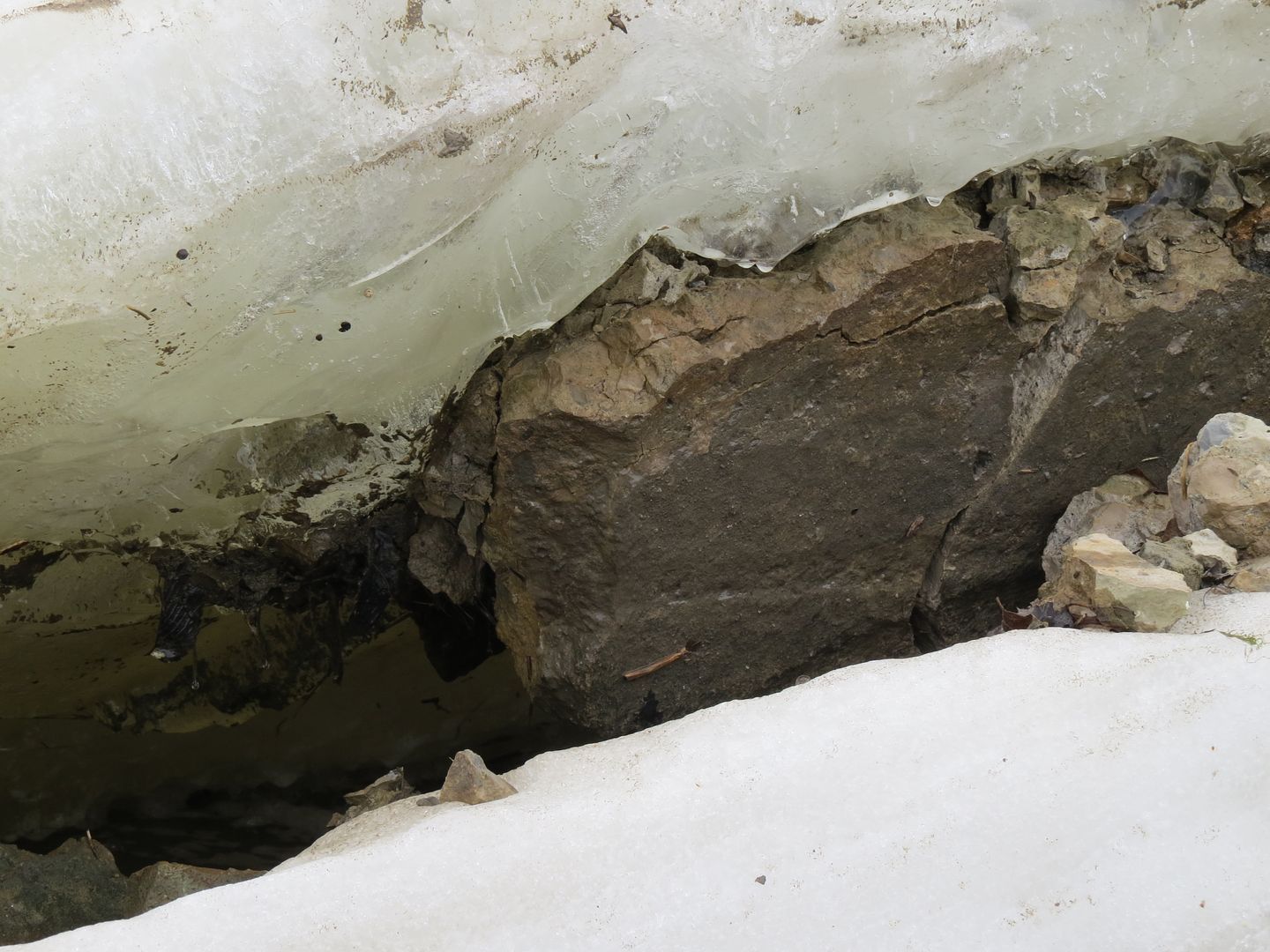
There is no more dramatic expression of winter’s back being broken than the annual river ice breakup. Fighting against the ever present pressure of flowing water, river ice always exists on the edge. It gives way dramatically at the first sign of weakness. This winter, although it started otherwise, turned out to be another harsh one and enabled the River Raisin ice to reach a thickness in excess of one foot. The river finally broke up last week and, true to form, it was a spectacular event.

First piling up at the Waterloo Bend, the mass of fractured ice eventually jammed up downriver at Hellenberg Park last Saturday. The weekend flow temporarily backed up onto the flats and deposited a field of huge blocks over the grass. The Baseball diamond was populated with a hundred new “base pads.” There would be no spring training on this field until after a week of warm weather permits it. A few Ring-billed Gull outfielders, waiting for their first crack at a fly ball, waded through the puddles.

Out on the river the ice jam filled the channel from shore to shore as it waited out the breaking of the river mouth ice. The jumble of ice blocks created a tortured landscape – an icy version of a construction landfill filled with broken pieces of building concrete. Perhaps the most surprising aspect was the sheer amount of wood in the pile. The winter’s accumulation of mangled branches, tree trunks, and lumber was staggering.


Several robins and a flock of Grackles hopped among the branches in the ice field. They seemed to find assorted “goodies” amid the chaos, although one can only imagine what they were. If indeed Robins were a true sign of spring, I would title the photograph below as “Dual Signs of Spring – Red-breast riding the Breakup.” Unfortunately, because this particular robin was probably one of the regular winter residents it would be wrong to assume he was a recent arrival. I’m not afraid of being wrong, however, so I’ll put the picture up anyway.

The whole scene got me to thinking about the ice age. Much of our landscape was created by continental glaciers grinding their way across the continent, collecting boulders, rocks and soil along the way, and depositing them hundreds of miles away. Each chunk of river ice was a mini glacier of sorts – it is far from pure. Large rocks, and even some boulders, were embedded in their matrix. Buckets of soil, trapped within the layers of accumulated freezing, were being transported from their origin some 50 miles away. On small scale, the melting edge of each block could be mistaken for the leading edge of a glacier. I was hoping to find a tiny mammoth melting out of one of the chunks, but was disappointed.


The final stages of the breakup were starting as I observed the scene. Every so often the whole mass crept forward – robins, timber, rocks, and all. A dull rumbling, accompanied by tinkling ice cube notes, filled the air. It would come to a grinding halt after a few minutes.
Sometime over the course of that evening, the whole dam thing flushed out into Lake Erie. I’m sure it made an impressive sight and sound but I wasn’t there to hear it, (you know what they say about “if a tree falls in the forest and no one is around to hear it does it make a sound?”). Regardless of the lack of witnesses, the river was ice free and flowing freely in the following dawn’s light. Spring had arrived on the fractured back of a river.
 Once Upon A Michigan