The Shade of Night

I guess I took it as a challenge – a friendly one, but a challenge none-the-less. A friend of mine was hanging out in the back museum yard as I was doing a public program about autumn. He happened by at the point where I was asking the families to look for different colored leaves. In particular I wanted them to find at least one yellow one, one red one, a red-speckled one, and a dead brown one since I use these colors to tell an autumn legend. At that point my beneficent tormentor loudly suggested that we should look for something impossible “like a blue leaf.”He plastered one of those “S.E.” smiles across his face as he waited for my reaction. I donned a matching smile and replied “Well, smart aleck, there are some blue autumn leaves but I just don’t happen to want one right now.” He laughed, I laughed and we went about our ways. Unfortunately, I just knew he’d be back at me later to find out what this blue leaf plant was and I would have to back up my statement with a picture.

The autumn leaf landscape is indeed painted with a varied palette, but it favors (not counting the original green shades) the red, orange and yellow end of the spectrum. Blues and violets are left to flower petals and fruits. Now, leaves of Ash, Red-panicled dogwood, Nannyberry and the like do turn a really deep purpley brown but the shade never really leaves the maroon family.  There is no way I could argue that a deep maroon leaf was really blue. It had been a while, but I know (at least I was pretty sure) that I’d seen some Nightshade leaves with a beautiful true blue/violet hue in the autumn. The question, however, was if I could actually find one again.

Just in case, I went to the internet to see if I could come up with a picture of one of those blue-leaved Nightshades. Certainly other folks had noticed this. Unfortunately, for a medium that brings us pictures of dogs dressed up in Halloween costumes and portraits of blue frogs, there was not one mention of, or image of, a blue-leaved autumn nightshade. Perhaps my memory was a shade off. I mean, if the internet doesn’t have it – does it truly exist? Thinking that my species memory, not the color memory, was wrong, I tried a lame search for “blue autumn leaves” to turn up something else. No luck. I would have to find my own blue leaf and get a picture of it. I only had a few weeks before I’d have to face my tormentor and produce the goods. Heck, fall itself wouldn’t even last a few more weeks. Maybe I’d have to break out the indigo ink bottle and inject a maple leaf or something!

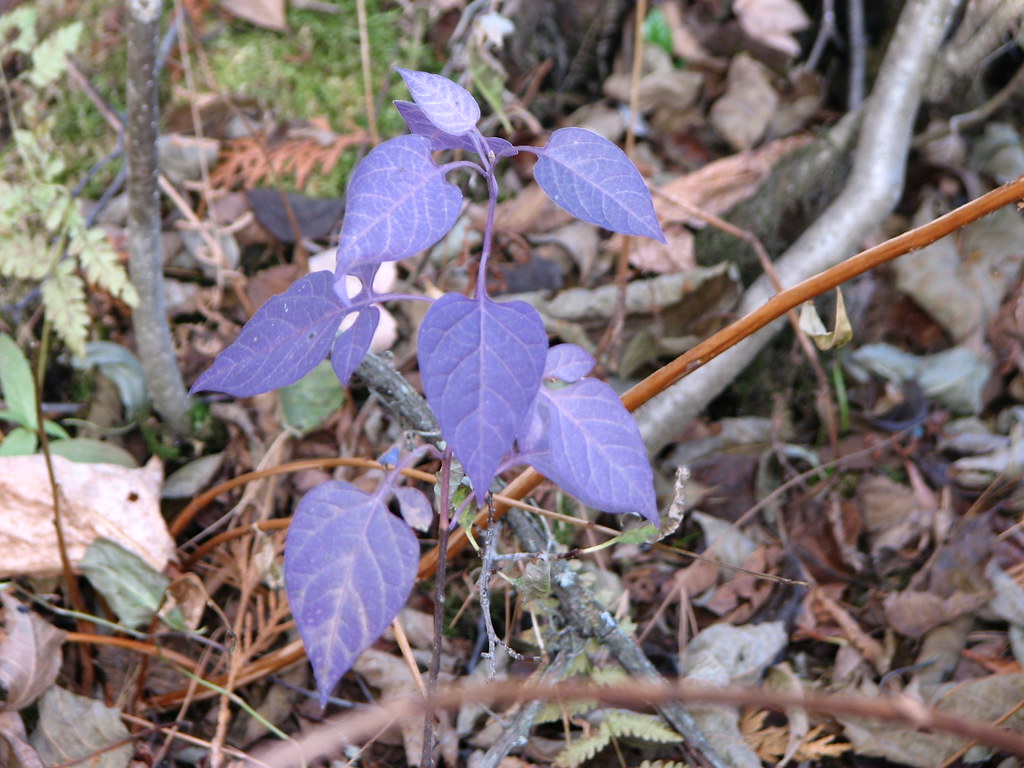
Just when I had given up all honest resolutions, personal salvation finally came at an unexpected location. While exploring the woodlands across the lake from our West Branch cottage, I shoved through the thick brush that led down to the marshy shore and came upon the remnants of an old beaver canal. There, tucked back among the scrub alders along the edge of the waterway sat a singular blue nightshade (see above and larger version here). This plant was even bluer than I remembered. It fairly glowed in the shade. I got my picture and was satisfied that all my faculties had not yet abandoned me.

The “exotic” plant in question is actually an introduced European plant called the Bittersweet Nightshade. It can become a noxious weed in pastures but it pretty much keeps a low profile. The fact that it requires saturated soils keeps it confined to wetlands. Slightly poisonous, this viney plant produces a chemical called Solonine – a toxin shared by many other members of the Nightshade family such as potatoes, egg plants, and tomatoes (yes, I said tomatoes, but you needed worry since it takes a different form in our garden variety plants). Nightshades produce tiny red fruits that taste so bad that very few things eat it by accident.  Though sharing a surname, the Bittersweet Nightshade has nothing to do with the highly toxic Deadly Nightshade of crime & mystery novel fame.

I realize the question remains as to why Nightshades turn blue when no other local plant does. Unfortunately I have no real answer for you or my sarcastic tormentor. Sure, I can say that the hue results from the anythocyanins in the leaf but little else. It does appear to relate to the particular situation in which a plant is growing. Those growing in open sunny areas don’t seem to turn blue while those within shaded situations do. Even on the same plant there are some leaves that take on the hue while others stick to their green & yellows.

As it turned out, I later found a few more of the plants closer to home (frighteningly close to where the initial smart aleck remark was first made). Armed with these photos and the confirmation that not all my memories are false (although I still believe my dad called off a tornado once) I am ready when I next see my nature heckler.

Cranes in a Cow Field

The rolling hills around West Branch, Michigan are a patchwork of pasture, marsh, hayfields, and woodlots. By mid October the colors are confined to muted greens and browns with a scattering of dark green Balsam Fir and White Pine thrown in for effect. Although most of the deciduous trees had already shed their leaves, the Oaks remained rich ochre and the Sugar maples were still holding onto their crop of bright orange leaves – lending patches of fire to the autumn landscape.

Against this background, which also included herds of black and white cattle, it was a large group of tall gray birds that commanded the most visual attention. My wife and I came upon a flock of migrant Sandhill Cranes as we traveled along one of the back roads. It was late afternoon, around 4 pm, and the low angle of the fall sun highlighted the gangly group as they sauntered through the pasture. Their white cheeks, elevated above the ground about four feet, caught the light. There were about 60 of them and they were strung out along the low weedy portion of the fence line.  The combined sight of wild birds and tame cows in the same field made for an unusual view.

The sight of Sandhill Cranes, the tallest resident bird in the state, is not an uncommon thing in most parts of Michigan. There is a firm breeding population here and both the rusty summer birds and their offspring are regularly seen in local pasturelands.  Starting in late September, the big birds assemble and begin to gather into large “staging areas” in preparation for their long journey south – a trip that takes eventually takes them to north-central Florida.  By October, the migration is in full swing and places like Waterloo Game Area near Jackson become populated by thousands of staging birds. These pasteurized West Branch birds were part of a migrant flock probably making their way down to Waterloo.

I pulled off the road to get a better look at the creatures and aroused the suspicion of the farmer across the road. I assured him everything was alright and asked him about the cranes over yonder. “Oh them, “he grunted, “they come here all the time – especially in the field behind the house.” There was large marsh there and I gathered that is where these birds would probably spend the night.  As he turned to amble back to his ramshackle farmhouse he added,”yeah, they are pretty wary too.”  True to form, the birds were keeping a keen eye on me and the car even though we were probably over 1,000 feet away and not getting any closer due to the fence. The cows didn’t pay us any mind.

One thing that was notable about these fall cranes is that they were clean gray in color. As I alluded to earlier, their spring/summer plumage is typified by a rusty – nearly deerlike – shade of brown. They literally get this from the iron-rich muds found in their breeding marshes.  By fall, the rusty feathers are mostly replaced by gray ones. A few of the birds retained an umber shoulder bar and the younger birds still sported brownish plumage.

As one sub-group ambled into another, they erupted into a bout of gargling and dancing (which is about the same thing that people do, now that I think of it!). This was part of a greeting ceremony which involves wing-spreading, jumping, and calling. Several of the birds spread their wings and bounded straight into the air similar to the style of African dance (see below and here).

The call of the Sandhill is one of the most distinctive sounds in nature and one which carries for long distances. It’s hard to define, or confine it, as an English phrase, but “garoo-a-a-a” with a rolling “r” does the trick. Even though the wind was carrying some of the sound away from us, it was still very clear (listen to recording here). It’s a wild sound that, like the wind, never sits still.

We returned to the spot the next day, but the birds were long gone. The cows were there, along with their pies, but the pasture was once again quiet and domestic.

The Black Sun Bird

It could be argued that a Starling alone is not really a Starling. These European imports are society creatures and rarely, if ever, can one be found without the company of others – many others. A lone bird, like the creature pictured above over gas station pump no. 3, truly looks lonely and somewhat incomplete. We tend to take Starlings for granted because they are so common, but up close they are rather natty looking this time of year. In fall/winter plumage, like this gas station bird, the mature birds are covered with white “V’s”- the tip of each feather neatly gilded. As the season progresses, this tip wears off and the birds become bronzy blue-black by spring. Starlings, however, can look even better from a distance.

They find safety in numbers and in the fall and spring, their flocks can swell up to tens of thousands of birds which feed together over open ground. When upset by a predator or gathering for a night roosting, they become poetry in motion. Like an aerial school of tropical fish, such flocks perform a mesmerizing dance as the individual birds move about in perfect synchrony.  They clump together and morph into all manner of odd organic shapes that shift instantaneously (like the group pictured below). I liken these vacillating movements to a dark version of the northern lights, but in Denmark they compare them to another astronomical entity.

In their native Danish haunts, huge flocks of starlings are known to gather just before sunset in the spring and fall to perform their ghostly maneuverings. These evening groups are referred to as the “sort sol” or the Black Sun. It’s a rather ominous sounding designation but one that fits because the flocks frequently take on the form of a ball or orb – a black sun in the sky at sunset. The birds perform for about a half hour before settling in for the night when the real sun finally dips below the horizon.

Starlings will also form a black sun whenever danger is detected. They will do this at any old time of the day whenever an approaching bird of prey comes along. The prey bird in question may or may not be interested in nabbing one of the Starlings, but the blackbirds do not take chances. Non-predatory Turkey Vultures are often mobbed. Basically, the idea is to cluster into a tight ball and actually follow the predator through the sky. The predator is less able to take any one bird when they are so massed. I call these anti-predatory maneuvers “hawk balls” (I wonder how that translates into Danish?). This is less euphemistic than black sun, but descriptive none-the-less.

I was privy to a fascinating hawk ball formation last week as I drove to work at sunrise. There over the winterwheat fields of eastern Monroe County a gang of Starlings was in tight formation around an immature bald eagle (see below). I doubt the eagle was actually looking for a meal, but it was simply paying the price for being a big bird.  The Starling cluster not only maintained contact with the eagle as it soared, but actually seemed to engulf it at times. I was able to catch the action on a video sequence that you can see here.

The eagle, looking more like a bird trying to shed itself of pesky mosquitoes, seemed to dash up at the center of the Starling flock a few times, but it never made a talon grab. It eventually veered toward Lake Erie after a few more failed attempts at gentle soaring. This day was not a good one for being a noble national symbol. After sustaining its eastward direction for short while it finally left the hawk ball behind and that is where my video ends. Actually, the Starlings called the thing off – having had their time in the black sun and successfully achieving their mission.

Spanworm Splendor

It’s not a name that is uttered often among everyday folk, nor does it normally find its way through the parted lips of the everyday naturalist, but the Maple Spanworm is a splendid creature worth mentioning. Now is a good time to bring it up.

On chilly October mornings this medium sized moth is frequently found hanging out by back porch lights. Lured there by the siren call of the bulb from the night before, the jilted moth finds itself exposed on an open brick wall by the dawns early light. The creature stands out in the low morning sun due, in part, to her habit of perching with the wings up at a 30-40 degree angle– a habitual position which casts a long shadow across the surface – but also because flat brick is not the surface for which this pose is designed.

As an adult moth, the Spanworm is protectively colored in order to blend into the autumn leaves. The ragged wing edges and spotty orange camouflage create a near perfect imitation of a leaf (like the one pictured below). This trick only works its magic if the moth in question is perched on a natural surface. On an open flat wall, a windblown leaf caught in a spider’s web is about the best imitation that can be mustered. Fortunately, this ploy works pretty well for confused porch moths. I’ve seen a few Spanworms on the museum porch over the past week and they both made it through the day without being eaten by birds. I guess if you are a good leaf imitator, it doesn’t matter where you end up.

The whole life of the Maple Spanworm is about deception, so it’s a wonder they ever know who they really are. Members of the inchworm clan, the larvae of the spanworm are a perfect twig mimics. Sporting fake bud scars and a mottled gray brown skin color, the caterpillar looks more like a stick than most sticks do. When disturbed, the larva suddenly goes “twig” by straightening out. It stays in position until danger is past or until the real twigs around it get jealous and start to taunt it.

When not acting twig-like, Spanworm caterpillars eat a wide variety of tree leaves off of those real twigs.  Alder, ash, basswood, elm, hickory, oak, poplar and, yes, even maple are consumed with equal delight. As you can see, even the name of the Maple Spanworm itself can be a bit misleading given this eclectic menu. Notchwing Geometer, an alternate name for the species, eliminates this maple bias but introduces the need to explain what a geometer is. Officially, inchworms are called Geometers, you see. Spanworm happens to mean the same thing, so I guess this discussion doesn’t need to go any further does it. Where was I anyway?

Apart from expressing admiration for this moth, there is little left to say about the Spanworm without starting to make things up. There is only one generation per year and the notch-winged adults can be found flying from late summer into October. Those that successfully pull off their dead leaf trick, and avoid be eaten by birds or pressed between sheets of wax paper, will lay their eggs and die just as the real autumn leaves die and flutter to the ground.

The Hell Cricket

From external appearances alone the Wheel Bug looks downright silly, but if ever there were a critter that deserved the name of “Devil’s Riding Horse” it is this insect.  It is not an especially vicious beast, nor is it dangerous in the true sense of the word, but it does pack some nastiness behind those goofy looks. Don’t let those “put together by a committee looks” fool you. This fellow deserves respect.

The Wheel Bug comes from a family of true bugs called Assassin Bugs, so that alone should key you into its reputation. It is, in fact, the largest local member of this clan and so, by default, can be considered as the head assassin of the family (the Don, you could say). Assassin bugs kill their prey – usually other soft-bodied insects – by plunging their stiletto shaped beaks into their victims and sucking out the innards. The formidable assassin’s beak of the Wheel Bug is nothing short of a fang. There is even a groove on the underside of the thorax which is used for safely storing the tip of this weapon (see below). When this predatory tool is driven home, the bug then uses it to inject a toxic and paralytic substance that both immobilizes the subject and renders its internal organs into mush. In short, the victim is turned into a box drink as the juicy juice is sucked up by the killer. True to the assassin’s code, there is no emotion in the kill– it’s just a job in order to stay alive.

They can inflict a painful bite on a human if that human carelessly allows it to do so. It is said that such an event is worse than a hornet sting and that the burn, or the resulting numbness, can last for several days. Fortunately, regret not death, is the only long lasting effect.  I probably don’t even have to mention that this fellow also gives off a foul odor when irritated and is attracted to turpentine oil! Nice, eh?

I came upon one of these creatures in Dayton, Ohio last week. The thing was acting rather stupid when I picked it up and it appeared to be paralyzed – which allowed me to be brave. It was alive and fresh, but unable to do much about anything around it. I could theorize that it had just experienced a run-in with another Devil Horse and had experienced a bit of its own medicine, but I have no idea on that account. At any rate, this compliant bug allowed me to pose and handle it with impunity. I will not publish the picture in which I placed a tiny fiddle in its arms nor will I display the shot where it was wearing little lederhosen, but the remaining pictures are here on this blog for you to see (see below and here).

The common name of this bug comes from the armored ridge on the thorax behind the head. A series of nine cogs are aligned on a semi-circular structure that looks like a gear wheel. There is no known function for this device other than preventing anyone but the devil to ride it (although it does make it look “wheel” nasty).

Yes, in case you are wondering, the Wheel Bug can fly and it can also chirp like some sort of diabolical cricket. The sound is made by rubbing the tip of the rostrum over series of small ridges on the bottom of the thorax. There is only one generation of Wheel Bugs per year because they take around 100 days and five instars to reach maturity in the fall. Jack Frost achieves the ultimate victory over the seasoned adults and the population overwinters in the egg stage.

Now, for all its wonderful nastiness, remember that this critter is beneficial. By feasting on damaging crop pests it serves us well. It may be devilish but its not satanic.

Dead Fish Talking

Though I love catching and eating fish from Dollar Lake, I do not enjoy cleaning them. It is a necessary function of rendering fish to filet but part of the problem involves having to destroy their perfect form. When a freshly dead sunfish or perch is lying on my cutting board, the naturalist in me requires that I give “the specimen” a good look over before even thinking about unsheathing my knife. You could say that I am trying to see what the fish can tell me about life in the weedy depths of the lake. Even after being rendered into parts, the partial fish may still have something to say, so I keep on listening. The only time I do not want a fish talking to me is after I have eaten it!

So far, none of my fish have actually talked. They have not murmured things like “I see dead people” or “help” but my recent set of fish – a nice little batch of Perch, Bluegill, and two Pumpkinseed Sunfish -did provide some mute testimony regarding scale design, snails, and the meaning of roughage.

The first step in the fish preparation process is the scaling. This is the part I really hate because it removes the beautifully patterned skin of the creature. The scales themselves have no color but they are things of beauty none-the-less. I saved samples from each fish in order to later look at them under high magnification. The resulting images are, even considering my meager micro-photo abilities, fascinating.

Scales are thin rigid plates that both protect the fish and streamline their form for swimming. Each scale is imbedded in the skin and only a small part of it is exposed (see skin detail here). Perch have a heavily scalloped scale (see above and beginning photo) that looks very much like a baseball mitt. The Bluegill (see here) and Sunfish (see below) are more rectangular in outline. On all three images, the exposed portion is facing downward and the embedded part is uppermost. All three species have a type of structure called a Ctenoid scale which means that the exposed portion has “teeth” or multiple tiny spines.

Multiple concentric lines on the scale reveal seasonal growth patterns. These lines are somewhat like rings on a tree, but only the more prominent lines are actual year indicators (the rest are random records of yesterday, the day before last Tuesday, etc.). It takes some staining and light angling to really see these annular lines, but you can make them out on my pictures if you squint and stand on your head. If you can’t make them out then please take my word for it that fish cannot lie about their age. The perch was probably about three or four years old by the time it latched onto that worm-concealed hook dangling in Dollar Lake.

Both of the Pumpkinseed Sunfish spilled their guts in order to inform me that they enjoyed multiple escargot meals while dining below the waves. Their stomachs were packed with small orangish discs like those shown above (and in detail here). These discs are operculums from Banded Mystery Snails (now that’s a name!).  Not all snail species have them, but some possess this hard operculum which acts as a front door whenever the creature withdraws into its shell (see below). It is carried back behind the shell, on top of the fleshy foot, when the snail is roaming out and about.

It should be no surprise that these snails would compose a large part of the fish diet because they are extremely common in the lake. The shoreline of the lake is littered with their empty shells and live individuals can be seen climbing over the aquatic vegetation (see above). It was interesting to see that the pumpkinseeds seemed to have the corner on this shellfish market. The shells are easily crushed on the smaller individuals and the fleshy creatures contained within are probably quite the morsel.

It appears that the only downside to eating Banded Mystery Snails are those darned operculums. They do not break down and therefore accumulate in the stomach. I can only imagine what the fish has to say when it eventually has to pass these things. I mean their anal opening isn’t all that large and, well…..the question is begged: when a fish screams underwater does the sound reach the surface? I will be listening on my next visit to the lake.

Jim Beam Bark

Tucked away in the rolling bourbon soaked hills of northern Kentucky, the trees around the Jim Beam distillery grounds are unique. In terms of species, they are no different than the trees that surround their hilltop. There are stately white oaks, spindly ashes, maples, and solid sycamores just like those in the hollows below. Their leaves, acorns and all other vegetative growth are remarkably average and they are taking on a tinge of autumn gold in the October air just like all the other trees. They cast a normal pawl of light shade over the bronze statue of Booker Noe that stands adjacent to the old homestead. The thing that sets them apart is the peculiar darkness of their bark. These are black barked trees.

This feature is not apparent at first. This should be no surprise, of course, because normally folks come to this distillery to tour and to drink whiskey – not stare at trees. Our party missed the last tour of the day but we did manage to sneak into the final bourbon tasting at the visitor center – a large red barn emblazoned with “Jim Beam” on the gable end. Probably due to the sinus and sense clearing effects of the product, we were made aware of the unique blackness of the trees as we exited the building. Actually, I am not ashamed to admit that it was my daughter’s boyfriend Adam who first pointed this out. There was still a thin veil over my eyes from the thimble full of whiskey recently imbibed, but 90 proof is 90 proof, if you know what I mean.

At any rate Adam wondered out loud if the large oak next to the statue was some type of exotic such as an English Black Oak or something on account of its black bark. On closer look it turned out to be a regular old native white oak, however it looked to be completely charred as if in a fire (see above). Since this charring extended to every little twig on every branch, this had to be ruled out. White Oaks are called white oaks because of the lightness of their bark. Black oaks have dark bark, and thus their name, but this was a black white oak (as opposed to a black & white oak).

Soon it became apparent that every tree trunk in the vicinity was nearly as black as coal.  The nearby specimen of Sycamore, a tree species which normally exhibits a patchwork of olive green and cream, instead looked like a black and white photo of itself (see above). No, there was something in the air causing this. Perhaps it was something bad – something dark and polluted – or it was something else. In short, it was something else.

The blackness was caused by a harmless fungus called Baudonia cominia…er, comeniace…never mind, let’s just call it Black Fungus. This particular type is unique to distilleries (as well as a few commercial bakeries) throughout the world. In Europe, specifically Cognac France where it was first described, it is simply called “warehouse staining” because it coats the rocky walls of the dark storage cellars. The fungus thrives in the vicinity of alcohol vapor and humidity and therefore sprouts around places where fermentation is going on.

Specifically, black fungus grows where the fermentation product is aged in oaken barrels. The barrels breathe over time and, as the Jim Beam tour guides would have likely told us had we of attended, up to 30% of the alcohol contained in the whiskey is lost to the atmosphere over the years through evaporation. This is affectionately called the “angels share” in the trade. It is this airborne ethanol that stimulates fungal germination and provides some additional heat protective proteins to the organisms. I, of course, did not just make all this up; I got it from several sources including a fine article by Bernard Dixon in Microbe Magazine. You can probably look over a copy of this rag at your local dentist office underneath that pile of old Highlight magazines.

So, the combination of tree bark, humid climate, and ambient alcohol creates a lush field of growth for those mysterious black bark fungi found on Jim Beam hill. In a microscopic view this fungus looks like a string of simple beads or pearls. At an eyeball distance it appears as a crusty coating (see below and detail here). At a greater foot distance, it appears like ink staining.

Old man Noe, the grandson of the original Jim Beam, seems to know that there is something in the air about his place. To the trees and the local angels goes 30% of that something and to the humans goes the rest.

Snakes on a Lane

While the cinematic reference of this piece may be a bit obscure, the subject is directly entertainment related. Should you ever find yourself in northern Michigan and at a lack for things to do, then I have a suggestion. There are many different things to do up in these parts and most of them involve off-roading and engines of some sort. So, wanting to fit in somewhat, we decided to spend a few hours on-roading for snakes. Yes, you read right – driving on the backroads looking for linear reptiles.

If you found “Snakes on a Plane” creepy then you will not appreciate my entertainment suggestion so you are free to skip this entry entirely. The cool early fall weather provides a great incentive for lane snaking. The snakes come out onto the roads in order to soak up some of the morning sun. This past week the evening temperatures have been dipping down into the low 40’s so the reptiles are needful of all the extra solar heating they can get during the day.

Road basking is a hazardous task for late season snakes, especially given the number of vengeful drivers out there who delight in running the poor things over. The trick to snake laning is to detect the snakes long before you accidently run them over, pull off the road without alerting your quarry, and getting out to grab them, observe them, or simply photograph them. You’ll need to drive with one eye on the road ahead, and one on the road itself with your third eye scanning the rear view mirror for traffic. If you do not have a third eye, then a wife will do. Oh, by the way, the Michigan Department of Traffic Safety requests that this activity shouldn’t be done on a busy road – it must be a back road with no real traffic.

Our chosen snake laning morning took us along a dirt road that had not seen a vehicle since the previous night (I know this due to the night rain, Sherlock) and onto a blacktop that served only the local cottage crowd. We came upon several snakes on that round. Three of them were unlucky enough to have already found themselves between the rubber and the road, but two were alive and well.

Since I’ve presented Northern Water Snakes to you before, I will only briefly exhibit a few shots of the first snake. It was a young water snake lounging in mid lane like a stick. This fellow, a crisply marked young individual, was only about a foot long and was in full stretch when first encountered. Upon my approach it recoiled a bit and took on a slight attitude. Because the morning was still cool, however, his actual movement was slow as if to say “Haaaaay, I Seeeeee Yooooooou.” Here is it for you to see (above) and to admire the banding and dark background color of this species. The young ones have an especially bold pattern.

I made sure to shuffle this guy off the road before moving on to the next discovery. This is another primary rule of snake laning, by the way. You must make sure your snake is out of harm’s way before the next car comes by. It is very probable that the next passer by will be Alice Cooper. You can’t do anything about the snake’s probable return to the open road, but at least you can leave the scene with a free conscious.

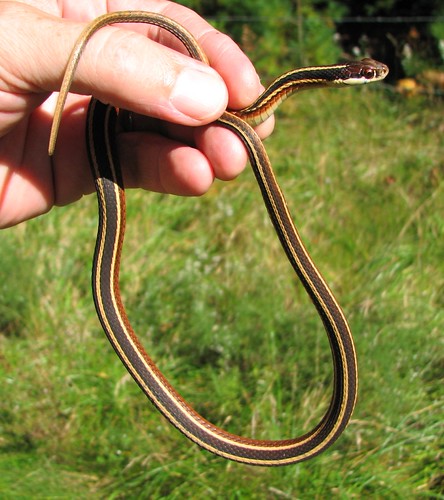
The second snake was a Ribbon Snake. These very slender members of the garter snake tribe are common enough, but I have never before seen one in the wild and I’m banking that you may not have either (if you have, then you have permission to leave the room and watch “Snakes on a Plane”).

At first glance this serpent appeared from a distance to be a common Garter Snake (see beginning picture) but the combination of three very clear lines and a very skinny frame marked him for what he was. This individual, having the advantage of an extra half hour of solar heating, was a bit more on the ball than the earlier water snake. He tried to make a break for the shoulder as soon as it realized I wasn’t a car, so I had to grab him for some close examination (remembering the old adage that a snake in hand is better than two on the tarmac).

There are two more very specific traits, beyond the aforementioned items, which serve as identifiers for the Ribbon Snake. The upper set of scales on the lip are unmarked and appear to be solid white (see above) whereas the Common Garter has patterning on these scales. A second feature, less obvious but equally important, is that the lateral lines are located on the 3rd and 4th line of scales as opposed to  the Garter whose lines adorn the 2nd and 3rd row.

Now, not having held a Ribbon Snake before, the one trait that really caught my eye was the beautiful brown color of the sides which contrasts so nicely with the light belly (see above). It was such a rich brown shade that to simply call it “brown” seems less than adequate. I’d like to call it Burnt Chestnut or German Chocolate, even if those terms are not scientific. But, hey, since lane snaking is not a purely scientific pursuit, I feel fully justified. Afterall, lane snaking as a sport needs some emotionally descriptive language in order to catch on.

Next week: the downriver sport of Raccoon Canning.

It Just Ain’t Natural!

If I were to read you a headline like “Mom Gives Birth to Pregnant Daughter,” it would be natural for you to suppose that it came from the “National Enquirer”. After all, this would rank right up there with alien space babies and man-eating chinchillas in terms of un-believability, right? Well, actually, this statement could have “Scientific American” legitimacy if the mom/daughter/un-born trio in question were insects –aphids to be exact. These tiny sap-suckers can do this kind of thing, you know, and I find it to be slightly unsettling from a male’s perspective. But, there is a deeper horror to this scenario.

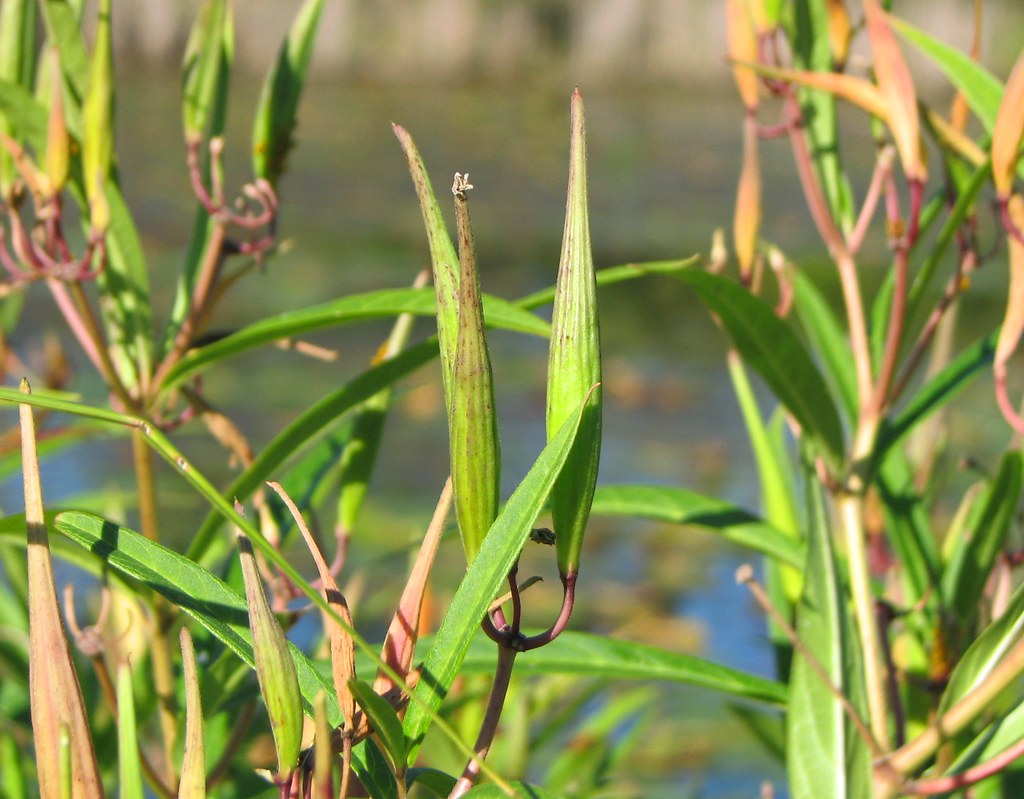
This summer has been an especially good year for aphids, which is why I bring this topic up. By good, of course, I mean bad for you gardeners out there.  I guess I can’t speak up for all types of aphids, but I can definitively state that this has been a banner year for a specific kind known as the Oleander Aphid (see above). A carrot-colored European immigrant who hitched a ride on imported Oleander plants, the O. A. (as I shall call the Oleander Aphids from now on) have taken to our native milkweeds in a big way. Butterfly weed, Common Milkweed, and Swamp Milkweed fall into this category. Not every plant, but a majority of those I saw after mid-summer were infested with the O.A.s. The spindly Swamp milkweed has certainly been hit hard.

A normal Swamp Milkweed in autumn should be bearing upward pointing seed pods – string bean versions of the more robust Common Milkweed pods (see here). An O.A. infested plant, on the other hand, will be nearly un-recognizable (see here a shot with a lone ladybug feasting on the flock). The creatures will populate the tender stems and leaves in such numbers that the plant is completely covered. In small numbers, the creatures do little harm, but in big numbers they can literally suck the life out their host. This is not the deeply unsettling part of my discussion, by the way, but it is bad enough.

Up close, an individual O.A. looks like an orange balloon with a pair of black bristles sticking out of the fat end.  It is exceedingly hard to just see one of these aphids, I know, but a close look at a colony will show lots of individuals. The narrow, or head end, is equipped with a hollow straw mouth which does the plant juice sucking. Those butt end bristles, called cornicles, are also hollow and they exude drops of sugary fluid called honey dew. Again, even though this sounds frighteningly close to “Honey Do” – as in jobs- I have not yet arrived at the scary part.

These creatures are flightless, for the most part. Generation upon generation will pass before a few scattered winged ones appear (see above the individual at top center). The winged alates, as they are referred by people far smarter than I, are for migration purposes.  When a colony gets so dense that their host plant starts to die from sap drainage, the winged forms are released onto the world in order to find sappy new home worlds. In truth, these distant worlds may only be a few feet away, but for a juice bag shaped wingless insect such as a typical O.A., it might as well be a million miles. So, Oleander Aphids flee the ship when times get tough.

Although not “manly”, it is perfectly alright to adopt this “rat abandon ship” mode in order to survive, but what is not alright here is that every single O.A. is a female. Yes, that’s right, every single one of these things from the tiny ones to the bloated balloon ones, and even the winged ones, are girls. There are no male O.A.s!  Yes, now you know the crux of my concern.

All aphids have the ability to reproduce by means of parthenogenesis. In other words, they can produce young without the benefit of male genetic material exchange. At the height of a season, a female can indeed give birth to a daughter who in turn is already “with egg” herself. This is called telescoping generations, by the way. Eggs are not laid, but the young are popped out just like human moms do it except without the breathing exercises (insects breathe through holes in their sides). But, even normal aphids will eventually produce a generation of males at the end of each season so that there is some sex before winter comes. Eggs are laid and the whole thing starts anew next year.

As far as anyone knows, however, Oleander Aphids never produce a male generation at all. They appear to be doing famously without the male gender – period. They are, in fact, spreading across the globe. There are other examples in the natural world where this one-sided sexism exists, but there are no examples where only males exist. I would find all this really fascinating if it didn’t trouble me to the core. The next time I feel useless I’ll have to consider the option that maybe I really am!

A Fall Peek at a Spring Peep

There are many things I expected to see on my mid-September day walk. I count among these expectations, Woolley Bear caterpillars earnestly rambling across country roads, Monarch Butterflies drifting about on the airy currents, and Goldenrod flowers – lots of goldenrod flowers. On this particular day last week, a glorious one by all September standards, I saw all the above and more. What I did not anticipate was an encounter with a Spring Peeper! I mean, it is fall after all. It’s hard enough to find one of these diminutive amphibians in the springtime and even then they come out only at night. Here was a Peeper out in full view in the middle of the day and late in the season.

The tiny tan frog was sunning itself on the upper center of a red maple leaf. It stood out like a Spring Peeper on a fall day there in the full light of the sun. Unlike tree frogs that can change shade from gray to green, peepers are restricted to a particular shade of light creamy brown with a light brown “X” on the back. These features, along with the tiny bandit mask, are definitive peeper particulars. There was, therefore, no attempt to blend in or hide in this case. From its chosen position on the leaf it was obviously sunning itself.

Initially, the creature was hunkered into a tight oval pose – eyes closed and body plastered tight to the leaf surface (see above). I watched it for a short while through the camera lens so as not to disturb it. The disc-like toe pads, which clearly mark this little beast as a climber, were visible along with the dark brown underside of the back feet. You’ll have to excuse me for all this doting, for it had been a very long time since I’d seen one.

Even though I hear them every year, the last time I actually saw a live Peeper was when I caught one in the Great Smokey Mountains over 25 years ago. Back then, before the luxury of digital cameras, I took the opportunity to confine the thing in a jar and enter it as a sketch in my naturalist’s notebook. I drew a picture of one of those giant mountain millipedes on the same page This one was about the size of a breakfast sausage as I recall. Well, being at a lack of suitable containers, I put both creatures together in the same jar and the millipede killed the peeper. O.K., it didn’t outright maul it to death, but I later learned that millipedes exude a defensive poison. This millipede was apparently feeling defensive and willingly, or un-willingly, did his jar companion in. At any rate, I learned to never mix ‘pedes with peepers (a lesson I have never been able to call into play since).

Safe from the poisonous reach of giant southern millipedes, my newly discovered fall peeper was enjoying his last rays of sun. He was content with the world until the rumbling of a low flying passenger jet stirred him into action. The vibrations caused it to begin chirping. It rose up its head and rhythmically chortled until the gigantic “frog in air” moved on. Now arisen from deep slumber, the peeper took advantage of the situation to crawl up the leaf a few inches to re-position in relation to the changing angle of the sun.

After settling back into the sun worshipping mode, it resumed its tight oval pose (see here). I chose to leave the critter to its own at this stage. There are only so many pictures you can take of a resting peeper before you’ve tapped all the angles – sleeping peeper seen from the right, left, center, etc.  But, because I may never see one in such a clear light again, I took all the shots I felt like and a few I didn’t feel like. I even tried to get one of the peeper peeping over the edge of the leaf just so I would have a clever title for this blog entry. But, alas my shortcomings as a photographer didn’t allow it. Had I my naturalist’s notebook I could have drawn the scene just as I wished it.

I’m sure this little peeper wishes that the sunny autumn days will never end. Soon he will have to descend to the leaf litter and bury itself before the killing frosts hit. Come to think of it, however, I really can’t know what goes on in the mind of a peeper and I am glad of it. Was this guy thinking that the jet was another frog – something like the voice of the frog god? At any rate, I would not want to know what my captive peeper was thinking 25 years ago. Was his last thought “Oh my frog god! I’m locked up with one of those freaky giant millipedes. What? No, I didn’t say anything about you. Really, I di….”