Goose English on Ice

Although almost all of the snow has finally melted off the landscape, most of the inland ponds and marshes are still locked in a cover of ice. The pussy willows are expressing springtime at their tips but are still locked into winter at their watery bases. So, until this last vestige of winter ice finally yields to the sun, the locals just have to wait.

Aquatic creatures such as geese are forced to walk on the water until swimming becomes a viable option.  Canada Geese are not ones to patiently wait for anything. They are already carrying on as if things were already in a liquid state – staking out nesting territories and mates just the same. Late February to early March is the pair bonding season for geese and they are full of overflowing emotions this time of year.  Behavioral interactions that would normally take place while swimming are happening in full body view on a cold level playing field.

Canada Geese are hardly worth the expense of too much digital ink, but you can’t ask for a better bird to demonstrate body English. Actually, I’m pretty sure that they don’t speak English, and that their bodies don’t either, but it’s not hard to translate some of this stuff into our tongue. I’ll just call it Goose English. With their long expressive necks, large size, and wide vocal skills they can’t hide their feelings well.  And, because they are so common, they are easily observed. Let’s not look a gift goose in the mouth.

You can break down goose English into a few body moves and some nine different calls. For the sake of this discussion I’ll stick to the body English and sum up the calls into “honk, a-honk, and hiss.” In short you have the head/neck pump, the head bobble, the extended neck and – of course, the attack. The honks accompany all these actions except the extended neck which tends to be a hissing or even a silent move.

I watched a pair of birds recently at Crosswinds Marsh that were in fine form.  When first encountered they were placidly napping, along with several other widely spaced geese (as well as a farm goose that joined the flock a few years ago). Heads tucked back between their shoulders and balancing improbably on one leg, they were the picture of complacency.  That was until three other geese landed on the ice nearby. These birds arrived in a flurry of honking and slid wildly across the ice for a few feet as they landed. Our sleeping birds immediately raised their heads high and turned to meet the arrivals.

Both sets of birds started to bob their heads up and down. The sweep of the head pump brought their beaks down to the level of their chest and back up again. All were agitated as if to repeatedly say “oh yeah” to each other without actually issuing any challenge.  This patch of ice weren’t big enough for all concerned, however, and eventually our pair started to walk.

While walking, the two – especially the one I took to be the gander – performed a head bobble. This can best be described as agitated honking accompanied by head shaking in the manner of shedding water after a bath. This action accentuates the white chin patch and signals something to the opposition, but what exactly is not known. Bobbling appears to be a decision making mode similar to one scratching their head while thinking and saying “why, I’m gonna…I’m gonna have to… do something about this…” In other words, bobbling geese are thinking geese.

Soon enough, after only a few seconds, our pair made their decision to charge the interlopers. At this point they lowered their heads so that their necks were parallel to the ice and charged the other geese. Loud hissing turned into a flurry of feathers and honking as the birds met up with the opposition (who decided to flee this onslaught without delay).

When all was over, our pair returned to their spot of cold ground, and celebrated the victory. Heads high and wide mouthed, the gander stuck out his tongue at the world like a Kiss fan (see above). All quickly returned to peace and they resumed their one-legged pose. Of course the whole scene was repeated as soon as the next flight arrived.

Now, you will notice that the farm goose (A Graylag Goose) was sleeping next to this pair of geese. He has somehow bonded with the Canadas and has mentally become one. He occasionally joins them in some of these scuffles, but seems to ignore most of them. Oddly enough he is ignored in turn by our aggressive pair. I’m guessing this fellow is affectionately called the “big guy” by the natives. Unfortunately, because this bird speaks in heavily accented Hungarian tones (due to his European roots) he’s not well understood by anyone.

Squirrel Dew

This is the time of year when broken maple twigs begin to weep. Their outflow of sap will freeze overnight and form pale sugar-sickles (see above) that catch the morning light. Because only the water content of the sap actually freezes, the sugar is naturally concentrated at the tip and the sickles make for a refreshing treat. Unfortunately, they are fleeting creations that melt with the slightest prompting by the sun. These sickles probably provided the original idea for the human processing of Maple Syrup (apologies to Nanabozo). Sugar sickle season is maple sugaring season.

The traditional joys of the sugar season – tapping the trees, boiling off the sap, and breathing in the billowing sweet steam of the sugar shack, should be experienced by all.  I am not a big time sugaring guy. I have tapped a few trees in my time and produced my share of stovetop syrup. I have breathed in the steam coming off a canning kettle and nearly destroyed our wallpaper in the process. I have further processed my syrup into maple candy. So, I am vetted in the process, but beyond that I can claim no special knowledge. It should be said, however, that the process is not an especially complicated one. You drill a hole in a Sugar or Red Maple, tap in a spile to direct the flow of sap, collect the watery sap, and then boil off the sap until you achieve the syrup stage.  It is a magical process but not a mysterious one.

After a hiatus of nearly 15 years, I decided to again tap a maple – a Red Maple to be exact (see above and here). From the second the auger bit into the tree, it started to weep the sweet tears of late winter. So far the tree has yielded about 10 gallons of sap. I’ve yet to turn any of this into syrup. To date, all of this production has been rendered into a wonderful elixir I call Syrup Tea. Rather than finish everything off, I stop the simmering at a stage well before it becomes syrup. At this point it has a rich golden color (see below) and tastes, well, like sweet elixir. A small cup– taken cold – is a taste experience unlike any other. Heck, it might even be good for you but I don’t care about that. It can’t be bad for you. In another life I’d be marketing this stuff under the label of “Squirrel Dew.”

The above  title is actually an old prohibition word for hooch and refers to homebrew. While the old-fashioned stuff was highly alcoholic and sometimes deadly, this natural version has none of the side effects. It is as pure as it can get (actually chock full of chemicals, but good chemicals). The idea of drinking concentrated sap (pre-syrup) is not my own, it is one inspired by creatures such as Sap-suckers, Mourning Cloaks, Red Admirals and the like who lick tree sap. Perhaps the earliest and most active seasonal practitioners of the art are squirrels. Thus, it is appropriate to call my product Squirrel Dew.

Red Squirrels are especially prone to drinking sap.  These spritely rodents definitely have a sweet tooth. They will take advantage of natural seepages such as sugar sickles but will also deliberately maintain sap wells by chewing away bark. Freshly chewed bark, complete with tooth marks, are especially visible this time of year because of the cascade of wet bark below them (see here). In other words, they reduce the art of maple sugaring its most basic level: wound tree, allow sap to leak out, let heat of the sun concentrate sap, and enjoy.  They are not able to cook the stuff into syrup and have no abilities to handle pancake batter, so they just drink the Squirrel Dew and go on with their little lives.

Squirrels will even take this whole thing one step further. They do not restrict themselves to maple trees. I have often watched as our neighborhood reds lick sugary sap off of the upper twigs of Black Walnut tree, for instance (see below). These wounded twigs are glistening with sticky wetness and the squirrels will passionately lick it up as they cling to the narrow twigs.

As to how this tastes I can’t say. I’ve never tried to make walnut syrup but, as odd as it sounds, such a thing can be done. In native times, white birch often served as an alternate source of maple..er, of tree sugar. Nearly any deciduous tree will do when it comes to rendering sap, but when compared to the product of King Maple they are hardly worthy of human effort.

To a sweet-hungry little Red Squirrel, however, such matters are of no concern. I’ll drink to that!

The Early Bird Doesn’t Always Get It

I got a call the other day about a Woodcock hanging about someone’s driveway (I won’t use their name without permission, but it was a resident of Monroe). The bird was initially injured and sluggish, but appeared to perk up a bit after being captured and confined in a safe warm place. I wanted to look at the little guy before it was released, so the caller kindly agreed to drop it off at my house. I told him I would probably release it into proper habitat the following day or get it into proper hands if it needed treatment (such as a woodcock chiropractor or something). The creature was waiting for me when I got home – confined in one of those copy paper boxes. Good things always come in cardboard boxes punched with a million ventilation holes (see here).

Although the opportunity to see a Woodcock up close was too much to resist, I really wanted to see the live bird before it bit the dust. I’ve held plenty of dead ones in my hand, but warm wiggling ones have eluded me thus far (a woodcock hunt is rather like a snipe hunt you know). I’m not trying to be morbid here, but this was a very early bird indeed. His chances for survival were somewhere between thin and none. These long-billed fellows, called Timberdoodles in some circles and bog suckers in others, are not due in the North Country for a few more weeks at the earliest.  The more usual arrival time is around late March to early April.  Unfortunately, this was a case of the early bird not getting the worm.

Woodcocks are worm specialists. They can, and will, eat insects and spiders if pushed, but they are built for probing soft ground for earthworms. One look at this bird and you can see his distinctively long beak. The tip of this marvelous tool is flexible. Once it is inserted deep into the soil, the woodcock can pull back on the upper mandible (thanks to a kinetic skull) and open up the tip to grab the prey. You’ll also note that the nostril opening, due to this mode of feeding, is located very near the face and that the eyes are located impossibly high on the head (see above and here). To put it simply, these combined features keep dirt out of his sniffer and allows the bird to see potential stalkers (you can imagine how compromising it can be to have your beak embedded in the dirt as a fox sneaks up from behind). Fortunately those bulging eyes permit a nearly unimpeded 360 degree view.

To allow for repositioning the eyes, the timberdoodle has essentially turned its head upside down internally and externally. The ear openings are actually located ahead of the eyes and the cerebellum placed atop, rather than behind, the main portion of the brain. In evolutionary terms, however, their decision making is usually right side up. They certainly can’t be blamed for occasional lapses in judgment given this arrangement. There are records of fall Woodcock failing to move south in a timely manner and paying the price when hit by a sudden cold snap. It is logical to assume they might experience similar lapses of migration logic on the return trip as well.

Because of their lifestyle, the population necessarily heads south to the unfrozen grounds of the S.E. & Gulf States in order to overwinter. There are no worm probing opportunities here when the earth is as hard as a rock. Therefore, they can’t safely return to their spring haunts until the ground thaws out and they can resume their proper occupation.  In all likelihood, this bird experienced thawed conditions while moving north through Ohio and probably entered the county with high hopes of a warming trend.

Unfortunately this Woodcock also experienced a set-back (it had a small wound on its breast – perhaps from running into Jack Frost) and was forced to waste valuable feeding time as it recovered. When the bog sucker was finally released the following morning it was vigorous and alert. The temperature was a wet balmy 51 degrees F. and things were looking very wormy indeed. Perhaps he had cheated death after all, I thought. Unfortunately, the rain eventually turned to snow as the temperatures dropped well below freezing by sunset. The following days have been cold and wintery.

This fellow experienced several changes of fortune over the course of a single day. Bad luck became good, and good luck became bad. Nature doesn’t look kindly upon luck of any sort, so I don’t have any preconceptions that this bird is still alive, but I could be wrong.

Red with a Side of Gray

Ounce for ounce, Red Squirrels are one of the pluckiest beasts around – this in spite of the fact that they are rather small mammals. Most undersized mammals make it a habit to be secretive. They are, after all, usually part of the predatory dinner menu. I mean, look at Winnies the Pooh’s Piglet and his general fear of everything. It is good survival sense not to call attention to yourself when you are small and weak. Red Squirrels, on the other hand, are more like C.S. Lewis’s brave character mouse Reepacheap. They think nothing of verbally taking on creatures 100 times their size. If they perceive that some great injustice has occurred they will tell you. Crossing over an invisible territorial boundary is an example of one such infraction.

I am not here to dwell on the pugnacious nature of the Red Squirrel, however. I merely highlight this fact because their “in your face” nature makes them a very visible part of the winter landscape. They don’t tend to hide right away. Fortunately, Red Squirrels happen to be one of our more visually interesting mammals. Let’s face it, most of our cold-season fur bearers are characterized by their plain Amish style fashion (by this I mean a practical use of subtle color palettes). Red Squirrels are boldly colored with white bellies edged with two black racing stripes, a nice rufous red-brown back, white eye rings, and even a dashing black nose stripe (see beginning photo and here).

During the winter these dynamos take on a drizzling of gray about the sides of the head and torso. This peppery dash certainly enhances their look. The amount of grayness varies between individuals. Some of these creatures appear more like tiny Gray Squirrels (such as the half-tailed version shown above). Unfortunately, there are true Gray Squirrels out there and some of those true Gray Squirrels can be coal black in color. So, it is possible to have a Black Gray Squirrel sitting next to a Gray Red Squirrel on your feeder. Several decades ago there was a regular population of albino Red Squirrels at Kensington Metropark near Brighton, MI.  Back then you could have added a White Red Squirrel to this confusing mix. Not that this has anything to do with it, but I believe this was about the time the Red Green Show started on Canadian television.

In reality, no self-respecting Red Squirrel – red, gray, or white – would allow a Gray Squirrel – gray or black – to sit next to it anywhere, so the potential situation posed above would never actually happen. Red Squirrels have been known to literally bite off the balls of fleeing Gray Squirrels (and I am not completely making this up). In fact, even two Red Squirrels of any color can’t stand the proximity of each other beyond the mating season. This probably explains how the short-tailed squirrel (below) lost half his tail. He’s lucky to have his masculinity intact.

Many mammals, even those Amish ones alluded to earlier, put on a grayer coat in the wintertime. Part of this has to do with blending into the gray winter scene. Northern mammals as a whole are generally much grayer than their southern counterparts, but I won’t get into that because our northern Red Squirrels are actually southern Red Squirrels and that would lead into another semantic nightmare. Red Squirrels, apart from growing longer grayer fur during the winter, also put on a pair of long ear tufts.  This adds to their especially “perky” cold-weather appearance.  All of these hair features disappear during the summer, although the sparky nature of the beast that goes with them does not.

On Eagle’s Wings

Although it may not sound like a great place to be, the mountainous landfill close to the Lake Erie shore in N.E. Monroe County (MI) is a spectacular place to watch winter raptors.  The birds gather there to take advantage of the updrafts racing over the grassy slopes and to hunt the mice living on those grassy slopes. I feel fortunate that this place is along my route to the park, so I can eyeball it at sunrise and sunset.  On one late afternoon pass – even considering the troublesome reality that I also had to keep my eye on the road at the time– I spotted a Kestrel, a Northern Harrier, a Rough-legged Hawk (I’ve shown you this bird in an earlier Naturespeak), and a Red-tailed Hawk.

Last week two Bald Eagles caught my eye at this location. Bald Eagles always catch my eye, but these two birds were cavorting so actively that I was forced to pull over and watch them.  I use the word “force” because they indeed exerted some mysterious energy which caused my hands to turn the steering wheel toward the road shoulder. These massive birds don’t normally engage in mousing like their smaller cousins, so it appeared that these two were simply enjoying the wind under their wings. Note that I said “appeared” because I would be the last to insert human emotions into the activities of a child of nature. But, these birds were not accomplishing anything except wind surfing. They were gliding up and down, over and back, and even sparring with each other (see above) like two kids on an ice pond. Now, I did intend to use the term “kids” here. Let me explain.

That these eagles were both “kid” birds was obvious by their dark appearance.  Since bald eagles don’t get their bald – or white – heads until after their 4th year, they exhibit a variety of patterns as they mature over their first quadrant of years. One can usually tell how old a particular pre-adult bird is by visually checking off the field marks. Let me point out that my use of the word “immaturity” has nothing to do with behavior or size. Immature eagles are full-sized as soon as they leave the nest and they rarely engage in hissy fits or tantrums. Let me also point out that I will stop using parentheses now that I have achieved this, the “meat”, of the blog.  Oops, sorry about that.

Although it is a non-scientific exercise, it has been calculated that eagle years are equivalent to about 2.5 human years. By that standard, the two birds I am discussing here were between 3 & 5 years of age. Since I don’t know of any 5 year human child that can fly, I’ll drop this line of discussion and re-direct it to the fact that one of the birds was in its 1st year and the other in it’s 2nd.  In other words, even though they were “hangi.., darn it,… hanging out together they were not nest-mates.  How do I know, you ask?

O.K., here goes. The one year old bird (see above) is pretty dark overall. There is plenty of white sprinkling on his underwings and wing pits, but very little on his chest and belly.  These portions are evenly brown. The belly is a lighter shade of brown than the chest, as a matter of fact. You’ll also note that his tail is whitish with a dark band at the edge and his bill is relatively dark. I wasn’t able to capture this angle, but you’d also see that there is was no white patch on the bird’s back. Most significantly, I want you to look at the trailing edge of the wing and note that the feather edging was even.

Now, take a good look at the second bird. In the beginning photo, it’s the one at the upper right. Note that the edge of this bird’s wing appears ragged. This is a 2 year old bird. At least half of the secondary feathers are molting and replacing the baby feathers (I would have normally used parentheses there but a promise is a promise) which leads to that uneven appearance (see below and here). This single trait is enough to peg a 2 year old eagle anytime, but you should also look to see that there was quite a bit of white speckling on the belly, lighter feathering on the head, and dirt on the feet which indicates that it was able to walk. That last fact was untrue, by the way, but the rest was the honest truth.

Now, just for kicks, take a look at this last shot (below) and see if you can tell which bird is which?  I don’t think you’ll need me to provide the answer. (Especially if you were mature and paid attention).

Light at the End of the Tunnel

For all of us that have grown up with northern winters, there is no excuse.  Spring always follows winter no matter how hard that winter was. We “know” this as fact but we don’t trust it. Unfortunately we cannot forget the year 1816. In that year Spring never actually arrived and the deadly summer that followed was the coldest on record. Crops failed and the grim reaper enjoyed global business. Perhaps because of this, we still harbor annual doubts that spring will arrive. Right about now, as we are being hammered by multiple February storms, we are left to ponder if it will ever end.  Perhaps history will repeat itself and we’ll be faced with a year when even teenagers can’t wear shorts.

I am here to say that there is a light at the end of the tunnel and that it’s not a train. The steps towards Spring have already begun and unless they are de-railed …oops, poor choice of words…let’s say thwarted by the climate gods, then the seasonal progression is inevitable. I don’t have a crystal ball or possess any special powers (although I did make a balloon pop by looking at it once) – nature has bent my ear.

One week ago, the first Red-winged Blackbird of the season arrived from the sunny south.  Unlike many robins and bluebirds which stay all winter, nearly all Red-wings migrate. So, when they show up around Valentine’s Day they are the first true migrants of Spring. The black and red males arrive about a month ahead of the females. Not needing to ask for directions, they arrive promptly and immediately begin to stake out their territories.

I watched this bird for a short while as it explored the brown landscape.  Even though I have way too many Red-wing shots, I followed him with my camera lens.  I thought the chance to get a shot of the first bird of spring was worth pursuing. He picked his way to the upper branches of a hawthorn tree and acted as if he was going to take flight. Just as a shaft of sunlight broke through the clouds, however, he lifted his head, fluffed out his feathers, and belted out a slightly weak, but confident, challenge. “Oak-a-lee-ahh” he said : “I am back!”

I clicked my shot as a reaction to his surprising call, so my resulting photo was not the best Red-wing shot ever. But, I captured this clarion call of spring (see below). His was the first breath of Spring that will inevitably lead to many more as one season ends and the other begins. His single call went unanswered for the balance of the day due to the lack of any other males in the vicinity. But, the ice had been broken, you could say. I wonder if the Red-wings ever had a chance to do this in 1816?

Yesterday, a small flock of newly arrived Red-wings were filling the air with their bubbling calls. While this will become mundane and common within a few short weeks, I reveled in it. Mixed in with the Red-wings, the winter robins were doing something that they hadn’t done for months. They were singing. I don’t mean their “chuck,chuck” call, I mean their warbling spring call. A cardinal, perched high on a Cottonwood, was belting out his “real-la-tee” call. A few days ago I heard the cackles of a few Sandhill Cranes around Brooklyn, Michigan and a Killdeer was heard somewhere off in the distance.

Of course, all of this forecasting isn’t limited to the birds. You will recall that the Fox Squirrels have already concluded their round of early mating. The sap is now beginning to run in the Sugar and Red Maples. Their buds, even when coated in a layer of ice, are swelling ever so slightly. What do they know that we keep forgetting? Spring is not to be rushed. It will arrive in its own sweet time and not a moment sooner.

All signs point to 2011 and not 1816 – at least for one more year.

How Does the Turkey Trim His Beard?

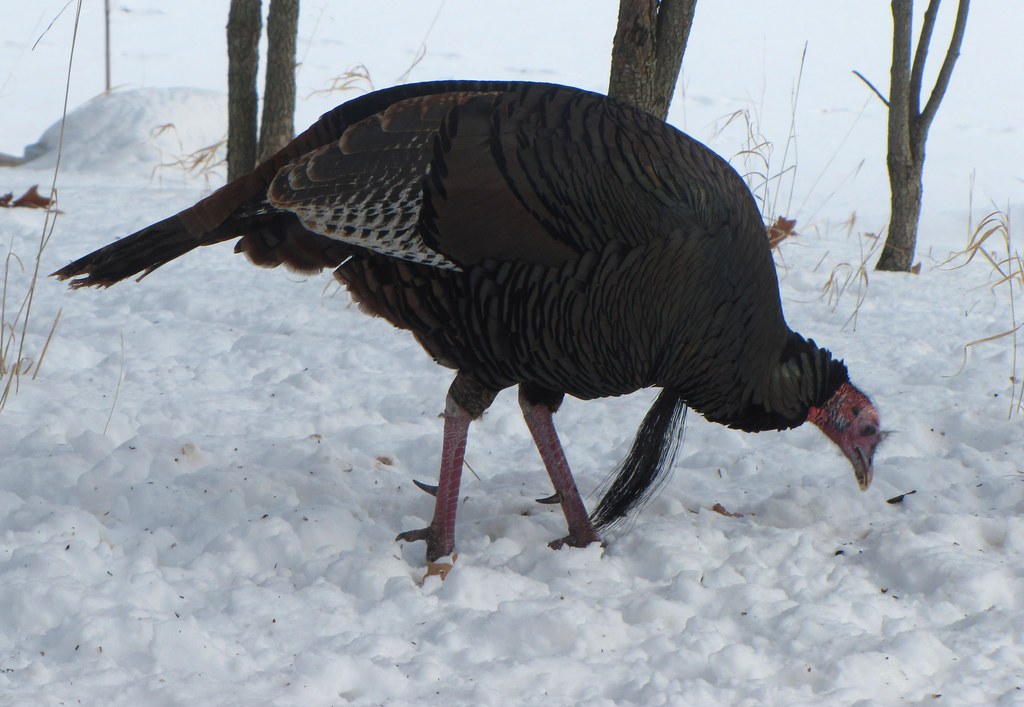
Until recently, I’ve only been able to view Wild Turkeys from afar – glimpses seen from country roads, mostly, of foraging flocks out in the middle of snow-covered corn fields.  Like giant dark chickens their snaky forms can be seen scraping away the snow cover in order to reach the scattered grains below. They appear nearly black when placed against this white backdrop, with only hints of lighter wing feathers. Even at a great distance, however, the wary birds note my stopping and they invariably start to wander back toward the cover of the woods and out of binocular range. I was grateful, therefore, for the chance to recently do some close observation of some fine Jakes (male birds) at Kensington Nature Center.

Close up, wild turkeys are very impressive. For those of you who have spent time watching these birds I certainly don’t have to tell you that. From their wrinkled blue & red skin heads to their iridescent body feathers, the North American Turkey certainly has the flashy looks. They transform into multicolored creatures when viewed in a bright winter sun. I was especially impressed with their wonderfully bronzed rump feathers for some reason. When the light hit them just right, these feathers seemed to glow like dull flames viewed through a sheet of isinglass. O.K., I was taking pictures of turkey butts … so what (see below).

If this wasn’t bad enough, I found myself focusing (literally) on two other particular male traits – their spurs and long dangling chest beards. Only the males possess leg spurs. They use them during courtship battles just like barnyard roosters and pheasants. Starting off as mere buttons, spurs eventually grow sharp and slightly curved as the Jakes mature. As you can see, both of these birds have decent spurs, but frankly, I was more interested in the beards.

Call it male envy, but if I could grow a chest beard I would do it in a minute, although I admit that multiple chest hairs would be nice for a start). Like spurs, only the males grow them (although a very small percentage of females will end up sporting small beards. There are also a few cases of bearded human females but none of them have chest beards as far as I know. Please… don’t let me know if this is not true).

This ornament is a unique structure. It grows out of a papillae of spongy skin located at the midline where the base of the neck meets the breast. On rare occasions there are birds that have multiple chest beards sprouting from the same vicinity. Collectively, the multiple beards are small and never as impressive as a single large one. It’s hard to characterize just what turkey beards are made of. Because birds don’t produce hair, it is safe to say that they are not hair but, then again, they are not modified feathers either. Feathers are molted on a regular basis and Jake turkeys do not molt their beards. Whatever they actually are, they look and feel just like stiff bristles from the tail of a small mammal such as a woodchuck. Perhaps there is some Native story out there that tells of the time when a woodchuck ran smack into a turkey and had to escape through the bird’s rear end –leaving the rest of it’s once long tail sticking out of the turkey’s chest (if not I’ll make one up when I have some free time).

Because they grow throughout the life of the bird, some turkey beards have been recorded at well over a foot long, but most are significantly shorter. All are limited in length by the height of the bird and the elements. Young turkey beards are long and slender. They taper off into wispy tassels. Older birds have thicker structures that look as if they were trimmed into a brush-like ending.  Why? Well, it has to do with feeding.

Turkeys have to lean forward and bend down in order to feed. On older birds, the beard has reached a length where comes in contact with the ground whenever the bird is in this head-down position (see below & here). Successive ground contacts wear off the ends and makes for a neatly trimmed appearance. Other factors, such as snow and weathering can also break down the tassel tips as well. This is how the turkey Jake keeps his beard so nicely trimmed.

So, there you have it, a semi-thorough discussion of turkey beards and spurs. We’ve spent so much time talking about this aspect that the birds have now run off. I was just going to wax poetic about the snood – that fleshy projection on the head.  This will have to wait for another time, so please excuse me while I go off and flex my chest hair.

Something Fishy in the Detroit

Fish don’t often make the news, but when they do it usually involves lots of them – dying in droves and stinking up the place. Unfortunately, more often than not, this type of calamity is due to some form of accidental chemical or thermal discharge. In other words, it is usually our fault. Recent reports of massive Gizzard Shad die-offs in the Detroit River and the shallow waters of western Lake Erie, however, have a totally different spin to them. The silvery fish are showing up and dying in biblical quantities. Earlier in the winter a massive influx of the fish clogged the intake gates at the Monroe Power plant and their mangled bodies mucked up the pumps.  There were so many fish that their collective weight actually bent the iron bars supporting the grid.  Were this one of the ancient plagues, the Pharaoh would definitely have considered releasing Moses’ people!  Large windrows of the fish are showing up where the ice has retreated from the shore. But none of this is our fault – nor can we blame it on global warming, polar bears, or an angry God. We can pin most of the blame on the fish themselves.

Gizzard Shads, you see, have the spineless constitution of gelatin on a hot August day, although it is the cold January days that do them in. They are native North American fish, but are nevertheless highly susceptible to cold and oxygen deprivation. Harsh winters (like the current one) create a solid ice cover which, in turn, leads to a lowering of the dissolved oxygen in the water. This in turn leads to lots of dead gizzard shad.

This year, there are a few additional factors that make it an exceptionally bad shad (hey, that rhymes!) season. A few years ago, it was a good shad year (a super shad season) and lots of little shads were born. These little fellows are now coming of age and clogging up the river space. There is so much shad sushi out there that nearly every living creature, including traditional vegetarians such as Mute Swans, Canvasback Ducks, and Canada geese are eating them. Some of these birds are even fighting each other over the fish! Add to this a very cold winter and the apparent spread of a fish virus called VHS, and you have the makings of a great shad smackdown.

Usually it is the smaller individuals that take the brunt of these natural evils. Most of the dead fish are less than 6 inches long. Gizzard Shad, however, can get quite large – attaining a length of 20 inches or more. Because they are such odd looking fish, and currently news-worthy, I thought this would be a great opportunity to show you one of the big ones that recently came into my possession.

What one sees upon first gazing at a big dead Gizzard Shad is platter shaped silver fish with a big eye and small head (see above). What one smells I will leave to your imagination. The mouth is quite small for a fish of this size (this one was about 18 inches long) because they are filter feeders. They have no teeth per se.  Instead, they simply take in microscopic plankton and filter it through a set of comb-like gill rakers. The “gizzard” part of their name comes from their muscled stomach which functions much like a bird gizzard to crush and grind the collected mass of micro-life.  They are members of the herring family – a group which includes herrings, shads, sardines, menhaden, and anchovies – but are they are unique in possessing this gizzard-like stomach.

Like their cousins, however, they have a ridge of saw-like scales along the belly (see above) and they lack a lateral line -that row of vibration sensitive openings usually spanning the length of most fish.  This is somewhat hard to see on the specimen, but easier to see (or, in this case, not to see) on my drawing of it (at beginning). Unlike their relations, they are not considered tasty by humankind (although I am not personally a fan of anchovies – nor they of me).

Externally, the Gizzard Shad has one more claim to fish design fame. The last ray on their dorsal, or top, fin is very long (see above). It extends several inches beyond the trailing edge. Why? Well, there doesn’t appear to be any “reason” other than looks. Even a glass-eyed shad needs some fashion flare in order to look good when their pictures start appearing in the morning news.

Not Asking for Much

When temperatures are hovering around the zero mark, the lives of hot blooded little birds become greatly simplified.  Their daily routines become a series of black and white issues rather than a whole string of grey options. For them, the primary need is keeping warm. Finding liquid water and locating life sustaining food become secondary concerns – at least in the short term – when things become harsh.

Over the course of my wanderings over the past few bone-chilling days I’ve noticed quite a few birds making the best of things (or, I guess you could say they were “birding up” to the elements). To greatly simplify my observations, let me say that a little warmth can go a long way. As far as birds go, they don’t ask for much.

The colder the temperature the more likely it is that birds will engage in sunbathing. For them tanning has nothing to do with it. It’s all about microclimate.

I noticed a cluster of Starlings clinging to the top rail of a barn door (see above). The flock selected the east facing side of the structure which was flooded by the full brunt (and warming influence) of the morning sun. Although there was precious little perching space, they clung wherever they could. Many were facing the sun with their heads pointed downward – presumably to warm the top of their little pates. In such a pose they looked to be humbly bowing to a great king, however. I suppose a giant ball of fire which influences earth from over 93 million miles away is worthy of such adoration. Heck, people have paid such homage for centuries!

Further down the road a White-throated Sparrow was taking a different tact. Fluffed out into a nearly perfect ball of feathers, the bird was facing east and sitting on the ground at the edge of a patch of reed stems. His eyes were closed in apparent appreciation of the morning glow (see beginning photo and here). I hesitate to call it a state of bliss, but the little fellow certainly looked, let’s say, “satisfied.” My approach only elicited one open eye as if to say “please don’t bother me – not now.”  I didn’t.

Sunning is a tactic which works only when there is no wind. The good thing about bitter cold mornings is that they are often still and cloudless, so sun worship is usually an option. By puffing into a ball, our sparrow was maximizing his ability to trap heat and minimizing his conductive heat loss. If you were to ask him, he would say he was just trying to soak up more heat than he loses to the air. Actually, he would probably just say “Old Sam Peabody Peabody Peabody” and request that you get lost.

Windy weather changes this dynamic because the sunbathers loose more heat to the effects of moving air than they take in. At such times it is better to slim down and hold one’s feathers tight. And, of course, get out of the wind.

Starlings, perhaps because they come from a long association with European urban life, will employ another warming trick. As temperatures plunge, they will make more use of chimney heat. This behavior is not exclusive to Starlings but nine times out of ten, when you see a group of birds on a chimney they will be of the Sternus vulgaris ilk. They will cluster around the stack opening like so many bathers at a sauna – opening their lower body feathers to receive the warming draft directly where it counts. They do not appear to talk politics or of the weather (which would be an endlessly repeating mantra of “boy it’s cold, eh?). No they are usually silent when so engaged – deep into their few moments of summer within the winterscape.

In Search of the Rabbit-footed Hawk

Up to this winter, I could count on one hand the number of Rough-legged Hawks I have seen. This is more from lack of trying than anything. They are uncommon, but regular, winter residents in our neck of the woods and if I were the on-line birder/posting type I could follow the internet highway and direct myself to dozens of local sightings every year. Since I am not an e-birder or a lister, I prefer to find them on my own – which means I don’t see them very often. I do listen to other folks, however, and will keep an ear open for verbal reports. Of course, I realize that many of these “word of mouth” sighting reports originate from net postings, so I guess I am a blatant, although honest, hypocrite.

This self imposed rareness factor creates a joy of discovery when I do spot one before anyone tells me about it! Call it the simple pleasure of a Capuchin monkey finding a peanut next to a jar full of them. This is one of those years when my self-hypocritical Luddite restrictiveness paid off. I have required the use of both hands and even a few toes in order to track my independent Rough-legged sightings. It has been a banner winter for the birds and I (and many others) have spotted them across southern Michigan.

In fact, a pair of these birds hanging about the Pointe Mouillee Game area have nearly become an obsession for me. I have seen them often enough, but the obsession arose from the obstructed desire to get a few decent pictures of them. It seemed that every time one or two were in sight, it was either in the middle of a snowstorm, when I was driving and a Mac truck was pushing up my rear,  or the creature was a mile off. This morning the glaring sun was behind one of the birds which happened to be a mile off as multiple trucks crowded me. My photos certainly reflect all these situations but my quest is still on-going.

Why the excitement, you ask? Well for starters, Rough-legged Hawks are Arctic visitors. Just like Snowy Owls, they winter down in the lower latitudes and return north to nest. Their summer breeding range is in the high tundra zone which stretches around the entire top of the world from Alaska and Canada to Europe and Siberia. Our Michigan birds do not come from Russia, mind you -they are from the Canadian Northeast – but the species is distributed worldwide. They are called Rough-legged Hawks on this side of the pond but are equally well known as Rough-legged Buzzards or Zimnyaks depending where “here” is (I suppose you can tell which one is the Russian word).

Scientifically they are called Buteo lagopus which means “rabbit-footed hawk.” They do not take rabbits, but they have fully feathered legs extending right up to the toes which give their legs a distinctive rabbit-foot appearance. Only Golden Eagles and Ferruginous Hawks share this trait. Although their long pointed wings span a wider space than those of the locally common Red-tailed Hawk, their feet are actually smaller and are equipped only to handle small rodents.

As a group, Rough-legged Hawks vary tremendously in pattern. All have a dark belly band, white tail with darker terminal band(s), light flight feathers, and dark wrist (carpel) patches on the wings, but these traits are often obscured by other factors. The two Pointe Mouillee birds represent two different color morphs, for instance. Unfortunately, there are probably a dozen different recognized color variations so I’ll just call them a light morph and a dark morph and won’t insult you by explaining that the dark morph is the…well…the…darker one (really). The lighter phase bird (see above in this glide-over shot) exhibits classic coloration in all regards.

Often, the bird guides will explain how approachable these birds are. Being from un-inhabited regions they are “quite trusting and docile around humans” they say. My Mouillee hawks are proof that birds do not read, for they have proven skittish in the first degree. While cruising past their hangout last week, I noted that both birds were perched atop two consecutive telephone poles close to the road. It was in the middle of a mini-blizzard, but I turned around and approached them at a respectful crawl. I was only able to snap off a few shots of the lighter bird (see below) before it took off into the flurry. The darker one lifted immediately as soon as I stopped (see ghostly portrait at beginning).

I am especially enamored of the mysterious dark bird because it is so unusual. It is chocolate brown from head to toe, front and back, with only the white inner tail and primaries to show variety (see here in this long range portrait). I will not give up my attempt to get a slightly better shot of this individual. My time is running out as Spring slowly approaches and it vacates the banana belt for its return trip to the howling north.