Milkweed Manor Mates

  There is little question that the Monarch Butterfly is the royalty of Milkweed Manor. Nearly every discussion of the Milkweed gets around to mentioning this noble butterfly and its lifecycle link to this plant. Unfortunately, lesser occupants such as the Milkweed Tiger Moth and the Red Milkweed Beetle are often ignored as a result. Perhaps it is time to look over this overlook and see what we’ve been missing.

  The Milkweed Tiger pictured above is a member of the Tiger Moth family  Typical of their ilk, they are furry to the extreme and appear to lack a definable head end. They do have a head end, of course, and this can usually be defined as the part nearest the chewed portion of a leaf (here, is an exception to the rule).  This common species chews only on milkweeds and dogbanes. 

  As a milkweed eater, they ingest the cardiac glycosides found in the milky sap of these plants and use the chemical as a predator deterrent.  They try to avoid eating too much of the sap, however, because it gums up their chewing mouthparts (it contains a latex like rubber).

  When young, the Milkweed Tiger is a colonial beast – all the hatchlings stay together and feed together. During this early gregarious stage they carefully skeletonize the leaves and try to keep away from the sappy veins as much as possible. After their third molt, the tiger cubs head off on their own. Older larvae often deliberately cut the main vein, close to the stem, before dining in order to “bleed off” extra sap and make the leaf more palatable. During all this time they ingest just enough poison to keep themselves toxic.

  By the end of the summer these hairy little creatures will descend down into the leaf litter and weave themselves into a nice furry cocoon made up of body “hair” and silk. They will overwinter as pupae and emerge next year as rather plain looking moths.

  Red Milkweed Beetles, the other unappreciated members of milkweed society, are so named because they are (red milkweed eaters, that is). They claim lineage to a group of insects known as longhorn beetles. All members of this group have very long antennae – the so-called “horns” of their type – which emerge out of the forehead uncomfortably close to their eyes. The antennae base on these insects usually overlaps into the eye space, but those on the Milkweed beetle actually divide the eye into two separate parts! Given that there is plenty of room on the head capsule to put these things, it is not certain why this is so. The scientific name of this antennae-eyed creature is Tetraopes tetrophalmus which is Latin double-speak meaning “four eyes.”

  I invite you to pick up a Milkweed Beetle sometime. Hold the creature firmly in your fingers and hold it up close to your ear (see here).  You’ll hear the thing complain about its treatment with a series of raspy squeaks. As long as you maintain your grip they will keep up this mechanical response.  Properly translated, the beetles are probably requesting a return to their food plant and offering some kind of comment on your mother’s ancestry! 

  Milkweed Tiger Moth caterpillars will offer no commentary if similarly handled, but will roll up and attempt to drop to the ground.  Neither beast appreciates the attention – they apparently prefer being overlooked.


Wren in Need of Sun

     Perhaps no other bird, other than the Red-winged Blackbird, embodies the spirit of the marsh better than the Long-billed Marsh Wren.  While Red-wings frequently leave the marsh and enter into our everyday world, Marsh Wrens hardly ever leave the reedy realms.  To see and hear them you have to seek them in their places.

  True to their name, these wrens inhabit the thick vertical vegetation found in cat-tail and bulrush marshes. As mouse-sized members of the wetland fauna they spend most of their time hopping about in the shadowy depths of the lower stems seeking insects and cover. During the early summer breeding season they create wonderful ball shaped nests located about mid-way up on the cat-tail stems. These structures have bottom entrances and are, as you might suspect, hard to find amongst the tangle of green and brown.  I’ve personally only seen a few and in those cases I had to go knee deep into the marsh.

  Marsh Wrens are visually secretive. More often than not, their presence is betrayed solely by the movement of the upper plant stems as they perch on them down below. When you do spot one, it is usually only for an instant before they melt away (see here). The most notable feature is their diminutive size, up-right tail, and white eye brow stripe. It probably goes without saying that the bill is relatively long (they don’t call ‘em that for nothing).

  These wrens are not audibly secretive, however.  They are constantly calling and commenting on the world around them. Often, a small swatch of marshland will ring out with the dry twittering call of multiple wrens.  I was able to record one of these song bursts at Crosswinds Marsh (Long-billed Marsh Wren) – you’ll need to listen to this sequence several times to get a sense of a talkative wren in action.  My wren apparently sensed my desire to record it and decided to grant me one little burst (but it was a nice little burst).

  After recording this songster and getting one quick photo, I figured that would be all I’d get. This little guy proved to be more generous than I could imagine, however. In a few minutes it emerged out onto the board walk and immediately dropped into a spread eagle pose (see here). The bird was taking advantage of the hot morning sun and performing a little sun bathing ritual.  My presence made him a bit nervous and he frequently hopped back into the shadows. Fortunately, the lure of the summer sun finally overwhelmed the fear factor and he lost all sense of restraint. He eventually let it all hang out (see here).

  In full solar glory, the bird pointed his hind end toward the sun. Every wing and tail feather was fanned out, the body feathers fluffed, and the head turned up and slightly sideways. All that was missing was a reflective panel held under the chin.

  Take a good close look at the detail picture above and you’ll notice that the body feathers are lifted to the point where they expose the naked skin. It must feel good to air out these nether regions. I can’t help but to point out that the patch of bare skin visible in this shot is directly above the tail.  This is wren butt, ladies and gentlemen- a full moon in the full sun.

The Horntail Cometh

  I’ve been concerned about the health of my backyard Silver Maple as of late. The tree has slowly been falling apart and whole limbs have died back to the main trunk.  One section of the upper main trunk has rotted to the core – much to the pleasure of a family of Red Squirrels that raised a brood in the cavity this summer.  Yet my tree continues to produce fresh green leaves and branches like a faithful old white-faced dog.

  I, like a faithful old dog owner, have chosen to ignore what I know to be true – the tree is in decline. A recent visitor, in the form of a Pigeon Horntail, has clarified the situation like a visit from the Angel of Death.

  Horntails are large wasp like insects that lay their eggs in dying trees.  Females are known to prefer silver maples, ash, cottonwood, and elm and they seek weakened wood that is sufficiently low in moisture content. They do not bring about the death but simply take advantage of, and encourage, previously sickened trees. The horntails are so named because of the pointed stinger-like “horn” that terminates the end of their abdomens. This structure is not a stinger, however – the creatures are stingless.

  The mission of a visiting female is to deposit her eggs deep into the sapwood.  To accomplish this task she has a very long ovipositor with which to “sting” the wood. I watched the female slowly examine the surface of my tree before she finally settled on one location.   She raised the middle portion of her abdomen, un-sheathed her ovipositor, and directed its point at a right angle into the bark.  In essence, she sets herself up like an oil drilling rig (see photo above – note ovipositor pointing down from the center of the body and the sheath pointing back). Since the ovipositor has the consistency of a stiff hair, it seems near impossible that she could drill this thing into hardwood, but she can.

  I can best describe her technique by referring to the human action of running a plumber’s snake down a drain. You need to twist and turn one end in order to push the other end around the bends and curves of the pipe. This horntail performed the same action with her body as she drove the drill tip into the fine spaces of the wood fiber.  First a twist to the left (see here) and then a twist to the right (see here) drove the thing home. These creatures can penetrate solid wood up to 20 mm deep with nothing more than a robust hollow thread!

  Once the egg chamber is drilled, anywhere from 2-7 eggs are laid.  The female adds a hefty dose of a white rot fungus to the chamber – the spores of which are stored within two sacs located at the base of her ovipositor. This fungus accelerates the wood decay process and softens the wood for the hatchling larvae. Without it, the larvae can not survive.

  As the Horntail ended her egg-laying session, a process that took about 5 minutes, she clumsily fell to the ground.  Instead of seeking revenge upon the messenger, I helped her on her way. I carefully offered a twig for support and watched as she launched into a slow departing flight.

  Young Horntails take up to two years to mature. The wood munching larvae will eat tunnels into the sapwood and grow to be 2 inches in length before exiting the tree as adults.

  In a way, the Pigeon Horntail’s visit offered some assurance.  My Silver Maple will probably hang on for at least a few more years since it takes all of that to complete the larval growth process. Horntail females don’t invest in their future without some innate knowledge of the odds.

  Whether I will need to have a “vet” put my tree down before that time is the future I will need to ponder.

The Crack of the Bat

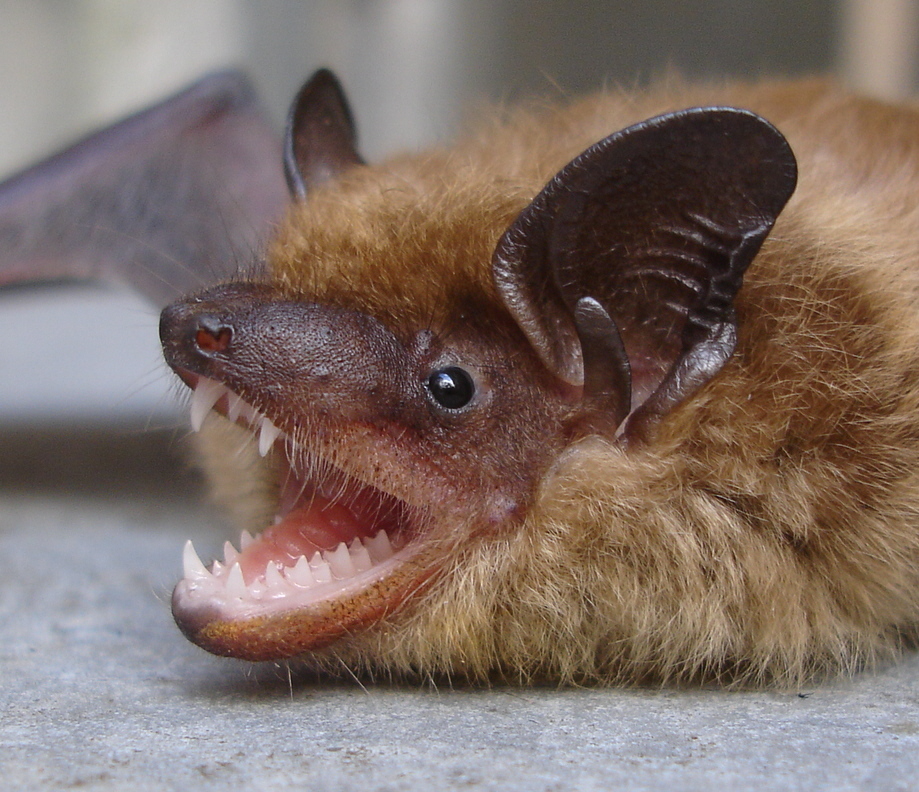
  To any baseball fan, one of the most satisfying sounds in the world is the resounding “crack” of a ball coming off of a home team bat. This is a sound that reverberates around the stadium and prompts the faithful to rise up and believe. Wooden baseball bats, however, are not the only bats that make warm summer nights sounds.  The mammalian bats of Michigan also fill the night with resonating tones.  In addition to being a Detroit Tigers fan, I also happen to be a big fan of the Microchiropteran Bats, and their sounds can bring me to my feet as quickly as any Louisville Slugger can.

  There are over 800 kinds of Microchiropteran bats in the world – the closer you get to the equator the more kinds there are.  We happen to have nine species that can be found in our state ranging from the tiny Pipistrelle to the bird-sized Red Bat. These bats all use echo-location to locate their food (the Megachiropterans, by the way, don’t).  

  Echo-location allows these night-flying creatures to literally “see with sound.”  They let out short sonar bursts and listen for the returning echoes to tell them about the landscape and prey species ahead of them. Since their hearing range is far above ours, most of their sounds are well above our capability to naturally detect them – a sound of silence you could say. Bats echolocate in the 20 to 200 kilohertz (kHz) range while we function in the 20 hertz to 15 kilohertz level.

  Last night, there being no Tiger game on, I ventured out into my backyard about a half hour after sunset to listen in on some bat noises. This is the prime time to see bats as they begin their night-time flight and the night sky is still bright enough for us to see them.  I was equipped with a Bat Detector – an electronic device that converts the high range bat noises into lower range human sounds. The detector can be tuned to species specific kHz levels and is a useful tool to “see” invisible bats with audible sound.

   It only took a few minutes before the detector lit up with sound. I dial-tuned the device and found that the noises were best heard the 29 KHz level (see above). This alone would be a good indication that the noise makers were probably Big Brown Bats, the most common bat in southern Michigan.  As soon as my eyes adjusted to the dark, I could see the ghostly forms flitting about overhead and indeed, they appeared to be Big Browns (see here- note the large ears).

  Unfortunately, the other thing that only took a few minutes to occur was the ascent of the mosquito hordes from the depths of hell. The detector was sensitive to the brushing sound of my hand whisking off blood-thirsty pests, so my audio results were compromised. I was able to stick it out just long enough to record a few of the echo-location sounds before lack of blood forced me inside.

  Listen to my recording (Recording) and you’ll hear what I heard. There were several bats flying about, so you are listening to several individuals taking turns in the air space above my head.  There is an amazing amount of information contained in those clicks and pings. The pulses are emitted through the mouth and nose at a noise level equivalent to a smoke alarm (110 decibels), but at such a high frequency we don’t sense it. Believe it or not, Big Browns are classified as “shouting bats” because of this.  

  Some of these calls are directional, but most are designed to pin down the location flying moths, beetles, and (theoretically) mosquitoes. Relative velocity, range, size, elevation and azimuth are the kinds of things that can be determined using sonar technique. In this series of calls, you’ll notice that the blips start off at an even pace and then get faster before cutting off. As the bat approaches an insect, their call rate is increased just before making the grab and going temporarily silent while they munch their prize – this is what you are hearing.

  Listening to this extremely short segment recording the capture of at least three insects, it is easy to see how bats are able to eat their body weight in bugs every night. There is another side to this aerial battle that we can not hear or spend enough time discussing. The insects themselves have developed an impressive array of defense tactics since they too are equipped with bat detectors. Some moths are covered with sound deadening “fur,” but others send back false signals or drop out of the sky as soon as they hear an approaching bat.

  I’m looking forward to spending some more summer nights listening for the crack of the bat.

Nature Ain’t Necessarily Natural

  It might seem natural to expect Black Swallowtail Butterflies to emerge from Black Swallowtail Chrysalids. Given three identical crysalids, “made” by three identical swallowtail larvae, the odds are even better that three butterflies would emerge. I had three such potential packages awaiting delivery this week. Nature ain’t necessarily natural, however. Three large orange wasps emerged instead (see above).

  My swallowtail larvae & chrysalids were parasitized by a species of wasp known as the Trogus Ichneumon Wasp. Ichneumons make their living off of other creatures and they specialize in certain types. The Trogus wasps zero in on swallowtail butterfly larvae and they appear to do un-natural things to their victims. In short, the wasp maggots develop inside the unsuspecting host and eventually kill them, eat them from the inside out, and then emerge from their hollowed out shells. All that is left of the original butterfly chrysalis is the empty casing with a massive hole in one side (see here). This is all perfectly natural.

  It is estimated that 20%-40% of butterfly and moth pupae (crysalids in the case of butterflies) fall victim to parasites like the ichneumons. The process begins with an egg laid inside a young caterpillar by the female wasp. Ichneumons, the term means “tracker” in Greek, hunt down their hosts by using a finely developed sense of smell. They are attracted to the scent of leaves damaged by feeding caterpillars – deducing in their tiny wasp noggins that where damage exists the damagers can’t be far behind. Once located, the female inserts her needle-like egg laying tube (ovipositor) into the soft bodied host and deposits a single egg. She then resumes her search for fresh fare.

   When the egg is laid, the female ichneumon adds a dose of Polydnavirus for good measure. This virus immediately infects the surrounding cells and essentially tells the caterpillar’s immune system to ignore this intrusion. The wasp maggot hatches and begins to eat all the non-essential internal parts of the swallowtail larva which, by the way, continues to grow as if nothing is wrong. 

  By the time the caterpillar enters into the chrysalis stage, it is more maggot than caterpillar (“twisted and evil”).  Once settled into this stage, the wasp maggot is no longer bound to keep its host alive so it consumes the rest of the innards before entering into its own pupal stage.  Two weeks later, the adult wasp emerges and exits via a custom made port hole (a closer view here).

  In case you are wondering why the wasps in my hand are dead, I decided to freeze them for the benefit of recording their appearance. These are active beasts that don’t photograph well. I admit there might have been a little bit of come-uppance on my part as well. Sure, I was witness to a perfectly natural occurrence, but I admit to being slightly peeved and felt it was perfectly natural for me to claim the final word in this scenario.

A Stag Survivor

  I found a reddish brown colored stag beetle underneath a porch light yesterday morning. It was pretty beat up – missing a few feet, suffering from a shell dent, and still dragging an extended wing tip out from under the wing covers (see another view here).  No doubt it had recently engaged in combat with a bird. Stag beetles are naturally attracted to night lights and are revealed to potential predators at dawn’s early light.  To say that this tough little creature “won” the tussle might be a stretch, but it definitely made sure that it’s predator never met up to its potential.

  A little research on the wounded veteran revealed that it was, believe it or not, called a Reddish Brown Colored Stag Beetle.  The orangish color of the upper legs (see here) and single “tooth” on the jaws are enough to put that name to this particular face.

  All stag beetles are endowed with impressive “pincers,” and this one sported a quite a pair (see above).  These are better called mandibles, but could be called horns because the translated species name means “small goat.” The beetles in this group are generally known as stag beetles because their mandibles look like stag (deer) antlers. This individual is a male. The females have much smaller jaws. As formidable as these male appendages are, they are meant more to intimidate fellow stag beetles than to deliver crushing bites. Males wrestle each other for mating sites and the honor of delivering the first pick-up lines at arriving females.  I guess you could call these wrestling matches Stag parties.

  When all the mating hoopla is done, these battling beasts feed on tree sap. Tell me that isn’t a surprising choice of fare for such a well armed warrior! 

  Now, I didn’t put this guy in my palm just to talk about his mandibles. I’d like to give you an opportunity to take a closer look at a few other features. Take those antennae, for instance (see here in this underside view).  The end segments on each antenna are flattened into platelets – structures called lamellae. Note also how the eyes wrap around to provide a downward glance (or, in this case, an upward glance). Finally, give an appreciative ogle at the wonderful texture and fit on the hard exo-skeleton plates.

  This external skeleton is better on some insects than others, but beetles definitely have the heaviest armor in the micro kingdom. There is no question that this plating defined the fine edge between life and death for this beetle. Incredibly, stags are reported to live two years as adults thanks to their sturdy casing.

  I set the survivor down in the grass and watched it limp off at a slow but steady pace. It will live to do battle another day.

Don’t Touchel the Teasel

  The Common Teasel is a plant that needs to be handled lightly, but not taken lightly. These towering plants are just beginning their flowering stage in late July. Their beautiful lavender flowers, artfully arranged on decorative cone-like heads, might seem like candidates for the flower vase but the potential arranger should be aware of the danger. Teasel plants bristle with stout spiny armor. Un-gloved hand contact is not recommended unless you are the kind that sleeps on a bed of nails. Take a good look at the photo above and you’ll see what I mean.

  Normally, I wouldn’t even hint at a suggestion that any wildflower should be cut and vased, but this plant is a tough customer. It is an alien invader hailing from Europe, Asia and Africa that has the real potential to choke out our native plants. So, go ahead and cut away and don’t forget those industrial strength gardening gloves. The dried seed heads are equally as attractive, by the way, and equally as spiny.   

  It would be a mistake to think that the teasel is a totally worthless plant. After all, we humans brought it to North America in the first place. Someone once thought it was worth the effort. The dried seed heads of Common Teasel, also known as Fuller’s Teasel, were used by textile manufacturers to treat woolen cloth. Strapped and stacked onto a wooden “teasel gigs,” multiple spiny heads were drawn by hand or attached to rotating cylinders.  The flexible, but stiff, spines firmly plucked at the cloth and raised the nap without tearing it. Steel or iron spikes were too harsh to perform this duty.

  This once helpful plant soon became an anachronism in human society as textile manufacturing advanced beyond the old ways.  The teasels (there are several species) did not disappear with the old ways and are now more common than ever. They are plants without purpose, however, and thus relegated to weed status.   

   One of the unique features displayed by this stout plant is the manner in which it blooms. While most plants with multiple flower-heads bloom in sequence from top to bottom or vice-versa, Teasels bloom from the middle out. The blooms begin as a purple belt (look above) which divides as the flowers work their way toward the ends. You can see (in this view) that the flowers in the center of this cluster are already turning brown as the newer marginal blooms emerge. If filmed in time lapse, the sequence would look like a sparkler that was lit in the middle (I used to do this all the time because it doubled the “spark” effect).

  Although the flowers are getting all the attention here, it is worth a downward glance to note how the leaves attach at the stem on this plant (see here). The leaves are stemless and opposite.  They join together to form a cup that often holds a pool of rain water. Dipsacus, the Greek name for the teasel group, means “to drink” and refers to this feature. I wouldn’t do what the name suggests.

Promethea’s Patterns & Perfumes


  If you’ve been following this blog, you have been subjected to multiple exposures to that wonderful group of insects known as the Giant Silk Moths.  Because these big beauties are all named after Greek gods, you’ve also gotten a hefty dose of mythology along with it. Let me warn you, then, that you are about to get one more turn at the mega-moth table. I’ve had good luck this year in finding the cocoons of both Polyphemus and Cecropia Moths and both have emerged out into glorious adults. Well, good things come in threes.  I found the dangling cocoon of a Promethea Moth at the Petersburg Game Area last week and now it too has emerged.

  The Promethea Moth (see here) is a relative midget in the Giant Silk Moth clan yet ironically it is named after a Greek Titan – a giant. As part of one of the dumber myths in the Grecian myth treasury, Promethea gained fame by cracking Zeus up side the head with a rock. This action, believe it or not, was performed in order to rid Zeus of his headaches!  Somehow Athena popped out of the big god’s head upon delivery of the blow and his headaches were cured. Although I am not making this up, I’m sure some Greek suffering from a case of blunt force trauma did.

  The real moth named after the mythical giant, is worthy of a mythical title – no matter how stupid the namesake might be. Artistically, it is a gem of creation as the detail view above (and this view here) illustrates. A detailed look at the wings of one of these newly emerged beauties reveals a subtle patterning of scales and the obligatory “eye” spots found on most silk moths.     

  This specimen is a female. Her reddish coloration, V-markings, and plump abdomen are sure indicators of this. Males of the species are smaller, dark purple brown, and have light tan wing borders. Unlike most moths, these scaled down titans are active during the day which allows us to get a peek at some of the unique behavior that brings the boys and girls together. Actually the behavior is not unique; it’s just that we can see what’s going on during the daylight hours.

  The first job of a freshly emerged Promethea female is to attract a mate by releasing sex pheromones into the air. To do so, she dangles down from the end of the cocoon and extends a brush-like organ out of her posterior. Take a look here and you can see this scent wand. She will occasionally waft the thing back and forth to distribute the perfume into the air stream. The males can detect these pheromones from as much as 7 miles away and will hone in on the target and come a-court’n.

  All of this takes place in the late afternoon from around 4 pm until sunset.  By the time the Prometheas pack it in for the night, all of the other moths are just getting started. As of this writing, my female hasn’t attracted any suitors yet and the sun is going down.  I’m pretty sure she’ll get her man after I release her tomorrow. Her perfume will end up hitting some guy moth up side the head like a rock.

Shoo Fly Don’t …Ouch!

  I’d like you to know that I took a hit for the team. Yes, when a Deer Fly landed on my hand I reached for the camera rather than swatting it away. I figured that I’d do a Naturespeak piece about them for the sake of my two readers out there – the team, as it were. Before I could finish the shot, the thing drove its saber-like beak home. I held on just long enough to make double sure that I’d gotten the shot and then creamed it.

  These troublesome flies are worse than mosquitoes when it comes to biting human flesh. Their bites elicit far more blood flow than their smaller brethren (mosquitoes are flies also) and they make a habit of sneaking down into your hair before biting.  They take up their biting gauntlet in open sunny places, where the ‘skeeters dare not tread, and they are not affected by the usual repellants. We “sapiens” are not alone, however, in suffering their assaults.  You will be satisfied in knowing that they make their main living off of livestock and other wild mammals such as deer. They aren’t called Deer flies for nothing.

 On that note, I was startled the other day by a bounding White-tail fawn that careened into a grassy clearing just ahead of me. The spotted beast was being harassed by some deer flies and made its entrance into the clearing at break neck speed. It slammed on the brakes momentarily – giving me just enough time to take a photo (see here). Note the wild look in her eyes. Right after I took this shot, she jumped straight up into the air, ran around in a tight circle, and then took off in another zig-zag sprint. It paused long enough to look in my direction and she then leapt back into the undergrowth from whence she came.  As you may know by now, I’m for anything that torments deer, but I felt a twinge of sympathy for the little gal.  I felt her pain, you could say.

  To put the record straight, male Deer Flies are not the ones to blame in this matter. The adult males do not share the sanguine needs of the female. They feed on pollen, as a matter of fact. It is the female half that requires a blood meal and therefore seeks warm-blooded donations. This is why they possess a set of knife blades for a mouth.  When a lady fly lands on the victim’s skin it employs these tools in the manner of an old-style lancet. One quick slice prompts a small pool of blood to form and the fly laps it up. She is then free to lay her fertilized eggs in the moist soil next to a marsh or pond where the hatchling larvae grow up eating dirt (actually, they eat the organic material in the dirt).

  Researchers aren’t sure how Deer flies find their victims, but they’ve “narrowed” it down to an attraction for movement, shiny surfaces, Carbon Dioxide and warmth.  That pretty well covers the whole picture doesn’t it? So, if you stop breathing and moving you’ve increased your chances by 50% that a hungry fly won’t find you. Unfortunately, there’s not much you can do about the warm-blooded thing. 

  By the way, next time you successfully swat a Deer Fly into the afterlife, stop a moment to admire her eyes before tossing her aside. These flies are characterized by wildly patterned green and gold eyes (see here). Those funkadelic shades give them a slightly crazed look that mimics the look of their tormented victims.

Jeepers Creepers


Because there are so many eye-popping insects to choose from, it is almost un-fair to limit this discussion to only two of them.  But, since life in general isn’t fair, I feel no particular guilt in making a purely personal selection here. I present, therefore, a baby butterfly and a beetle for your curious consideration.  Take a peek at either a larval Spicebush Swallowtail or an adult Dogbane Beetle and you’ll find something staring right back at you.  In the case of the second beast, the face staring back will be a very familiar one.

  The adult version of the Spicebush Swallowtail is a handsome dark butterfly with a wash of electric blue on its back wings. This species is known by the Latin name of Papilio troilus. The latter half of the name refers to a character of Greek legend known as Troilus – a person known as the “paragon of youthful male beauty.”  This young fellow was slain by that heel Achilles and the dastardly act is depicted on the decorative panels of many Grecian Urns.

  I bring this up because the caterpillar of this butterfly bears a striking resemblance to the Troilus of old. Take a look at this image – the kid is the one on the horse. Look at his eyes and then look at the picture of his namesake larva shown above. See what I mean?  As an additional layer of similarity, both Troilus’s “urn eye” and the caterpillar’s “back eyes” are merely artistic depictions of eyes. Those larval eyes are not real and, since the Grecian youth is merely a figment of legend, his eyes were never real to begin with.

  Spicebush larvae resort to trickery as a means of survival.  The caterpillars possess those fake Greek eyes on their backs in order to startle potential predators.  During the day they hide themselves within the protective folds of a leafy taco.  They feed on Sassafras and Spicebush plants and deliberately draw together the leaf edges with silk to form a larval chamber (see here).  Coming out at night to feed, they rest within the chamber by day. If an inquisitive bird opens the flap it will be startled by the sudden appearance of a pair of bright eyes. On top of this, this is another one of those caterpillars that have a forked stink horn (called an osmetrium) that everts out from behind their head when alarmed. This act, combined with the eye thing, makes the caterpillar look more like a snake with a forked tongue than the juicy edible insect that it is. The whole effect is disturbing enough to frighten away meek hearted enemies who are heard to declare “Jeepers Creepers where’d you get those Peepers?” as they flee.

  The second eye-popper to consider is the Dogbane Beetle (see here). I encountered a few of these brilliant beetles just a few feet away from the lair of the Spicebush caterpillar.  They are a common insect, but restricted to places where Dogbane, or Indian Hemp, grows (see one on food plant here). To say this insect is a living jewel is an understatement.  Even taxonomists had to perform double speak when naming this one – Chrysochus auratus, their Latin name, could literally be translated as “Golden-gilded Gold” Bug.  

  To be fair about it, this particular bug is a member of a family of beetles called leaf beetles and all members of this group bear the “Gold-gilded” pre-fix label. It’s just that this one is really special, I guess.  To be un-fair about it, however, gold is not the first thing that comes to mind when looking at the bright reflective colors found on the creature’s wing covers. As you can see it’s a wonderful mix of metallic blue, green, violet, and a hint of gold that meets the eye. These creatures make no attempt to conceal themselves and they bear their splendor proudly.

  Look very closely at the picture you’ll notice my reflection in the shell (see here). The image is a fish-eyed image of me. I was wearing a white shirt that day and you can plainly see me, my shirt, and a contorted view of my face with a camera in front of it. So, the face looking back at me from the back of this insect was my own – an image equally as scary as the fake snake on the caterpillar.