Arakun’s Up and Out

  This winter has been a doozey in many respects.  Although punctuated with warm days and periods of snowlessness (is that a word?) there have been equally long sessions of bitter cold and snow to balance them out.  Members of the Arakun tribe long ago adopted a wait and see strategy to deal with winters such as these.  In other words, they wait out the cold snaps and come out during the late winter warm spells.  This last bout of warmth (a relative term used by us northerners) has encouraged the Arukuns to spill out over the countryside.  The critters look out of place in a snowy setting – something like your hairy neighbor walking out to get the Sunday paper in his bathrobe and bare feet. The fact is that you don’t usually see either of them. The track evidence is enough to decipher both Arakun activity and the actions of your neighborhood Yeti.

  The Arakun critters we are talking about here are Raccoons.  Like our Coyotl discussion earlier, the name of this familiar bandit derives from a slight slander of their Indian name. In this case, the original name was bestowed upon them by the Algonquin speaking peoples of North America. Say “Arakun” enough and you will find yourself saying “A Raccoon.” Drop the “A” and you have the present name, although many simplify that to plain old “coon.”

  Raccoons are basically southern beasts that have learned to tolerate northern winters by getting fat (perhaps your neighbor does the same thing?). Healthy early winter coons can pinch nearly an inch of the life saving flab which accounts for well over 1/3 of their total body weight. They retire to denning sites, such as abandoned woodchuck burrows and hollow trees, when the snow begins to fly.  The first few months are spent in a drowsy sleeping state.  This is not hibernation, but an effective way to conserve energy that allows their bodies to maintain heat by burning off the fat reserves.

  By the time the late winter thaws arrive, the coons are starting to feel the need to begin re-stocking their internal cupboards. They pepper the snowy landscape with their prints as they wander far and wide foraging for food.  

  Here is a typical set of raccoon tracks.  The one thing you’ll notice on this set is their resemblance to tiny human hands. Each foot leaves an impression with five finger-like toes. The hind foot is larger -2 inches or so -and leaves a full sole impression (raccoons, like bears, skunks, and your neighbor, are so-called plantigrade walkers that put full weight on their soles when walking).

  In cases where the critter walks in deeper snow (see here) the toes are harder to see. There are swish marks made by the tail in this last example, but normally that kind of thing doesn’t show up. What you will notice on any set of coon tracks is that they are laid down in pairs with the front and hind feet marking the snow right next to each other (see here).

  Today I followed an extensive set of raccoon tracks that bounded back and forth along a creek. At many points, the tracks ventured out onto the ice or ended at the open water. It was apparent that this animal was searching in the stream for victuals. The creek was flush and the rushing cold water was not very conducive for the usual Arakun hand fishing method. After a quarter mile, though, I did find the remains of a very large crayfish pulled out onto the bank (see here). It was “rent asunder” by the coon and no doubt provided a nice seafood entrée.

  The fishercoon was long gone by the time I arrived on the scene this afternoon, but there was enough evidence before me to reconstruct a potentially mesmerizing picture. Last night there was a total eclipse of the moon.  By 11 pm, the earth’s shadow enveloped the lunar face and the full moon glowed with a deep copper radiance.  I can picture our coon as a ghostly form moving about the snowscape – his nightshine temporarily removed. A few crisp splashes and the crunching of crawdad shell would have cut through the still night air as he made his find.

  This night of the blood moon was bitter cold, so the coon – his hunger temporarily satisfied – hurried back over the flats and entered his cozy den.  By the time the moon was restored to its full face in the wee hours, our raccoon was sound asleep and dreaming of the next thaw. 

The Passing of a Song Dog

The passing of a song dog occurs more frequently than we might be aware of. Song dogs are out and about during the full extent of the cold season and leave evidence of their wanderings in the form of crisp snow tracks.

  You may have guessed that I am about to embark on another track treatise and that I have introduced the subject in my usually obtuse manner. Song Dog is a euphonic name for the coyote, by the way. This nick name came from their propensity to yip and yap at the full moon, but their common name derives from a corruption of their original Native American label. The coyote name, in fact, came from the same Central American folks who brought us the word tomato. Tomato was “tumatl” and coyote was “Coyotl.” Don’t ask me how the “l” graduated down the alphabetic line to “o” in the first case, but I suspect the “l” in coyotl caused too many tongue injuries in frustrated Europeans trying to pronounce it.  The “e” ending simply made things easier to say – just like it made chocolatl easier to eat.

  While keeping track of name origins is important, knowing the track at hand is even more important in this case. Earlier in the winter I spied a lone coyote loping along the edge of a corn field. As is usual among this species, it appeared to be self absorbed and laid down his feet in a mantra-like beat pattern. It was a good half mile away and I initially felt that I was unobserved, but the wily beast stopped every 10 yards to throw a glance over in my direction to prove me wrong. Only smart coyotes survive in this area and so they must be constantly aware of all that is near and far. Most eastern coyotes have turned to nocturnal habits and so they stay out of our way for the most part. We must rely on their track evidence to give testimony to their abundance.

  I spotted this set of coyote tracks last week on a morning after a nice overnight snowfall. At first glance you’ll probably remark that they appear very dog-like (as the animal itself does). As fellow members of the canine corps, coyotes and dogs share many traits – not the least of which is a four-toed foot with a central pad.  There are a few particular differences that can help separate their tracks, however.

  First of all, the average coyote track is about 2 ½ inches long, while dog tracks can vary from glorified rat-sized Chihuahua prints to cattle sized Great Dane spoor. A German Shepherd would leave a track similar in size to that of a coyote, but it will reveal its “dogginess” by the fact that the paw print is nearly round in outline.  If you draw an imaginary line outlining the borders of a dog track you will trace out a fairly circular shape. A similar exercise with a coyote track will reveal a narrow oval. The coyote track is more pointed and is narrower than a dog’s print.

  Both dogs and coyotes set down their feet in a repetitious pattern which leaves a single hind foot mark adjacent to a front foot. The larger of the set is the front foot in both cases. If you take a look at how these multiple tracks line up, you will see another coyote sign marker. Coyotes pretty much keep in a relatively straight line when they walk, while dogs will veer and angle about (especially in the presence of hydrants). This dotted line trait is also indicative of foxes, but they have much smaller feet. 

  Now that you know what to look for in a coyotl trackl, it’s time to go in pursuit of the story behind a set of rare winter Arakun prints. But, that will have to wait until next time.

Veryclose Voles

  A substantial layer of snow is a God-send for some animals. While a cold blanket of the stuff can spell hardship for the likes of turkeys, deer, and larger critters, the small and meek are comforted by its sheltering cover. Meadow Voles, being of the small and meek ilk, take advantage of snow cover to explore places normally off limits for foraging trips. You could say that snow allows them to eat without being eaten. This picture illustrates just how they do it.

  Among all the deer tracks you’ll notice a branch-like pattern of raised snow looking like a set of varicose veins bulging from the whiteness (excuse the anatomical reference, but it was the only one I could come up with). These are the runways created by Meadow Voles seeking greens out on an open lawn. Like bugs under a rug, the mice are able to tunnel out into the exposed grass and do so knowing that aerial predators such as red-tailed hawks, kestrels, or owls can’t see them. As the perennial protein choice of nearly every predator in existence, Meadow Voles strive to keep out of the food chain for as long as possible. Feeding out in the open is a sure invitation for early induction into the chain. Voles spend most of their time under the cover of high field grasses until snowfall draws them out into the shorter stuff.

   It has been shown that these nocturnal mice become more active in the daytime when living with snow insurance. This interesting snow tunneling pattern is a common late winter sight (here’s another set). You can see that the tunnels branch out from the adjacent field and provide a record of feeding sorties to and from the lawn. It seems that hungry voles are desperate for some luscious greens after a subsistence diet of dry shrub bark and seeds.

  Under the snow, the tunnels are shallow highways arched over with grass and their structure becomes visible once the snow retreats (see here).  The runways become littered with grass clippings and droppings – the mice finding no immediate need to be sanitary in these temporary alleyways. Meadow voles are voracious eaters and can consume 60% of their weight daily. Sometimes they even resort to cannibalism, but only under stress (as if life as a walking snack isn’t stressful enough).

  Meadow Voles, also known as Meadow Mice or field mice, are probably the most common and successful rodent in North America. They are found in field environs stretching from Alaska to the Midwest.  They are cylindrical in shape and covered with a dark brown pelt that lightens to a silvery sheen on the tummy (see here).  In hand (see here) they reveal their mousey good looks, but unlike others in the mouse clan they possess relatively short tails and ears. These short characters define them as members of the Vole tribe. The scientific name of the common meadow vole, Microtus pennsylvanicus, means “short-eared mouse from Pennsylvania” in Greek (the Pennsylvania part being where the original specimen was described by the 19th century naturalist George Ord).

  The snow cover that created the conditions that allowed us to see the tunnel evidence has vanished in the last two days.  The Vole that made them is likely dead by now, but worry not, for there are millions more to replace him.  Their tremendous eating capabilities are matched by their tremendous reproductive abilities.  A female can crank out 3-10 pups and get them out of the house in a little over a month before immediately starting on another batch. They are love machines making tunnels of love.

Waxing Poetic

A marvelous thing is the Waxworm/ To beekeepers it makes their heart squirm/ To panfish’s delight, / They’re a wonderful sight,/ But to call it a “worm” is the wrong term. 

  I begin my third, and final, installment in my Ice Fishing Entomology series with this pathetic little verse in order to justify the “waxing poetic” title. Waxworms are in a category apart from their fellow bait mates, the wigglers and mousies, because they do not reside with them in the refrigerator section.  No, my latest purchase of “Waxies” came from a container directly behind the counter. Jeff, the guy behind that counter, looked a bit confused as I pushed aside the cans of Pepsi in the cooler and asked about his waxworms.  “They’re here,” he said while reaching for a box immediately behind him at the cash register.

  My first lesson about wax worms was that they don’t need to be refrigerated.  They can be, but don’t do as well when submitted to cool conditions.  Up until the moment they are plunged into the icy depths at the end of a hook, they are terrestrial warm air loving creatures. Here’s what a pile of them looks like when dumped unceremoniously out onto the table. At fist glance, they look very much like grubs and bear a passing resemblance to the pale white rat-tailed maggots we discussed earlier.

  A closer look reveals something quite different.  They have legs – short and stubby, but real – and walk on them like they know how to use them. They also have a definite head end with a shield like patch behind the head.  Wax worms aren’t worms at all, they are insects. Specifically, they are the caterpillar stage of the Greater Wax Moth.

  As caterpillars, they possess 12 body segments and a head capsule.  There are three thorax segments and nine abdominal ones.  I’m sure you find that fascinating.  If so, you’d better hold onto your seats when I reveal that there are 16 legs on this fleshy little fellow – six are immediately behind the head, eight more are found beginning two segments down, and two more at the very end. That’s a lot ‘o legs to deal with.  Once they become adult moths, they only need to contend with six legs.

  Insects don’t breath through their mouths. Land living ‘sects breath through tiny holes in their sides called spiracles.  You can see these openings as tiny dots along the sides of the Waxworm.  The head end, aside from possessing jaws, also contains spinnerets for silk production. The sawdust medium they are kept in is often joined by a mat of silk laid down by the caterpillars as they roam about the place (see here as I lift a string of sawdust laden silk).

  Commercially these larvae are raised not only for pan-fish bait, but find a year round market as a pet food product. Caged birds, reptiles, amphibians, and even hedge hogs and sugar gliders all enjoy their fatty goodness.  My bait examples, as well as those destined for pet palpitation, are raised in a clean dry environment and are fed dry dog food, or Gerber mixed cereal, mixed with honey or sugar. This sweet tooth betrays they’re original position in the natural world as nest parasites in honeybee colonies.

  Waxworms are the scourge of bee-keepers. These moths specialize in invading weakened hives to allow their larvae to feast upon the bee cocoons, shed skins, droppings, honey and pollen dust. In the process the caterpillars burrow through the beeswax and weave silken galleries throughout.  An infected comb is a mess (see here).

  It is to the waxworm’s credit that they are able to resist attacks by their hosts.  Beginning with the second stage after hatching they make a pliable silken tube from which to conduct their business.  This silk barrier is impervious to the bees, so the caterpillar continually enlarges it as it develops. The old silk is eaten and new silk produced. Once mature and measuring 1 inch or so in length, the tube is abandoned and the caterpillar seeks a place to make a cocoon and pupate.

  In the wild, Wax Moths overwinter in the hive as a pupae and emerge the following spring. In captivity, the breeders only allow a few to reach adulthood – the rest being sent out as sacrificial child laborers.

  Fortunately, maintaining healthy hives is the best way to prevent an infestation of waxworms. The goal of any bee keeper is a world without waxworms, but that will never happen.  This parasite will never disappear from the scene because it is has found a niche in our economy. As long as there a hungry hedgehogs and ravenous Bluegills, the waxworm will live on behind the counter.

A caterpillar living with bees,/  Is in danger, one plainly sees./  One mis-taken move,/  Surely will prove,/  Quite deadly to one with sixteen knees!

Alouetta, Gentile Alouetta

I know it’s not safe to snap photos while driving, but doing so while on an isolated back country road is not as unsafe as doing it, say, on a busy interstate during rush hour. Life is relative, after all. Being that I was the only one on this particular stretch of snowy road, I gave myself permission to make the attempt to capture a flock of frolicking larks in the road ahead. The problem was that the flock of nervous birds would not sit still long enough for me to creep close enough to get them in my viewfinder. I crept, they flew, I crept, they flew.  You get the idea. 

  It was only upon the approach of a big blue snow plow that I, the camera, and a single lark were able to meet in time.  I snapped this picture and gunned my truck forward just before the plow, I, and the camera could meet at a single point in time. O.K., the picture’s not that great but at least it records the presence of a bird we frequently see along our roadsides – the Horned Lark.

  Our country roads frequently host winter flocks of Horned Larks who gather upon them to eat dirt – or more properly gravel.  In this situation, patches of the dirt road were exposed by the action of the plow. The sparrow-sized birds ingest tiny pebbles which end up in their gizzards as food grinders. As seed eaters, larks appreciate the grindstone qualities of good road gravel.

  If I were to literally follow the instructions laid out by that innocent little French song “Alouetta Alouetta, je te plumerai” I could show you one of those stony little gizzards.  This innocent little ditty is about a lark – a little gentle lark – being torn asunder.  First you rip off his little beak, his head, take out his eyes and tear open his back and do so in a merry euphonic manner. Why, you may ask? “To eat eet, but of course Monsieur,” would be the indignant French reply. People eat songbirds in Europe and find great pleasure in singing about it – “four and twenty blackbirds” for instance.

  Although I came upon 25 larks on that snowy stretch of road, not a one offered itself up for culinary inspection.  I also was not in Europe on a lark, but in West Michigan, so you’ll just have to take my gizzard description at face value.

  Horned larks are the only lark species found in North America. A long time ago a rabid group of Shakespeare fans tried to introduce Sky Larks here because they were mentioned by the Bard, but they were unsuccessful in this endeavor. Our native lark does a fine job of representing the clan. It is a pretty little thing, though not flashy. A black gorget hangs about the neck, and the yellowish face is accented with a black face mask framed by black eyebrows that terminate as little horns. Take a look at this professional shot (probably not taken from a car window) and you can clearly see the horns, but keep in mind that the birds don’t always erect these tufts. 

  The best way to describe their call is as a tinkling “ti-ti-ti”.  Theirs is a light airy sound that is often rendered as a series of bubbly ascending notes. My roadside flock tinkled out into the nearby cornfield and waited my passing.  Horned Larks are an open country bird – a prairie species really – that finds comfort in exposed fields and low cut grasslands. They will stick to this airy habitat as spring approaches and even manage to get off an early brood before spring plowing occurs.

  It was my intention to simply introduce the bird to you and be done with it, but I find that my use of the word “flock” to describe the roadside gathering might be somewhat controversial. Here in America, you see, it’s perfectly acceptable to use that term for a gang of larks but in Europe they have no fewer than five different terms for the same thing. On the outside chance that a Parisian reads this and scoffs at my ignorance (le stoo-peed commoner, no?), I will list the following descriptive words that have been used to designate a group of larks. You can have an ascension of, a chattering of, exaltation of, a happiness of, or even a springul of larks. 

  I have to admit that espying an exaltation of Horned Larks sounds so much interesting than just watching a flock of ‘em. 

Turkey in the Corn

You never know when it’s time to talk turkey, but when that time arrives it’s best to take advantage of it.

 This weekend, I ventured over to the west side of the state to northern Kent County.  The area north of Grand Rapids is getting hammered with lake effect snow this winter. Over a foot of the white stuff sits on the level ground and wind blown drifts are cresting over the weed-tops. Driving down an unplowed back country road through the rolling fields of the northern county, I spied a tremendous flock of wild turkeys in the distance. They were foraging in a stubble cornfield ahead.  Since there was absolutely no traffic, I simply stopped the truck in mid road and reached for my binoculars to take in the scene. A mist of fine snow obscured the distance, but I was able to count at least 60 of the big dark birds spread out over a half mile.

  Even though a substantial space separated them from me, a few alert avian heads shot upright and made note of my halted progress on the road. Soon the whole gang began to crane their necks and look about in confusion. A few of them continued to scrape away the snow cover like so many barnyard fowl and others were blissfully chasing one another with loping -almost dinosaur like -gaits. At any given time at least a half dozen birds managed to shoot a stink eye in my direction and keep abreast of me (that was a little joke, by the way). They all began to gravitate back towards the tree line in slow retreat. 

  Over the course of a few minutes I was able to determine that a majority of the birds were beardless and therefore females (that was not a joke).  Turkeys gather together into winter flocks based on sex and age. Hens, like the females in this group, stick together to form a sisterhood of survival. Young males, or jakes, will form separate gangs as will the adult males called Toms.  All this separate but equal stuff will end with the onset of the breeding season, but for now segregation is the law. Male turkeys are distinguished by their larger size, possession of fighting spurs on their legs, and long bristly tufts coming out their mid chest (these tufts are very hair-like in consistency and thus the reason they are called beards).  Like people, hens can sometimes have beards but, unlike people, the turkeys don’t relegate them to the circus sideshows.

  I decided to step out of the truck, leaving it in the middle of the road, to walk a short way into the field to take a look at some of the turkey sign.  Hens usually weigh about 8-10 pounds or so, so their bulk impresses a clear track into the moist snow.  They walk by placing one foot directly in front of the other and so leave a linear line of footprints when on the move. Here you can see a single wrinkled print with three large forward pointing toes and a small mark made by the tiny back toe. (Here’s another print with a 6 inch pen next to it  for size reference).  The field was pockmarked with deep scrape holes that exposed the soil level. The turkeys were gleaning corn grains left by the fall harvest.

  During the time I was investigating this sign, the whole flock had pulled together into a dark cautious mass about a quarter mile away along the tree line.  They clearly didn’t want to leave the field unless they had to.  Even if it took energy to dig down to it, the promise of waste grain was more than worth the effort. The pressures of finding late winter food reserves are made all that more difficult by heavy snow conditions.  Woodland nut crops, the mainstay of turkey fare, are buried under the deep snow whereas the wind-blown open fields offered easier access to food. Historically the fate of our northern turkeys has hung on the severity of our winters, which is why they are not found further north than the level of the Upper Peninsula and extreme southern Ontario.  My presence wasn’t helping this particular flock either, so I elected to scoot back to the vehicle and leave them be.

  Further down the road, I was admiring the stump fences that mark the fields in this area.  Danish farmers who worked these grounds in the early 1900’s found the place littered with the stumps of white pines cut during the great pine era.  What once was a mighty forest had been clear cut in the late 1800’s. All the land had left to offer was fertile ground for those willing to work it for crops. In the process of plowing the ground, the hardy immigrant farmers pulled up the stumps one by one and laid them up as fence rows which survive to this day. This deforestation from pine lumbering was one of the reasons that wild turkeys disappeared from Michigan in the first place. 

  The resurgence of the wild turkey is one of the great conservation stories of our time. Their return has occurred only within the last few decades – orchestrated by the hard work of game agencies and conservation groups. It wasn’t that long ago that the only wild turkey to be seen in these parts was to be found in a bottle of Wild Turkey Bourbon.

  I passed a hand-made sign out in front of one of those old Danish farms as I entered onto the main road.  I don’t know whether an old Dane lived there anymore, but the message in his yard was one that cut across cultural barriers.  “Repent” it said.  In the light of what we’ve just talked about I can see a dual message of both personal salvation and making good on past ecological wrongs.

Mousies Ain’t Mice

  Most ice fishing bait critters are marketed with simple easily pronounceable names.  I believe this a marketing necessity brought about by tight-mouthed frozen fishermen attempting to express themselves when their lips are iced up. Burrowing Mayfly nymphs are simply called “wigglers” and Wax Moth larvae are dubbed “wax worms.”  In this, the second in my series of bait shop entomology articles, I’d like to address the most misleadingly named ice fishing bait of all time – the “Mousie.” 

In short, Mousies ain’t mice and they ain’t cute.  They are the aquatic larvae of a relatively nice looking fly called the Drone fly (see adult here).  A fly larvae, as you may or may not know, is generally called a maggot.  It so happens that the maggot of this particular fly is commonly called the Rat-tailed Maggot. Now there’s a name to inspire all kinds of nice thoughts.  The necessity of calling them Mousies should become immediately obvious in polite society.  For instance, my wife will allow me to put a container of Mousies in the refrigerator next to the salad dressing, but would have forbidden a container of Rat-tailed Maggots.  Pre-schoolers love looking at Mousies but their parents will forbid them to look at Rat-tailed Maggots. Of course, I should mention that ice fisherfolk also call them Mousies because they do resemble a mouse in a somewhat horribly skewed way. Take a look at this view and decide for yourself before further reading.

  Rat-tailed Maggots are not cuddly looking things.  Basically a fleshy white cylinder with a needle sticking out of its butt, there is little to recommend this maggot for public viewing. I guess you could say it has a body for radio.  There is no actual face to present to the microphone, but the narrow end of the thing is technically the head end. There are seven sets of leg-like bumps arranged on the body that almost qualify as such, but the most obvious feature is the needle end – the tail of this little naked semi translucent pulsating mouse. It is this wonderful little tail that demands a closer look.


  When not residing in a bed of septic woodchips (this is how they are packaged at the bait shop) Rat-tails live in sewage.  O.K., let’s not get all shocked here – they are filthy little fly maggots after all. They find comfort in contaminated water, farm manure run-off, and other low oxygen environs that are commonly defined as maggot-gagging places.  The only way to survive in this nutrient rich swill is to use a snorkel to insure a constant supply of clean air (otherwise they too would gag).  The so-called “tail” is a telescoping breathing tube used for just such a purpose. Although the critter may only be 20 mm long, its snorkel can extend out nearly 40 mm thanks to a hollow three segmented setup that comes out like the leg on a camera tripod.  Here’s a great view of a Mousie using the full extent of its tube to reach the water surface.


  I feel it is necessary to mention that technically the Mousie breathes through its hind end.  What else would you expect from a creature sometimes called a Filth Fly by non-fishermen? 

  Sewage life is relatively easy. There are no real competitors for the rich supply of food. The maggot merely strains the watery poo through finely spaced bristles located around the mouth. Particles trapped in the sieve system are taken into the digestive tract and eventually turned into more diluted poo at the other end. In answer to the occasional need to move about, those stubby leglets are set into rhythmic motion. I clocked one of these guys (perhaps it was a gal) achieving the breakneck speed of 2 inches per minute.  At this rate, I calculated that it would take him/her/it approximately 66 days to go a one mile (a worthless fact, perhaps, but fascinating none-the-less).  You and I could certainly move faster than that if we found ourselves immersed in sewage – even if we had a snorkel sticking out of pants!


  A Mousie has little need to move any great distance.  Once they have completed their development, they need only to crawl up out of the water to find a place to pupate (usually only a few feet away). Alas, our bait Mousies will never have the opportunity to turn into adult Drone Flies.  They are destined to enter the aquatic food chain through the mouth of a fish.  It is of small comfort to note that these maggots have extremely tough skin – a trait that makes them well suited to bait life.


 Adult Rat-tailed Maggots relinquish their maggoty ways and devote themselves to a life of nectaring at flowers.  They are frequently called Flower flies because of this habit. I’ll have to introduce you to one of these attractive little creatures sometime, but we’ll have to leave this story in the sludge for now.


  Ogden Nash once quipped that “God in his wisdom created the Fly, and then forgot to tell us why.”  In the case of the Mousie fly larvae, I believe the answer is that somebody has got to eat that stuff.

Stone Cold Chuck

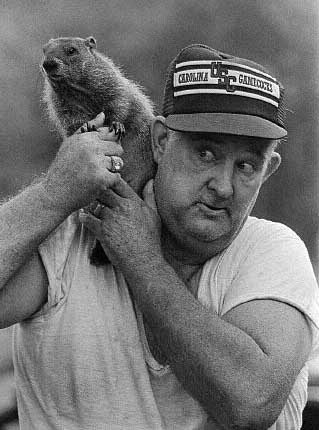
    A mid-winter woodchuck is basically dead to the world. When I say this, I don’t mean “dead” as in the midst of a deep sleep, I mean it as being as close to death as you can get without actually being actually so.  Despite the apparent ease with which Malverne Mel, Stanton Island Chuck, Pardon Me Pete, and Punxsutawney Phil rise out of their stupor to make their Ground Hog Day predictions they can do so only with the heavy assistance of their handlers. I believe that Phil has a heated burrow with a hot tub and tiki bar at his pad.  He is not one of the common ‘chucks, but instead one that is forced to deny his very woodchuckiness.  It is rumored that he even chucks wood – an activity totally against the species grain.

 Most wild woodchucks, this time of year, are curled up into a tight ball and engrossed in a self induced state of denial. Deep within their burrows they are hibernating and completely removed from the realities of the harsh world above (see here a picture of a hibernating woodchuck- click on the 6th picture down).  You could dig ‘em up and put them in front of the television cameras and they would say exactly nothing.  It’s not an antisocial thing, rather a physiological thing.

  There is a very select group of mammals that have the ability to hibernate.  Animals such as the Woodchuck, Thirteen-lined Ground Squirrel, Jumping Mice and all of our regional bat species choose this strategy.  Others such as Opossums, Raccoons, and Skunks retreat to their dens to sleep off bouts of severe weather, but they need to come back out to re-fuel throughout the winter. They sleep but don’t hibernate. Even Black Bears don’t truly hibernate – they go into a deep sleep. Winter bears can be roused relatively easily, so it’s a wonder why folks don’t go about waking them up on Groundhog Day to ask them for predictions. The answer to that question should be fairly obvious (an angry bear will not tolerate men in top hats and crowds of reporters with flashing cameras).

  The answer to the question asking why true hibernators do what they do is not so obvious. The impending seasonal lack of available greens certainly forces the decision out of the woodchuck, but this is not the entire answer. The cottontail rabbit, a mammal of similar size and food needs, chooses to scrape through the winter as an active creature.  For now let’s just gloss over the thing and simply say that the ‘chuck and his fellow members of the “Hiber Nation” do what they do because they can.

  Hibernation is controlled by body chemicals.  A substance, unimaginatively called H.I.T., or Hibernation Inducement Trigger, is produced at the request of a structure in the brain called the hypothalamus. This control center, located mid brain under the thalamus, east of Eden, and just ahead of the hippocampus, is prompted into action by the shortening days of autumn. Once this chemical is circulating in the bloodstream, all kinds of things begin to happen. Woodchucks become Ground Hogs, for instance. They begin to eat like, well, hogs and put on a rich layer of fat – including a special patch of fat called brown fat between the shoulder blades.

  Next, the corpulent creature vows abstention from further eating, makes one last visit to the bathroom, crawls down in his den and curls up.  The transformation into hibernation mode is gradual but dramatic. Blood composition changes, hormonal balances are re-figured, insulin levels are increased, and vessels dialate (constrict) in order to maintain blood pressure. Breath rate, heartbeat, and body temperature all take a plunge.  This isn’t napping!

  A woodchuck in full hibernation is cold to the touch and appears to be stone dead. From an active body temperature around 95 degrees F the critter has descended to around 46 degrees F. The heart only beats about 5 times a minute (as opposed to an average of 100 beats per minute) and the breath rate is reduced from 30-100 per minute to once every 5 minutes. Only the heart and brain are kept relatively warm and they are fed by the reserves of body fat.

  Researchers have conducted all kinds of experiments, some down right evil, in their attempts to understand the mysteries of hibernation, but two stick out in my mind. In one, a hibernating chuck was sealed up in an airtight jar filled only with Carbon Dioxide gas for one hour.  This treatment would have killed a summer chuck within minutes, but had no ill effect on the slow respiring winter chuck.  In another experiment, blue dye was injected into the leg vein of a hibernating ground hog. The dye didn’t circulate to the rest of the body until springtime when the critter woke up. That same experiment on an active animal resulted in the dye reaching all parts of the body within a few minutes -even tinting the eyeballs blue.

  Only warming ground/ air conditions or the internal ringing of a pre-set biological clock will awaken our sleeping beauty (while not exactly beautiful, chucks are kinda cute).  Quick metabolism of the brown fat is involved in this, but we’ll talk about the awakening procedure some other time. For now I’d like to let sleeping chucks lie about the weather.

So, What Did the Groundhog Say?

Yesterday was February 2. What significance that day had for you depended primarily upon your culture or lack of it. Be you a witch, pagan, wood sprite, hill folk, city folk, catholic folk, fossorial mammal or a combination of the above (although you can’t be a pagan catholic you could be a hill witch), your explanations will vary.  Billy, Phil, Wiarton, Shubenacadie, and Dave disagree even though they are closely related. One thing that is fairly certain is that Groundhogs had very little to do with it.

  For many of us yesterday was Groundhog Day. This meant that the name of Punxsutawney Phil was invoked and images of the sleepy forecaster were plastered across the news media. Phil saw his shadow, they say, and his top hat wearing translators have forwarded his declaration that six more weeks of winter lay ahead. 

  There are dissenters in the species rank, however. No fewer than 17 “official” ground hog forecasters have cropped up over the years and their predictions are rocking the very foundation of Ground Hog Day. Dunkirk Dave, of New York saw no shadow and boldly proclaimed the early onset of spring and Shubenacadie Sam (Nova Scotia), Buckeye Chuck (Ohio), and Jimmy the Groundhog (Wisconsin) agree with him.  Only Sir Walter Wally (North Carolina) and West Indies Wilbur (do they even have ground hogs in the islands?) side with Phil for this year’s prediction.

  It’s no wonder that the others are gnashing their rodentine incisors.  Phil – actually a series of creatures since 1887, better called “the Phils” – has (have) been wrong over 60% of the time.  That is worse than guessing, in case you are doing the math.  Phil has been giving the brotherhood a bad name, so the others are trying their paw at this game but are proving to be just as unreliable.  While Gus Wickstrom’s Pig Spleen forecast method has proven only slightly more accurate, the truth is that Ground Hogs shouldn’t be expected to possess any prognostication abilities.

  I suppose we could blame the Germans.  German immigrants settling in western Pennsylvania brought an ancient old world tradition with them and planted it firmly on American soil. Although the original tale centered on a bear, the idea of a creature rising up out of the ground to see – or not see (that is the question) its shadow was central to the story.  “Seinen Schatten Sieht, so kriiecht er wieder auf sechs wochen ins Loch”, so goes the rhyme – if the bear sees his shadow on Feb. 2 he will crawl back into his hole for another six weeks. Over time, hedgehogs and European badgers have been interchanged with the bear.

  We can’t place blame on the early Catholic Church for trying to clean things up, but their efforts have confused the situation a bit.  In the ancient days, the period around Feb. 2 fell exactly half way between the winter solstice and the spring equinox.  This was the time to celebrate the renewal of spring with pagan sacrifices, the invocation of wood spirits, the heavy intake of spirits, and the induction of new witches into the Land of Oz.  The church astutely chose to place a solemn ceremony on that very day and call it Candlemas.  That way everyone could still get together for a big party but put their celebratory efforts toward the forces of good.

  During Candlemas, all the church candles to be used for the year were blessed.  The candles represented Christ and his role as the Light of the World – this melded well with the concept of increasing daylight which brought healing to the land and the soul.  The candle/Christ tradition still holds today but the pagan underbelly is still there. Magical earth powers are sometimes credited to the candles. Blessed candles had the potential to ward away “tempest, thunder, devils, fearful sprites, damaging hail, and frost” according to one old English rhyme.

  It had long been tradition (possibly as early as the 4th century) to use a little phrase during Candlemas which went something like this: “If Candlemas is mild and pure, winter will be long for sure.”  Another rhyme went “If Candlemas day be bright and clear, there’ll be two winters in a year.”  Does this sound familiar?  Does it? Huh” Huh?

  It is likely that this Candlemas phrase was an attempt to replace the earlier pagan ditty which used the image of a sleeping animal rising from the earth and casting a shadow.  Basically it didn’t work. Instead a brown bear became a hedgehog then a badger and finally, in the absence of any of them, an American ground hog. Somehow the deep meaning of the renewal story got trivialized into a movie starring Bill Murray.

  So you see, ground hogs got sucked into this thing and have unjustly suffered in the limelight. They now have to endure the label of groundhog when their proper name is Woodchuck.  Because they spend their winter in a state of suspended animation, they don’t know diddly about winter and are forced to endure handling by strange men.

  Just how “out of it” winter woodchucks really are will be the subject of my next entry. Prepare ye the way for the hibernating ‘chuck, but he ain’t coming out on groundhog day.

Mayflies in February

  Out on the big waters of the Detroit River and Lake Erie life goes on beneath the cover of winter ice. Ice fishermen are well aware of this fact, although their version of the story is very icthyocentric (fish oriented).  To them the meaning of life comes in the form of a 14 inch Perch or a slab-sided Bluegill. Heaven’s gate is a round hole through the ice providing access to an endless procession of filets.  But when the point is forced, experienced fishers will grudgingly admit that there is more than just finned life beneath their feet.

  Truth is, just about every aquatic life form from mudpuppies to crayfish are active during the winter.  I saw a very large bullfrog tadpole cavorting around an open water patch two weeks ago and have heard reliable stories of painted turtles swimming under the ice. Yesterday a friend relayed a story to me that a fellow ice fisherman detected something “that looked just like a stick bug” crawling up out of his hole and out onto the ice. The unexpected guest turned out to be a Water Scorpion – not a scorpion at all but merely a spindly relative of the giant water bug. 

  One winter water critter that all fishermen are familiar with is the ever popular “wiggler.” These creatures are sold as bait, along with leaf worms, wax worms, mousies and the like. Unlike their shelf mates, wigglers are a natural part of the local offshore waters. Wigglers are actually insect nymphs officially known to the non-bait world as Hexagenia or Burrowing Mayflies (see here).

  It’s nice having such easy access to these entomological specimens because it saves you from taking a very cold dive to the lake bottom.  For a buck seventy-five, you can walk into a local bait shop and come out totally dry and in possession of a plastic bait container crammed with 24 mayflies. I discovered that I had 25 in my recently purchased container, but decided not to return the extra one (although I felt guilty for several prolonged minutes).  I released my charges into a larger pan of water for closer examination and would like to share a few observations with you.

  Swimming Mayfly nymphs manage to propel themselves in a manner similar to miniature whales – very clumsy tiny whales.  They rhythmically wave their abdomen up and down in order to move in a haphazardly forward direction. In other words, they wiggle (which is why fishermen call them wigglers rather than tiny clumsy whales). Burrowing mayflies are not built for sustained swimming, but they can be forgiven this aquatic inadequacy because they are built for, you guessed it, burrowing in the bottom muck. This is why they call them…never mind, you already know what I am going to say.

  Take a look at this shot and you can see that an individual nymph is about 2 inches long. I’ve provided a dime for size comparison (Mr. Roosevelt is just under ¾ inches in diameter here).  Those feathery things lining the side of the abdomen are gills.  Three tail filaments trail off the back end and six robust legs can be seen at the front end. A pair of beady black eyes, a like number of antennae, and a set of substantial tusks are evident on the head. All the parts are tinged with a pleasant golden hue that almost makes them look appetizing – at least to a hungry fish.

  It is the full intention of every young burrowing mayfly to become a big mayfly so they need to deliberately avoid predators while fulfilling their personal destiny to get fat. They start off as eggs laid the previous summer by the flying adults. Over the course of the next year, the nymphs (a.k.a. naiads) eat algae and detritus, and shed their skins many times to accommodate their growing size.

  Nymphs operate out of a small semi-circular tunnel in the bottom muck which they excavate with a powerful set of shovel-shaped front legs and stout tusks (features best appreciated from this angle). The passage has two open ends and the animal positions itself midway along its length. Constant gill motion keeps a steady flow of water going through the corridor and tiny particles of food are snagged in the hairy fringe bordering the head and legs. Every now and then, the nymph brings the fringe up to its mouth to take in the particulate goodness.

  It is mesmerizing to watch the waving motion of the gills as they pulse in sequential waves from front to back. The gills are operated in pairs. Their tips are brought together over the abdomen and smoothly returned to their side position.  A glance at these two images – first this one then this one – will give you an idea of what I’m talking about.

  My 25th mayfly didn’t last very long.  It died soon after I poured it and its container mates out into the water tray. My consumer guilt now completely gone, I thought about returning it to the bait store for a refund, but opted not to. Instead, I quickly returned the others to their container and placed them back in the fridge. It is crucial to maintain the chilled conditions of winter water because cold water retains more oxygen which is easier to retrieve by gilled critters.

  There are many features of Burrowing mayfly life that are noteworthy but only so much patience on your part to hear them. So, let’s boil this down to a few summary remarks. Ecologically, it’s important to note that Hexagenia are one of the most important sources of fish food in the entire lake system. They are eaten as nymphs and adults. When they emerge as winged flyers in June or July (not May) they will temporarily take over the near shore world and everyone will know them as those “blanky blank fish flies.”  Mayflies live for that brief 48 hour period when they can break the bonds of the water world.  Until that time they bide their time in relative obscurity beneath the winter ice – known only to fishermen and the fish they seek.