Kestrel of Many Colors

  An un-announced guest dropped by Jeff Read’s Gibraltar house the other day. The well dressed visitor stopped in for lunch and while delivering a poorly aimed stab at his food, was propelled into the porch window with near fatal force. Fortunately, he survived his experience -and in spite of it -will likely return to sample the fare.

  The house crasher was an American Kestrel bent on nabbing a sparrow. His intended prey veered off just shy of the window and left the pursuer little time for course correction.  The predator and the pane were introduced to each other in short order. This could have been the high impact end of a wonderful career. Many other bird eating raptors, such as the larger Cooper’s and Sharp-shinned Hawks, suffer this fate while pursuing their trade in the close vicinity of houses. This ill fated hunter struck with a glancing blow that knocked him for a loop but apparently didn’t break anything.  After a few minutes of counting stars he shook off the cobwebs and flew off.

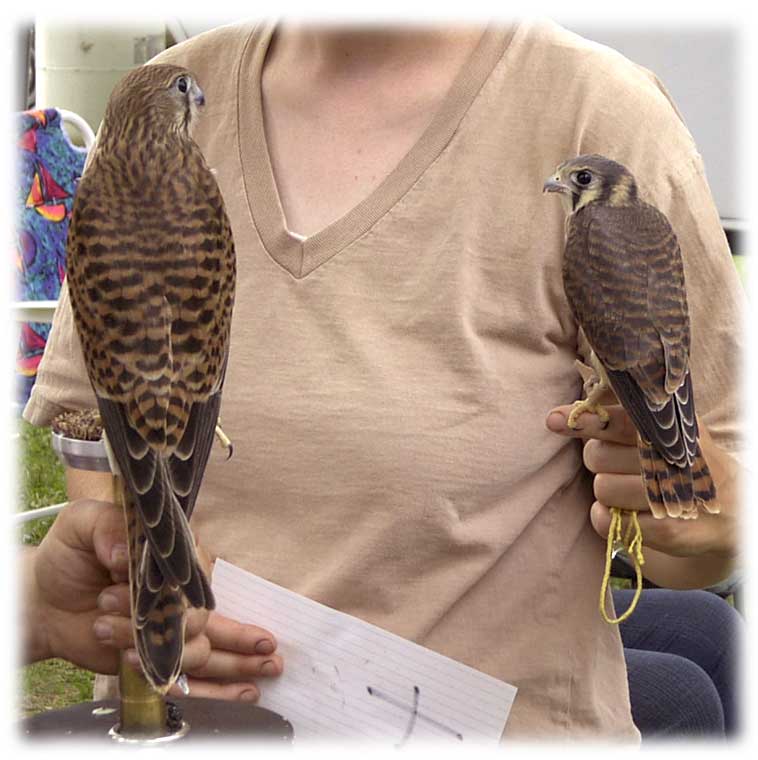
  Mr. Read took full advantage of the opportunity to click off a few splendid images of this splendid visitor (You know what they say about opportunity knocking!) I would like to share them with you. His detailed shots capture the incredible beauty of the bird in crisp detail (here, take a look).

  The dazed bird in question is properly known as a Kestrel, but they are often referred to as Sparrow Hawks. Considering that the species is not a hawk or a sparrow specialist, this latter name can lead to some confusion. These robin-sized raptors are card carrying members of the Falcon family – a group typified by sickle shaped wings and side burns.  Kestrels are, in fact, the smallest falcon in North America so their prey selection is limited to the likes of grasshoppers, mice and an occasional sparrow (when they can catch ‘em, that is). Besides, the name Sparrowhawk is already taken by a European bird that eats sparrows and is a true hawk (see one here).

  To be completely official, we need to call this one an American Kestrel because there is another European bird also called a Kestrel.  Take a look at this photo and you can compare the much larger Kestrel on the left with an American Kestrel on the right. All of this muddling of names happened because many of our birds were originally named by homesick Europeans. If one of our North American critters kinda looked like one of the neighborhood residents from across the pond, then it was dubbed with the old name.

  One thing that probably everyone in the world agrees to is that the American Kestrel is the prettiest falcon in the world (although I’m sure the French would disagree). The male bird is the boldest of the bunch. The distinctive male features on this pictured bird are the wonderful pastel blue shoulders and crown, speckled peach breast and solid brick red tail. Females lack the blue coloration and have a heavily barred tail. 

  Both sexes have paired black sideburns (called malar stripes by those folks looking to come up with specific terms where none are needed) and prominent spots on the back of their head (called ocelli by those same folks). Take a look at this view and you can get some sense that those spots take on the appearance of a pair of eyes on a fake face – a trait accentuated by a pointed  black “beak” coming down off the top of the head. Why, you might ask, would a bird need a fake face? Kestrels are frequently attacked by larger birds of prey, and they are able to keep these potential predators off guard by tricking them into thinking that they are being watched even when the potential prey is looking away. This, of course, works only some of the time.

  If you look carefully at both photos of this little dandy, you’ll note some dried blood on the beak and on the right foot (the other foot is pulled up out of view). This is sparrow blood spilt from an earlier kill. There is likely to be a spattering of fresher blood by days end.

Sleeping Beauty

  Perhaps the last thing you’d expect to come across on a sloppy gray January day is a sleeping god.  Gods are omnipotent, so you’d think it would be a nearly impossible task to sneak up on one –at the very least these deity types should have guard godlets or twelve-headed mythical doglike things to warn them of approaching visitors, right?  I guess not.

  Well, I just walked up to the ancient king of Athens today and peered right into his secret chamber without being smit (or is it smote, or smotted?).  I was smitten, however. Cecropia’s winter lair turned out to be a silken cocoon and like all royal homes, this one was certainly worth a second look

   The earthly personification of the ancient ruler was a Cecropia Moth – a species of moth named after the mythical figure. Why this impressive insect is named after a half man/ half snake fish is beyond me, but it is a member of a group known as the giant silk moths.  All the members of this robust family are named after Greek and Roman gods, so it’s a clan thing.  Even the family name itself, Saturnidae, is in honor of the child-eating god Saturn.  It happened to be Saturn’s day when I discovered the cocoon – coincidence? Maybe.

   The tough woven cocoon was adhered to a leafless silver maple branch. It was within easy mortal’s reach so I pulled it down for closer examination. The impressive larvae of this species make their over-wintering home in late summer/early fall and then pupate within a protective casing of their own making. (Here’s a picture of the caterpillar as it is about to sip from a caffeine free Pepsi can).  After a long winter’s rest, the adults emerge early the following summer.  Sporting a wingspan of 6 inches, these beautiful beasts are the largest moths in North America (look here and you’ll see what I mean).

  For the time being, this potential summer beauty was hidden within a silk purse. I thought you’d like to get a glimpse of the resting king, so I broke off the branch and carried it home in order to peek inside.  I made a careful incision through the papery tough outer layer to reveal an inner chamber of steel wool consistency. Both cocoon layers were woven by the caterpillar to create a weather and predator proof package. 

  A final cut into the inner sanctum exposed the pupae (look here) hidden deep within this multilayered sleeping bag. A wadded dry skin – the last shed of the caterpillar – lays crumpled off to one side.  I gingerly removed the pupae and took several shots of it before quickly returning it to its original location. Close scrutiny of this marvelous entity (see here) provides an image more akin to a pharaoh’s casket than to a Grecian urn.

  The dark leathery skin is sculpted with all the features the insect will exhibit as an adult. From the front (see here) the folded wings are evident. Two ear-like antennae curve down from the head and give the pupae a peculiar rabbitish look. A side view (see here) clearly shows the prominent segments of the abdomen and the breathing holes called spiracles that will provide the future moth with life giving air. Inside this casing, the caterpillar has already made the miraculous transformation from land based slug to aerial acrobat, but it needs to wait until the world is ready for its summer revelation.

  I carefully sutured the cocoon back together (see here) so that the creature can emerge in natural style when the time is right.  I’ll keep it in my un-heated back porch to insure that it doesn’t dry out and protect it from the legions that would delight in the destruction of Cecropius Rex. Rest easy my noble sir.

Swan Song

   I will be the first to admit that putting the title of “Swan Song” on a piece about swans is a corny thing to do, but there was no other choice.  I wanted to talk about swan songs – specifically Tundra Swan songs- so what else could I do?  It probably would have been more insightful and clever to label this as “Call of the North,” “Tundra Tunes,” or “Winter Windpipes,” but then again it really doesn’t matter what I call it. “Pygmalion” was the original title of “My Fair Lady” and that didn’t affect the stage or theatre success of the musical, did it?  O.K. then, I’m here to talk about “Cygnus columbianus – the Musical 

  As you might expect, Tundra Swans are visitors from the high north (the north slope of Alaska & the Yukon territories).  They come south every winter to bide their time in the relative comfort of our southern cold season. Most of the migrating population flies to the east coast and Chesapeake Bay, but a significant number do their time here in the western end of Lake Erie at the mouth of the Detroit River.

Tundra Swans are large white birds – no surprise there (take a look at this pair of mature birds). The young birds retain their youthful gray head and neck feathers and a pinkish bill (see here in my portrait). Adults weight around 16 pounds and can stretch the tape at over 4 feet long from beak to tail. Their wingspan is over 7 feet, so there is nothing small about these northern visitors. The younger birds are pretty much full size as well. As big as they are, Tundras are still slightly smaller than the non-native Mute Swans.  The adult birds are best distinguished from those obnoxious year-round residents by their solid black beak with a speck of yellow near the eye. Mutes have an orange beak with a tremendous black knob near the face (I will explain why I think these birds are obnoxious at a later time when I discuss “Mute Swan – the Tragedy”).

  The single most distinctive thing about Tundra Swans is their sonorous voice which can carry for miles on a still winter day.  Mutes, in spite of their name, can make a few nasal vocalizations but they can’t hold a candle to their native cousins. The collective effort of a few hundred singing Tundra Swans creates an aural experience for the listener. Like a Himalayan mantra or a Gregorian chant, the vacillating tone envelops you.  When issued through a frosty river fog by ghostly shapes out on the river, the overall effect is just plain mesmerizing.


  It is difficult to describe the call. Some have characterized it as a “cooing” or a “whoohing” or even a “soft ringing bark.” I like that last description even though I have no idea what it means. I prefer to compare the sound to that issued by those winged monkeys in the Wizard of Oz – the movie.


  Ask any opera singer and they’ll tell you that a good voice is all in the pipes and the lungs (actually they will tell you to go away first, but in my musical they manage to snort out an answer). Let me tell you, Tundra Swans have great pipes. Their trachea (windpipe) is over 3 feet long.  Because their neck is less than 2 feet long, the windpipe tube needs to extend down below the breastbone, loop up into it, coil around inside it, come back out, and loop back over to enter the lungs. Take a look at my drawing of a tundra swan breastbone (sternum) to see how the trachea loops around inside the keel (the lower pipe end doubles back and extends up the throat while the top pipe end continues back over the sternum to the lungs). The similarity of this arrangement to the convolutions of a trumpet or trombone is no coincidence.


  I’d like you to look at another view of a swan’s breastbone. Both this example, and the one I sketched, came from two birds that literally sang their swan songs last winter. Both were found dead from starvation.  Fortunately, by examining their remains we can appreciate the living birds even more. This is an end-on view of the leading edge of a swan sternum.  Note the large cavity inside the keel where the wind pipe went.  Also note that this view looks like a laughing gargoyle (weird, eh?).


  While our opera diva creates her glass shattering effects by manipulating her voice box (larynx), the swan does it with a similar organ called a syrinx.  Unlike our voice box, the swan’s tone adjuster is deep within its chest at the point where the windpipe divides into two short bronchial tubes at the lungs. The human larynx creates an Adam’s apple throat lump, but swans can’t afford to have such a thing, so they locate it at the far end of the tube for aerodynamic reasons.


  The result of all this Tundra Swan tubing is a great symphonic sound. I can recommend that you make the trip to the Detroit River shore at Lake Erie Metropark to witness this firsthand.  You’ll need to do it before March because that’s when the fat lady sings and the orchestra moves north.

Bug in a Cat-tail Rug

  The winter edition of the cat-tail moth is a bug wrapped in a cat-tail rug.  The tiny larvae of this aptly named moth – also known as the Shy Cosmet – pass the cold season within the fluffy seed heads of cat-tails.  They are in the enviable position of never having to leave the security of their comforter on a frosty winter morn like us warm-blooded types.

  Finding one of these caterpillars is a difficult thing – but finding a bunch of them is easy.  All you need to do is locate a puffed out cat-tail head. In normal circumstances, a cat-tail seeks to attain nudity by the time spring comes along. It hopes to surrender its cottony seed blanket to the four winds and remain as a bare spike. Any creature seeking long-term shelter in this temporary refuge has to take steps to insure that its cover won’t be blown. Cat-tail Moth caterpillars, therefore, weave a silken net around the entire cat-tail head before entering the winter season.  When the seeds start to peel away they are held within the confines of the silk bag. A poofy cat-tail with a hair-net is the result. Here you will find caterpillars – lots of them.

  I took this cat-tail inside in order to perform a larvaectomy. Since the caterpillars eat the micro sized seeds where they attach to the central spike, the cottony down was free to peel away like a sheet of sheep wool. There were no insects immediately apparent – it’s not like cockroaches dashing for cover when the light is turned on. No, you need to wait a second or two before you begin to see one sticking its head out from the fluff.  Pretty soon another shows itself and before you know it you have a small confused herd on your hands. There were ten individuals in this single head.

  The caterpillars came in different sizes, depending on their stage of growth, but none exceeded 8 mm in length.  Here’s a detailed view of one of the larger larvae venturing out onto the Martian surface of my fingertip.  The dark head capsule distinguished the forward end and the pale body was pin-striped with brown.  As a caterpillar it was required to motivate itself via 16 stubby legs but it moved at a good clip. You’d expect it to be somewhat sluggish but such was not the case.  It was actually difficult to get a stop action shot of the little beast.

  I attempted to gather in the whole team of ‘pillars for a group shot, but had to settle for this shot of some of the slower ones.  I suppose their agitation was driven by the need to seek shelter.  They have absolutely no defense from predators other than their security blanket. Exposure is not an option.  Even under cover they are in constant danger. Chickadees, those little black and gray dynamos of the bird world, actively seek them out with their probing little beaks.

  Assuming that another curious naturalist or bird doesn’t come along to disrupt the natural order of things, these caterpillars should pupate and emerge by mid summer.  The adult Cosmet is nothing to brag about, but as a proud member of the micro-lepidopteron clan they hold their own with a 22 mm. wingspan of fringed cappuccino colored wings adorned with a few eye spots.

 I re-introduced my little friends to another undisturbed cat-tail head. I felt slightly guilty about destroying their home for the sake of science, but also did it as a meaningless gesture to bring in the New Year. Unfortunately, the chickadee that was watching me the whole time probably saw it as an act of feeding. From Cat-tail to Cosmo to Chickadee – the cycle of life continues into the year 2008.

Hanging Hedghog Bladders

  In the dry winter world of plants, the Spiny Cucumber fruit is a stand out. During the summer, this climbing vine blends in with the greenery and pretty much goes undetected. When the cold season strips all the foliage from the landscape the prickly globes of this plant steadfastly remain in suspended view. 

  As you might expect, the Spiny Cucumber- a.k.a. wild or mock cucumber – is a vine producing member of the cucumber family, but unlike their edible cousins are not people palatable. The late summer plant bears star-like leaves and fruit which resemble unshaved runt cucumbers. Their impressive array of stout spines gives them a distinctly unfriendly look, however.  Each oval fruit eventually produces four large seeds that fall earthward when the husk dries out.

 The dried “husks” that hang from the winter vine consist of a papery outer coating (the spine bearing part) encasing an intricate mesh pouch. This inner pouch is divided into two chambers.  Once the fleshy parts are gone, only the tough open weave of supporting veins remain.  Luffas, those odd looking face cleaning sponges sold in health and beauty departments, are larger denser versions of this dried out wild cucumber fruit (in other words, a similar structure on a related plant).

  The scientific name of this plant is Echinocystis lobata. In Greek, the technical name means Lobed Hedgehog Bladder, which pretty much says it all, doesn’t it.  One of the reasons that scientific names are so important is that they cut across all language barriers. For instance, our hedgehog plants are currently rampaging over the Polish & Serbian landscape as an invasive species. Their name has therefore been plastered throughout the European botanical literature, but they are rarely referred to as spiny cucumbers. The scientific name is used instead.  So, when you read “Zhrnuli sa poznatky o historickom a sú?asnom rozšírení invázneho druhu Echinocystis lobata na území Slovenska,” in one of the Polish technical journals you can clearly pick out the name of this plant. You may not know what they are saying about it, but at least you know they are referring to it.

  For all I know this particular article might be recommending the use of this plant as a face cleaning sponge. I would think the first order of business for any Polish entrepreneur looking to sell this product would be to immediately change the name from Hedgehog Bladder to something gentler like “Cucumber of Love”.

  I do know that one of the English language botany journals did have an article referring to the thigmotropic character of spiny cucumbers. When growing, the vine tendrils respond to touch and wrap around whatever surface they are in contact with. This slow motion climbing action is called a thigmotropic response. The tightly coiled tendrils, resulting from this response, remain long after the plant they were wrapping around has died.

  At this point I realize that I have cluttered you with some relatively useless information about a relatively simple subject.  That is my job and I take it seriously. As an antidote, I would like to leave you with a blessing. May the “Cucumber of simplicity” descend upon you and clear your mind for the season ahead.

Interview with a Dead ‘Possum

 Finding an opossum dead in the middle of the road is not an unusual thing. Such a sight is an expected part of roadside décor, though less frequent during the winter. ‘Possums den up during severe winter spells but they eventually emerge to forage for food as soon as the weather breaks.  It is as if they are called by destiny to carry on their legendary one sided battles with our automobiles.  In possum society it is apparently not enough to just play dead.

  I found one of these vanquished road warriors the other day while Christmas shopping. For me, of course, this was a gift from heaven – or at least Purgatory.  The freshly killed specimen was perfect in every aspect and begged to be picked up. Keep in mind that roadkills don’t beckon everyone equally, but I felt compelled to pass this gift on to you. 

  I am well aware that presenting a dead possum as a wrapped present may be construed by the receiver as a weaker version of the old horse’s head in your bed “offer you can’t refuse” kind of thing.  You can refuse my offer to take a closer look at this critter, but I implore you to indulge me.  It’s not every day that you get a chance to interview North America’s only marsupial.

  By interview, of course, I mean a forensic examination to draw out some telling details.  Perhaps the two most talkative details on any opossum are found by looking at the tail and ears. This individual bore the distinctive marks of an animal ill-suited to northern climes. Most Michigan possums have frost-bitten ears and/or tails.  The delicate exposed tissues on these features are subject to freezing. This unfortunate critter had a severely frost damaged tail where the end tail vertebrae bone was actually exposed and the tender terminal flesh was discolored.   Since the wound was healed over, it was not a result of the accident that sent it to the great garbage can in heaven.

  Opossums are southern creatures that have expanded their range northward over recent time. They do not appear locally in the prehistoric archaeological record. Antoine de la Mothe Cadillac, the founder of Detroit in 1701, made first mention of the creature as a resident of S.E. Michigan during his brief tenure here, although the first actual Monroe county record was made in 1850. By the early 1900’s, possums were popping up throughout Lower Michigan.  They even ventured into the ‘da U.P. by the 1950’s, eh! The problem is that they have yet to cover their tails and ears with fur and often pay the price.

  Oddly enough, this particular roadkill had perfect ears showing no signs of frostbite what-so-ever. These rodent-like appendages prompted the aforementioned Mr. Cadillac to write about “large wood rats which are as large as rabbits; most of them are grey but there are some seen which are as white as snow.”  His further explanation that the female rat has “a pouch under her belly which opens and shuts as she requires…” makes it clear he was definitely talking ‘possum.   

  As a marsupial, opossum females are equipped with “pouches” with which to carry their “joeys.” Take a look here and you can clearly see the pouch on this female specimen, but you’ll notice that it is not a pouch in the true sense of the word. This pouch opens more like one of those plastic change purses where the opening is in the center. Our female was several months away from mating season, so her pouch folds were not swollen. During the breeding season there would also be 13 nipples in evidence on the pink hairless belly skin, but these are barely visible during the winter.

    I’m glad you’ve stuck with me so far, because there are a few more things I’d like to point out. Take a look here, for instance, and examine the bright pink nose.  Early naturalists used to think that opossum females would mate through their nostrils and then sneeze their young into the pouch. This belief started when those same naturalists looked at the forked nature of the…well, shall we say, the “male organ” and literally put two and two together.  They were wrong, by the way. Opossums do “it” like every other mammal on earth, so you can look at this nose picture without guilt or shame.

  Last and certainly not least, the hind feet of the opossum are simply incredible.  They have thumbs on their back feet that give them the appearance of monkey paws (see here and here).  These clawless foot thumbs point inward and assist them in climbing. Close examination reveals that they are startlingly like our human hands. Draw your eyes closer to inspect the foot pad and you’ll see they possess one more human-like trait – they have unique fingerprint ridges on their thumbs and palms.

   So, it’s O.K. to look a gift ‘possum in the mouth and everywhere else because dead ‘possums do tell tales.

Hark! The Herald Spider Clings

  I recently encountered an unseasonal sight in the form of a dangling spider.  The tiny beast was swaying gently in the wind while suspended from an invisible silken thread.  It appeared to be a lifeless body without control of its earthly form – hung by Dame Winter as a testament to her mastery of fragile life forms.  After all, the temperatures have held below the freezing mark this month and only the hardy survive.  In sympathy, I swept my hand through the space above it in order to sever the thread that held it up for display and allow it to tumble to earth.  

  To my surprise, the form that fell onto the snow below was not a lifeless one. The spider was alive. It slowly uncurled and began to walk across the snow drift. This being Christmas week, I declared “Hark” and bent down to examine it. The slender arachnid was a Long-jawed Orb Weaver. These narrow spiders are common summer residents who spin their radiating webs in wetland habitats.  

  Long-jaws overwinter as inactive juveniles that stay tucked away under the cover of bark.  Winter birds eat these things, so the juveniles must stay well hidden if they want to see adulthood.  It is very likely that this spider survived a feathered assault by bungee jumping to silken safety. Had I not helpfully cut its line (sorry), it would have quickly returned to its hiding location via its safety rope.  

  As it was, the disgusted little orb-weaver was forced to walk across an icy layer of snow in order to regain its home tree. This freezing feat of feets is nothing short of a miracle (although I’m pretty sure the spider did not view the situation in this light). Spiders are hydraulic beasts that operate on internal fluids. Those fluids are mostly composed of water which means they should freeze solid in these conditions.  The reason they don’t is due to the animal’s ability to reduce its so-called supercooling points through a process known as thermal hysteresis. This is not to be confused with thermal hysteria, which is the human trait of getting all hot and bothered.  At the risk of oversimplifying things, let’s just say that hysteresis involves pumping the body full of additives such as glycerol that alter the freezing level of body liquids. 

  It takes a few weeks for a spider to get to this level, but once imbued with anti-freeze protection they can laugh off the worst of winter’s remaining rage. My spider was not laughing by the time he reached the base of the tree. 

  There is another reason why I chose to profile a lowly Prestone spider on this Christmas Day.  Spiders do play a role in traditional Christmas legend. They are credited with the invention of tinsel, for instance. According to an old German tale the silken webbing laid upon a tree by a bunch of curious spiders was turned into silver garlands by the touch of the Christ child (or Santa Claus – the details are fuzzy).   According to another legend, a spider was credited with saving the Savior himself. When the Holy family fled to Egypt during the reign of King Herod they sought the shelter of a cave in order to elude the king’s soldiers. As the family slept within, a spider wove her web over the entrance as an act of kindness. When the soldiers approached the cave they elected not to search it because the web indicated that no one had entered it recently.  They moved on and the Christ child survived.   

  Apparently this ancient spider was carrying on a family tradition.  The same act had been performed while protecting the great Japanese warrior Yoritomo, the prophet Mohammed, and David – the future king of Israel.  Spiders, such as my long-jawed friend, are apparently content with small acts of kindness. Their Christmas message to us is one of “Peace on earth and good will toward men.”

A Bittersweet Concern

  Contrasted against the backdrop of leafless gray shrubbery and framed by an equally gray winter sky, the brilliant oranges and reds of the bittersweet are almost electric in intensity. Their artistic spacing and informally draped arrangement demands attention. Close scrutiny only enhances the experience. The individual fruits of this woody vine are fine examples of natural design – three parted scarlet berries surrounded by yellow-orange stars. The fleshy red portion is called an “aril” and each chamber holds one or two brown seeds. It’s the packaging and not the contents that matter in this case, however. There’s nothing better to fill the photographer’s frame or the flower arranger’s vase. This is a good thing 

 To an overwintering bird, this fruit laden vine is a welcome sight.  The arils are eagerly consumed by the likes of chickadees and blue jays and the remaining seeds are subsequently pooped out.  This is how Bittersweets get around.  Unfortunately, this is a bad thing because of the particular bittersweet in question. This is an example of a bad bittersweet. 

  There is a good bittersweet – a native plant called the American Bittersweet.  The bad one pictured here is called the Asiatic Bittersweet and it, as you might have concluded, hails from way out east. It is native to Japan, Korea, and China north of the Yangzi River. Telling the difference between the two can be difficult to near impossible.  The Yankee version has elongate oval leaves and produces berries in a cluster at the end of the vine twigs.  Alien bittersweets have rounded leaves and berries in small clusters along the entire stem. Since the vines are sans leaf this time of year, the only things to go by are the naked fruit facts. The alien plant is supposed to have a yellow outer covering and the native plant an orange covering, but one person’s yellow is somebody elses orange (are school buses plain yellow or orangish yellow). The Asiatic plants are believed to hybridize with the native ones anyway, which blurs trait differences and fudges identity. This too is a bad thing. 

  The best thing to do is to rip the plant out by its roots and clip off the attractive berry producing sections for your dried flower arrangement.  After all, the Asiatic plant was brought to this country in the 1860’s – 1870’s as an ornamental. Please make sure you are ripping up the correct plant before doing so.  The American Bittersweet is relatively rare nowadays and destroying the native plant would be a bad thing.   Asiatic bittersweets are listed as noxious invasive weeds because they are diluting the native bittersweet and they tend to grow in dense smothering clusters. They will not take over the world but should be herded back into captivity.   

  Now that I have burdened you with these bittersweet concerns, I might as well tell you a few more bad things about all bittersweets.  First of all, they really aren’t supposed to be called bittersweets at all. They are officially known as staff vines. The bittersweet title rightly belongs to a wild member of the tomato family commonly called bittersweet nightshades.  Our brightly fruited vines were supposedly given the copycat title because their berries looked like those of the nightshade, but they really don’t.  Confused? Well, it appears that a lot of folks are confused by this plant. This person, for instance, was confused when she named her ceramic creation “bittersweet” (see here).  

  There is one thing that needs to be made perfectly clear.  The Bittersweet fruit is deadly poisonous for humans.  This is a good thing to know.  By dictionary definition, something bittersweet has elements of both happiness and sadness. Maybe the false name is appropriate after all. 

Crusty Bunny Toes

“The fact that rabbits gots toes ain’t a foreign concept to no one.  Why, them lucky rabbit feet dangling from my rearview are simultaneous proof that that theys got toes and that bunnies ain’t especially lucky.”

 -Anonymous Philosopher


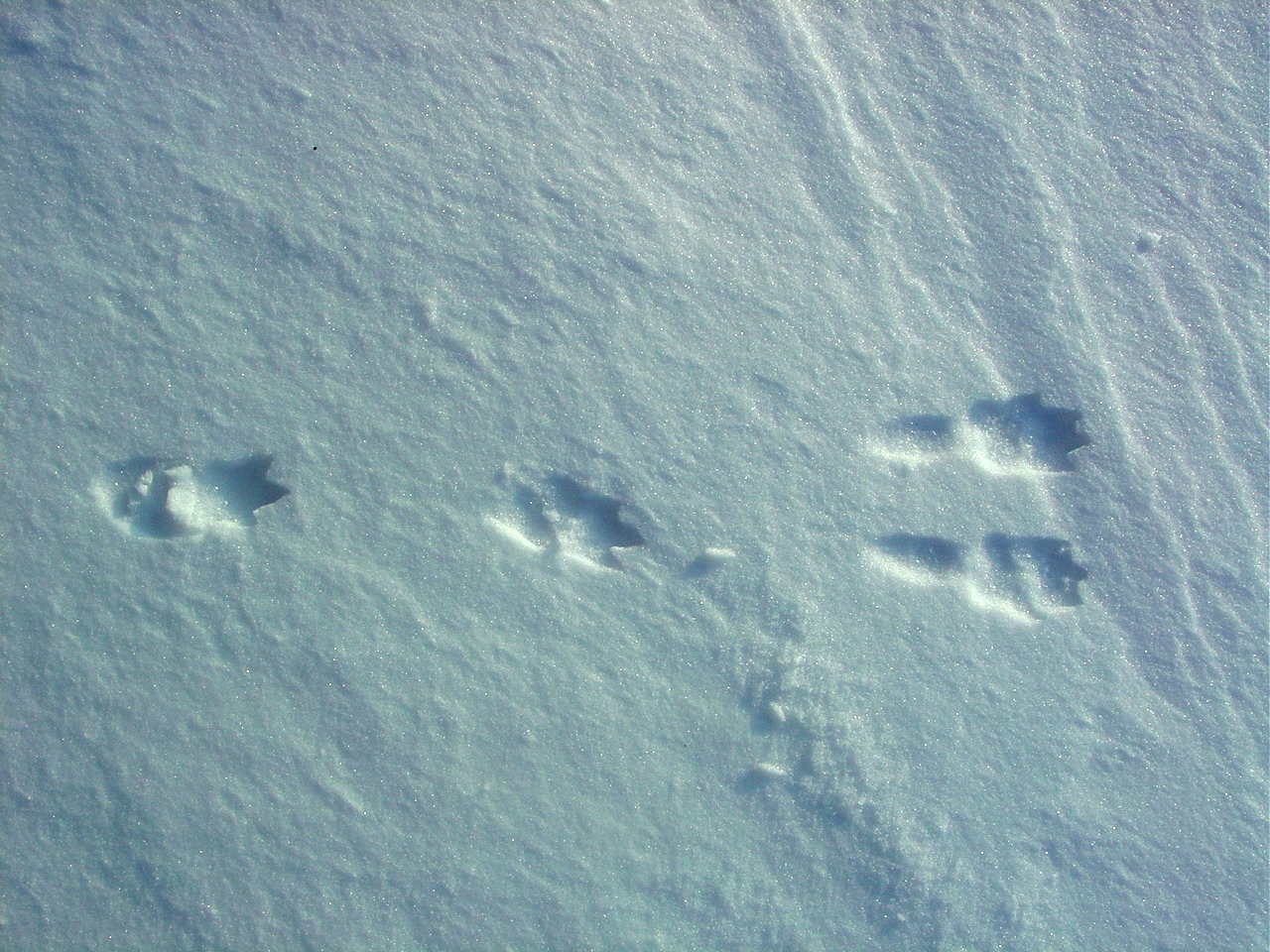
  I don’t really need to add anything to this learned statement “regard’n the likes of bunny toes,” but I feel compelled to enhance it.  As “part two” of my informal series of snow track discussions, I’d like to show you some especially good rabbit tracks.  These crisp prints were laid down on the hard surface of a windblown drift and they provide some insight into the nature of attached rabbit feet.

  As in the case of many winter mammal tracks, the hind foot impressions precede the front foot marks on a typical rabbit track set. A running rabbit does a leap frog maneuver in which the feet cross over and the hind foot ends up striking the ground ahead of the tiny front feet. Take a look at this print set and you’ll see what I mean.  The hind foot on a Cottontail Rabbit is about 3 ½ inches long and when the heel mark registers the larger nature of the back foot is obvious. The front foot is only about 1 inch long.  In this case, the bounding bunny is headed to the right of the photo and the two front foot tracks are trailing behind.

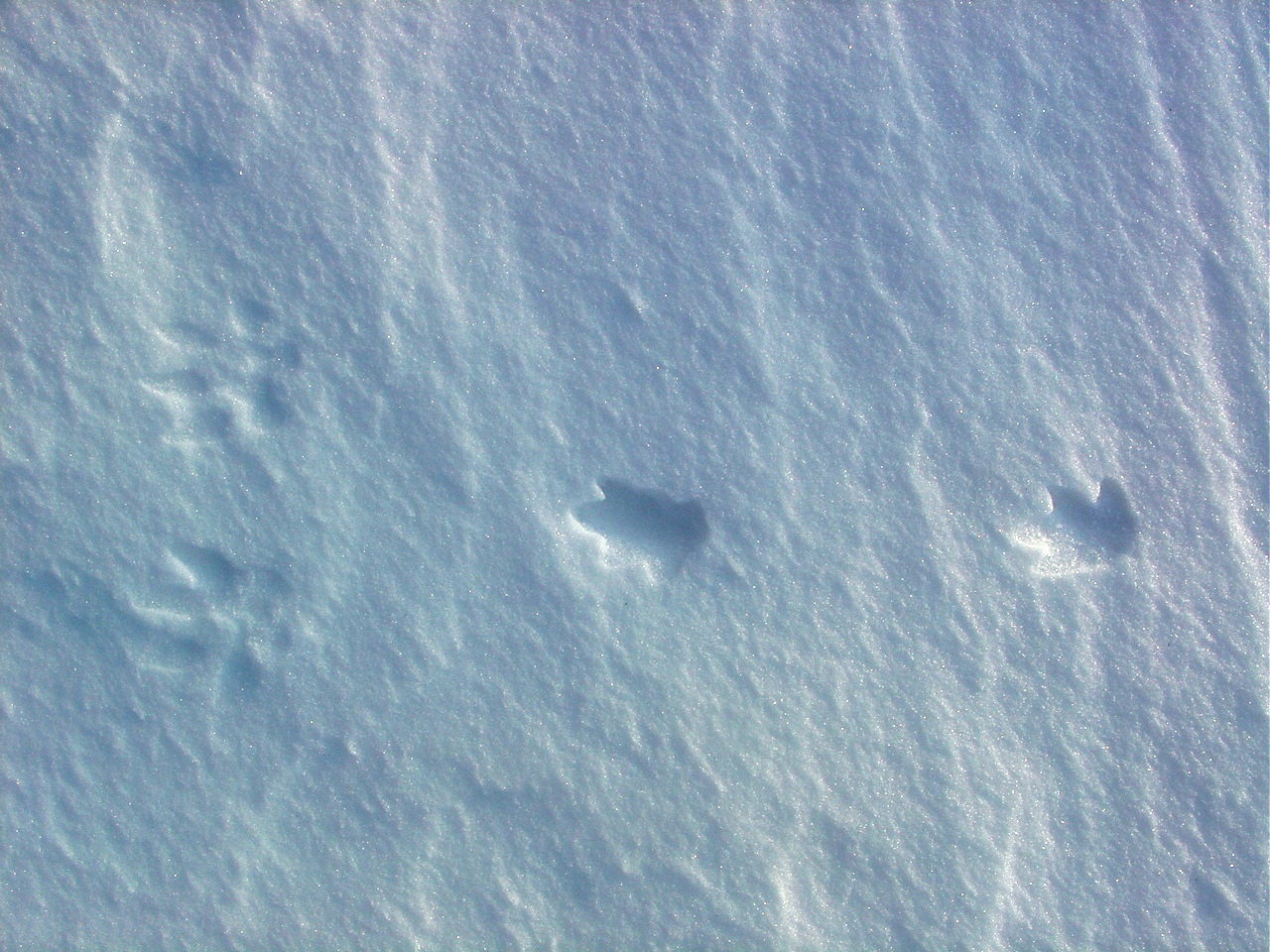
  Since rabbits have fully furred heel pads and they generally keep their toes together, their prints usually appear as indistinct oblong smears in the soft snow. In actuality, cottontails have four toes on their hind foot and five on their front, but this rarely shows in the track. On the hard pack snow tracks, the toes were forced to spread out a bit.  This track clearly shows the hind foot toe count and you can see at least four digits on the front feet (the outer toe is held tight and doesn’t show).

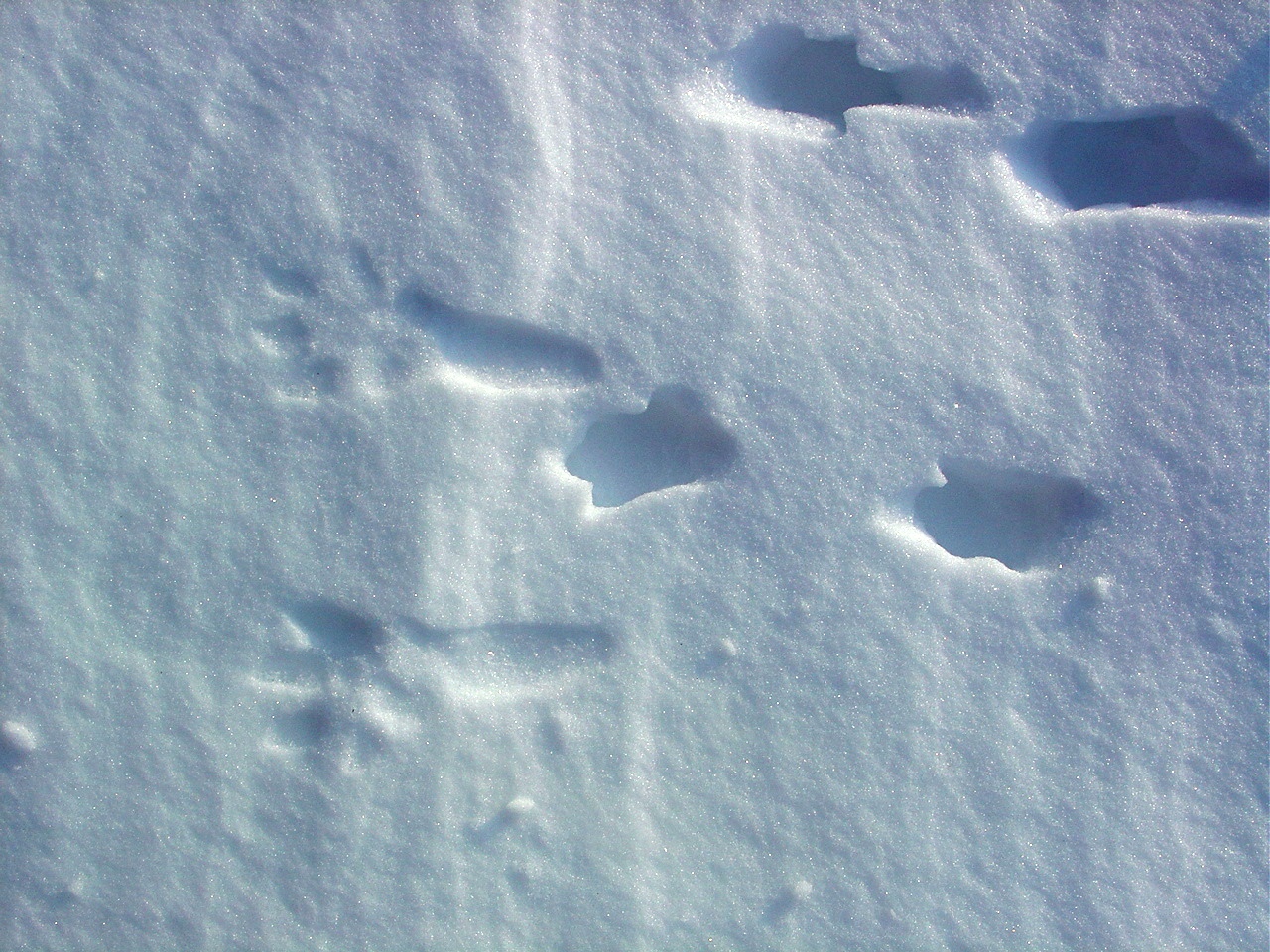
  While the snowshoe hare, the cottontail’s northern cousin, takes the cake in the big foot category our southern cousin is no slouch when it comes to snowshoeing. Take a look at this track and you’ll see just how far the hind foot can spread (the heel didn’t even register).  By distributing the weight over a larger area, the toes supported the weight of the rabbit on top of the snow.  The tinier front feet punched through the crust a bit.

  All of these tracks were covering an exposed area between a Christmas tree plantation and a woodlot. There was a good 3-6 foot space between each set of prints to indicate that the leaping makers were in no mood to linger.  Crossing an open snowfield on a moonlit night can be a very dangerous task for a prey animal like the Cottontail.  There are a whole host of predators raining death down from the sky and from the shadowy sidelines, so the rabbits make haste when traversing open spaces.  This track shows a moment of directional change in which a bunny decided to make a quick turn to his left – the critter slipped for a moment before bounding off. We can only imagine that he was reacting to some perceived – or very real- danger.

  Over 75% of the wild rabbits die before they reach their first birthday and most of these hop onto the heavenly bunny trail before they are even 5 months old.  So, you see, the truly lucky rabbit feet are possessed by those fortunate few that remain alive.


An Alien Presence

  I want to show you something shocking – something that may shake your Christmas beliefs to the very core. Grab tight to your eggnog and prepare yourself for a breathtaking glimpse of an alien life form which masquerades as a common holiday houseplant.  That red and green thing you call a Poinsettia flower is actually an earthly deception.  Here, ladies and gentlemen, is the real Poinsettia flower.

  You see, the red petals of the Poinsettia are nothing of the sort. They are simply glorified leaves- called bracts – which serve to frame the collection of bizarre micro flowers within.  To the naked eye, these flowers appear like so many greenish yellow buds.  When viewed on an enlarged scale, however, true Poinsettia flowerets look like something from the world of Dr. Seuss.

  The minute structures are properly called “Cyathia.” The Cyathians are a race of simple flowers which have no petals.  A single female structure- looking for all the world like an anemone perched on a Granny Smith apple – projects from the top of the cup. A single red male stamen occupies the uncomfortable space next to it. The fringed cup, holding the two parts together, has a pair of bright yellow Mick Jagger lips coming out of it and the whole is supported on a narrow pedestal.  I did nothing in my drawing to enhance the appearance of this unique Martian bloom. Say hello to one of the strangest flowers on earth (it just might answer you in return).

  So ugly as to defy description, the flowers of the wild Poinsettia resort to a cheap advertising ploy in order to attract pollinators.  The big yellow lips on the cyathia are actually nectar glands, but the flower itself has no sweet alluring scent. This is where those bright red leaves come into the picture. Red attracts hummingbirds.  The scarlet leaves lure in the tiny birds and direct them to the central flowers for a sugary kiss. Red also attracts human beings, as it turns out, and this is how the plant became a Christmas standard.

  The wild plant grows naturally along the Pacific coast of Mexico and Central America. In its native haunts it lives as a gangly perennial shrub which grows up to 16 feet in height. Around 1828, amateur botanist and U.S. statesman Joel Roberts Poinsett encountered some wild specimens in the Taxco area while stationed there as the first U.S. envoy to Mexico. He sent some cuttings home to his greenhouse in South Carolina and the rest is, as they say, history.

 Within a few short years, the colorful tropical plant was developed into its familiar potted form. Horticulturist William Prescott initially named it Poinsettia pulcherrima in honor of Mr. Poinsett (here is a botanical illustration from 1836 – a mere eight years after the plant was introduced to the U.S.).  The common name Poinsettia stuck even after the scientific name was later changed.

  Being a political year, I should divulge that Joel Poinsett was a democrat who also did his turn as a South Carolina legislator and later served as Secretary of War under Martin Van Buren. His legacy as a politician remains largely ignored, but his memory lives on in the form of a beloved and bizarre Christmas plant.