The Right Fluff

   Like every other American on the home front during World War II, a young Sam Gay wanted to do his part.  “We were told to do things to help the war effort and we did them.  Our family saved fat, rubber and even the little pieces of tin foil packaging on gum sticks.  We’d bring them down to a collection point in town and that was that – we never knew whether they were used or not.”  Among the products Sam collected for his national uncle was milkweed floss. The plants flourished along the weedy edges the family farm near Rockwood and the pods yielded up their fluffy crop in October (see here).  

  Sam, along with thousands of other children, ended up contributing 11 million pounds of the stuff by war’s end.  Answering the call that “two bags save one life,” he was aware that the milkweed floss was needed to fill the life vests needed by servicemen.  This native fluff literally filled the void left when kapok, the preferred stuffing material, became unavailable due to the Japanese activities in the Pacific.  Kapok came from the Dutch West Indies.

  War products researchers hit the labs to find a suitable substitute and milkweed fibers rose to the surface.  Scientists also learned that the insulation quality of the material was superior to goose down.  Ironically, the floss was originally developed by nature to serve as parachute material.  The silky fiber tufts are meant to catch the air and transport their seeds aloft via the four winds. Packed neatly within the pods, the seeds are layered like the scales on a pine cone (see here) and are liberated for their task once the pods split open.

  Another superior stuffing product that came to light during the war was Cattail down.  Sam Gay’s farm bordered the Lake Erie shore and acres of cattails were available, but he was never prompted to collect any of them as a “war effort resource.” Today, not far from his home, cattails heads are currently changing over into their fluffy fall wardrobe. Each cattail head contains over 200,000 tiny seeds which are equipped with parachute fibers similar to those on the milkweed seeds, only in miniature (see here). Autumn winds will strip the heads of their fluffy crop and distribute the seeds over the landscape.    

  Cattail down had been used for centuries by Native Americans to line their moccasins and wrap their baby bottoms and European settlers adopted it for stuffing their dolls and quilts. It was far from a new-fangled product when called to the battlefront, but it had fallen out of use in civilized society. The U.S. Navy used cattail fibers to stuff life belts and aviation jackets – alongside milkweed fluff. The product, called “Swamp down,” was proven to maintain its buoyancy even after 100 hours of submersion.

  For a brief time in the mid 1940’s the fluff was even used commercially to fill cushions and baseballs, but the end of the war ended our national affair with this native material.  In the postwar years, synthetic fibers replaced milkweed, cattail, and the original Kapok as the primary insulation and buoyancy material.  There is at least one modern company out there attempting to commercialize milkweed fibers as a non-allergenic alternative to synthetics and waterfowl down, so the potential of such native plants has not been entirely forsaken.

  Fall is the time to recall, however, how many lives were saved by these two common plants. During a time of great need they were there to serve. “It takes an old guy like me to tell you young guys about these things,” concluded Mr. Gay.  I agree – let’s pass it on.

Le Geai Bleu

  O.K., quick – give me an answer.  What are the two kinds of wild critters that bury acorns in the fall?  Squirrels certainly come to mind quickly as the first response, but the second part of the question might slow you down a bit.  If I say this second critter is blue and according to the Cornell University issues a “bell like tullull call, a melodious whistled teekle, and a variety of chattering, harsh notes and growls,” a chipmunk choking on an acorn is not the correct response. Give up?  The answer is the Blue Jay.

  You will see that there is nary an October tree without a few of them in it and you will hear that presence loudly announced. It is not the blue jay way to be subtle about anything. Their loud calls, aside from the Cornell listed ones, include everything from the typical “Jay, Jay” or “Jeer, Jeer” to a very well executed imitation of the scream of a Red-shouldered Hawk.  One of their calls – the so-called tulull call- reminds me of the sound of a rotary dial on a vintage telephone (you know, the ones that didn’t take pictures).

  To date, scientists don’t know why jays scream like hawks – perhaps it’s their version of a prank call to scare the little birds.  Geesh, maybe they really are dialing a phone!  But scientists do know why they target oak trees.  Blue jays harvest the acorns and save them for spring use. They are known as “scatter hoarders” which is a frightening way to say they save their acorns all over the place rather than put them in one basket. These bold blue birds pry off a few nuts and carry them off to a forest edge or tree line.  There they push them into the ground, but not together.  Each is put into a separate location – thus the caches are scattered over a wide area.

  Jays are finicky when it comes to their acorns.  Not just any old nut will do.  Studies have shown jays prefer small acorns such as those from the Pin Oak and other members of the Black Oak group. Small acorns fit nicely in the bill and black oak acorns don’t germinate until spring. This latter fact is very important when you consider that white oak acorns have a tendency to germinate the second they are put into the ground.  It’s good to know your emergency food will still be in its package when you retrieve it in late winter/early spring. By that time, the tannic acids which render the black oak acorns bitter, will have leached out as well.  Although the squirrels won’t admit it, these jays know a thing or two about nutting.

  Of course, squirrels can’t afford to wait until spring to eat their buried acorn treasures.  This is their main winter diet.  Blue jays can afford to wait because they can, and will, eat anything from seeds to slow mice.  Early spring is when such food sources are in scarce supply, so the acorns are preserved toward that end. Many jays migrate south and skip the toughest part of winter, but not all of them. 

 In keeping with their complicated persona, Blue Jays exhibit some odd migration patterns as a way to further baffle those scientists trying to figure them out.  Some individuals (the jays, not the scientists) remain resident all year long while others chose to fly south.  Certain birds have proven to fly south one year and elect to stay north the next.  Young birds tend to migrate more, but otherwise there really is no clear cut answer to this riddle.  Taxes don’t seem to make any difference.

 So, I offer a few jay tidbits here to give you something to think about upon spotting the next Blue Jay.  There’s obviously much more hidden within that crested little head than meets the eye – although what meets the eye is very pleasing. I believe most people could pick one out from any bird line-up, but I offer this neat old engraving as an illustration of the bird (see here).  The brash behavior and stunning cerulean hues of these loudmouths made them one of the first North American birds to become well known in Europe. The early naturalists included them in their natural histories as early as the 16th century and they were scientifically described by 1758.

  This illustration dates from around 1790. Even though it was drawn from a London museum specimen, the character of the bird stands out.  I have also included the text that accompanied this figure (look here) and will give a few minutes to read it.  You’ll see that the early works are rather slight on information.  I do appreciate the French name for the blue jay, as listed about mid page: “ Le Geai bleu de  d’Amerique Septentrionale.”   Now that’s name befitting this plucky little Napoleon of a bird.


Mantis Kung Fu

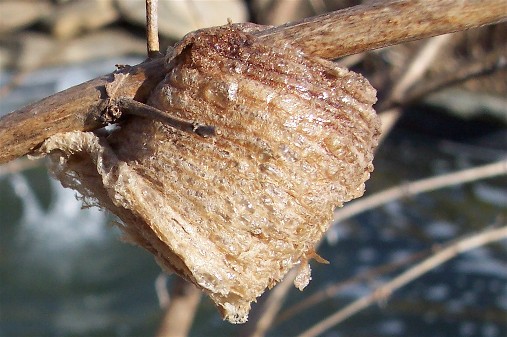
   Although Praying Mantises have been around all summer, we humans don’t usually encounter them until late September or October.  This is both their mating season and their last hurrah on earth.  The females will lure in males with a pungent perfume and, after mating, lay their characteristic “seas foam” egg masses (see here). The eggs will overwinter within their protective casing and this year’s mantids will slowly wither away before the snow flies.

  Most folks are familiar with these distinctive insects but nurture a few falsehoods about them.  Tell them that they are related to cockroaches and you’ll get a decided sneer – believing they must be of nobler stock than that. Mention mantis mating and the perception usually is that the females always kill and eat the males.  In the unnatural setting of a laboratory experiment, this is usually the case, but in nature the two sexes get along pretty well.  In the wild, the female will chew the head off her mate less than 30% of the time. Besides, the female only eats her mate and skips the killing part (the male is too occupied to realize he’s dead and continues on without his noggin as if nothing happened). The scary thing about this whole thing, speaking as a male myself, is that I have had my head chewed off many more times than your average mantis. I also have been accused of not using my head.

  There is little confusion about the name, although some southerners have opted to call them Devil’s Horses for some mysterious reason.  Mantids hold their specialized front grabbing legs in a prayerful pose while hunting.  This meditative pose has earned them the name “Mantes,” which means soothsayer or prophet in the Greek tongue.

  While the Greeks were reflecting on the gentle nature of the beast, a particular Chinese countryman was focusing on their defense skills.  Encounter a mantis on the trail or sidewalk, and he’ll flare his wings and hold his pinching claws outward in order to appear bigger than he really is.  He’ll occasionally flash out with aggressive grabs as well. This tactic is meant to intimidate bird and mammal predators (like us).  Pick him up by the thorax and these praying legs are extended back over the head in an attempt to spear you with those formidable spines (see here).  Some 350 years ago, Wong Long a Chinese martial arts master, observed one of these insects doing battle with and eventually succeeding in defeating a cicada.  He developed a series of Kung Fu moves that are known even today as the Praying Mantis style (take a look at one of the poses here). His footwork was derived from those of a monkey, but the hand work is pure insect.

  Take a close look at a pair of those appendages that inspired Master Long (see here).  They are folded like a pocket knife when not in use.  Note that there is a double row of spines on the “forearm” matched by a double row on the “hand” portion – acting like a backwards lobster claw of sorts. The insect prey is secured within the pincer grip of spine upon spine.  Once immobilized, the predator proceeds to eat the head of the prey (and you thought that was a special thing just reserved for amorous males).

  Praying mantises can fly, although they look ridiculous doing it. Night flight poses a hazard because bats can – and will – feed upon them.  Bats are much better flyers, so you’d think the mantids would just avoid the night air altogether, but they have developed a fascinating bat detection system instead. Most mantids have a single ear (a Cyclops ear as one entomologist puts it) that can detect the ultrasonic emissions of a flying bat.  This ear is located on the lower side of the thorax, or middle part of the body.  When a bat is near, the mantis simply drops out of the sky to the safety of the ground.  Perhaps a few of us could use just such a chest ear – you know when we stop using our heads, for instance.

  All insects are very fastidious about personal hygiene and this soothsaying member of the gang is no exception.  To finish off our visit with the mantis, take a look at these two pictures (here and here) of one individual thoroughly engaged in pedicure.  First the killer legs are picked clean and then the other four feet (regular type insect feet) are attended to.  I’d challenge anyone out there to try this last pose at home – it resembles another Asian tradition called Yoga.

The Sweet Smell of Love

     One of the life’s small ironies is contained within the form of a medium sized ant called the Yellow Ant.  These critters are better known as Citronella Ants because they emit a very strong sweet odor which smells like, you guessed it, citronella.  I think that ironic because citronella oil has been a major insect repellent agent for many decades.  The actual chemical scent emitting from the ants is different from the scented oil that we use in our backyard mosquito repellent candles (which comes from a type of grass), but I still find it odd that we use a known insect smell to repel insects.   

 The reason I bring this topic up is that I witnessed a swarming flight of citronella ants the other day.  The planter bed next to my front door was crawling with hundreds of ants and the air was charged with that familiar scent.  Mixed in among the “regular” pumpkin orange workers were winged ants nearly twice their size (see here).  There’s a good chance that you’ll witness a few of these ant “coming out parties” yet this fall, and knowing what they are will ease your mind.  Too often we assume such swarms to be termites or carpenter ants. In short, the sweet smell alone should immediately set you at ease and noting their color and behavior should keep you there.  Citronella ants are harmless colonial farmers that do not impact our daily life in any negative way. 

  For most of the year, these ants live in a subterranean world of darkness – never willingly venturing up into our space.  Down in their tunnel system they quietly farm herds of plant aphids attached to plant roots. The ants protect the aphids from predators and the aphids return the favor with the gift of honeydew droplets– a sugary product issued out the south end of an aphid heading north. Occasionally the farmers eat a few of their charges every now and then, but for the most part it is a very domestic and amicable relationship.   

  After a few months of good husbandry combined with the efforts a productive queen and her attendant workers, the colony thrives.  Eventually things begin to get a bit congested.  During such times a chemical signal sets off the production of special ants called reproductives that are meant to leave the home colony and establish new ones elsewhere. Reproductives consist of fertile females (new queens) and newly minted males which are eager to mate with them.  The hitch is that all this hanky panky has to be done far from the colony (so the grubs don’t have to watch) so these sexually active ants are endowed with wings.   

  The emergence of a swarm of winged ants is a phenomenon known as a nuptial flight.  Swarming usually takes place in the cool of the afternoon or morning.  During the height of the emergence, these earth dwelling ants come to the surface for a brief time and the ground above the colony resembles a madding crowd. Workers mingle with their winged mating core and boil around as if giving their colonists a grand send off – possibly saying things like “good luck in the New World” or “don’t forget to write.” The new queens take flight and the males follow them off into the undiscovered country (see here).   

  The flight that I witnessed peaked at 5:30 pm and was complete by 5:45 pm.  By 6:00 pm not a single living worker remained above ground.  The aphid herders returned to their old pastures. A lucky spider was finishing up a silk wrapping job on the body of an unlucky winged male who should have zigged when he zagged, but all the other winged ants have cleared the scene. Perhaps one or two of the departed couples will successfully mate and start a new Citronella colony.  The first thing they will do is shed their wings and return to the sweet earth from which they came.

From Hair to Eternity

So, why did the Wooly Bear cross the road? Was it: A) To get to the other side?  B) To prove to the raccoons that it could be done?  C) Because he was in a fowl mood?  D) To get from hair to there?  

  There are a million potential joke answers to this riddle, but only a few serious ones.  Although I like “D” the best, the best possible answers are not listed as choices.  “To get to the safe side” and “16” are more succinct answers.

  This time of year you’ll notice the fuzzy caterpillars of the Tiger Moth clan crossing our roads by the thousands.  Many of them are the black, brown, black type commonly known as Wooly Bears – actually larvae of the Isabella Tiger Moth.  Others in this group include the overly furry Yellow Bear, which is the larva of the Virginia Tiger Moth.   All caterpillars in the collective group known as Tiger Moths are covered with hairy bumps, or tubercles. The hair covering is stiff and bristly and serves for protection.  Some of these hairs break off and produce an irritating itch when the owner is roughly handled. Tiger moths primarily use these hairs to their best advantage when they roll into a defensive ball upon being picked up (take a look see). When in such a circular pose they are nearly impossible to grasp and impossible for predators to eat. This does not protect them from passing cars, however.

  All of this may be so, but the initial question remains as to why these things cross the road and why now.  Here’s a shot of a lightly colored Wooly Bear in the midst of his dangerous trek across the asphalt. He represents a typical example of a road crosser in that he is nearly full grown and thinking about ending it all – not his life, but his life as a caterpillar. Tiger moths overwinter as full grown larvae.  They hibernate under a log or in the leaf litter. Upon emerging in the spring they enjoy a few more bites of plantain then spin a cocoon in order to transform into a moth.  So, the itchy teenage caterpillars start to get the wanderlust in early fall and actively seeking out hibernation spots.  The roads are simply in the way and the plantain is always greener on the other side. While still in the early growth stages during the summer, these larvae stay put and don’t do much wandering.

  So, getting to the hibernation side is getting to the “safe side” and thus the reasoning behind correct answer number one.  The second response – “16” – is the literal, but unhelpful, answer to our riddle. These caterpillars have 16 legs, you see.  They are able to cross the road because they can co-ordinate these multiple appendages and achieve a rather rapid and rolling gait.  Secure in the knowledge that they are inedible, they can afford to take the chance and sprint over the wide exposed expanse offered by the road surface.  I guess you could say they cross the road simply because they can.

Elephant Trees

   Among the many thousands of things classified by the great Swedish naturalist Karl Linnaeus was a very prickly giant American bean plant which he called Gleditsia triacanthos -which translates into “Mr. Gleditsch’s three spine tree.”  Gottlieb Gleditsch was a botanist and director of the Berlin Botanical Gardens in the 1700’s. The decision to pin Mr. G’s name on this tree probably had nothing to do with his personality, but rather would have been an honor.  Gleditsch was one of Linnaeus friends and a defender of his ideas (one of which includes something called binomial nomenclature, the system by which all living things are now designated with a unique two part scientific name). Here’s a picture of the crusty old Mr. G his-self.

  The tree which bears Gottieb’s surname is better known around these parts as the Honey locust.  The wild tree grows throughout the East Central United States but only barely makes it into the southern tier of counties in Michigan (Monroe & extreme southern Wayne included). Chances are you have a Honey Locust along your street or in your landscaping (it probably looks like this). Labeled with tags that say Sunburst, Shademaster, and Majestic, these domestics are trademarked products of selective breeding that bear little resemblance to its wild form.  Their array of compound leaves, gilded with tiny leaflets, cast gentle sidewalk shade. When those tiny leaves fall in autumn, they don’t need to be raked (ahhhh, now we know why they are planted so often!).

  The two distinctive traits that make a Honey Locust a Honey Locust -the large flat seed pods and the formidable thorns – are the two things that have been bred out of the yard plant.  One needs to visit a wild locust to get an appreciation for the true soul of the plant (something like comparing a wolf to that lazy mutt chasing his tail in your backyard under the Sunburst Honey Locust). 

  I encountered a pack of savage Honey Locust in the woods of southern Ohio.  Here they are sizable trees. They surrounded me as the waning moon looked on (see here – note the compound leaves and pods).  Bristling with thorns (see here) and draped with an unkempt collection of dangling bean pods (they are in the bean family) they declared “We are wild and free locusts.”  These wild spirits spoke of ancient family ways long forgotten by their spineless relations.

  Tremendous branching thorns cover the trunk and lower branches.  Young thorns have only three branches, thus the “three spine” part of the scientific name.  Older spines continue to branch and grow to a foot or more in length.  In the south, these trees earned the name of Confederate Pin Trees because the war worn followers of Jeff Davis were known to use the thorns to pin their ragged uniforms together.  Beyond the cause of southern dignity, the question remains as to why such a bristly defensive array is necessary?  The answer lies in the distant past long before the rebellion when large beasts roamed these woods.

  Until about 12,000 years ago, massive Mastodons and Giant Ground Sloths fed upon the fruit of such trees.  Honey Locust pods are full of a sweet edible pulp that fills the spaces between the seeds (see here for a view of the pods and here for a peak at the sweet interior).  This is why Gottlieb’s tree is called the Honey Locust, by the way. The sweets were a deliberate ploy to tempt big herbivores to eat them and pass the indigestible seeds though their digestive system.  Once passed, the scarified seeds could germinate. The problem is that the big boys sometimes got carried away in their eating frenzy and started to strip away the bark and tear away branches.  The thorns were developed to put a stop to such nonsense. Big giant thorns were needed to penetrate thick giant hides.  “Enjoy the fare, guys, but don’t mess up the kitchen,” was the clearly broadcasted message. 

  In Africa, where there still are large plant-eating elephants and high toppers like giraffes around, many plants possess such defensive thorns for the same reason.  Our North American elephants and mega fauna became extinct long ago – leaving the Honey Locust with a useless system of defense.  The pulpy seed pods are still edible, but now have to be satisfied with passing out the hind end of domestic cows.

  Horticulturalists have simply accelerated the process and rid the tree of a useless accessory.  The spineless locust may be the plant of the future, but there is no denying its brutish Ice Age past.

Crossing Under the Potomac

The Wandering Naturalist

 For the next few weeks you’ll be hearing from me while I am on the road.  Some might call this jaunt a vacation, but a naturalist vacation is usually a busman’s holiday. I’ll continue to do what I always do and see what the regional scene offers.  My ability to check in will depend on our ability to connect to a local internet server from time to time, since we are camping on this trip.  My blogs will be short and (hopefully) sweet and will be based on a series of photos. Think of these sessions as a series of postcards sent home by your wandering naturalist.


Crossing Under the Potomac

  The mighty Potomac River cuts a 385 mile path through the mountainous country from Fairfax, West Virginia to the tidal flats of Point Lookout, Maryland. It is primarily a west to east flow, so it is not surprising that we had to cross it several times on our journey to and from the Outer Banks. Since everyone crosses “over” the Potomac (George Washington had his portrait painted while doing so) I thought it would be nice to cross “under” it for a change. Actually a better way to put it would be to “peek under” the waters of this great stream and see what lives there.

  The low sloping banks of the river are easily accessible at Fort Fredrick State Park on the Maryland side. At this point the river is near to its source and has carved a gentle arc through the hills. Here it is a wide shallow pebble bottomed stream with a strong steady current. High sand banks and stacks of drift wood give testament to periods of high water and scouring floods. Back during the canal building craze of the early 1800’s, the Chesapeake & Ohio Canal was dug along a good portion of the Potomac’s route to provide transportation of goods from the east coast to the Ohio River drainage. The canal bypassed the unpredictable river and took advantage of the valley it created. In the end, floods and railroads finally rendered the canal obsolete. You cross over one of the old canal locks on the way into the park and are constantly reminded of the railway’s victory by the rumble issuing from the well used train tracks across the river.

  I walked along shore on the pavement of rocks exposed by low water.  A beautiful little damselfly called the Rubyspot (whose inner wings are bright red) called my attention to the life just below the rippled surface. It landed skittishly on an exposed rock but quickly flitted away upon sensing my presence. Damselfly nymphs are aquatic, so I took this as a clue to look in the water and under the river stones to seek a calmer version of the damselfly.

  The first rock yielded a spritely crayfish that dashed off in a cloud of slit.  I caught it with my left hand and scooped it out of the water.  I’ve gotten pretty good at holding things with my left while I photograph them with my right hand held camera.  You’ve certainly seen enough of my fingers in the pictures sent back from this trip.  To capture an image of the crayfish, I invented a new grip – which I’ll call the Lateral Potomac Crustacean Restraint – to fully expose the whole creature (look here).  The L.P.C.R. hold enabled me to show you the young mudbug in full profile.  You’ll note that crayfish have tiny claws on their feet as well.  The larger pincers do the heavy work and the leg pincers do the delicate pick up tasks. 

  I don’t know the species name, since crayfish look very much alike across the country, but I can tell you it was a male.  An underside view (see here) reveals several sets of swimmerets under the tail section which are used to, well….swim a little (thus the name). The large uropods, or flippers, do the major back swimming work.  Located just after the last set of true legs, the first pair of swimmerets are actually called claspers. They are used by males to “clasp” the female during mating.  My little “crab” was finally able to restore some sense of personal dignity after I released him back to the water.  There he took up position next to rock and dug in to resume his private life (see here).

  The next rock produced a large damselfly nymph clinging to the underside.  Although this wasn’t a Ruby spot nymph, it was a nice one (look here to see it being held using the Potomac Palm Puddle Method).  There in the wrinkled pink folds of my palm, the robust larvae displayed three leafy appendages coming off the end of its abdomen.  These are the gills.  Many of the damselfly nymphs that come from still waters tend to be gangly with long delicate gills and lanky legs, but this one exhibits the traits necessary to survive in quickly moving water.  Short gills and legs combined with a flattened and somewhat streamlined body equip this baby damsel to live in the water flow without being swept away.  As a predator that seeks out other insects for a living it would be very embarrassing to be swept away right at the “Gotcha” moment. 

  In retrospect, I think this damsel is probably a type called the Blue ringed Dancer, but with some 30 species of damselflies along this stretch of the Potomac, I’ll withhold judgment (though I know it leaves you in terrible suspense!).

  A few rocks later, I revealed an even more streamlined insect in the form of a mayfly nymph (see here).  Not only will you note that I elected to keep this creature attached to his native rock underbelly rather than give it the Palm Puddle treatment, but you can also appreciate how tightly it grips that surface.  Mayfly nymphs are herbivores that graze algae and other particles from the bottom stones.  Unlike the damselfly, the gills are located along the sides of the abdomen. The long feelers extending out from the abdomen are for motion detection (for detecting, say, a sleek damselfly nymph approaching from downstream). 

  As to when this mayfly may fly, it likely will emerge from the current sometime next spring.  When it does, it will crawl out of the water and shed its aquatic ways by shedding its larval skin. Many of the exposed surfaces of the river rocks were covered with the shed skins of recently emerged aquatic insects (see here). I think these skins are damselfly sheds.

  Perhaps the most aqua-dynamic of the down under set of the Potomac are the Water Pennies. These critters are easy to overlook when a rock is flipped up for view.  Take a look here and you’ll see what I mean.  and here at a more detailed view. Water Pennies look more like ancient trilobite fossils than recent living beings – that is until they move.  This insect is the larvae of a rather plain looking non-aquatic beetle.  The head and legs are concealed underneath a segmented limpet like covering.  Water flows evenly over the armored back and creates a suction that keeps the water penny clinging to the rock surface.  When Washington threw his quarter over the Potomac before his crossing, the bottom was already coated with pennies.

  Later in the evening, I watched a swimming mink make his crossing of the Potomac and viewed a pair of Quachita Map Turtles feeding on snails.  The turtles half swam- half crawled headfirst into the current with their backs just below the surface.  Their passage was marked by a shadow of ripples on the surface that glinted in the last rays of the setting sun.

  One reason to take a trip under a river – any river – is to monitor its health.  Damselflies, Mayflies, Map turtles, and Water Pennies are all signs of a healthy stream with lots of oxygen and good flow. Though sunset drew my day to a close, I could leave knowing that this mighty river flowed on in relative health. 
Beginning to Look Like Christmas

The Wandering Naturalist

 For the next few weeks you’ll be hearing from me while I am on the road.  Some might call this jaunt a vacation, but a naturalist vacation is usually a busman’s holiday. I’ll continue to do what I always do and see what the regional scene offers.  My ability to check in will depend on our ability to connect to a local internet server from time to time, since we are camping on this trip.  My blogs will be short and (hopefully) sweet and will be based on a series of photos. Think of these sessions as a series of postcards sent home by your wandering naturalist.

Richmond, Virginia

  On the route from Roanoke to Richmond, the hot hazy surroundings provided an atmosphere which reminded me Christmas.  The need to think about cooler climes is a very necessary thing when in the middle of a very unseasonal heat wave.  Signs of the Jolly season are here in the form of Mistletoe, Holly, and Santa’s beard. 

  On Roanoke Island, at the site of the famous “lost colony” settled briefly by the first Englishmen in the New World, the Red Maples sport clusters of mistletoe.  You may not have realized it, but the “kissing plant” is a parasite.  It requires the host tissue of a tree in order to grow.  This presence of this evergreen becomes obvious once the host trees lose their leaves.  Take a look here at healthy cluster growing like a branch directly out of the trunk of a somewhat unhealthy maple.  Think of that sickly maple when you hang a sprig of mistletoe three months from now. 

  Holly trees grow as an understory tree beneath the canopy of the oak/pine forest.  We tend not to think of Holly attaining treelike proportions, but it can grow to 30 feet or so. Take a look here at a cluster of the familiar evergreen leaves and the not so familiar patchy gray trunk.  Soon the surrounding oaks will drop their leaves, leaving the Long-leaf pines and pyramidal Holly trees to carry on the tradition of Christmas green (although there will be no snow to complete the scene).

  I am reminded of the holiday tradition of fooling young children as we passed the fields of cotton growing in southern Virginia.  My father made a point to adhere some strands of cotton to the bricks near the table where we left snacks for Santa on Christmas Eve.  In the morning we found positive proof of St. Nick’s visit in the form of small strands of his beard.  It wasn’t until many years later that I discovered to my shock and horror that my old man was messing with us kids.  He knew that we wouldn’t investigate the strands to reveal that they were really plant material. From that time on, I vowed to do the same thing with my kids.  In this ploy I was fairly successful – just ask my offspring.

  As a devote northerner, I could not resist the temptation to pull over and grab a specimen of a cotton plant.  All of the back roads are littered with pieces of cotton.  It is harvesting season here and the raw cotton is apparently flying off the trucks heading for the mills.  If you are like me, you probably have never seen the actual plant that Santa’s beard comes from. 

  Take a look here at the plant itself – a stout looking thing about two and a half foot high.  The leaves (see here) look somewhat like a maple leaf and the Cotton bolls themselves look like small limes (see here). The pods burst open and yield their product in surprisingly pure form (see here).  Each pod produces the equivalent of 4 or 5 cotton balls. 

  One could write a history of the United States based on the cultivation of this plant.  It is safe to say that it was one of the primary causes of the Civil War.  The invention of Eli Whitney’s Gin – made to extract the seeds out of the raw product – alone precipitated the necessity of slavery and ignited the moral responsibility to end it.  Today the plant still holds sway in this country, so is well worth examining.

Cape Hatteras Hard Hats

The Wandering Naturalist

 For the next few weeks you’ll be hearing from me while I am on the road.  Some might call this jaunt a vacation, but a naturalist vacation is usually a busman’s holiday. I’ll continue to do what I always do and see what the regional scene offers.  My ability to check in will depend on our ability to connect to a local internet server from time to time, since we are camping on this trip.  My blogs will be short and (hopefully) sweet and will be based on a series of photos. Think of these sessions as a series of postcards sent home by your wandering naturalist.


Cape Hatteras, North Carolina

  The wild rolling dunes, crashing Atlantic surf, and bustling town waterfronts of the Cape Hatteras are home to a wide variety of crabs.  Feeling a bit crabby myself due to the unusual late September heat wave, I thought this might be an appropriate topic to discuss.  Over the last few days I have encountered these leggy crustaceans at every turn (and on nearly every plate).

  Although the pounding surf line is a harsh environment for wildlife, one diminutive crab calls this environs home.  The Mole Crab really doesn’t look like a crab at all; it looks more like a crayfish without tail or appendages.  Living just under the surface sand these “moles” filter out debris from the backflow water from a dying wave. They stick their heads out of the sand just long enough to perform this duty and quickly retreat to avoid the Whimbrils, Oystercatchers, and other hungry beach combers.

  I was fortunate enough to get hold of a whole one – well, relatively whole (it had a hole in his head left by one of those beach birds).  While the cast skins are all over the beach, their owners are much more cryptic. Since the photo doesn’t do it too much justice, I did a field sketch to illustrate the filtering antennae and arrangement of stubby legs (look here and here).  It really does resemble a pebble.  I guess that’s a good shape to have if you are a beach bum like this.

  Just up from the surf is the domain of the Ghost Crab.  During the day their numerous burrows dot the beach and dune slopes (look here).  Tiny tracks mark the feeding activities of each burrow owner.  Large individuals leave much larger tracks that register military precision while co-coordinating their many legs (look here).

   Although most of the Ghost Crabs are tiny, they get to be pretty sizable. This large one was master of a small estuary beach and held court from the safety of his large burrow.  I caught his lordship away from his burrow and he wasn’t happy about it.  Eventually he turned to offer a taste of his substantial claws and caused me to back off.  True to their name, these crabs appear and disappear like spirits.  They blend into the sand so well that at times they can only be seen via their shadow (see here).

   Clouds of vicious salt marsh mosquitoes have kept me away from the haunts of the familiar Fiddler Crabs, so I can’t offer any photos of these lop-sided beasts.  I did encounter a crab that I had not seen before outside the confines of a pet store – the Hermit Crab.  These fellows were patrolling the quiet edge waters on the estuary side of the
Cape. Hermits take over the empty shells of snails, whelks and periwinkles to use as mobile homes.  When they outgrow their old house, they seek real estate in a larger shell.  Transferring from one shell to another can be tricky business since the hind end of the Hermit Crab is very soft and un-armored.  The whole body plan of the hermit is elongated, as you can see here.  I especially admired the long eye stalks. 

This one picked up his camper and hauled shell across the sea wall in order to get back to his liquid element.   Last, and certainly not least in this incomplete tour of Cape Crabs, is the blue Crab.  Here is a crab that everyone can love – inside and out.  We enjoyed several meals consisting of this succulent delight, but we also did some live crab watching off the pier behind the restaurant in Nags Head.  In the dim light of the setting sun (the sun sets here at 7 pm!) the waters beneath the boardwalk began to swarm with sulking forms.  I was able to take a shot of a one-armed Blue resting on an old crab trap.  

  Though the photo is blurred by several feet of cloudy water, you can see the prominent flippers on the back pair of legs.  Blues are swimming crabs and their scientific name literally translates as “Beautiful Swimmers.”   They use these paddles at times when side walking won’t do. 

  A fleet of jellyfish entered the cove as the last reflected glow of the sun washed over the bay.  We left our one armed bandit to his night-time wandering.  I’m pretty sure one of the things he’s looking for is his lost limb.  Once he finds it, in true crab fashion, he’ll probably eat it and drink to the success of his remaining claw.

The Gannet of Opportunity

The Wandering Naturalist

 For the next few weeks you’ll be hearing from me while I am on the road.  Some might call this jaunt a vacation, but a naturalist vacation is usually a busman’s holiday. I’ll continue to do what I always do and see what the regional scene offers.  My ability to check in will depend on our ability to connect to a local internet server from time to time, since we are camping on this trip.  My blogs will be short and (hopefully) sweet and will be based on a series of photos. Think of these sessions as a series of postcards sent home by your wandering naturalist.


Cape Hatteras, North Carolina

  They say that opportunities come to you if you are open to them.  Approaching the small coastal berg of Hatteras at the S.E. angle of the Outer Banks of North Carolina we encountered just such an opportunity.  On the right side of the road was a Northern Gannet attacking a trash barrel.  Now you don’t see this everyday, so we pulled over to see why the bird was fending off the receptacle.

  It was immediately obvious that it was injured – having been struck by a passing vehicle.  The road was very narrow here, so it was pretty important to get the bird away from the offending barrel and further off the road.  As I walked up from one side, a bright yellow pickup truck pulled up from the other.  Two salty employees of the local ferry service, dressed in their Texaco uniforms, inquired out the window about the bird.  They were willing to “do something” about the poor seabird, but didn’t show any desire to pick it up themselves. 

  I can’t say that I blame them for their hesitation, because the Gannet had switched his hatred over from the barrel to my pant leg.  It was attempting to land some pretty severe blows – it was hurt but not without spunk.  I should explain that Northern Gannets are birds of the open sea who nest along the north Atlantic Coast. They are not from around here.  As a goose-sized fishing bird, it is well equipped with a formidable dagger of a beak and spring loaded neck.  They dive for their prey and normally turn themselves into missiles while making their catch.  Both forward facing blue eyes were aimed directly down the line of the beak – at me.

  Eventually, after a comical battle in mid-street Hatteras, I managed to get a burlap bag over his eyes long enough to grab the back of his head and control the weapon.  The ferry gals said that “Ray could probably do something about it.  He could hep it out,” so I slowly placed in the back of the pickup and wished it well.

  Before saying goodbye, I took the opportunity to take a good look at that fish spear beak.  It was about 7 inches long, blade-like and equipped with a slitted nostril. The head, neck and breast was thickly feathered. This is a trait to absorb the impact of a high altitude dive.  The wings were very long and narrow – something typical of open sea birds.  Such a wing structure is referred to as having  a high aspect ratio, but this only means that the ratio of length to width is something like 6: 1 (or something like that). Birds that sail on the ocean breezes use these appendages which are shaped just like glider wings. 

  In all respects, the bird appeared to be an immature bird.  Adults are white with black wing tips while this individual was buffy brown.  Gannets are the only North American representatives of the Booby clan.  The one booby that always comes to mind is the blue footed booby.  While this is no blue foot, the foot is pretty impressive. Take a look here before the critter yanks it out of my grip! 

  As the bird drove away (actually the humans were driving), I fully expected to never see it again, but the opportunity offered itself one more time.  At the Ocracoke Ferry dock, some 15 minutes later, I spotted a familiar looking yellow pickup with a bunch of employees looking at something in the back.  I asked what they were looking at and one of them said “looks to be a heron or a loon or something. Some guy picked it up”  I peeked in and there was my Gannet.  “Are you going to be able to do anything?” I asked, after admitting that I was that guy.  They assured me that some guy from up Manteo way was coming down.

  Right now I’m sitting under the shade of some pigmy Loblolly Pines in Ocracoke,  not too far from a whale skull that washed up on the beach in 1988.  I’m hoping the nearby Ocracoke Library will provide the elusive internet connection I need, but am willing to send this piece via repaired Gannet.

  Meanwhile, I’m waiting for another opportunity to come by.  I know it will.