Leave it to Castor – Part 1: The Boring Part

Although I am primarily a muskrat man (as confirmed in my previous post on the MDL) I must admit to more than a grudging respect for beavers.  In fact, as long as we are confessing here, I have spent an inordinate amount of time seeking out the opportunity to observe these large rodents in the wild. The chances have been few and far between. Even in the North Country I have been provided with sustained views of their handiwork, such as dams, lodges, or felled trees, but only glimpses of the creatures themselves. They are primarily nocturnal and this made things even more difficult.

Incredibly, my golden opportunity presented itself in a very regional manner. It turns out that one of the most observable beaver colonies in the state is located in urban Detroit. No, this is not a joke. The colony is located at DTE’s Conners Creek Power Plant on the Detroit River just opposite the north tip of Belle Isle.

You might recall a news story from a few years ago that a beaver was spotted on the plant property. A trail cam video captured by DTE wildlife Coordinator Jason Cousino in 2008 confirmed the tale that not only did two of the flat-tailed beasts show up but that they were raising kids!  At least two young were shown reaching for some cottonwood boughs placed before the trail cam in 2009.

The press releases trumpeted the “Return of the Beavers to the Detroit River” and cited a mystery figure of 75 years as the last time these creatures were seen in the region. Perhaps biologists were looking at records from the Canadian side of the Strait, because in terms of the Detroit side that figure should be well over 100 years and probably much longer. As a center of the fur trade, Detroit was “ground zero” for local representatives of the Castor clan.

Some 200 years ago this location was prime Castorland.  Bela Hubbard, the early Michigan surveyor, once wrote that much of the pre-settlement landscape of Wayne County – and by inference, the adjoining counties – was actually created by beaver activity (dams, ponds, meadows, etc.). In case you are wondering, he is no relation to Bela Lugosi nor is he responsible for naming Big Beaver Road (that was an early settler thing based on a lodge near the road).

The Conners Creek Power Plant was built between 1915 & 1921 (originally known as the Seven Sisters Plant due to the line of seven stacks that once adorned the building). Placed on the marshy ground where the creek entered the river, this plant loomed over the landscape for 90 years without casting a shadow on any member of the Castor clan. The entire Michigan side of the shoreline south of that point was developed, filled, industrialized, and basically beaver un-friendly.

But, over time the immediate area opened up as surrounding buildings were razed and the place slowly took on the substance of a proper beaver habitat. The appearance, however, remained urban. When that wild beaver colony showed up, they completed yet another grand cycle of life.

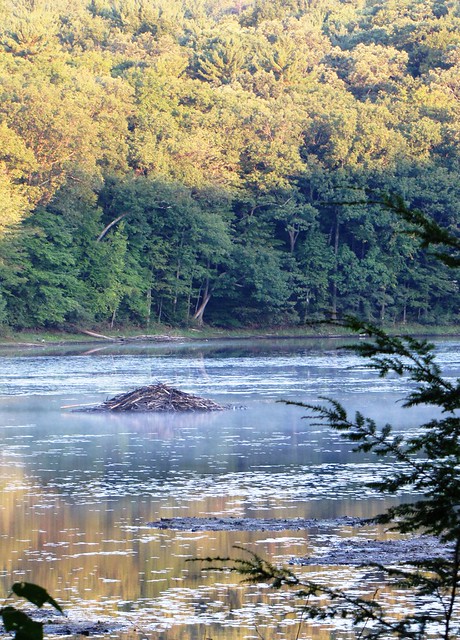
My introduction to this colony occurred this past summer when I was asked to give a presentation for the Kid’s Day at the Edison Boat Club. This club just happens to be located on the canal leading to the Conners Creek Plant and they promised to show me the beaver lodge. Not only did I see that the lodge was within touching distance from the club property, (the spot was even equipped with a chair!) but they were open to allowing me to return for some further study.  I did pull a Douglas (as in Macarther) and returned. My experience was, to say the least, memorable. I offer you the accompanying photos as a teaser (wait ’til you see the video).

Harvard Can be Wrong (A Victory for the MDL)

              copyright G. Wykes 2011

This will not be my typical Naturespeak blog in that it will be on-topic. My motives are, well, less than noble. I wanted to show my readers that I am occasionally right. My self-serving topic is a simple one. Harvard can be wrong on occasion.

Words are wonderful things but because it takes a thousand of them to describe a picture, I often resort to pictures in order to save the alphabet. I was searching the web for some word-saving pictures the other day – looking at the Google image page to find them. I was seeking old illustrations of beavers and beaver colonies. Some of the early woodcuts that came out during the fur trade era were done by European artists that had never actually seen one of these North American animals before. There were beavers in the Old World, but the artists that illustrated these travel accounts were forced to rely purely on fanciful descriptions. Their pictures certainly reflect that and they can be quite amusing by current-day standards.

The 1738 account of Claude LeBeau contains a woodcut showing a colony of industrious beavers which look more like Naked Mole Rats with flat tails. There are dozens of animals working together. In one corner of the picture 6 beavers are shown chewing away at a single tree. The dam in the background is topped with an upright fence. There are no beavers shown painting that fence but the image definitely hints that they probably did so every Wednesday after the groupsing.

As part of this search, I was directed to the site maintained by the Harvard Art Museum. The listing was for a drawing labeled “Head, Paw and Fur of a Beaver”(see above).  From the second I clicked onto the image I could see a problem. The picture did not depict a beaver. It was a muskrat. So, in a moment of self induced authority I shot off the following e-mail:

I was just looking through your Harvard Art Museum Website and noticed a mislabeled illustration. Since it doesn’t appear that the piece was originally labeled by the artist, I assume that this is probably a cataloging error made at an early stage – possibly during initial acquisition (in the 1920s?). You might want to consider changing the label for the sake of accuracy (in cases of on-line search engines etc.).
The illustration I am referring to is the William Rowan drawing titled “Head, Paw, and Fur of Beaver”. This sheet actually depicts a muskrat – detail of head, hind foot, and portion of tail. There is a world of difference between the muskrat and the beaver. The hind foot on the beaver, for instance, is fully webbed whereas that same appendage on a muskrat is equipped with only a tiny portion of webbing. It also takes about ten hefty muskrats to equal the size of an average beaver. As a career naturalist my observation can be considered valid.
Yes, I know this may not seem much of a distinction but the two creatures, although related, are as different as a house cat and a lion. Of course, the real reason for calling this to your attention is for the defense of the lowly muskrat. The beaver has always gotten the attention over the years while the muskrat’s recognition has been delegated to that cheesy “Captain and Tenille” song. I guess someone needs to be captain of the MDL (muskrat defense league)!

I did not really expect an answer. The pencil drawing, by a Swiss immigrant to Canada named William Rowan, was executed in the early 1900s. It was not a major piece of work. I, however, felt proud of the chance to flex my Muskrat Defense League muscles.

Imagine my pleasant surprise when I received the following response within hours:

Dear Mr. Wykes,
Thank you for your message. The title has been changed to reflect the correct species.
With best wishes,
Michael T. Dumas  Staff Assistant
Specialist   Division of Modern and Contemporary Art

Needless to say, I felt the need to forward this tidbit for two reasons: vanity and education. I’ve explained the vanity part, but ask that you examine this illustration closely. Examine the details and compare this with foot  and tail details of a beaver (see below) and you too can become a member of the Muskrat Defense League.

Short Live the Queen

Yes, I know, it’s supposed to be “Long Live the Queen” but in the case of hornets, the term “long” is relative.  A queen Bald-faced Hornet is lucky to live a little over a year – and to do so she has to sleep through half of it. Considering that the average life of a run-of-the-mill worker Baldie is closer to three months, of course, her reign is considerable. Perhaps “Longer than average  live the Queen” would be a more appropriate phrase.

Late autumn is the time when a hornet queen is forced to keep a stiff upper mandible, so to speak.  By the time the first killing frosts hit, the entire colony will be dead. There may be 500 individuals in a typical “hive” by late summer and they nearly all perish with the autumn leaves. This includes the old queen as well. Before the old gal kicks the bucket, however, new potential queens are produced from her generous supply of eggs. These virgin queens do not remain chaste for long. They are quickly mated and thus prepared for the next crucial stage in their lives.  The newly minted, and fertilized, royalty are the only colony members that will survive winter.

At this point in the discussion I should interject a few crucial points for the sake of accuracy. First of all, the name of the Bald-faced Hornet is a bald-faced lie of sorts. These large black wasps are endowed with ivory white markings including a full white facial mark – so the bald-faced part of the name is true enough (you might remember from earlier blogs that the term “bald” means white). But, because these hornets are not true hornets there is more than a bit of falsehood in the name.

Technically they are members of the Yellowjacket clan and are designated as “aerial yellowjackets.” This latter term may seem perplexing at first given the fact that all yellowjackets are aerial (all fly directly into your face when you are eating outside in the fall, for instance). The term is more specific than that. Bald-faced liars…er, wasps… built large paper nests during the warm season, as do all yellowjackets, but they build their structures in exposed aerial situations suspended from tree limbs. Other ‘jackets create their paper nests in underground or between-wall locations.  In other words, if you can actually see a roundish gray paper wasp nest then it is a Bald-faced edifice.

Bald-faced yellowjacke…er, Hornets build their reverse teardrop shaped nests out of a unique form of wasp paper. Wood pulp is chewed, mixed with saliva, and applied in semi-circular patches. The interior of the nest is hollow and contains suspended combs in which the young are reared. The new queen starts the thing in the spring and the later generations finish it. At peak activity in mid-summer the walls are multi-layered affairs that can be over two inches thick.

Ignorant  folk have long maintained that a thick-walled hornet nest is a sure sign of a bad winter. Sure as toot’n, they’d say. The idea being that the critters inherently know that a big winter is coming and can prepare themselves a “right nice cozy little home” in which they can brave the arctic blasts.  Of course, in light of the fact that all the little critters are dead before winter even arrives, this is a tale that needs to die. There’s nobody home in a winter wasp nest except for a few homesteading flies or other small hibernating insects. The old nests fall apart over the course of the winter (see below), so they are not good winter shelters period.. (Note the use of the extra period in the previous sentence to emphasize the word preceding it).

Even the wintering queens do not overwinter in their old nest. They seek protected places under bark, and inside hollow trees where they enter into a state of hibernation called “diapause” (a condition completely un-related to menopause, by the way). I spotted one of these potential ice queens clinging to the side of my house during one of our recent chilly days. Her wings were neatly folded into a position reminiscent of the pose she will assume when passing the long cold season. She moved away from the spot when the next day crept into the upper 50’s.

Although I do not know where she ended up, we can be assured that if she successfully passes the winter with her precious cargo intact she will begin the cycle anew from young non-hornet queen to old non-hornet queen. “Short live the queen.”

Swallowing the Nuthatch

“Swallowing the Nuthatch” sounds like one of those euphemisms employed to describe another event in the same vein as “Seeing the Elephant” or “Pushing the Envelope.” But, in this case, it serves to describe something that nearly happened – I did nearly swallow a nuthatch. To be specific, the nuthatch in question was a Red-breasted Nuthatch.

It was an unusual thing, to be sure, because I rarely see this diminutive species in my yard (the White-breasted variety are far more common around here) and even odder that I came close to receiving one in my mouth!  I was taking out the trash – a task that led me out the front door and through a narrow space between the front corner of the house and a large cedar bush. It was at that point when a grayish blue blur whizzed past and perched on the cedar branch only inches from my head. We eyed each other for a second before the startled bird launched. I instinctively ducked as it whizzed over my head and landed on a maple tree branch about twenty feet away.

It was only after the bird landed on the distant perch that I was able to identify it as a Red-breasted Nuthatch. A black line through the eye, a rusty breast, and a series of “tin horn” toots confirmed the I.D. The question that remained, however, was the reason why the little ‘hatch was on that cedar bush to begin with.  Like their larger White-breasted cousins, Red-breasted Nuthatches spend most of their time working up and down tree trunks and large branches.

A bunch of Black-capped Chickadees were flitting around the same cedar on that morning and they eventually provided the answer. I watched and waited for several days after that incident in order to see what the birds were doing. The Chickadees were more than willing to show me (the traumatized Nuthatch was never seen again). The tiny birds were landing directly on the tiny cones, probing into the open scales and extracting sizable seeds.

I’ve always liked my Cedar bush/tree. It is not especially attractive and was planted in the wrong place by the previous owners. But because it serves as winter cover for many local birds, and remains vibrant green throughout the long winters, it has remained. I’ve always assumed it to be a Northern White Cedar. As a naturalist, I should have paid more attention.

This year the tree was having an especially productive year and was covered with hundreds of cones. Wild White Cedars have very small cones- less than ½ inch in length and are covered with papery scales. I did notice that the cones on my cedar were heftier than the wild ones, but I chalked that up to the fact that I said hello to it every morning. A closer examination of the cones, prompted by the Nuthatch incident, revealed that they were very different from those on the native wild trees.

To begin with, the cones were distinctly bluish and each scale was endowed with a prominent spur. They were opening naturally in the late fall air and, although most were emptied already by the feathered clan, some still had their cargo of oblong seeds. Considering the size of the cones, these seeds were quite large (about ¼ in.) and were un-winged. Northern White Cedars have two small wings attached to either side of their much smaller seeds.

I popped one of them in my mouth and found it to be nutty and refined in taste (like pine-nuts). If it was good enough for a nuthatch or a Chickadee it was good enough for me. Of course these same critters also eat maggots and caterpillars I am not tempted to take this comparison any further.

While munching I was forced to consider that this was not a White Cedar. To save you the process, let me simply state that this bush/tree – my bush/tree-  is a Chinese Arborvitae. A native of Asia, this species is commonly planted as an ornamental because it never attains any great size (ohhh, so that’s why my tree hasn’t grown much in the last two and a half decades!). They are related to our White Cedars and share with it a common group name of Arborvitae. This is a term that means “Tree of Life” and given the context of this blog, I find this a very appropriate term. The addition of a wildlife food value to the list of this tree’s benefits has cemented it’s value in my mind.

I learned several things this week, not the least of which was discovering the secret of a bush/tree that has been in my face every day for over twenty-five years. I also found out that my Naturalist instincts were not working as well as they should. But, there remains one un-answered question.  I know what a Chinese Arborvitae seed tastes like but still wonder what a Red-breasted Nuthatch would have tasted like.

Mink in a Candy Store

Mink are elusive critters. This is not to say that they are un-common – only that they are stealthy and rarely seen.  Their public perception is that they are very rare (“I didn’t know we had mink here!”). This fog is carefully maintained by the BW&M -the Brotherhood of the Weasels & Mustelids but traditionally called the Brotherhood of the Wild & Mink by Mink types). It is a requirement for all BW&M members to be mostly nocturnal, slink about, and pursue their predatory habits with gusto.  The truth is that mink are not rare. In fact, in some places they are very common.

If there is a trick to spotting mink, it is to spend an inordinate amount of time in their wetland haunts (they are water-loving creatures) and trust that one or two of the animals will be caught bumbling about in the daylight hours. All of my mink encounters have been of the bumbling kind where we both were bumbling about.  My most recent encounter was by far the best.

Last month, around mid-day, I happened to be walking the sea wall along the River Raisin. The water was lowerin , as opposed to raisin, and large stretches were reduced to shallow riffles. Because of an extended dry summer, much of the river below the step dam has erupted into lush beds of smartweed and flowering rush.

This is not my usual “nature spot” and all hopes of being alone in this place have to be abandoned here, but it does offer some excitement (such as the very exciting mussel movement I brought to your attention some blogs ago). On this day, it appeared that the most interesting thing of the day would be Damselflies (I could insert a dam joke here, but will refrain). Acting as if they were full of summer vigor, dozens of Ruby Damselflies were cavorting. The males were engaged in a maneuver that can only be described as a butt dance in which they raised and lowered their assets to either attract females or ward off other males.

This would have been fine, but thanks to a human couple standing further up the shore/wall I was directed by their gaze to something happening in the river below. They were watching a mink dart back and forth out of the vegetation.  I approached cautiously – as much to avoid spooking the mink as to respect the space of the folks engaged in nature observation. The people soon abandoned the spot to re-direct their attentions to the geese wandering through the grass (no comment), but the mink continued to act as if no one was near.

Even though this animal seemed to be breaking all BW&M rules by appearing in public, she was “pursuing predatory habits with gusto” (rule 6- sub paragraph B). In other words, food trumps all other rules in the brotherhood.

For some reason, whole bunches of fish were beaching themselves on the shelf rock in the shallow flow and our mink was nabbing as many as possible. They could have been spooked by the human couple I mentioned earlier and blindly bolted along this dangerous route to the next pool. It turned out to be a gauntlet in which only a few would succeed in passing. The mink would dash out, grab the nearest victim and promptly carry it back to a secret storage place back in the smartweed patch. Vanishing only for a second or two, it excitedly returned to grab another fish (see movie here)

The process was repeated again and again for over ten minutes. There was no time for eating – this was manna from heaven and was to be gathered and stored.  I lost count, but she grabbed twenty or so – mostly smallmouth bass and a few sunfish – before the candy store closed.

Mink are not fish specialists. They prefer crayfish and mammal prey (especially muskrats) and fish typically only make up less than 15% of their diet.  They also don’t tend to cache food – or horde it- as other weasels are wont to do. But, as we can see, there are no set rules in nature.

As the fish numbers dwindled, the mink wandered a bit further downstream in hopes of finding a few more. Because it was a small individual, I assume it was a juvenile and probably a female. A male would have been a third larger. She increasingly threw nervous glances up towards me with beady little eyes and finally opted to retreat for cover. I can only imagine the feast which followed over the remainder of that day. If this animal even looked at another fish for a few days I would be surprised (but then again BW&M members are a surprising lot).

A Melanistic Moment

One technique of a wandering naturalist is to wander the back roads until something presents itself. On a particularity crummy day in the backwoods of Northern Michigan I did just that. It was one of those dark days when you can’t quite convince yourself that you are totally awake. Light rain showers punctuated the morning drive and seemed to set the tone for the rare things I did come across.

Let me tell you what I saw and go from there. There was a spoon, a Cyclops eating a sign, and a melanistic deer. Now if that list doesn’t instill a sense of curiosity then you needn’t proceed any further. If it does, then please do (proceed, that is, to the next paragraph). Even if you have seen a spoon before, you have to admit that the last two items certainly need some explanation.

First, the kitchen utensil. My random drive brought me to a spoon in the road. Now, everyone knows what to do when they arrive at a fork in the road – they need to make a decision, right? They either take the right or left route. Robert Frost would opt for the route less travelled while others would take the route indicated by the poet Garmin. There is no straight option – that would lead to a plummeting (into the ditch) followed by a towing (by the Frost Towing company).  But, what does one do when a spoon is present? This is a rare thing.

My road spoon was flattened by previous traffic (which on this road is not very frequent) but it was still identifiable. I decided that one is required to turn around when a spoon is present, so I did. The effort did not result in anything especially notable except for leading me to a sign-eating tree.

To be precise, this tree was a sugar maple, and the sign it was consuming was a well-rusted “No Trespassing” sign. Only the “Tres” part was visible, so I have to assume that’s what it said, anyway. Perhaps it noted “Mauvaise enfant Tres bon permit” as a crude French way to announce “Very good poor child allowed.” Perhaps the owners of the place were announcing their willingness to help the unfortunate. However, in this part of Northern Michigan the only written French appears as “No” in the numerous “No Trespassing” signs.

Regardless of what the sign used to say, that the maple tree in question was a Cyclops was not in doubt. Call it a branch scar if you must, but that tree was definitely looking at the world through one eye. This one would fit nicely into a Halloween landscape. Like the spoon, I saw this rare item as a signal to turn around once again.

This time I spotted a trio of White-tailed Deer grazing at the far end of an open field. Because one of them appeared nearly black, I stopped to get a better look – thinking it was an escaped exotic such as a Fallow Deer or some African Antelope. It turned out to be a Whitetail, but was a rare example of a Melanistic deer.  Albino deer may be uncommon but melanistic deer are much scarcer.

Everybody knows what albinism is – or at least they know without knowing that they know. In a black and white world, an albino is all white. Individuals lack skin pigment of any kind. There is no such thing as a partial albino – something either is or it is not an albino. Any mix of white and normal is called Pie-bald. Melanism, on the other hand, is a different beast – so to speak – because it involves the over production of a skin pigment called Melanin. The pigment can be produced anywhere from slightly over done to totally dominant. So, an animal can be semi-melanistic. It seems that recessive genes are responsible for this effect, so it appears on a hit or miss basis in most critters (although it is very common in Grey Squirrels).

Melanisim is very rare in White-tailed Deer. Over the years there have been notable examples of jet-black deer and random spottings of very-dark deer with varying shades of black. Texas is apparently the hot-spot for black deer in North America, in case you are interested.

My deer retained her white belly and under parts as well as a fringe of reddish orange on the legs and top of the head. The rest was a deep ashy gray and resembled, for lack of a better comparison, the shading on an antelope. The dark portion ended at a definitive border on her flanks. She was a beautiful animal (and this coming from a man who has expressed on more than one occasion that deer are ugly).

As an astute reader you might recall that I was out on a misty day and might be thinking that she was just wet. I can put that aside because wet deer are more intensely orangish or light gray (depending on the season) and are not darker. Secondly, she brought along additional proof that rain had nothing to do with her shading.

She bounded off after only a few seconds of observation. Her two fawns followed suit. The trio vanished within a few bounds but not before revealing that her fawns were normally colored. They were wet little orange spotted deer.

Ahh, it was a rare day in the North Woods. I’ve been past that point several times over the past month to see if I could spot her again, but without luck. The Cyclops is still there, however.


Exhaling Silas


It had not been my original intention to seek the grave of Silas Culver. My wife and I were vacationing in the vicinity of Upper New York State, Vermont and New Hampshire. Although this was not the primary focus of our trip (I’ve heard that some people go on vacation to relax), I was actually on the track of another long dead soul who once called this area home – a remarkable revolutionary soldier by the name of Thompson Maxwell. I’m not remotely related to the guy but he had piqued my historical interest enough to inspire a pilgrimage of sorts to his homeland. My brother sent a text message our way wondering if we might find some time to swing by the gravesite of one of our own lineage who was buried in New York. Blood being thicker than Vermont water, we agreed that we were indeed “in the neighborhood” and would make a go of it.  His name was Silas Culver and he was laid to rest in the South Horicon Cemetery in Warren County New York.

Horicon is south of Glenn’s Falls, New York and very close to the Vermont border. Our Grandfather, on the old New England Culver side, hailed from that neck of the woods and was appropriately named Glenn Culver Wykes. Unfortunately he died back in 1929 and was never available to fill in the family story (he, in fact, created an entirely new and fascinating chapter in the family line but we’ll have to categorize that one as a “skeleton in the closet” tale and leave it for now). Silas was his grandfather. Most of what we knew about this “great great ” was based on a geneology book about the Culvers.  In that tome, Silas Nelson Culver was listed a farmer who enlisted during the Civil War, was captured, imprisoned in Libby Prison for a while, and eventually exchanged or released. Suffering from the effects of that imprisonment, he returned home and died shortly thereafter in 1863. A good story to have in any closet if it’s true.

The fact that this fellow was purportedly a Civil War soldier caught the imagination and interest of my brother Dan who had been immersed in re-enacting as part of an Illinois Battery for many years. He never claimed to “be” Silas but admits that it was nice to have someone to channel when engaging in such affairs.  The other nice thing that made Silas stand out is the existence of his photograph. Putting a face to a name and a name to one’s own name is always a thrill.  The fact that he looked like one of the family certainly helped. My wife and I gave the Culver name to our middle child, in part because of this palpable connection.  Jim has never shirked the responsibility of explaining that unusual middle name when asked. I have never been asked why my middle name was Paul.

The problem came when we tried to verify this Civil War/Libby Prison story. There was no solid evidence that Silas Nelson Culver ever enlisted in the Union Army or was in Libby Prison. He does not appear on any veteran list either in New York or nearby Vermont. Nope, the only reference was this one family text.  Still, soldier or not, it was still worth seeking out his tombstone. A picture of it appeared on an on-line genealogy site but none of us had ever seen the real thing. It was my duty to be the one.

Located off a dirt road off another dirt road in a forgotten part of Warren County the south Horicon Cemetery (aka Pitt Cemetery) is small by cemetery standards. It is large by small cemetery standards, however, and the idea of locating a single rock among a hundred headstones was slightly daunting. Fortunately my wife found it right away.

It was a rectangular lichen-encrusted affair with the simple letters “Silas N. Culver” over “Born April 9, 1828 / Died May 13, 1863.” Oddly enough I was slightly disappointed. It looked just like the picture. Had I had travelled 300 miles just to stand next to a picture?

I did my familial duty and posed for a photo.  Late afternoon sun in my eyes, I decided to kneel next to it, in the manner of a football picture, because Silas was shorter than me. I dislike such staged shots but what else was there to do. Upon viewing this photo on my wife’s Facebook page (sent out instantly through the miracle of the ether) my other brother was prompted to wonder which of the two gnarly figures in the shot was actually the headstone. Such helpful comments from my brother, my much older brother I should add, are why I hate staged shots.

Any feeling of disappointment rapidly dissipated upon telling myself that I had not specifically travelled this far for that single reason and secondly upon the realization of a sense of place.  As an historian I’ve told countless people about the importance of being in the place where something significant happened – regardless of what it looks like today. Battlefields, for instance, give off a feeling from the ground level that is hard to describe. Without getting all “spooky” about it I have even been known to say that we channel some sense of being from such hallowed grounds.

Brother Dan, the kinder gentler brother, later asked me whether I felt any “vibes?” from standing next to the stone?  I had to admit that I did but was forced to admit to another on-site reality – the kind you couldn’t see in the on-line picture. All of the headstones in the S. Horicon Cemetery belonging to vets were marked with a flag and a bronze star marker. There were at least 13 Civil War vets in that place. At least one appears to have died during the war. There was no flag or star next to Silas Culver’s grave. Although not definitive proof against the family claim, this evidence was one more indication that his coffin nails were driven into the pine box of a civilian and not a soldier.

We may yet discover that some forgetful maintenance guy forgot to put the marker back after trimming around his gravestone. We may yet find some long lost record proving that the family story was true and my brother may yet charge across the re-enactment field crying “remember Silas.” He would never do that, by the way, but he could. Silas’s father was a minuteman during the Revolutionary War and likely did so that his sons wouldn’t have to fight.  His connection to the Green Mountain Boys of Vermont was enough to qualify the females in our family line for membership in the DAR. My sister never took up this flag but she could have.  David James Culver’s patriotic blood flowed through Silas’s veins and that same blood has flowed through the centuries through our father, through us, and will continue through the following generations. Brother Dan could presently revise his battle call to say “For the Sake of David and what he fought for!” and maintain historic accuracy.  He won’t, but he could. In truth even if Silas turns out to be “just” a God-fearing American farmer who died of consumption he will always be worthy of a battle cry – at least from our side of the clan.

The Culver gravestone looked somewhat lonely on that low sandy rise at the edge of the cemetery.  It appeared to be between rows, as a matter of fact, but was well cared for (leaving serious doubt about the forgetful maintenance theory forwarded in the previous paragraph). As I left the place I wasn’t sure how to finish my meeting with my dearly departed g.g. I’d taken plenty of shots, touched the stone, and silently talked to the neighbors. As if on instinct I finally reached down to pluck a tiny weed from the poor soil directly over the bones of Silas Culver and walked off. I pressed the plant between pages 120 & 121 of a book I had in the car. Don’t ask me why. Barely a week after returning home to Michigan I discovered the reason.

I happened to be reading an book called “the Native Grape” – a small 1866 publication by Missourian George Husmann about the American wine Industry (again, don’t ask me why) when I came across the following passage. It was in reference to a particular variety and why it flourished in Missouri:

“I think this is pre-eminently a Missouri grape…I have seen it in Ohio, but it does not look as if it was the same grape. And why should it? They drove it from them and discarded it in its youth; we fostered it, and do you not think, dear reader, there sometimes is gratitude in plants as well as in men? …it will cling with the truest devotion to those localities where it was cared for in its youth.”

Husmann went on to explain how this same devotion was expressed during the “recent war” by those German immigrants who gladly spilled blood for their adopted free country in the Civil War. “But you may call me fantastical for comparing plants to human beings,” he continued, “and will say plants have no appreciation of such things. Brother Skeptic, have you, or anybody, divined all the secrets of nature’s workshop?”

According to Husmann, plants are people too. They sense that which is about them beyond the earth, sun and water and incorporate human essence as well. Perhaps Mr. Missouri was imbibing in a bit too much of that happy Grape Juice and willing to bypass the “show-me” requirement of all Missourians. However, I did take away a fascinating thought. I had to consider that plants do have a connection to the human occupants of the land even if I could not swallow the whole of Hunsmann’s belief.

My tiny weed was flat and dry when it was later retrieved it from the book. I had a difficult time identifying the thing because it was such a micro-example of its type. That thin dry Horicon cemetery soil was not plant friendly. I won’t go into the details but it took a week to determine it was an anemic version of a mint called Self-heal. Members of the mint family, Self-heals are so-called because of their many medicinal uses. One early herbalist explained that, “when you are hurt you may heal yourself” with it. Of course the identity of the plant wasn’t especially important. It was the worse possible example of its type. Still, it started to take on some greater meaning because it could now be appreciated on two levels.

A few days later, I heard a recitation of Walt Whitman’s poem “Pensive on the Dead Gazing I Heard the Mother of All.” This, combined with the thoughts of the grape man, crystallized something in my head. Written in 1865 as a reflection on the tragedies of the Civil War – of which Whitman a witness- this poem probably has a greater meaning beyond that which I drew from it. The selected lines which centered me went as follows:

“Absorb them all, O my earth, – lose not my sons! Lose not an atom;”

“My dead absorb – my young men’s beautiful bodies absorb – and their precious, precious, precious blood;”

“Which holding in trust for me, faithfully back again give me many a year hence;”

“In unseen essence and odor of surface and grass, centuries hence”

“In blowing airs from the fields, back again give me my darlings – give my immoral heroes;”

“Exhale me them centuries hence – breathe me their breath – let not an atom be lost.”

Whitman and Hunsmann, neither theological geniuses nor men of science, might have breached a third level of thought beyond reality. Of soldiers and grapes, the same can said of regular folk. There is a connection between plants and people both in life and death. We both come from and are returned to the soil. I’m not all in on the idea that plants appreciate our admiration but am willing to give the idea a nod. I am closer to considering the possibility that the tiny Self-heal plucked from my ancestor’s grave may contain a part of him – or at least a few of the atoms that once formed him. And, if you blend that thought with Whitman’s vision, it was exhaling them.  That could have been why I felt compelled to pick it.

My piece of Silas is now carefully preserved in the center of a square from a very old baby quilt. The square only measures 3 inches itself and makes the micro plant looks larger than it really is.  Yes, it’s just a pressed plant but, as you can see, such a thing can be much much more.

Things I would have written Part 3

Sept. 14   Halloween Town & Moreau State Park

Before crossing the State line back into New York we paid a visit to Windsor, Vermont – the birthplace of Vermont. Apart from visiting Dan’s Windsor Diner, a chrome & wood diner car dating back to a much simpler era and the oddly named, but fascinating, American Precision Museum (site of the 1840’s Robbins and Lawrence Armory) I managed to focus in on the one thing the town is not likely to promote. Windsor Vermont is a Halloween town complete with a spooky old graveyard full of slate headstones topped with hollow-eyed angels and spiders. Lots of spiders.

I won’t dwell on this aspect, but the arachnids of Windsor appear to be working for Hollywood set designers. They have spanned nearly every building angle with webs and have occupied every crack and cranny in town. The stoplights at the corner of Main & State are mounted on the sidewalk like streetlights. The light on the northeast corner was completely draped with a layer of webbing (see below & here). It is real webbing and not the movie prop kind.

This means that Windsor is probably free of noxious all insect pests but few spider-phobic types would acknowledge that fact. Perhaps the town could hit on this as a slogan and proclaim themselves as “the bug free town” and remind folks that spiders are bug-eaters and are not bugs themselves.

The scenery around Lake Moreau in New York is a long way from that offered by Windsor’ween Town. The rolling topography and deep woods offered many highlights, but two came to the fore.

There was a beaver lodge actually marked on the park map. It was a real beaver lodge and not a creatively named picnic shelter. This thing shared as much ink on the paper guide as the other permanent facilities such as the bathrooms, park office and, well… picnic shelters. On one level this was like marking a woodpecker hole or a Chipmunk den, being a creature-made structure, but on the other hand it acknowledges the amazing abilities of our largest local rodent. Woodpeckers change location every year and chippy dens are hardly worth viewing. Beaver lodges can last for years and remain a part of the landscape long after the residents have moved on.

I assumed this lodge was abandoned but ample shoreline evidence proved that an active family of Castors still resided there. These guys had even attempted to dam up the narrows under the bridge between the lakes.  My efforts to see these fellows were a bit frustrating, however. Beavers are primarily nocturnal. I did see the pair in the twilight at around 7 pm and resolved to return the next morning to catch them again.

Early the next morning before the sun had sufficiently crept over the mountains enough to illuminate the lake, the beavers were again in evidence. Unfortunately they were in the process of heading home. I was able to see them linger for a moment before plunging under and entering the lodge for the day(see here). It seems that the Lake Moreau beavers keep a 7 to 7 night schedule. They would not show themselves in the full light of day for better observation/photography. Dam.

I couldn’t have asked for better view of the Red Eft that showed itself on the beach just as the first beams of morning light struck the opposite shore. Efts are the terrestrial stage of the Eastern Newt. They start out as aquatic larvae, leave the water for a few years to live as a land lubber, and eventually return to the water to spend the rest of their days as a water beast. The water form is a green gill breather with a substantial tail fin. On land it becomes bright orange-red lung breather with a round tail. I believe Newt Gingrich, for instance, transformed into Newt Rockne for a brief time.

There is a possibility that this particular Newt was recently transformed (after losing out on his candidacy for the lake presidency). He was discovered on the sandy beach heading toward the forest and was about as fresh looking as you can get. This little beast actually glowed. The pebbly skin texture, gummy worm glow, and bright red speckling made it look almost good enough to eat.

I did not eat that Eft, but instead let it continue on its terrestrial adventure. Red Efts have toxic skin (it’s not just the eye of the newt that makes for a good witches brew). They will emit noxious compounds when roughed up by potential predators. Ingesting one would either have made me very sick or have turned me into a politician.


P.S. Just for fun, I thought I’d include this roadside image taken in the neighborhood of Halloween Town – talk about mixed messages!

Things I would have written Part 3

Sept. 9    Button Bay, Vermont

Button Bay is on the Vermont side of Lake Champlain (named after the notorious Samuel de). By some this is classified as a “Great Lake” – except by those who actually live among the Lakes. It is a great lake, to be sure, but just not in the capitol letter sense. This long narrow body of water on the New York/Vermont border certainly has seen its share of human history from French-Indian War actions at Fort Ticonderoga & Crown Point to the War of 1812 Naval Battle of Plattsburg.

The very name of the place where we stayed at Button Bay stemmed from the English period when the British soldiers noticed the peculiar circular formations found about the place and declared “Why them looks just like button moulds, they do.” Metal moulds, or molds, were used to cast pewter and brass buttons.  According to the official word, Button Mould Bay later was simplified to Button Bay because the Mould part was too hard to say or explain. In other words, the Brits really meant to say “them’s buttons.” As a doubtful Michigander I don’t fully buy this.

There were many oval & round clay concretions found here and some do look remarkably like buttons but most simply look like blobs.  At the point itself, a barren piece of glacial scarred Ordovician rock (see glacial grooves here) there are quite a few true “button moulds” exposed in the rock (see above).  They appear to be iron based concretions with a softer material inside. They really do look like button moulds…er, molds. The soldiers were probably referring to these things. Why would they say mould when they meant buttons? I believe they meant what they said. One doesn’t see a spoon-shaped object and declare that it looks like a spoon mold – no, either it looks like a spoon or the mold from which is made.

Perhaps there is some linguistic thing going on here that I don’t understand so I’d better push the STOP button and let it drop before exposing my own ignorance. I did spot a pair of Daddy Long-legs (see here) on the rocks apparently arguing/discussing  the same issue (“thems buttons – no, them’s molds”…etc). Actually they were engaged in a more amorous endeavor but for the sake of visuals I will stick to my earlier statement.

The great Lake Champlain is down this year. It is really down, according to some of the locals, to record levels.  Multiple beach ridges – at least six – are exposed to create fresh-water tidal flats.  The place was attracting quite a few shorebirds picking through the exposed mire. Among the long-legged long-necked Greater Yellowlegs (see below) were pint sized Semipalmated Plovers (second below) and Semipalmated Sandpipers.

The Yellowleg name is pretty self-explanatory but the Semipalmated thing needs another “button mould” type explanation.  To be palmated means to be “hand-like”. To be semi-palmated literally means somewhat hand-like. In the case of these shorebirds it means that there is partial, or reduced, webbing between the front three toes – in other words their feet are more hand-like than duck-like. O.K. ,that makes more sense than the button thing.

These two small Semipalmated shorebirds are migrants making their way down to the warmer Gulf climes for the winter. The Semipalmated Plover looks like a Killdeer reduced in a shrinky dink oven – losing one of the neck rings in the process. It is in the same family as the Killdeer but looks more like a Killfawn.

One of the Semipalmated Sandpipers posed for me among the wave-washed rocks of Button Point.  I hate identifying shore birds because I am shore to get the identification wrong. There are far too many subtle points to consider. In fact, I might even call it a shorebird mold. In this case, I initially thought the bird was a Sanderling. It was very small and certainly looked like all those Sanderling pictures. As usual I was wrong – I think.

Because the bird was so co-operative I was able to take many shots of it (see above and here). This allowed me to take a closer look, after the fact, to note that the tiny fowl had back toes. Sanderlings lack a back toe and possess only three forward pointing (and un-palmated) toes. The Semipalmated Sandpiper was the only other thing fitting the fully-toed description.

Again I will need to push the STOP button and risk further ignorance exposure at this point.  Never publish a shorebird image unless you are willing to accept revision. I am therefore waiting for two revisions – one on my Button Bay theory and the other on this bird. Perhaps I should spend more time on vacation looking at the scenery rather than pondering such questions. At least the scenery is what it is – no more, no less.

Things I would have written Part II

Sept. 6   In the Adirondacks     

Although not exactly Rip Van Winkle territory, the Adirondacks of upper New York State certainly have that misty mountain Winkle feel. You could fall asleep here for decades and wake up to a place that looks exactly the same as it always was. We stopped at Eagle Point  State Park, located on Schroon Lake at the eastern edge of the Adirondacks on the Vermont side of the state, for an overnight stay. Schroon is one of those narrow north-south bodies of water carved out by the glaciers. The opposite shore is speckled with cabins but the un-tamed peaks behind them dominate the horizon. It is a deep cold lake that probably holds a lot of deep cold secrets.

My wife and I were pretty much the only residents of the park – this being very late in the season. The place was scheduled to close down for the year in just a few more days. This, of course, allowed for ample solitary exploration of the abandoned lakeshore the following day.  As expected, a singular loon was gliding the still lake waters in the morning (would it be a northern lake without one?) along with another solitary fisherman in the form of a human in a small aluminum boat.

As stunning as the scenery was, my attention was drawn to a pile of mussel shells on the bank bordering the sand beach. There were dozens of them in the cluster and all of them were cleaned out. Each had been opened and the valves remained connected by their hinge – “butterflied,” I guess you’d call it. This bore all the characteristics of a muskrat midden.

Muskrats are primarily vegetarians but they do not adhere strictly to this regime. They have to have a bit of bloody meat every now and then in order to stay interesting. Fresh-water mussels are one of their favorite guilty pleasures. Muskrats will pig down on mussel flesh whenever and wherever they are readily available. A purple nacred (that means purple mother-of-pearl) Sand Shell and a thin-shelled Paper Shell appear to be the most common varieties in this lake.

It is still somewhat of a mystery as to how muskrats open these things, but they do manage to force them open enough to sever the single muscle that holds the two shells together. On occasion, they will break the thinner shells in the process, but for the most part the only evidence left are some tooth marks marking the where the mussel was carried.  They rarely separate the two shells at the hinge. Because they are creatures of habit, the ‘rat will return to the same location repeatedly for their shellfish respite and thus these piles are created.

The only unusual thing about this muskrat midden was that it was located nearly 25 feet from the water. Due to the unusually hot summer, the lake level was obviously down by many feet. The original shore lapped at the base of the slope where the shells were deposited and it is likely that whatever ‘rat  built this shell temple did so in the early spring when the water was still up. “Eat clams while the water is high” is an old muskrat saying (original text: “wheep chip chatter gnash-chup”) and it certainly applied here.

Elsewhere in camp, squirrels were again part of the main show. I’m sure there were raccoons about (along with a few black bears) but the only garbage raider I saw was yet another portly Grey Squirrel. This one was trying to act innocent -like he was just using the edge of the dumpster as a perch -but I know he was eying the contents and was ready to dive in when I interrupted him. And talk about bushy tails. This one was certainly well-endowed.  It’s not a muskrat saying, but perhaps you’ve heard the one about “Big bushy tails means that a long hard winter is ahead.” Although this is a totally false concept,  it can be said with complete confidence that it means that winter will eventually get here.

A brightly spotted giant slug completed my morning discoveries at Schroon Lake. It was sliming along the Hemlock needle mulch looking for someplace to hide for the upcoming winter. Sure, it’s a bit early to take cover but slugs are not all that fast. It also serves as a reminder that this place is not entirely timeless because these are European introductions (and so, I remind myself, am I).