Consider the Female Red-wing

Walk out to the end of our Dollar Lake dock these days and you will be accosted.  The cat-tail clusters on both sides will explode with Red-winged Blackbirds – males, females, and young. Although none of the birds physically goes on the attack, they all engage in loud protest calls consisting of “Tee tee tee” , “Check”, and “Teow” calls. This is the standard Red-wing repertoire meant to announce danger and tell that dangerous thing to get lost. Most of the adult birds ascend to the branches of a nearby birch tree to file their complaints while the young birds flutter for safety among the stalks.

There are at least three nests located within a few hundred feet of the dock, but only one is visible. For a Red-wing nest to be visible is saying quite a bit. They are constructed of dead cat-tail fibers woven betwixt dead cat-tail stalks and they look like, well, dead cat-tails! Add a new crop of growing cat-tail leaves to the mix and you have a well concealed structure.

The nest closest to the dock, and the one which caused the most angst among the birds, has just produced a crop of fledglings. The young birds left the confines of their nest about a week ago but are still heavily dependant on their parents. They certainly look uncertain away from their familiar cradle. Tufts of down still cling to their head and their faces are bare of feathering. They are not ugly, but it’s safe to say that theirs is a face only a mother blackbird could love (see below). The back feathers look reasonably well developed but their tail and wing feathers have a long way to go.
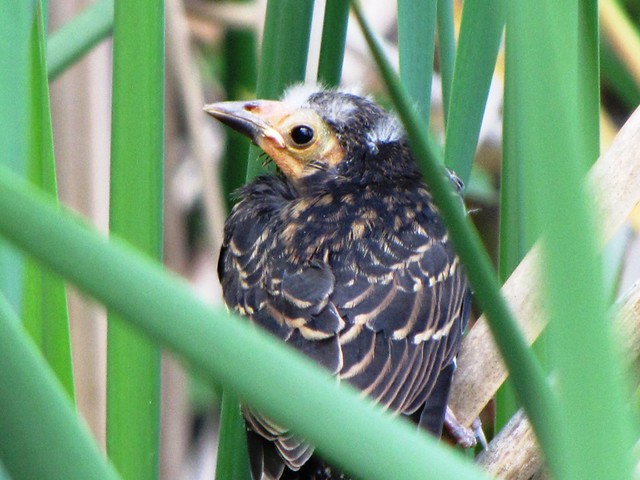
There is no more diligent parent than a female Red-winged Blackbird.  These birds – like I said, there are several nesters in this mini-colony – are constantly issuing in and out of the cat-tail stand. They are grabbing insects and returning to stuff them down anxious little throats hidden deep in the foliage. One favorite hunting tactic is to saunter through the mown grass picking off small moths. On occasion you’ll see them dart about like flycatchers whenever they intercept the path of a dragonfly. All insect food is game.

More than once I interrupted a female as she was returning with a mouthful of food. They will not drop down and betray the location of their young at such a time, so they hover about noisily until the coast is clear. No matter how full that mouth is, they have the ability to call loudly and clearly (why don’t you try that with a Twinkie in your maw). She will not drop or eat her load, but single-mindedly continues harassment until I am away from the dock. Since it is my dock as well, I once decided to stay on it for 15 minutes (to prove a point if nothing else) and noted that one of the females held onto her dragonfly the entire time (see below).

The males are the noisiest of the protest mob and they are always the most noticeable of the species by design. It is their task to be “in the face” of all intruders. This is why they are endowed with those bright scarlet epaulettes. They are the “Red-wing” of the species name.  The females are camouflaged so as to blend into the background and avoid calling attention to themselves or their young.  They are somber in coloration but not behavior. It is worth time to consider the female and realize that she too is attractive within her natural restrictions. Some even sport reddish shoulders as if to prove that they too are Red-wings. Of course, there would be no Red-wings of either sex without the diligence of the females during nesting season.

Yes, we need the males too, but since they get most of the publicity it is worth the time to post a blog posting without showing any male ‘wings for a change.

Back to Back Nature

My recent encounters with a turtle, a snail, and a daddy long-legs, have introduced me to a leech, a fish, and a little pile of crap. Please let me explain.  In all three cases, these initial encounters led me to discover something new either upon the original creature’s back or pretty darn close to it. The third discovery led to yet another piggy back situation. So, you could say that I have a back-to-back nature theme going here. Let’s start with the turtle and his little friend.

June is turtle month (when local turtles come out to lay their eggs), so it was no surprise to come upon a medium sized Snapping Turtle lumbering across the grass the other day. She was headed back to the water – having already done her duty – and was looking pretty tired and dried out. She neither objected to, nor condoned, my presence but sat complacently for examination.  There was a large boldly patterned leech suckered onto the rear portion of her shell. I’ve rarely seen a wild turtle without a resident leech or two, but this one was an eye-catching example.  Not all leeches are plain and ugly – some are patterned and ugly (see below).

Snapping turtles are a safe bet for aquatic leeches because they are large, slow moving, full of nutritious blood,  and spend very little time out of the water. June leeches have to sweat it out in the open dry air if they chose a female for their ride. This one was “hangin’ shell” and waiting out the overland excursion. Condensed to a resting length of about two inches, this hitchhiking annelid (segmented worm) was conserving all the moisture it could. Leeches have sucker discs at both ends of their body and both the anchor and mouth discs were employed in this circumstance. When back in its liquid element it will stretch back out to eight or more inches in length.

A Ramshorn snail (see above) pulled up from the shallows of a Lake Erie marsh revealed another sort of shell rider.  June also happens to be Carp month (much to the angst of the turtle union). This is the time when so-called German Carp (aka Dutch Carp to the Germans) venture to the weedy shallows for spawning. The gravid females enter the marsh literally exploding with upwards of 2 million eggs per, and they spew their cargo onto the submerged plant stems and leaves. The eggs, about 1 mm in diameter, are sticky and they adhere to anything they touch. In this case, a slow moving snail was caught in the egg fall and became un-willing host to at least 4 carp eggs. Two of them are visible in this shot (below).  It is a good place for an egg and a completely indifferent situation for the snail.

Normally, carp eggs hatch in 3-6 days, so it remains to be seen if these fry will ever have the chance to acknowledge their unusual wet nurse.  Can you imagine the ribbing these carplets will take as their viscous schoolmates taunt them with chants of “Na, na…you’re a son of a snail!” Because there are no mirrors underwater, the snail would remain ignorant of the whole thing.  There is no chance his reputation will suffer given the slow communication network within the snail community.

On a final note, a close-up look at a Daddy Long-legs (above) revealed that the dropping on the leaf next to it was, in fact, an insect. I actually took a shot of the Daddy before I noticed the secondary creature on the leaf. This larval Tortoise Beetle was in little danger from the predator lurking right next to it thanks to its impressive array of defenses. An adult Tortoise Beetle, although well camouflaged, is a nice looking critter (see here), but the larva is not.

There turned out to be several of these unusual larvae on the Canada Thistle plant. All were equally un-noticeable thanks to their unique method of protection.  Tortoise beetle larvae are intensely offensive little beasts.  Not only are they are bristling with a body-encompassing array of outward facing spikes, they also carry a fecal shield over their backs. This shield is created by multiple deposits of droppings glued together by a liquidy paste politely called “exuvia.”  They are able to wave this poop club around when assaulted (see side view in begining photo).

Research has shown that the Tortoise beetle’s “S–t Shield (no, I will not spell that out for you) is laced with lots of nasty chemicals in addition to the nastiness already in the feces. So, there you have it. If you poop in your pants every day for the rest of your life, and never change those pants, you too can become a Tortoise Beetle Larvae. You’ll never have to worry about enemies…or friends for that matter.

Turkeys in the Corn

Yes, I know that the song is called “Turkey in the Straw,” but in this case I am talking about multiple turkeys in a field of new corn. These turkeys were not “of the straw” type, but wild birds strutting their stuff among the short corn sprouts. I spotted them east of M-30 while on the way to West Branch. The day was overcast, the birds were far away, and the air was damp with spittle rain. Viewing conditions were less than ideal but, on the other hand, one does not get the chance to watch strutting wild toms everyday.  Turkeys are an everyday bird, but courting turkeys are an exclusive feature of spring. The “strut” is not an everyday thing.

I must admit, the scene was a picture of new life and fertility – a rolling field of fresh growing corn, with parading testosterone soaked birds, and (cover your ears little ones) mating. Yes, mating out there is the wide open spaces visible to all who cared to watch.  I, the voyeur in this scenario, stopped to watch.

This flock of amorous birds consisted of two or three Toms and a half dozen hens.  Although I’m sure all of the toms desired attention, only one was actually getting it. It was not hard to pick out the dominant gobbler (appropriately called the alpha male) in this group. His magnificent tail fan and huge circular form made the secondary gobbler look, well, secondary….even tertiary. The secondary’s tail fan was less than adequate (uneven feather length etc.) and he wisely kept his teenage features subdued as the silverback stalked about (see below).

The whole courtship procedure is a study in stereo-typed behavior.  Not only is the dominant male obliged to enact a series of “fixed action patterns” starting with gobbling and leading into strutting and treading, but the hen’s reaction is also guided by strict instinct. The whole dance is well choreographed and is more like a ballet than a toe-tapping barn dance in the straw.

There would have been a lot of gobbling leading up to this affair, although from my observation post I would not have heard it even if I was there an hour or two earlier. Gobbling brings in the females, and other males as well, to the party grounds.  With the females (and over-awed youthful males) gathered in the center, the Tom strutted his stuff around the perimeter. He did his level best to look like a Thanksgiving centerpiece. Tail flared, wings spread, and primaries dragging on the ground, Big Tom repeatedly commenced a slow arcing route around the bunch. There would have been some low frequency rumble sounds issuing from the tom during this dance, but that part of the performance was gobbled up by the distance between us (did I just make another bad pun?).

The dominant bird did this repeatedly, without variance, until one of the hens finally accepted his advances. Soon she dropped to the ground (swooned?) and allowed him to step on top of her. He then tread upon her like a wine-maker in a vat of grapes until she volunteered to turn her privates up to meet his (see below). This treading behavior can go in for some time – in this case for at least 3 or 4 minutes – before achieving the desired effect. Then, boom, it was over and the male went back to courting the remaining hens who shamelessly showed great interest.  What a turkey, eh?

I took a video of the sequence (you can watch the video here), but don’t expect graphic detail or anything approaching lust. You’ll see the strutting and then what looks like a large turkey standing on a small hill amongst the corn. That hill, of course, is the female and you can barely see her head sticking out if you look carefully.

It was getting late in the season for such shenanigans.  Most breeding should have taken place much earlier in the springtime and it often begins on the wintering grounds. I can only guess that the cold wet spring might have dampened avian enthusiasm just like it stunted the growing enthusiasm of the local corn. This hot bunch of turkeys were doing what they could to make up for lost time.

Ebony Fliers

The last bout of sultry pre-summer weather found me wandering about the spillway on the River Raisin dam at Tecumseh.  I wasn’t lost, but not sure what I was looking for either. On a hot day you seek the shade of the woods first and, after being driven from same by the mosquitoes, you seek the presence of water. On the second phase of my walk I ventured to the concrete outlet were the impounded waters of the river are set free.

Just down from this active tumbling flow, the Raisin takes a gentle bend to the west and enters into a shady wood. The sunny streamside immediately before this turning point is lined with willow trees and among the fluttering willow leaves were clusters of fluttering black wings. These turned out to be the reason I was there (although I didn’t know that beforehand). It’s funny how this happens when taking an aimless walk. To turn around a popular song phrase, I could say that “you don’t know what you’ve got till it’s found.” At any rate, those willows were hosting a cluster of very active Ebony Jewelwing damselflies.

Jewelwings are among, if not the, largest damselflies in the state (a blanket statement that saves me from actually looking up the figures). They are among the most beautiful without a doubt (members of a genus Calopteryx – meaning “beautiful wing”). Ebony Jewelwings are creatures of dappled sunlight. They move into and out of shade so their décor is designed for this environment.  Their broad black wings, metallic bodies, and active behavior make them stand out from the background.  In true damselfly character, these insects flutter about like butterflies and employ their papery wings in the courtship process as well.  This was the thing that called them to my attention.

One especially low hanging willow was the center of attention on this particular morning. The coal winged males would face off with prospective mates and hover in front of them like bugs on a stretchy string. By flaring all four wings, the male’s display emphasized the bouncy movement.  The females, with their white (stigma) spotted wings, would flutter back in return – or not (see above).  No flutter meant a complete lack of interest from the feminine side (apparently damselflies are related to people).  When not fluttering, the males would roost on lookout perches and chase each other around.

Successful males – those whose wooing attempts resulted in woo – would grab onto the female’s head using claspers located at the end of their abdomen. The females would bring their abdominal tip up to receive their “prize” from the male’s thorax and complete what is entomologically referred to as the “wheel formation.” As you can see below, this is a proper and fitting name. Once the sperm packet was transferred, the females broke loose and began to lay eggs.  They directed their efforts on a matte of fine exposed tree roots in the water just below the tree. Although I didn’t actually see this part, I know that each damsel was inserting her eggs into the stem below the waterline(“you don’t know what you’ve got till you read”).

Jewelwings rarely sit still for their portraits (see below), but upon closer examination their beauty does fade a bit. Up close, you can see their widely spaced eyes and rows of long stiff leg hairs. Damsels are gawky looking predators that take their prey on the wing and these hairs assist in that regard. They interlock to form a neat little basket when the legs are gathered together to scoop critters out of the air.

They also are equipped with good vision and the slightest movement will send them off. Jewelwings (in fact, all damsel and dragonflies) have the ability to turn their heads around to look straight into your eyes.  I was both the watcher and the watched on that hot June morning along the Raisin.


One Good Tern Deserves Another

A visit to a Common Tern colony is an uncommon experience.  It is also a complete sensory experience which includes pain as one of the tour features. Needless to say, the birds do not want you there and do everything in their power to make you feel unwelcome.  Terns are small birds but have knife-like beaks and lightning quick flying abilities which they employ to dive bomb and peck any intruder. All birds utter a loud raspy call when attacking.  Add a shower of feces and multiply this by dozens of birds and you have a feathered onslaught – a pecking, pooping, and profanity laced barrage.  In other words, it is a wonderful thing!

I recently had the opportunity to accompany U.S. Fish & Wildlife Service volunteer Natalie Ray as she made her semi-daily rounds of the tern colony located under the Grosse Ile Free Bridge (see above and here). These birds have taken advantage of the main pier beneath the central portion of the historic structure (a swing bridge built in 1932) which crosses the channel from Trenton to the big island in the Detroit River. Natalie is charged with changing the memory cards on the night-vision trail cameras set up at various locations around the small colony (see below). Nocturnal predators such as raccoons, mink, and black-crowned night herons occasionally raid the place and these cameras are placed to monitor these depredations.

Common Terns are a severely depleted species (down from over 5,000 local breeding pairs to a little over a few hundred), so they need all the help they can get. A single Night Heron could potentially wipe out this bridge colony in a matter of a few nights if left un-checked. Let’s just say that habitual interlopers are swiftly “taken care of” by U.S.F.W.S. staff.  Oddly enough, the parent terns leave the colony undefended at night and are not available to employ their “triple P” defense on nest predators.  The chicks are on their own once darkness falls.

A daytime visitor – regardless of intent -is accorded the full un-welcome ceremony, however. Before I could don my hard hat, one pugnacious bird landed a direct hit on the top of my head. I hate to be a wimp about it, but dog-gone it that really hurt. It drew blood as a matter of fact. Once hard-hatted, we received regular noggin bops about every minute or so throughout our time inspecting the place. A fine spray of droppings accompanied nearly every close approach. The noise can only be imagined. The combined rumble of overhead traffic on the bridge and the constant cackling of the terns was deafening. I said deafeni…oh, sorry… I needn’t shout any more. Take a look at this video and you should get a sense of what I am talking about. It looks and sounds  like an Alfred Hitchcock movie trailer.

From the perspective of the elevated boardwalk that encircled the colony, I could see several nests and eggs. Each nest was a mere scrape in the soil framed with a few sticks. The speckled eggs numbered anywhere from 1 to 3, which is the average for this species (see below). A few of the females stuck to their incubation duties during our visit and peered cautiously over the scant vegetation in order to monitor our progress (see below).

Some of the chicks had already hatched and were scurrying around for cover (they are semi-precocial, which is a fancy way of saying they can partially fend for themselves). They are born, after a 23 day incubation period, with open eyes and a full covering of feathers but still require parental feeding for the next few weeks. One chick, spying my approach, tucked himself under a plant and instinctively froze. It became virtually invisible. Another, still hanging about the meager nest, also froze in place but her speckle pattern didn’t work nearly as well against the twiggy background (see below).  Had she of been only a few feet over, she would have been better served (see wider angle shot below close up).

We made our visit short so as to not overly distress the birds.  Even so, most of the birds went back to their nest duties even before we departed. One female, though located only a few feet away, wattled to her clutch and gingerly settled down on her charges (see below). She maintained a fierce cackle and directed a firm stink eye in my general direction as if you say “Ya’ll don’t come back now, ya’hear!”  Actually I think she said “Please do not re-tern,” but that would be a shameless pun on my part. On a final note, please note my extreme restraint in this regard – a feat nearly as painful for me as my initial whack on the head.

Death of an Acorn

Look up “acorn” on the internet and you’ll likely come up with a whole bunch of company names like “Acorn Group” or “Acorn Investments” etc.  Acorns represent the promise of growth and eventual stability – there is, after all, nothing sturdier than an ancient oak.  The implication is that an acorn represents the sure promise of a sturdy future tree (and, by association, sturdy future investment, life improvement, etc.). Unfortunately, there is a slight problem with that scenario. Nuts are lousy investment packages. 

I was driven into thinking about nut mortality by the huge acorn crop produced by our Dollar Lake trees last fall. It was a record crop and the place was under continual attack from falling nuts throughout October. The ground was carpeted with acorns when we locked the place up for the winter. Many of the surviving nuts are now attempting germination this spring, but I know that none of those within my yard will make it.  My mower is not the only reason for this.

In reality, very few acorns actually make it to treedom even in pristine forest conditions.  The odds against any Red Oak acorn achieving anything beyond nutdom, for instance, are somewhere around 500 to 1.  These poor nuts are under assault from the moment they begin development on the parent tree until germination. The slings and arrows of misfortune continue even after a nut becomes a sapling.

The process of making a Red Oak acorn takes two years (White Oak trees cut corners and get their nut crop onto the ground within one growth season). Assuming a developing nut survives the extremes of  cold, heat, wind, and insects over that time period it will then fall to the ground and suffer further indignities at the hands (or is it the mouths?) of  hungry squirrels, chipmunks, mice, deer, and turkeys. Three species of insect – a weevil, a sap beetle, and a moth – are especially hard on Red Oak acorns. It is estimated that at least 80% of the crop is thus rendered into fecal material or fungal mush.

Ah, but there is safety in numbers. As one research paper put it this “impact is diluted by a heavy acorn crop.” Red Oaks’ like other oak species, will attempt to overcome these bad odds by sheer numbers. Last year was one of those banner “shock and awe” years around our place and it appears that many acorns made it to stage 2 – germination.

After a requisite period of winter dormancy, the nuts split at their narrow end and push out a strong radicle, or root. The root tip automatically directs itself into the ground (in the direction of gravity) and burrows down to establish a tap root. The upper portion of the radicle simultaneously splits and issues a sprout which grows upward (opposite of gravity).  This becomes the stem or trunk. The action up to this point is fueled by the nutmeat (aka cotyledons).

There are now a whole lot of little nut trees (see above and here) with multiple pairs of real leaves in one corner of the yard. I did not mow them down, but left them to their own devices. These new leaves will start the process of photosynthesis that will allow these treelets will wean themselves from their cotyledon source. But – now comes the cruncher- these plants will need around 30% sunlight intensity in order to do their p-thing properly. Due to the shade, these little things will be lucky to get half of that.  In short, they will slowly fade in the shade.

To add insult to injury, I noticed that the local crop of Gypsy moth caterpillars have already started their move on my mini-forest. One delicate little leaf had upon it, a delicate little caterpillar who had chewed a delicate little hole into it (see below). There will be more holes and more leaf-eaters to come before this sprouting event is over.

To be philosophical about this, all acorns – even the successful ones that eventually achieve tree status – must die. You see, in order to become a tree, a nut has to stop being a nut. It must figuratively “die” so that it can live on as a tree. So, in effect, acorns are temporary things no matter how you look at them. Acorn mortality makes you think about such deep things.

Yellow-bellied Sign Whacker

Like others of its kind, the Yellow-bellied Sapsucker announces itself to the world through rap music. They do have a voice, but it is a relatively weak one when compared to the booming laughter of the Flicker or churling sound of the Red-bellied Woodpecker. They manage a vocal effort similar to an exaggerated cat’s meow and little more. ‘Suckers excel in the percussive arts, however, and get their message out loud and clear through the use of instrumentation – mostly by tapping on solid dead wood (note the word “mostly”).

A Female Yellow-bellied Sapsucker listening to the hammering calls of her mate

Their tree tapping is distinctive among the woodpecker clan. Instead of the rapid fire “tommy gun” approach used by others (including the diminutive Downy woodpecker), Sapsuckers choose a shorter staccato rhythm in order to get their message across. It starts out loud and quick and then trails off into a set of distinct beats: “Rat-ta-tatta-tat- –tat—tat— tat—tat.”  It is the sonic equivalent of a shutter swinging in a gust of wind.

Appropriately, the scientific name of this rapper is Sphyrapicus varius – a name that loosely translates into “the spotted hammer.” Sphura means hammer in the Greek tongue. The second part of that first name, picus, refers to an ancient Roman horseman who was turned into a woodpecker by the witch Circe. I am not sure why he was turned into a woodpecker, instead of a chipmunk or a naked mole rat, but such is the way of Roman myth. Regardless, we are left with a hammering soul in the form of a Yellow-bellied Sapsucker– ringing out danger, ringing out warning, ringing out the love between the brothers and the sisters all over this land.

We had one of these spotted hammers ringing love throughout the neighborhood of our Dollar Lake cabin. This frustrated roman bird staked out the place and made the rounds of his three favorite sounding posts this past weekend.  Two of the locations were trees. One was located across the lake and the other just north of our place. The third location, just down the short dirt road, was a street sign. The noise was very loud, although not terribly irritating. I, of course, can say this because my place is not right next to it.

The male bird in question – note his red bib (lacking in the female)

I could tell that he was sounding off one of the bullet riddled signs marking the end of the road, although I couldn’t be sure of which one. Sapsuckers are rather shy birds and startle easily, so it became somewhat of a mission to try and catch him in the act. A still foggy morning allowed me the opportunity to finally sneak up on the creature during one of his performances. I discovered that it was the “No Outlet” sign that was serving as his boom box. I managed to sneak behind a nearby bush to catch his next performance and film him in action.  Check out the video sequence here.

As you can see, he steadies himself with a firm grip on the bark before launching  into a set of direct blows at the aluminum. “Ring-ga-tinga-ting- –ting—ting— ting—ting.” You’d think that the impact of bill on metal would shatter the former, but the bird takes great care to strike at a perpendicular angle (no glancing blows) and at a point where the edge of the sign has some give to it. There is some paint wear where repeated blows are dealt on the uplifted edge (see below).  He would enact a series of widely spaced hammering events before flying off to the next tree to repeat the sequence. I will say that he spent more time at the sign tree than at any other station.

I suppose there was a bit of irony in this situation – considering that the bird was literally finding his outlet by hammering on the “No Outlet” sign. Since the bird preferred early morning for his noisy rounds, I am left wondering if the bullet holes left in the signs are from my earlier human neighbors taking exception to a previous sign whacker.  There is more than one way to stop a hammering Roman.

Bummer of a Birth Mark

Among fans of the cartoonist Gary Larson, there is a tendency to quote cartoon captions like biblical scripture & verse. There is no longer any need for the visual image that accompanies each line.  All that is needed to incite a laugh is to simply say the line. For example, one that should bring an immediate snicker out of a true “Larsonite” is “School for the Gifted.”  If you don’t know what I mean then you’ll have to picture a child pulling on a door clearly labeled “push” at the entrance to a building labeled as the School for the Gifted.  Actually I’m not sure if he was pushing or pulling, but either way the instruction was the opposite and the phrase alone has a life of its own.

I bring this up so that I can quote another classic: “Bummer of a birth mark Hal.” In this one (again for the sake of any non-Larsonites out there) one deer is saying this phrase to another deer with a target shaped mark on his belly. Indeed, I have often uttered this latter caption to myself whenever I see an Osprey feasting on a large wild goldfish – a surprisingly frequent occurrence around here. I am talking about a large gold-colored goldfish, by the way. Being gold is the bummer in this scenario, because a gold goldfish in the wild stands out like a sore thumb (or a clear target) against a natural background. It is no wonder that fish-eating Ospreys often single them out for destruction.

I was again reminded of this last week as I witnessed the annual spawning run of wild goldfish into our Lake Erie marsh. About the time that carp begin their splashy breeding rituals in late May, huge influxes of wild goldfish also make their way into the same marshes. We get lots of carp, but often there are literally thousands of goldfish swimming through as a large school. I have seen one such aggregation that literally stretched for miles (no I am not exaggerating). The only reason I can take notice of these fish within these muddy waters is due to the scattering of gold individuals among the regular ones. You know, those Osprey bait fish.

Perhaps I should explain how I know that these fish are not simply gold carp. Wild goldfish are introduced fish in Lake Erie and the Detroit River – a trait they share with Carp.  Although carp and goldfish are related, they are completely different fish descended from different stock. One way to tell them apart is to look for the presence or absence of barbels, or whiskers, about the mouth.  Carp have barbels and goldfish do not. Goldfish have a large hump behind the head and carp tend to have a sloping head to back transition. Color, oddly enough, is not a solid indicator of species but it can be a pretty good one.

There are gold carp (Koi are domestic carp) and there are greenish brown goldfish. Both fish have long been domesticated, so they can express their ornamental roots in their wild populations. Nearly all wild carp and most wild goldfish are greenish brown. A significant number of wild goldfish, however, carry on their gold or variegated gene pools.

But, back to the point of this essay.  Please look at the beginning photo and try to count the goldfish in that marsh view. I counted about 50 gold fish in that picture alone, although overall there were a hundred or so in the marsh at the time. The actual count of Goldfish – the species – was more like 500. Unseen in the spaces between the golden fish were the darker wild fish which outnumbered their ill-marked brethren by 10 to 1. Take a look at the photo below (and the larger version here) and you’ll see what I mean. In this shot there is one gold goldfish, one variegated goldfish, and at least 11 subtly colored goldfish mixed in the fray.

Now, I ask you. If you are a fish-eating bird, which individuals would you see from above?  In this school alone there are a definitely a few that are marked as “gifted.” You’d think these individuals would be eliminated over time, but I guess they have the advantage of numbers (or good schooling).

Wrong Egg, Wrong Place, Wrong Bird

When I got the call from the Lake Erie Metropark marina it was on a familiar topic. An egg had been found aboard one of the boats and the owner wanted to know what to do about it. Since sitting on it wasn’t an option, the response was to simply remove it. The offending layer was probably out of sorts anyway and looking to dump a few extra eggs. In any case, it wouldn’t have undergone incubation yet and was therefore prime for the frying pan. Once the boat was out of the slip, the situation would be ended.

In all previous cases the lone egg turned out to be a Mallard Duck egg dumped by a misguided female.  This sort of thing happens quite a bit. This time was different, however.  First of all, the egg was laid on the back portion of the boat at a place where the deck sloped toward the water. The only thing that kept it from falling into the drink was an electrical cord that lay across its path. Nestled in the uncertain embrace of the cord, the lone egg was held in precarious balance. So, it was an especially dim-witted duck, I thought.  Then an additional mysterious fact popped up via the phone conversation. A pair of nervous Black-crowned Night Herons was hovering around the boat containing the egg.  They refused to leave the vicinity and were acting very parenty.

Now, that was an unusual thing. I could not imagine a Night Heron laying a naked egg on the deck of a boat or acting in such a suspicious manner in mid-day. They are not called Night herons for nothing! I really wanted to check this situation out. The first thing was to check out the egg.

I had hoped that the staff would have kept the egg in position, but they opted to remove it before I arrived.  In retrospect this was probably a good idea. If it had slipped from its uncertain position and into the green waters, I would never have had the opportunity to take a look at it. There, nestled in a cradle of paper toweling within a coffee cup, the mystery egg awaited my inspection.

At first glance I thought it to be a Mallard egg – albeit a small one. “No,” I was assured, “it matches the Night Heron eggs on the internet.” At the moment I recalled that Night Heron eggs were blue, not beige like this one, but momentarily backed off of my knee-jerk assessment. The internet never lies, right?  I asked to be shown where the egg was found and was directed to the boat, the sloping deck, and the sad little electrical cord that once sought to save the egg (and perhaps had hopes to raise it as its own).

There on the adjacent dock sat the apprehensive looking Night Heron. The ruby red eye and long dangling head feather made for an impressive looking specimen. “The other one just flew away,” I was told. Sure enough, the other one returned as if to land on the boat but swerved away at the last minute upon spotting me.  The first bird remained in its exposed dock position and eventually joined the other on the low branch of a nearby willow tree. By golly these two were acting very parenty indeed.

Black-crowned Night Herons are typically creatures of the dusk and night. These small herons typically roost by day and can be seen flying to their evening fishing grounds like giant bats in the twilight. Their primitive squawking calls heighten their mysterious demeanor. They nest in rookeries, like their larger cousins the Great Blue Herons, in large twiggy nests.  All of this defies the situation before me. The birds were acting unusual in two regards.

I left thinking that maybe I was wrong and that the egg was a miscolored heron egg (an off color egg laid in an off color place by parents too ashamed to admit it yet unwilling to abandon it entirely).  The only thing to do was conduct some serious consideration of the egg. This I did.

First of all, I compared it to the Black-crowned Night heron eggs in our collection. They were slightly smaller and blue. This one, as mentioned, was beige. Unfortunately the shade of beige tricked the eye into looking greenish bluish beige when placed next to the heron eggs, so the contrast was not radical. I then compared it to another mallard egg in the collection. That one was the same shade of confusing beige but was slightly larger than our orphan egg. Finally I did the math and eliminated all doubt.  While the largest Night heron egg could be expected to be around 50 mm in length, this one was 55 mm long and wider by 10 mm than any recorded Heron egg. In short – it was a Mallard egg. The internet can lie if you just look at pictures, you see. The numbers do not lie (very much).

In this case we apparently had a pair of zealous birds who had grown used to fishing at the dock. They didn’t want to leave the spot now occupied by the boat in question. They were not acting parenty, as we thought, they were acting hungrily.  There is even the possibility that the herons were looking to eat the contents of the egg and that we humans were in their way. But the fact is that they didn’t lay it. It was the human factor that brought the wrong egg together with the wrong bird.   From heron in I shall be more careful in such situations.

Midnight at the Oasis

The world at the end of my Dollar Lake dock is shrouded in mystery after the sun sets. There are sounds, splashes, ripples, and peeps originating above the surface and movements in the inky darkness beneath it. By day it is a definable world but by night it is altered.  I ventured to the end of my dock late one night in order to peer into that dark world.  The Spring Peepers were in full calling mode. I wanted to see if I could locate one and see it in the act. Perhaps my resident muskrat might glide by on a feeding foray or I may see some pike coming up into the shallows while on the hunt.

I was surrounded by the ventriloquistic calls of the peepers as I reached dock’s end.  It was a dark still night and all the sounds were issued without competition from the wind. All were so close yet so non-directional. I could tell that most of the peeps were coming from the cat-tail patch south of the dock, so I prepared to walk back along the shore. First, I casually swung the beam of my flashlight across the water in the hopes of catching an eye gleam or a ripple before turning around and letting the beam descend into the water.

Once illuminated, I could see that every submerged stem, stick, or dock post was inhabited by a flock of snails. I don’t know what a bunch of snails is properly called (a shell, a twist, a slime?) but in this case “flock” is an appropriate designation. These particular snails are called Banded Mystery Snails. They are medium sized mollusks, about 2 inches long, with characteristic brown stripes that follow the axis of their whorls. To say they are common here is an understatement, for a multitude of their empty shells litter the shoreline. Even so, it is hard to find a live snail during the day.  My flashlight revealed why this was so – Banded Mystery Snails come out to play at night.

These snails were everywhere. In fact, they were even crawling on top of each other.  Grazers by nature, each snail protruded a proboscis equipped with a set of rasping teeth (see detail photo above) and they were feeding upon the meadows of algae. Eye stalks were much in evidence as were the large pad-like feet upon which these creatures crawled about. Barely visible on the upper side of these extended feet were the oval operculums which act as front doors when the snails withdraw into their shells.

The shell of each snail was fringed with a wig of algae filaments. Out of the water this fringe would have looked like a sodden mat, but when suspended in water it stood out like electric hair and produced a graceful effect.

You’ll note that there appears to be a host of cream-colored filaments floating in the adjacent water in the above photo. These are artifacts of the slow speed of the digital image.  Each represents the path taken by a host of micro-crustaceans (mostly Daphnia – aka Water Fleas) swimming in the water column around the snails. Since the camera shutter needs to stay open for a long time in such dim light the creatures were recorded as streaking tracks of life. Needless to say, the slower snails hardly moved at all during the exposures.

I finally pulled myself away from the snail scenery – one can only watch snails for so long – and walked to the shore in order to find the peepers. My hunt was futile. The beam of the flashlight failed to produce the sight of any calling frogs. Even though they appeared to be “right there” there was no pinpointing them either visually or audibly, so I opted for a different tactic. Aligning my camera along the flashlight beam, I slowing panned through the cat-tails in the hopes that a later examination might reveal a frog or two. The effect was interesting, but unproductive. True, I did get a good mood-setting backdrop for a Spring Peeper soundtrack but no sight of the swelling throats or shiny eyes making those sounds. There was a surprise, however.

Take a look at, and a listen to, this video and you’ll see what I mean. You probably won’t notice it the first time through, so you’ll have to view it a few times.  Exactly half way into the shoot (13 seconds in) you’ll notice a fleeting glimpse of the striped figure of a Northern Watersnake slinking through the stems. It appears briefly in the beam at the right side of the frame and moves off as the view continues left. I never saw this serpent as I was shooting. It was only later that I realized that I was not alone at the time of filming. It appears that I was not the only one looking for Peepers out there in my little snail filled oasis.