Holchoko, the Sleeper

Located within the city limits of Las Vegas, the Springs Nature Preserve encompasses a 180 acre section surrounding the original site where seeping water springs once flowed. This place attracted people long before there were slot machines and Wayne Newtons (and before Fig Newtons as well). Today nearly all of the ancestral springs are dried up, but the natural area and interpretive facility stand as a jewel tucked into city’s southwestern sprawl – the one case where you don’t have to leave Las Vegas in order to see something wild and real.

There are plenty of captive critters to see at the center – including Collared lizards, Kangaroo Rats, the fantastically named Vinagaroons (scorpion type beasts), and even a Black Widow spider but the one that really caught my eye was not a captive. While walking the nature trail, my eye was drawn to a peculiar rock laying on the ground beneath the cover a mesquite bush (I don’t know what kind of mesquite, mind you). It took a moment, but I finally resolved that the rock was actually a bird but it took a bit longer to figure out which end was which. It turned out to be a nocturnal Poor-will hiding in plain sight (see above and here).

Can you find him?

Poor-wills are the smallest members of the oddly named Nightjar family (also bizarrely called Goat Suckers by overly suspicious farmers). They share family ties with the likes of Whip-poor Wills and Chuck-will Widows – birds whose lives revolve around a penniless man name William. Nightjars are wide-mouthed night fliers that specialize in catching insects on the wing. During the day they employ their superbly camouflaged plumage to blend into the landscape.  Eastern Whip-poor Wills often perch lengthwise on a branch or fence rail, while western Poor Wills habitually select bare ground under small bushes as a daytime roost. My little Will was following all the rules.

Detail of head – Note “whiskers” around mouth

Detail of scapulars and back feathers

It is hard to figure out the topography of this bird due to its unusual proportions. The head and eyes are oversized compared to the body, the beak is tiny but the mouth itself is huge. When in roosting position the eyes are tightly closed and the head turned downward. A series of long stiff “whiskers” leading from the beak to the eye give away the edge of the mouth. The long cinnamon brown wing feathers stand out a bit (just a tiny bit) from the mottled gray and white body feathers. A few distinctive Poor-Will features are the small size (around 7-8 inches), the short tail covered by the wing tips and, although the field guides don’t make much note of it, the “x-shaped” blotches on the scapulars. If the bird was flying, the rounded wings and white throat patch could be added to this list. If the bird was calling, the “poor-will-ip” notes would be noted. But, this bird was going nowhere and saying nothing. It ignored me completely even though I was only a few feet away (although I am used to that).

Here is extreme southern Nevada the Common Poor Will is at the overlap zone between the summer breeding range and the permanent range. In other words, birds north of here tend to migrate south while those south of here tend to stay put all year. I assume this is a non-migratory fellow at home in the dry stony Sonoran desert. This roosting patch could be a regular hang out, although I have no way of knowing. I also assume that this Will aroused later in the day and took off into the night sky seeking what few insects were still flying about. But, in this I also could be wrong.

Poor Wills are one of the only birds proven to “hibernate” for long periods when food is scarce. Apparently where there is a Will there is a way (sorry, that was a “poor will” pun). Meriwether Lewis noted this in October of 1804 when he found a bird he mistakenly took for a Whip-poor-will that was cold and lifeless, yet very much alive. For some reason he skewered the poor thing with a knife and noted that it took several days for it to die because of the lack of bleeding! Dr. Edmund Jaeger found another one a hundred and sixty years later sleeping on the bare sand under a small bush in California. He determined, without running it through, that the bird was in a state of torpor with a lowered body temperature, heart rate, and slowed metabolism. He showed that the Poor Will is the only bird in the world that can truly enter true hibernation.

As usual, however, the “discovery” of this trait only confirmed what the S.W. Native Americans already knew. I believe it was the Hopi who called the Poor-will Holchocko – which meant “the Sleeping One.”

I left the Poor-will to his own devices. Returning to the resting spot just before I left, I found him still sleeping but saw that he had turned completely around in my absence. He was now facing north rather than south. Apparently he was just cat-napping and not deep sleeping. He was also a little easier to make out at this angle because he cast a long shadow in the late afternoon sun. Perhaps when I return to the southwest some day, I’ll get lucky and stumble upon another one of these fascinating nightjars. After all, they are quite common throughout their range and, according to the bible, the Poor Will always be with us.

Viva Las Vegas Baby!!

Yes, I am here in Las Vegas and let me tell you, I am loving it. I am soaking – no, drinking -in all the wild life this place has to offer. When a hometown Monroe boy hits Sin City things are going to happen!  Why, I was on the strip and cruising for action as soon as my bags were unpacked. I had used up my quota of “gollie gees” and “I ain’t seen that befores” by the time my first half day was over.

My trip up the strip was a necessary part of getting out of this town as fast as I possibly could. I wanted to visit the natural desert country surrounding the city. Apparently,  there are people who actually come to Vegas just to gamble and  “take in the shows?” These folks are never far from a flashing façade or a slot machine and never close to anything approaching reality. In a town where dead performers can still perform and electricity is apparently free, life is fast, fake, and fleeting. Out in the wild desert country surrounding Vegas, however, life is timeless and very real.

Consider this blog as a letter to the folks back home. The reason people say “what happens in Vegas stays in Vegas” is because nothing really important happens in this town. What happens in the country, well, that’s a different story and I feel compelled to tell you some of what happens there. Unfortunately, I don’t have a lot of time to write here because of all the wild places I have to visit (and the necessity of attending at least a few sessions of the naturalist conference I am here for – yes, you heard right). So, I will regale you with just a few impressions – none of which are ranked in any order of importance.

Just north and east of town lay the Sunrise Mountains – a desolate rocky tumble of ancient granite and red rock bluffs. Just a few feet off the road I was introduced to my first unique desert plant in the form of a gassy hydra. This plant, called a Desert Trumpet, is a member of the buckwheat family although it bears no resemblance to Spanky or Alfalfa. Because I am including pictures here, there is no need to imagine what this thing looks like, but picture a foot tall hydra (those microscopic multi-tentacled beasts). Trumpet Plants have stems which are inflated just below the point where all the branches come together. This swelling, which is hollow on the interior, is caused by a build up of Carbon Dioxide gas. I suppose plants injected with Beano would not display this trait.

In days gone by, the native Paiute would occasionally cut the stems and make temporary pipes and drinking straws. Gold prospectors sought out this plant as an indication of possible gold locations, although it turned out all the gold was in town! When these plants die, the tops fall off and leave the open-ended stems with flared tops looking like little upward pointing trumpets – thus the name.

O.K., so a gassy plant is not what you were expecting in Vegas so how about a critter with a glitzy billboard advertising it as “The World’s Smallest.” That is Vegas style.  This critter is a tiny butterfly called the Western Pigmy Blue. This must be a good time for these little guys because I saw a half dozen of them in the past few days in the Sonoran desert.  With a wingspan of only ½ inch, this colorful insect is certainly the smallest butterfly in North America and believed to be the smallest in the world. I took it for a fly fly (as opposed to a butter fly) the first time I spotted it flitting about the saltbrush. The pictures are very close up, so you’ll have to back up about fifteen feet to get a sense of real size.

The ghostly white clusters of Desert Holly stood out in stark contrast against the desert pavement. They made up for their small stature by their unusual appearance. The most salt tolerant of the salt plants in North America, this plant has highly reflective silvery leaves to reflect harsh sunlight. They are not really hollys but are instead members of the Goosefoot clan (a group represented by a common weed in our eastern gardens and byways).

I will introduce you to some of the cactii and a very unusual bird in another blog, but I should conclude with a particular beetle I met while wandering the open flats directly east of town. Hugging the shade of a tortured saltbush, a large black beetle caught my eye as I was bending down to photograph a Cholla Cactus. Unfortunately part of the spiny Cholla had inserted itself into my shin so I had to divert my attentions momentarily towards extraction before I could re-direct them towards the beetle. Called a Darkling or, in local terms, Pinacate Beetles, these fellows are endemic to the Sonoran Desert. Their common name derives from the Aztec name “pinacatl” which meant “black beetle.”

When the beetle detected me, it froze and locked its legs into a head stand. This behavior has also earned it the name of Clown Bug. I however, was the clown because I picked it up with a stick to get a closer look. After the fact, I learned that these beetles are also known as Stink Bugs because they squirt a noxious liquid spray when disturbed. I will not reveal whether I was sprayed or not because, well, in this case what happens in Vegas stays in Vegas.

That Terrible Hole

The sound of an angry Chickadee is not far off the sound of a happy Chickadee but it’s different enough to cause notice. Admittedly it’s hard to imagine a truly angry or spiteful Chickadee period. It’s sort of like trying to imagine a “mean” sound out of a “Mr. Barky” chew toy. A ticked off chickadee – and yes they can get ticked-off – will tend to drop the “chicka” part of its call and put emphasis on the “dee dee”.  They do this with such gusto that the “dee dee” becomes a string of Chickadeean profanity sounding like “zee zee zee.” I mention this because for the past several weeks my backyard Chickadees have been acting particularly testy lately. Their actions have, in turn, incited the rest of the avian population to act the same way.

The center of all this unrest is a certain tree hole. Every now and then all the birds in the area focus their angst on an old flicker hole in the willow tree across the creek.  I was first alerted to this phenomenon early one afternoon as the sound of disturbed chickadees drifted down to my ears. Soon their “zee zeeing” was joined by some frantic White-breasted Nuthatch tooting, Cardinal chipping, and the hoarse barking of a Red-bellied Woodpecker. A Dark-eyed Junco soon joined the fray (you know it’s got to be good when these tiny gray and white mobsters show up – such vicious monsters, they are).This had all the makings of a classic mobbing by all the peeping squeaking residents from the land of unwanted toys. Approaching the spot I expected to see a murderous cat slinking through the underbrush or perhaps a Cooper’s Hawk whose perch location was just discovered. Instead, all the birds were directing their efforts towards the empty entrance of that foreclosed woodpecker hole.

One by one the birds approached the cavity and, like timid schoolchildren, cautiously peeked in. Then, apparently seeing something horrible within, they would dash away in a renewed fit of screaming. The Junco and Cardinal never dared to take a look. A pair of Red-breasted Nuthatches added their tin horn vocalizations to the scene – something that surprised me because I didn’t know any of these guys were in the neighborhood. One these nuthatches even flew across the creek to investigate me during the height of the fracas. He landed a few inches over my head and stared me in the eye as if to say “either you is wid us or agin us…what will it be!”

Nothing ever appeared at the hole entrance during the time I watched. The whole scene was over in a minute or two as the mob lost interest.  Fortunately, I caught a bit of this action on video and you can watch it for yourself in this sequence (here).  The sound track alone will provide you with sounds from each of the above-mentioned birds.

This was not to be the only time this happened, however. I’ve been witness to it at least three more times over the past week and I believe it is still going on. The bird crowd has varied in composition, but always consists of the core of Chickadees, Juncos, Cardinals, and Red-bellied Woodpeckers. Last week it was a pair of Tufted Titmice that joined the protest and played peek-a-boo with the hole (see below). Each time, however, the afternoon revolt started with the chickadees, flared for a few anxious minutes, and then quietly ended.

I’m guessing that there is a Screech Owl hanging out in that dark place – like Winnie the Poo’s “Wol” except without the misspelled sign.  I’m also guessing that the chickadees must initially spot the owl whenever it shows itself at the entrance (as they are wont to do during the day). I also have no proof of this except for a very angry mob of otherwise cheerful birds. Even though I’ve tried on numerous occasions to catch a glimpse of whatever lives in that hole, I’ve yet to see a thing.

Real or imaginary, there is something dark and suspicious in that hole. Perhaps it is the hole itself that plays upon the minds of the little birds that flock about it. That dark void may open some small dark fearbox placed upon a narrow shelf within the tiny chickadee mind. The chickadees then whip the crowd into a frenzy (it is sooooooooooo easy to get a nuthatch hot and bothered). “The sky is falling’” says Chickadee Little, “and the beast within that hole is causing it. IT is the black hole which harbors evil. Expose it in the bright light of day, I tell you. Zee!”

You know, actually seeing the owl in the hole would kinda ruin all this fantasy. In true cinematic form, it is best to never see the beast at all. The hole itself is enough. Fear the hole.

Owl Be Back

One can only wonder, but the experience of an owl mist netted, banded, measured, and weighed must be something like an alien abduction. One minute they are flying wide eyed and confident in the comfort of darkness and the next thing they know they are being probed inside the confines of some strange bright place. Then, with pupils reduced to pin pricks, they are flung back into the night. I can only speculate as to the owl’s demeanor, but I can say with confidence that my human view of owl banding is one of fascination – so much so that I invited myself to experience it once again. I guess I would be the slender inquisitive alien in this scenario (although I am not especially slender, I am inquisitive and have large eyes).

Last week I joined Tom Carpenter, a life time bird bander and long-time acquaintance, on one of his owl banding expeditions. Tom was seeking Saw-whet owls at Lake Erie Metropark. Every year he manages to set up his nets for at least a few nights each season. The chill November air usually brings with it a silent invasion of tiny Saw-whets from the high north. This movement of owls can be impressive – especially during periodic population booms. By all accounts, this is one of those boom years.

Tom had set up earlier in the week and enjoyed phenomenal success. The combined total for the two nights was 26 owls. He had to occasionally shut the lure tape off just to catch up.  His total would have been much higher, save for the fact that a local Great-horned Owl started to pick off the micro owls one by one (there is no rule among owls regarding this, in case you are wondering). The massive owl moved in about midnight and killed two net-ensnared Saw-whets before Tom decided to stop for the night. “I had to stop,” he said, “because there was no way to stop that Great-horned from killing more birds. I’m sure if he hadn’t arrived, I’d of gotten a lot more Saw-whets.”

Knowing this, I was anxious to get in on some of the action. To tell the truth, I was secretly hoping that the Great-horned Owl would show up again. When we gathered at sunset later in the week, Tom was ready with a pair of large net traps (respectively baited with a live pigeon and a Starling) to lure and detain the big owl. The “flying tiger” didn’t show, however. The lure birds were amazingly calm within their little cages and probably not disappointed at the lack of action.

Fortunately, several Saw-whets and a Screech Owl were captured while I was there on that third night. The basic mist net setup was arranged with two nets set at right angles to each other. A recorded Saw-whet call was broadcast into the night from the inside angle (listen to the first part of this recording). Curious owls would approach the call and find themselves entangled.  The “alien” abductor – Tom – would check the net every 15 minutes or so, grab the bird and take it inside for examination and banding.

The first Saw-whet in was at 7:45 pm. As is typical for netted owls, the creature passively hung upside down like prey in a spider web. It didn’t start struggling until we arrived on the scene (see here). “This one’s banded,” Tom announced (I would say he did this “excitedly” expect for the fact that Tom never allows his excitement to reflect in his voice). I was excited due to the fact that two of his birds from earlier in the week were also banded. One, a young bird, was banded a month earlier in Ville-Marie, Quebec (well north of Algonquin Provincial Park) while the other had been banded a year ago in Long Point, Ontario.

Saw-whet Owl Foot

He stuffed this bird into an orange juice tube and we took it inside to measure the tail, get the weight, spread the wing for aging (I’ll explain in a minute), and then read the band. Unfortunately, the Canadian banders use a half-sized band with very small numbers on it. It took the best efforts of two middle aged guys to squint and adjust glasses before we eventually read those minute numbers off of that minute feathered leg sticking out of the tube (see here). Between us, we determined that it probably read “1014-15332” (not sure about the 5, but what the heck). Tom e-mailed me the next day to inform me that this bird had been banded at Holiday Beach, Ontario (a location directly across the Detroit River from where we were) only a week earlier.

Being abducted twice within a week explained, after the fact, why this little fellow was in such a sour mood as he was being handled. Most owls pop their beaks as a protest, but Saw-whets are typically mild mannered and passive. This bird was popping away like a typewriter the whole time (listen to the popping sound on the second half of this recording).

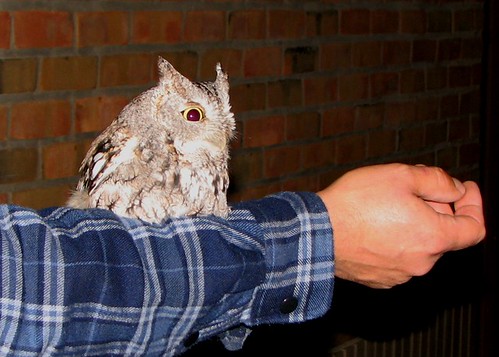
The second bird in was a Screech Owl around 9 pm. This was Carpenter’s first Screech of the season, but it wasn’t unusual to get these owls when setting up for Saw-whets. We could see something red hanging out of the owl’s mouth as it dangled from the net. This turned out to be the birds tongue!  It had inadvertently bit it while struggling but didn’t realize it (see here). I woulda thought, being a Screech Owl and all, that this bird would have been doing some screeching after having just bit his own tongue – but no. Tom pried the beak open and allowed the pink “worm” to slip back into its proper place.

Unlike the earlier Saw-whet, the Screech Owl took offered absolutely no resistance (resistance is futile according to the alien Borg). I would say he achieved a Zen-like level of peace (see below) and closed his eyes during banding (see here), wing examination (see here), and weighting. Only when offered the chance to fly away after the procedure did he finally open up his eyes and drift silently into the dark (see below).

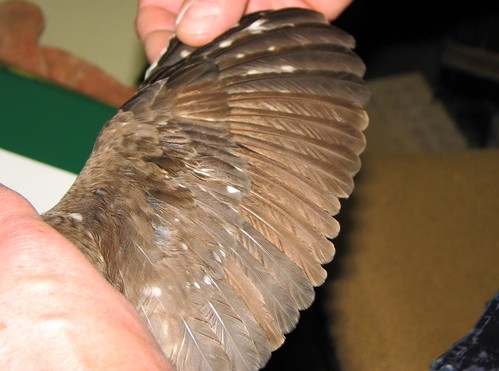
What turned out to be the final owl of the night, another Saw-whet hit the net at 10:30 pm. While the earlier Saw-whet and Screech where young-of-the-year birds born earlier in the season (entering the books as “Hatching year” birds), this bird was at least into its second year. One way to determine age is to look at the wing feathers. The old feathers are replaced from the edges of the wing in or, more technically, from the first primary on down and the last secondary on up. This Saw-whet (much calmer than the first by the way – see here) revealed a clear set of old cinnamon brown feathers that contrasted clearly with the newer darker feathers (see below).

Right wing of Saw-whet showing old & new feathers

Since this last bird was un-banded it was gifted with band number 664-78841 before release (see below). Tom used one of the full-sized bands, I might add, that had EASY TO READ NUMBERS on it. I hope you Canadians out there are listening because all the Saw-whets coming our way are originating from your country, don’t you know. Give us weak-eyed Americans a break. Tom, and possibly myself, will be back owling yet again before this season is over.

In Search of the Wild Asparagus

Although it may not seem a likely topic for a nature blog, I would like to briefly focus your autumnal attentions to asparagus. There is a wild side to this familiar domestic crop beloved by all but small children, dogs, and people who don’t belove it.  Asparagus often goes on the lamb. They jump the fences, and flee the confines of organized agriculture, to become feral residents of our weedy roadsides.

There, among the lush green of spring and summer, the wild asparagii blend in and go undetected by those who would decapitate them. Safe from prosecution they grow beyond harvest size and branch out into leafy mini-shrubs (the vegetative equivalent to growing a scruffy beard). They flower, fruit, and die back just like their wild neighbors. On extremely still nights, the scream of the wild asparagus can be heard – beckoning back to their ancestral haunts in Europe, Africa, and Asia. In autumn, however, this anonymous and savage way of life becomes threatened.

The tall asparagus clusters turn a bright orangish yellow in the fall – marking their locations against the background as clearly as if they were set on fire. They can be spotted by even the most disinterested of passersby (see beginning photo and above). Now is the time, my friends, to mark their presence because this standout color phase continues well into November. You can return to their spot next summer and harvest an unclaimed crop of succulent asparagus shoots. There will be a price for doing so, but that explanation can wait a moment.

Most of us are familiar with the appearance of cultivated asparagus, but many don’t recognize it in the feral state – looking more like yellow tumbleweeds than shoot crops. They become shrubby plants adorned with soft needle-like leaves and red berries. The fruits are poisonous for us, but highly edible for wildlife, which explains how they flee their garden boundaries in the first place (as seeds within bird poo, if you must know).

Even if you don’t end up marking these wild spots, you can still claim the right to shout out, as you are driving by, “Hey look, there’s another patch of wild asparagus” (if there are no passengers in the car, then you can yell this statement even louder). Should you choose to imbibe in the fresh wild shoots next season, the yellow color of the autumn version of the plant can serve to remind you that asparagus has an interesting chemical property.

Asparagus – both wild and tame – makes your urine smell funny. Oddly enough, not everyone can detect this unusual smell because of genetic issues, but all asparagus eaters are stinky pee-ers! As an early 18th century Englishman once put it: “asparagus causes a filthy and disagreeable smell in the urine as everybody knows.” Now dear reader you know and can now add this fact, as well as those mentioned previously in this blog, to your list of useless trivia.

Buckeye Invasion

I feel now that the killing frosts have come, I can say that the Buckeye invasion is over for another year. I’m not talking nuts here or those folks who scream “I O” whenever “O H” is chanted (or those few who combine traits of both). No, I’m talking butterfly here – as in Buckeye Butterflies. They invade Michigan every fall but their stay here is all too short.

I am not happy to see them go, for they are arguably one of the prettiest of North American butterflies. Adorned with peacock spots and bright, but not gaudy, colors they are classic members of the brush-footed clan. This species is frequently used as the poster child to represent all butterflies because they are so drop-dead gorgeous. If you’ve never seen one before then take a look at these photos (below and here) and see if you don’t agree with me.

I can’t remember a time in recent history when I saw so many of these beauties flying about S.E. Michigan. I look every year but don’t find them every year. Whenever I do find one, it was always in the fall. This fall I saw Buckeyes in great abundance no matter where I looked. Everywhere from St. Louis, Missouri to Dayton, Ohio and all parts in-between, they were seen flashing their beauty about. I suspect they had a good year throughout the eastern U.S. This statement may only be a hunch, but I feel like they were probably abundant back in Notre Dame too (a hunch back of Notre Dame, you could say).

Buckeye Butterflies undergo annual migrations as their summer populations swell into late summer. They are basically a southern butterfly that flies between May and October. In good years they can produce up to three broods and each successive hatch is imbibed with increasing doses of wanderlust.  “Papa was a rolling stone,” they chant, “wherever he laid his hat was his home.” Unlike other migratory creatures, these insects actually move north in the autumn to place their collective hats on new ground. Usually these expansions end in death (“and when he died…” O.K, I’ll stop) because they can’t survive harsh winters. On occasion, temporary northern colonies will become established as they recently did in parts of Ontario.

This season was a special one and we’ll see if any of the northern voyageurs will “take” in S.E. Michigan. Nearly all of our regional Buckeyes would have flown in as adults. If the evidence on trail post No. 4 was any indication, however, they might literally be hanging around for awhile. A mystery butterfly chrysalis hanging on a trail podium (see above and here) turned out to be that of a Buckeye. This superbly camouflaged chrysalis was evidence enough that at least one generation of this species was locally produced this year. Fortunately, a return trip to the podium a month later revealed that the creature successfully emerged (see empty casing below). We had, and maybe still have, a native born son in our midst.

Buckeyes overwinter as adults, so it is hoped that this freshly emerged butterfly found suitable shelter before the last bout of hard freezes hit. As I said before, most do not make it into the following spring and this one will probably require an obituary as well. Never-the-less, I will be looking early next year for something I’ve never seen before – a Michigan born Buckeye in the month of May.

A Murderous Migration

The sight of hundreds of crows filling the gray morning sky on Sunday morning should not have surprised me. It was Hallowe’en day, after all, when all manner of dark and suspicious things are supposed to occur (and Crows are both dark and suspicious birds). A “murder” of crows would be a natural part of the script. But, I was mildly surprised. Having already witnessed the very same thing only two days before, I was delighted to be privy to a repeat performance. Yes, there are many dark and suspicious birds on the move in S.E. Michigan.

Crows are unusual in that they are both migratory and non-migratory in nature. Typically they are cold hardy birds which do not shy away from winter conditions. In fact, as scavengers and intelligent opportunists, they actually thrive in the harsh northern climes of winter. The Lower Detroit River region is a winter gathering point for crows. But, local populations – especially those from the Canadian Shield area – do seek slightly warmer climes (with an emphasis on the word “slightly”). They engage in a population shift ranging form a few hundred to a few thousand miles. Southern crows are much more laid back and so they don’t bother to migrate at all.

That these migrating birds were Canadians was evidenced not only from their Northeastern flight origin but also by their slight accent (“Caw Caw-eh”). For the most part the flyover was silent, however. On both days, the crows streamed overhead like a living river. The flow direction of the flock changed course like a rivulet running down a windshield, but it rarely broke up. At the Detroit River crossing the flocks often appeared on the horizon like a haphazard cluster of blown autumn leaves before narrowing to a column. Fifteen miles south, over my yard in Monroe County, the birds stuck to a tighter riverine pattern.

I did attempt some type of quantification. I mean, saying that there was a “bunch” of crows just wouldn’t cut it. “Lots,” “Scads,” or a “Butt Load” wouldn’t cut it either (the latter statement depends on the size of the butt involved and therefore is very inexact). A “murder” is an old fashioned way to refer to a crow grouping, and only by extending this to “a serial murder of crows” could I come to a proper description of the flocks that flew overhead. This, however, would be even more confusing. So, I did attempt to block out portions of the sky for a time and count the individuals flying past. On two occasions I came up with 200 plus birds per minute. At times the combination of distant birds and those flying over at tree top height made it difficult to focus (see below, here, & here). This explains why my other attempts were abandoned in a flurry of Old English phrasing.

It is probably impossible to put a figure on these migration events, but it is easily involved tens of thousands of birds. In other words, a butt load!  Hawk counters at the Detroit River Hawkwatch sight, although focusing primarily on birds of prey, noted the first day’s flight as exceeding 15,000 birds. The Hallowe’en flight was certainly larger than this by a factor of 100 or so.  It is interesting to note that crows have proven themselves able to count. If we knew the language, and the proper French-Canadian inflection, we could probably ask them to account for themselves. Unfortunately, because their kind often proves smarter than we are, we dare not ask out of jealousy.

Whether you like crows or dislike them, the sight of so many of them at one time was an awe inspiring sight. They are native birds who have suffered from the effects of West Nile virus in the recent past. It is good to see at least one component of their population thriving. Oh, by the way, for those of you who are irritated by my spelling of Hallowe’en in this piece I am simply using the old style spelling – the kind found in the type of books which refer to a grouping of crows as a “murder”.

Capertillars in the Round

I have an idea for a new game. It’s called capertillar (cap-er-till-er) curling. It’s like Canadian curling but more exciting, which is like saying that watching corn grow is more exciting than watching wheat grow, but never-the-less. The premise is easy – in fact, stupidly easy. The contestants (I guess two of them because it’s difficult to honestly compete against yourself) go out into the “wilds” and look for caterpillars. They alternately pick them up as found and, if the caterpillar rolls into a ball, then that contestant scores a point. If the picked ‘piller doesn’t ball up but instead stays straight, then a loud air horn is blasted right next to the ear of the contestant and everyone yells “capertillar, capertiller, not a ball but still a piller!”

By the end of the session, which ends after 16 caterpillars are encountered, the loser will be deaf and the winner wins a trip to the annual Woolly Bear festival in Vermillion, Ohio. How’s that for excitement. I said HOW’S THAT FOR EXCITEMENT!  I said H..O..W.., never mind, if you can’t hear me you aren’t the winner anyway.

I’ve still got some kinks to work out. What happens, for instance, if no caterpillars are found or only three are located? What if a contestant eats the caterpillar (which would be a distinct possibility given the fact that normal people wouldn’t think of playing this game). Should the ‘pillar consumer be penalized or perhaps shot in the foot? Oh yes, you laugh now but think of how golf and curling started.

In the process of conducting research for this game I did come up with a few points of reference. For instance, autumn is probably the best time to do this activity because of the plethora of curling caterpillars out there. Most of them are of the hairy variety – either members of the Tiger, Dagger, or Tussock Moth Clan. Cutworms, however, are hairless caterpillars in the smoothy category which also curl up when assaulted (maybe naked caterpillars are good for extra points, eh?).

I think that the key to being a good capertiller curler is knowing your quarry (wearing ear plugs is another key). Those black and brown banded Woolly Bears are perhaps the most famous of the fall Tiger Moth larvae and it’s likely that whole curling tournaments would be played using these little guys. But, I’d like to introduce you to a few of the lesser known curlers just in case.

The prickly caterpillar hairs of the Smeared Dagger Moth (see above) may look intimidating when the beast is curled (see below) but they are not all that sharp. The adult moth is an unassuming brownish gray thing with a faint (smeared) dagger-like mark on its forewings – thus the odd name. As a larva, the dagger is a wetland creature that feeds on a wide variety of plants such as willow, cat-tail, alder, and button bush. It overwinters as a pupa within a cocoon, so is unavailable for winter capertillar curling.

Somewhat friendlier looking, the Hickory Tiger Moth (see below) is a world class curler (see beginning photo). The second you pick the thing up it turns into a fuzzy tire. Despite the name, this larva feeds on walnut as well as hickory and can be found in the vicinity of either one.

It is important to point out that the entire basis of capertillar curling is caterpillar curling. They do this as a defensive reaction against potential predators. When disturbed, these insects roll together in order to protect their soft inner belly. The hairy larvas present a barrage of spiky hairs to their attacker and are difficult to handle when in such a pose, which is an intentional side effect. The smooth-skinned cutworms, on the other hand, are simply protecting their family jewels (even though they don’t really have any at that stage).

There is a final consideration regarding these curling caterpillars – one which, indeed, renders capertillar curling a sport rather than just a walk in the woods. Without exception, all of these curlers will not continue to stay in a tight curl more than a short time. They are not blindly attached to this tactic. If they are handled too roughly or held for too long, they abandon the curl, open up, and try to make a run for it.  Here is the variable factor that should make capertillar curling a real sport. For a curling to actually count, it must be held for at least 30 seconds. If the handled beast unwinds at exactly 29.09 seconds then it’s “WAAAAHNK!  Capertillar, capertiller, not a ball but still a piller!”

This could be big, folks, just you wait and see.

The Shade of Night

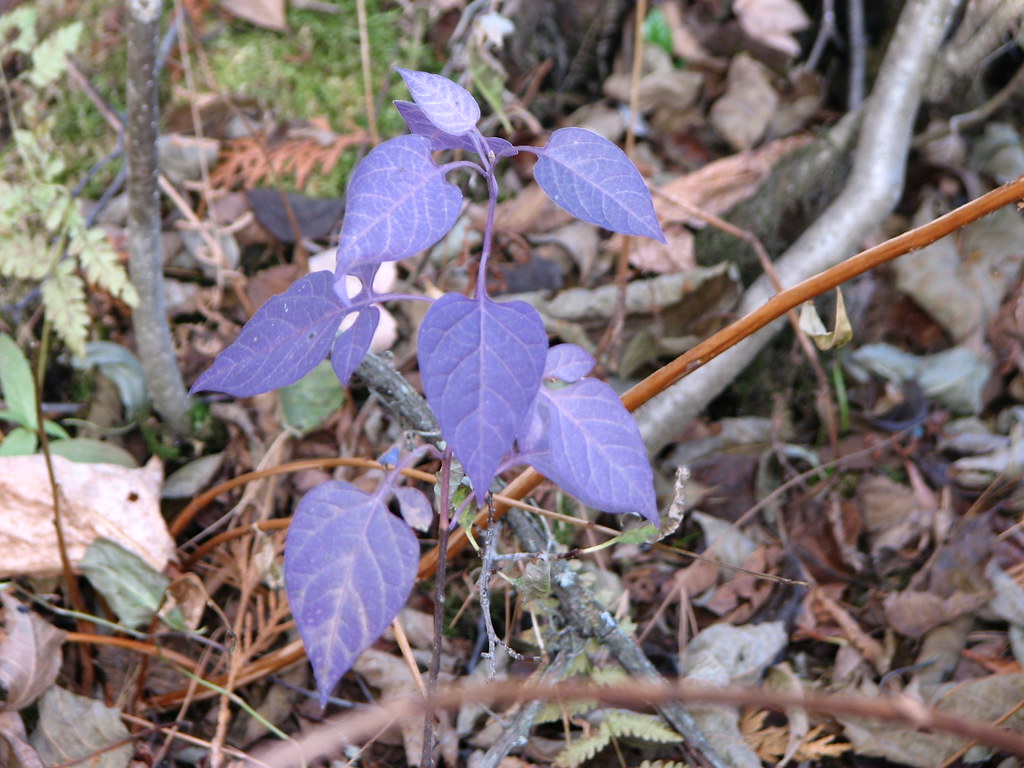
I guess I took it as a challenge – a friendly one, but a challenge none-the-less. A friend of mine was hanging out in the back museum yard as I was doing a public program about autumn. He happened by at the point where I was asking the families to look for different colored leaves. In particular I wanted them to find at least one yellow one, one red one, a red-speckled one, and a dead brown one since I use these colors to tell an autumn legend. At that point my beneficent tormentor loudly suggested that we should look for something impossible “like a blue leaf.”He plastered one of those “S.E.” smiles across his face as he waited for my reaction. I donned a matching smile and replied “Well, smart aleck, there are some blue autumn leaves but I just don’t happen to want one right now.” He laughed, I laughed and we went about our ways. Unfortunately, I just knew he’d be back at me later to find out what this blue leaf plant was and I would have to back up my statement with a picture.

The autumn leaf landscape is indeed painted with a varied palette, but it favors (not counting the original green shades) the red, orange and yellow end of the spectrum. Blues and violets are left to flower petals and fruits. Now, leaves of Ash, Red-panicled dogwood, Nannyberry and the like do turn a really deep purpley brown but the shade never really leaves the maroon family.  There is no way I could argue that a deep maroon leaf was really blue. It had been a while, but I know (at least I was pretty sure) that I’d seen some Nightshade leaves with a beautiful true blue/violet hue in the autumn. The question, however, was if I could actually find one again.

Just in case, I went to the internet to see if I could come up with a picture of one of those blue-leaved Nightshades. Certainly other folks had noticed this. Unfortunately, for a medium that brings us pictures of dogs dressed up in Halloween costumes and portraits of blue frogs, there was not one mention of, or image of, a blue-leaved autumn nightshade. Perhaps my memory was a shade off. I mean, if the internet doesn’t have it – does it truly exist? Thinking that my species memory, not the color memory, was wrong, I tried a lame search for “blue autumn leaves” to turn up something else. No luck. I would have to find my own blue leaf and get a picture of it. I only had a few weeks before I’d have to face my tormentor and produce the goods. Heck, fall itself wouldn’t even last a few more weeks. Maybe I’d have to break out the indigo ink bottle and inject a maple leaf or something!

Just when I had given up all honest resolutions, personal salvation finally came at an unexpected location. While exploring the woodlands across the lake from our West Branch cottage, I shoved through the thick brush that led down to the marshy shore and came upon the remnants of an old beaver canal. There, tucked back among the scrub alders along the edge of the waterway sat a singular blue nightshade (see above and larger version here). This plant was even bluer than I remembered. It fairly glowed in the shade. I got my picture and was satisfied that all my faculties had not yet abandoned me.

The “exotic” plant in question is actually an introduced European plant called the Bittersweet Nightshade. It can become a noxious weed in pastures but it pretty much keeps a low profile. The fact that it requires saturated soils keeps it confined to wetlands. Slightly poisonous, this viney plant produces a chemical called Solonine – a toxin shared by many other members of the Nightshade family such as potatoes, egg plants, and tomatoes (yes, I said tomatoes, but you needed worry since it takes a different form in our garden variety plants). Nightshades produce tiny red fruits that taste so bad that very few things eat it by accident.  Though sharing a surname, the Bittersweet Nightshade has nothing to do with the highly toxic Deadly Nightshade of crime & mystery novel fame.

I realize the question remains as to why Nightshades turn blue when no other local plant does. Unfortunately I have no real answer for you or my sarcastic tormentor. Sure, I can say that the hue results from the anythocyanins in the leaf but little else. It does appear to relate to the particular situation in which a plant is growing. Those growing in open sunny areas don’t seem to turn blue while those within shaded situations do. Even on the same plant there are some leaves that take on the hue while others stick to their green & yellows.

As it turned out, I later found a few more of the plants closer to home (frighteningly close to where the initial smart aleck remark was first made). Armed with these photos and the confirmation that not all my memories are false (although I still believe my dad called off a tornado once) I am ready when I next see my nature heckler.

Cranes in a Cow Field

The rolling hills around West Branch, Michigan are a patchwork of pasture, marsh, hayfields, and woodlots. By mid October the colors are confined to muted greens and browns with a scattering of dark green Balsam Fir and White Pine thrown in for effect. Although most of the deciduous trees had already shed their leaves, the Oaks remained rich ochre and the Sugar maples were still holding onto their crop of bright orange leaves – lending patches of fire to the autumn landscape.

Against this background, which also included herds of black and white cattle, it was a large group of tall gray birds that commanded the most visual attention. My wife and I came upon a flock of migrant Sandhill Cranes as we traveled along one of the back roads. It was late afternoon, around 4 pm, and the low angle of the fall sun highlighted the gangly group as they sauntered through the pasture. Their white cheeks, elevated above the ground about four feet, caught the light. There were about 60 of them and they were strung out along the low weedy portion of the fence line.  The combined sight of wild birds and tame cows in the same field made for an unusual view.

The sight of Sandhill Cranes, the tallest resident bird in the state, is not an uncommon thing in most parts of Michigan. There is a firm breeding population here and both the rusty summer birds and their offspring are regularly seen in local pasturelands.  Starting in late September, the big birds assemble and begin to gather into large “staging areas” in preparation for their long journey south – a trip that takes eventually takes them to north-central Florida.  By October, the migration is in full swing and places like Waterloo Game Area near Jackson become populated by thousands of staging birds. These pasteurized West Branch birds were part of a migrant flock probably making their way down to Waterloo.

I pulled off the road to get a better look at the creatures and aroused the suspicion of the farmer across the road. I assured him everything was alright and asked him about the cranes over yonder. “Oh them, “he grunted, “they come here all the time – especially in the field behind the house.” There was large marsh there and I gathered that is where these birds would probably spend the night.  As he turned to amble back to his ramshackle farmhouse he added,”yeah, they are pretty wary too.”  True to form, the birds were keeping a keen eye on me and the car even though we were probably over 1,000 feet away and not getting any closer due to the fence. The cows didn’t pay us any mind.

One thing that was notable about these fall cranes is that they were clean gray in color. As I alluded to earlier, their spring/summer plumage is typified by a rusty – nearly deerlike – shade of brown. They literally get this from the iron-rich muds found in their breeding marshes.  By fall, the rusty feathers are mostly replaced by gray ones. A few of the birds retained an umber shoulder bar and the younger birds still sported brownish plumage.

As one sub-group ambled into another, they erupted into a bout of gargling and dancing (which is about the same thing that people do, now that I think of it!). This was part of a greeting ceremony which involves wing-spreading, jumping, and calling. Several of the birds spread their wings and bounded straight into the air similar to the style of African dance (see below and here).

The call of the Sandhill is one of the most distinctive sounds in nature and one which carries for long distances. It’s hard to define, or confine it, as an English phrase, but “garoo-a-a-a” with a rolling “r” does the trick. Even though the wind was carrying some of the sound away from us, it was still very clear (listen to recording here). It’s a wild sound that, like the wind, never sits still.

We returned to the spot the next day, but the birds were long gone. The cows were there, along with their pies, but the pasture was once again quiet and domestic.