A Dusty Road Tells All

Most of the posts originating from my Dollar Lake cottage have focused on the lake side of the yard.  This is a perfectly natural thing given that this is the view that brought my wife and I there in the first place. This also happens to be the view which denies the presence of my neighbors or of the road that brings us there. In lakefront cottage lingo, this is the front yard.

The back yard faces a scattering of small cottages and a few long forgotten trailers distributed within a thin oak/heather woodland. I do occasionally go on early morning rambles along the “streets” of my northern Michigan neighborhood since this is the so-called sunrise side of the place. To call them streets is, of course, a wide stretch of the imagination because they are really nothing more than sandy strips of earth. In some places, they are mere two tracks which only feel the imprint of few passing vehicles daily. Because there is no night traffic on these roads, they act as faithful recorders of the animal activity of the “hood.” Every night creature that passes over the dusty strip is recorded in the powdery medium. Although often these tracks are subtle, the hard angled light of the rising sun acts to highlight these traces. This is why I take those early morning rambles – to read what nocturnal nature has written.

Probably the most frequently encountered sign is that of the lowly American Toad. Because their gait is rather short, individual toads are required to leave a lot of toe pad prints over any given stretch of road bed. When hopping, something that toads are not very good at but will attempt, they leave clustered prints clearly showing toe pads and the distinct toe-marks of the hard inward curled front feet (see here). In reality, Toads walk most of the time so their tracks exhibit the measured gait of a four-legged creature (see above).

At one location, a toad tossled with an insect and in so doing left a whole patch of toad marks (see above). This location looked more like a dance floor than a road bed (I understand toads can do a mean Tango). The trail of the ill-fated partner in this dance, an insect, was barely detectable in the upper right hand corner of this “kill site” as a set of parallel commas. Needless to say, the insect trial stopped at the center of the dance floor and only those of the warty amphibian left it.

Further down the road, the distinctive tracings of an unmolested beetle (see above) were in evidence where it crossed the dusty stretch. A snake, likely a Garter, produced a linear trace adjacent to the beetle tracks (see here). Since tracks of this nature do not leave a time signature, it was impossible to say whether the snake was in pursuit of the insect or just sharing some temporal space. It was relatively certain that the combination of cat and mouse tracks (see below) were laid down at vastly different hours. The white-tailed Mice that laid the set of tracks crossing the image from left to right cross the pad marks of the passing feral cat. The cat eventually ended up in my yard feeding on the fish remains down by the dock at 3 am (thanks to a capture on my trail cam).

The paired impressions of a cottontail rabbit (see below) clearly show where the front feet landed (to the left) and the longer hind feet eventually struck ground at the right. The creature was in fast mode at the time and was probably uncomfortable crossing the open sand in the moonlight. Oddly enough, I saw no raccoon tracks after several consecutive morning searches, but did see ample opossum tracks, deer, and even the singular pads of a coyote (see here).

As early as I rose to meet the sun each day, there were plenty of day shift workers that beat me to it. Their marks were already beginning to add a new layer over the previous night’s tracks. As evidence of this, a clear set of evenly paced Mourning Dove tracks (see below), some Turkey tracks (see here) and even a Grey Squirrel made their presence known.

The road slate was wiped clean by the end of each day – ready for the telling of new stories.

There was one track maker that was still in the road as I passed on one of the mornings. This fellow left a set of quizzical flailing marks in the morning dust. They were like those of a wounded snake only much smaller (see above). Fortunately, the solution to the origin of these marks was only a few inches away and in the process of making similar tracings.  I’d like to see if you can figure it out, before I reveal the identity of the maker. It is a squirming linear beast of moist soils. Let’s just say that this creature, unlike those I recorded earlier, was not well suited to crossing dusty roads. He was dragging much of the road with him by the time he struggled to the other side. Give up? O.K., click here and read the title of this photo. You could call this a dirty trick, but I prefer to call it a dusty one.

Who Dat!

There are some critters that are continually remarkable. No matter how many times you see them, each sighting causes instant amnesia and a declaration of surprise and new admiration. For me, sturgeon and newly emerged Polyphemus moths are like that, but I have a special place for the likes of the Spicebush Swallowtail Caterpillar. This is a creature that hides all the time and rarely moves unless prompted, but oh, how well it is packaged and presented.

In spite of their name, Spicebush Swallowtail larvae can be found on Sassafras trees as well as Spicebush bushes. The female butterflies will lay their eggs equally on both. This probably presented a small problem in the naming department at some point. Folks just couldn’t go around saying things like “Look there’s a Spicebush/Sassafras Swallowtail.” Name simplification was required. Spicebush sounds more exotic and alluring, so that was the name that stuck. I mean, a Sassafras Swallowtail sounds more like some kind of tame Root Beer Drink. A Spicebush Swallowtail, on the other hand, sounds like something that is alcoholic and perhaps even illegal on Sundays in some parts of the country.  Fortunately, this swallowtail is not a drink, legal or otherwise, but it is refreshment for the eyes.

Finding the larvae of this species involves a bit of a search. It is like searching through the Christmas packages to find the one with your name on it (What! Only one!). You need to search through the leaves to find one that is folded like a taco (Yes, I know, we don’t get tacos for Christmas but I am on to a new analogy now.) Take a look at the photo above and you’ll see what one of these tree tacos look like. From their very first stages, the caterpillars create these structures as protective shelters. They do this by weaving a mat of silk on the upper leaf surface –an act which eventually causes the two leaf edges to draw together to create a leafy taco. The larvae will exit the shelter to feed and retreat to it when resting or changing skins.

As the caterpillar grows, it creates larger shelters in order to accommodate its increasing size (about 2 inches at maximum size).  This means that there will be a series of these tree tacos spread about within the feeding area of the larvae. You’ll need to look in all of them in order to find the resident ‘piller. Since the top edges are not knit together by silk you can carefully slip your finger in the top and force it open. The empty ones will occasionally have a spider inside, so do your duty carefully. Upon opening an occupied shelter you will still jump back a little because the Spicebush Caterpillar is a shocking beast (see below).

Adorned with a double set of false eye spots, the caterpillar looks like a miniature snake. It positions itself within the taco tube so that the fake eyes are facing upward toward the stem. This front door entrance is left open for exit and entry and you could, if you wanted to skip all the package opening, look down into the doorway and see the larvae before opening the shelter (see beginning photo). But, where is the challenge in that!

The pseudo eye spots are there to frighten potential predators. You can get a good sense of that when you first open the leaf (see above). If agitated, like all members of the swallowtail family, the larvae will extend a pair of brightly colored stink horns out of a pouch just above the head, but they are not prone to do so unless really bothered. Once you are over the initial shock, you then have time to admire the rest of the lime-green body adorned with powder blue spots. The lower half of the caterpillar, including the real head, is subtly colored. The bright upper half gets all the attention and I think you’ll agree that it certainly deserves it – again and again (see close up here). By the way, should you find a spicebush caterpillar that is bright orange, instead of green, that means it is in the final stages before pupation.

I have a Sassafras tree in my backyard that regularly hosts these caterpillars and I try to find them there every year. Sure enough, every time I do find one I am delighted and visually refreshed. Call it short-term memory loss or low expectations on my part, but let’s call it what it really is: Nature is a present that continually gives.

Hot Snake on a Hot Day

This was the first time that I’ve seen a water snake lingering by my Dollar Lake dock. The creature just seemed to appear. I walked by the spot once and when I turned around, it was just there – lounging in the weed-choked waters under the glare of the mid-day sun.  A nearby green frog, only a few feet away, also apparently saw it and froze like a fawn trembling in the presence of a hungry wolf. The wolf, or snake in this case, was not in a hunting mood but rather in a lazy sunshine basking mood. The frog was not in a discriminating mood, however, and chose to react as if the situation were potentially deadly. Frogs don’t have the luxury of mistakes. So, there next to my dock was a still life consisting of a very rigid snake and a stone-like frog set among gobs of submerged plant life.

My first pictures were tentative and quick in the event the creature – the snake, that is – decided to dart away. Water snakes can be notoriously shy and flighty. But, after a dozen more shots I finally realized that this one was either dead or in a hypnotic basking state. It was equally oblivious both to me and the frog. It moved once, so I determined that it was not dead.

As a species, the Northern Water Snake is a variable creature of color. You may recall the pale sub-species I introduced to you last year from the Bass Islands of Lake Erie. Some can be nearly black in shade, while still others sport a stunningly beautiful red-brown and cream combination. My Dollar Lake snake was average in all respects.  One pattern aspect worth noting is that the markings on the first third of the body are bands running across the width of the snake and these bands eventually take on a broken rectangular design with alternating side blotches at the tail end. There is pattern to their pattern, you could say, but that would be a relatively meaningless statement akin to saying “all you need is love”. But, since I’ve already said it, we need to move on and trust our short-term memory to erase the whole thing.

The creature did appear to be smiling as if it were enjoying its sun-induced stupor.  The curved jaw angle implied a somewhat sinister, if not menacing, look to the face. Combined with a relatively flat head and forward placed eyes, the look of a water snake is one of unintentional slyness. Of course, you can’t judge a book or a snake by its cover. There are no mean or sly animals in nature – they just are what they are. True, water snakes tend to be more “bitey” than other snakes and possess anti-coagulant saliva to induce heavy bleeding, but not all of them choose to exhibit this trait. This one, for instance, made no move to strike at, or escape from, the inquisitive naturalist hovering around it.

Another detail easily observable on such a still snake, are the keeled scales (see detail above). In other words the individual scales each have a ridge running down their centers like an over-turned boat. One needs to pay attention to such things when identifying snakes because some have keeled scales while other do not. Scales without keels are called smooth scales. I’ve just blurted out another meaningless statement, didn’t I? Sorry, that was almost like saying that water snakes live in the water.

Thanks to a paper by some Rutgers University researchers, I can now say something meaningful about basking water snakes. Through their research, it has been determined that New Jersey Northern Water Snakes will engage in basking when the air temperature is between 53 and 86 degrees F. and the water temperature is cooler than the air. The greater the difference between the two temperatures, the greater the chance that basking will occur. They do not generally bask on really warm days over 89 degrees F. According to this group, the snakes typically choose a dead cattail clump or a low-hanging clump of willow branches as their basking site. Oddly enough, my snake was simply lying exposed on a bed of vegetation on a very hot day where the water was about as warm as the air. So, this proves that Northern Michigan Water Snakes don’t read and New Jersey Water Snakes do.

I did not share any of this with the terrified Green Frog for it would only fall as meaningless vibrations upon his quivering little ear drums.

Crater Makers

One of my favorite movie scenes of all time is the sequence that takes place over the giant Sarlacc pit in which Luke, Leah, Chewbacca, and the gang avoid certain death in the open jaws gaping at the bottom of the pit. I am, for those of you not versed in classic science fiction, referring to the Star Wars series and the movie Return of the Jedi. The scene takes place on the desert planet of Tatooine “a long time ago in a galaxy far far away.” Specifically the creature is in the great pit of Carkoon in the northern Dune Sea, but let’s not get too picky here. The creature depends upon wandering creatures and/or villains to bumble into the pit and slide down the sandy slope to their doom.

Fortunately, or unfortunately – depending how you view such things – there are real life Sarlaccs right here on earth in a place not so far away. They are the larval form of an insect called the Ant Lion. Although only ¼ inch long, these un-worldly looking beasts create sand craters in order to trap passing insects such as, well, ants.

Most nature type folks are aware of Ant Lions, but they are always worth a closer look. I fondly remember spending countless hours, as a kid, tossing ants into the neighborhood ant lion pits just to watch them die. This activity was much more satisfying than cooking ants with a magnifying lens. It’s been a very long time since I’ve sacrificed an ant at the altar of craterdeath, so I decided to try it again. The results were surprisingly tame this time around. Perhaps youthful imagination provided the screams of agony and the roar of beastly madness, because each event was over in a silent flash.

The larvae of the antlion looks like a hairy wart coupled with a pair of nasty hedge-clippers (see above). Arguably, it is one of the ugliest creatures on earth with the possible exception of Dog the Bounty Hunter. It is a hunchback thing with (proportionally) enormous toothed jaws. They construct their sand traps through a series of backward spiraling movements. The sand is flipped out at regular intervals with a jerk of the head. Eventually an inverse cone is created in which the sides are barely stable (something called the angle of repose). In all, the structure varies in size from one to two inches across. The larva positions itself at the bottom with only a portion of the head and jaws exposed. There it waits with infinite patience.

When an insect does tumble in, or one is thrown in by a sadistic naturalist, it attempts to scramble up but the sides collapse inward with each struggle. The ant lion strategically flips a load of sand at the prey to hasten its fall (You can watch the sequence here – the first part in regular time and the second in super slow motion.). Once in the grip of the lion jaws, the victim is paralyzed and its innards are summarily sucked out. This is why there is very little action at the Sarlacc pit after the initial struggle. Like a used box drink, the empty carcass is later flipped out of the crater.

It is worth noting that the antlion has no anus with which it can poo out the undigested remains of its prey. They essentially store up all this youthful crap and wait until becoming an adult to void it. This goes a long way to explain why the insect has such a big butt.

It can take up to three years for an ant lion larva to grow up (and eventually go to the bathroom). As an accidental predator it takes that long to ingest enough prey juice and gain enough weight to take life to the next stage. The adult antlion, by the way, is a very wimpy looking creature indeed. It is the Dr. Jekyll to the Mr. Hyde.  Think of an anemic damselfly with a set of ridiculous looking antennae and you have a good visual image of the adult. The name “antlion” is definitely all about the larva. It is the vicious larva that was depicted on ancient Mimbres Indian pottery and this is the beast that captures our current imagination.

Agrimonious Assault

Yes, it’s yet another picture of a fawn. This time the season is advanced and the little one is not quite as cute as it once was. The spots are rubbing off and it’s getting a bit angular in the face. Here we have a teenaged white-tail dorking about in the underbrush. If he had a voice it would be cracking with indignation: “Hey, what you looking at old timer? Get lost!” The last time I published a fawn picture (in early June, I believe) it was of a pair of giddy young’ns prancing about like puppies. Not long after I shot that video a coyote downed one of those fawns and crunched upon its tiny bones. He chose the original video location to make his kill as if to make a point. The other fawn survived. There is a distinct possibility that this gawky deerlet was that very survivor fearful of my taking another image – deer end up dying when I “shoot” them!

Now, I have no intention of publishing another deer picture just to talk about deer. I have much better things to do with this one. Upon close examination of the shot I later realized that this fawn had also been the victim of an assault. Look closely at the animal’s side and tail (see detail of de-side and de-tail below) and you can see that it is covered with Agrimony seeds. This critter was the victim of an Agrimoniuos assault! The result, however, was of a far different nature from a coyote assault.

Agrimony is one of those plants which bear hitch-hiker seeds. They depend upon passing animals – usually mammals – to distribute their seed capsules. In the form of this fawn, we are seeing this tactic played out as it was originally intended. The seeds will eventually get rubbed or picked off and drop onto the ground in a place far from the mother plant.

The plant is not terribly noticeable, being only 1 -3 feet high and rather gangly. The leaves are compound with deeply toothed leaflets (see above). One distinctive feature of Agrimony leaves is that they have little leaflets interspersed with the larger leaflets along the petiole.  Long slender flowering stalks extend up to deer belly height and bear a line of multiple tiny yellow flowers during the summer. These flowers mature into cone-shaped seed capsules at summer’s end which are equipped with a ring of crochet hooks at the wide end (see below). These hooks, identical upon close inspection to those on the hook side of a velcro strip, latch onto passersby like a mail bag onto a rumbling train – it only takes a slight brushing to dislodge them. Often, as was the case with this fawn, the whole seed-bearing frond goes for the ride. Yippee!

Specifically, the species in this discussion are called Small-flowered or Swamp Agrimony. These plants hang about in wetland or lowland situations and basically wait around for visitors. There are many species and Agrimonies are found throughout the world.  So, as you can imagine, they are known by many names by many people. I’m sure European deer have names for them too (stickbutt, comes to mind) but because people do the naming on this planet we need to stay with what we know. Because of their fondness for grabbing onto folks as if desiring their company, they were once dubbed Philanthrops (like philanthropists or lovers of mankind). In England they are known as Stickleworts or Harvest Lice. The English names certainly have a nice Dicksonian ring to them. In fact, Agrimony itself is a Dickens type name because it has a negative sound that fits right into the Scrooge and Marley mode.

You needn’t worry about looking for Agrimony, Sticklewort, or whatever you wish to call it, for it will find you. It has no preference as to nationality or even species!

A Bee or Not a Bee

O.K., so I was wrong. It happens every once in a great while – like solar eclipses and comets that arrive only a few times in a lifetime. O.K., so I am wrong about the infrequency of my wrongness, but I rarely mistakes (insert wink icon here and add the word “make”). Anyway, in the presence of small quick flying metallic green hymenopterans (bees and wasps) I generally resort to calling them cuckoo wasps. These emerald iridescent creatures get their name from their habit of parasitizing other wasps, just like European cuckoos which lay their eggs in other bird’s nests. They are electric green and fairly common, so most of the time my cuckoo wasps turn out to be just that. In a recent episode of hymenopteran naming, however, my cuckoo wasp label turned out to be, well, cuckoo.

During the initial stages of an archaeological dig, which I conduct as part of the interpretive program at the museum, we started scraping the soil to begin the day’s dig. A few electric green insects were exposed a few inches down and they took wing soon after being revealed. “Cuckoo wasps, “ I confidently proclaimed.  A few more came to light after a few more scrapes and again I identified them as cuckoo wasps to the volunteer archaeologists around the pit, although I was beginning to wonder what was going on. You usually don’t see a whole bunch of cuckoo wasps together any more than you see a flock of cuckoo birds. There was an outside chance that this was an unusual example. The third bout of scraping uncovered something very unusual indeed. This find proved to be the one which allowed me to de-cuckoo my green insects and give them the proper name they deserved.

There in the soil appeared something which appeared to be a perforated metal plate (see here a camera phone image of the find). In fact, one of the diggers pointed out that it looked just like an A.C. Delco Oil Filter – a PF3361 to be exact. Now this archaeological site is an old house site that dates Ca. 1800-1860, so one wouldn’t expect to find an oil filter there! Whatever it was, it was very hard but didn’t feel like metal. It felt more like hard cardboard. Just about the time I was about to proclaim it an early paper version of an oil filter, several of those green “cuckoo wasps” poked their heads out of the “holes” (see detail here). Since cuckoo wasps don’t nest in colonies, these things had to be something else. In other words, I was wrong.

In the final diagnosis, this structure turned out to be a grouping of Halictid Bees. I was able to arrive at the correct solution after hitting the books and looking at a few internet references. Even though the general appearance helps, the final call came only after examining the wing venation – the details of which I will spare you. These metallic green bees are sometimes referred to as sweat bees because of their alleged habit of licking up perspiration. In detail (see below and beginning photo) they are stunning examples of the bee clan. Most of the exposed bees were newly emerged adults fresh from the pupal stage.

There remained one more hurtle to overcome in this case. Halictid Bees are solitary bees which dig burrows in which to raise their young. They are not colonial. So, why the hive-like look? In this case what we have is merely a collection of burrows. The individual bees do not work together and, although they may talk over the fence every now and then, they do not barrow cups of sugar. Beyond the even pattern of holes, the individual burrows take their own divergent routes. This type of Halictid Bee is actually taking some evolutionary steps back toward colonialism (and no, I did not make that fact up).

Now, we have all the answers in one place and the world can remain turning.  I could only imagine the consequences of discovering that our early Michigan settlers used AC Delco oil filters and that cuckoo wasps run the earth.

Unfortunately, it was too late to tell all this to my volunteers. I’ll have to fess up next time I see them. Come to think of it, our dig season is over, so I won’t see them until next year. Gee, I hope I don’t forget to bring the subject up.

Full of Bull

There’s a lot of bull in this world. No, I don’t mean the “B. S.” kind of bull, although there is plenty of that to go around too. There are many things that bear the name “bull” something or other – a term usually attached to denote something large or pugnacious. For example, bull thistles, bulldogs, bulrushes, bull snakes, bull sharks, and – of course – bull moose and bull cattle are good examples of living things bearing the name. There are no bull shrimps as far as I know. Bull Durham is a tobacco and a movie, so it doesn’t count – either does Kevin Costner, although he can be full of BS at times (by that I mean big screen, I think).

Since there are so many bull-like things roaming and growing out there, it is inevitable that they will come in contact with each other from time to time. Most of these contacts are of a benign nature – bull cattle won’t each bull thistles, for instance, so they let them be. If a bull moose were dropped into the ocean, then the bullshark would definitely be at an advantage, but there is no logical scenario on earth that would put a bull moose with a bull shark unless they are both dead and stuffed in a museum. In that realistic case, however, they would get along famously. Realistically, there are situations in which an encounter of bulls could be deadly for one or the other. Bull moose will eat bulrushes on occasion and bulldogs could rip the tar out of a bull snake if they were in a suitably pugnacious mood.

On a recent walk I encountered just such a negative merger of bull-named things – a bullfrog in the process of eating a bullhead. The frog initially caught my attention because it was in such an odd upright position. I didn’t see the reason for this pose until I focused my lens on her. Although not as exciting as smack down between a bull moose and a rodeo bull, it was interesting – in a slow motion sort of way. The frog was a medium-sized individual, about hand-sized, which had selected a 4 inch bullhead catfish for its meal of the day. Had the quarry been any other critter, it would have disappeared down the big frog’s gullet without delay. Bullheads are armed with spines, however, and they don’t go down so easily.

The frog probably made the grab long before I came upon the scene. As a reaction, the small bullhead would have locked its pectoral (side) fin spines as well as the single spine on the dorsal (top) fin. Rather than rip himself a new esophagus, the frog simply waited for the fish to die. He waited at least ten minutes into the period I watched him, during which time the hind end of the fish hung out of his mouth like a wet noodle. Without any expression, and only an occasional pass of the front foot over the prey, the bullfrog remained motionless. Finally, the limp fish was re-positioned sideways and folded in half for the stomach-ward journey. I would think that this would have been the worst way to swallow a spiny fish, but what do I know. I gave up on catching the last gulp since it was going on twenty minutes and I had some drying paint that needed watching, but I’m sure the deal was all but done.

Bullfrogs will eat just about anything that will fit into their mouths. This list numbers insects of all description such as dragonflies and moths, but also includes other frogs, mice, and even small birds. Fish are on the diet as well, but not as often as you’d think because they generally don’t take prey under water. I suspect this individual popped the bullhead as it rose to the surface to catch some prey of its own.  Bullheads are also known for eating just about anything – including frogs – so there were several layers of poetic justice going on in this case.

As a final piece of semantic completeness in this bull-eat-bull situation, the small pads upon which the frog was perched were obnoxious alien plants which are new to the Lake Erie marsh scene. They are called, and I am not making this up, European Frogbit. So, it appears, bullheads have bullfrogs to bite ‘em and pads under the frogs that bit ‘em… and that’s no bull.

Hiding in Plain Sight

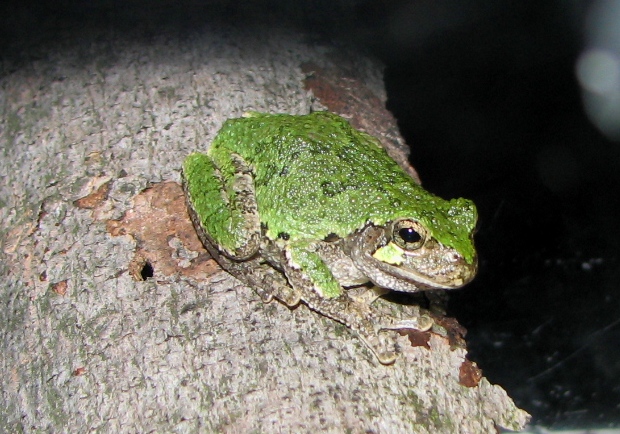
If you think that Gray Tree Frogs are gray frogs that live exclusively in trees, you’d be mostly correct. If you are one of those types who want to be right all the time, however, then you shouldn’t say such a thing. This statement isn’t incorrect in itself but it is incomplete. Because Gray Tree Frogs are often green and they spend the most important part of their lives in the water or in the ground, they defy simple description. Even their scientific name –Hyla versicolor- refers to the multi-colored nature of the beast. Not all Gray Tree frogs are even Gray Tree Frogs! (there is a genetically different, but visually identical, species called Cope’s Tree Frog). No, if you want to be right all the time you should avoid nature entirely or get used to qualifying your statements. I suggest the latter.

So, it is safe to say that all Gray Tree Frogs spend a great deal of time in trees and shrubs. They are all (note the definitive nature of this particular statement) equipped with marvelous toe pads which act like suction cups for climbing (see below). They are very adept at performing acrobatic feats thanks to their acrobatic feets and can jump from limb to limb or even climb glass.  It is also safe to say that when you hear them calling during warm summer nights, you will hear that sound emanating from over your head. Here is where a qualifier needs to be inserted, because that same sound, when made on a warm spring night, is more apt to come from ground level – or, more appropriately, water level.

The distinctive trill of the Gray Tree Frog reminds this naturalist of the churling sounds of the raccoon. I don’t like to think about raccoons more than I have to, so let’s just say it sounds something like the churling notes of the red-bellied woodpecker. Or, if that doesn’t work for you, then just listen here and come up with your own description for goodness sake!

Tree Frogs come out of hibernation (in the ground, by the way) in the springtime and congregate in woodland ponds. There they commence calling in order to attract mates and lay eggs.  In this regard they are like all other local frogs and toads. Although, unlike many other frogs and toads, they tend to call sporadically throughout the summer months as well. Their call is loud enough when blurted in close vicinity, but it doesn’t carry very well. I’m sure there are those who would argue with me on that last point but to those types I would suggest climbing a tree and staying there. Either way, it is generally truthful to say that Tree Frogs are heard far more frequently than they are seen.

I waited until the dog days of summer to bring up this topic because it took me that long to finally get my hands on one. I’ve heard them calling from the spring pond across from my house (first part of the recording) and from mid-summer tree tops (second part of the recording) but I never had one framed within my lens until one was brought to my attention earlier in the week. The individual portrayed in these accompanying shots are the same beast even though he looks different in each picture. This is the problem with Gray Tree Frogs – they are hue shifters.

It takes around a half hour for an individual to change color. They do so by controlling the pigment in their star-shaped skin cells. Though they can only go from green to gray and back again, they can also control the intensity of the dark splotch pattern found on the back. The sides appear to stay gray for the most part regardless of the chosen back color. Against natural settings, Gray Tree Frogs are masters of camouflage. Since the color choice is primarily intended for the daytime rest period (they are nocturnal) Gray Tree Frogs can pass the daylight hours in either color mode depending on background. In the photo below, this fellow was resting up against the chunk of bark and his pattern matched perfectly. The second photo is of the same frog at night, at which time he was in green mode (see here also).

Oddly enough, the reason this frog was caught in the first place was because it was attempting to blend into a pinkish gray block wall. For some reason our frog reasoned that bright green would work in order to blend into such a background. Needless to say it stood out like a sore thumb or shall we say like a tree frog on a block wall.

A Stone Cat on a Hot Town Night

Kyle is one of those old-fashioned kids who have no apparent interest in the trappings of the modern age. I guess I’ve known him since he was around eight or nine years of age, but it’s hard to tell. Apart from height he has not changed much and is ageless in a very good way. He delights in stomping through the reeds hunting frogs, handling turtles, and fishing. He especially likes fishing – simple fishing with simple gear. In another age he would have been called Tom Sawyer. I could always depend on him to come up with a constant stream of live specimens for the museum. Now that he’s in high school, I can still depend on him.

He and his friend, Huck, (not his real name but it might as well be)  have been spending quite a bit of time engaged in night fishing on the River Raisin in downtown Monroe. Two weeks ago he came in and described a fish that they caught one hot summer night in the riffled shallows. “I think it might have been one of those Madtoms,” he said in reference to another fish I introduced to him some time ago,” but it was kinda yellow and about 8 inches long.”  Recognizing that Madtoms don’t get nearly that big and that if they did they would become Angry Toms, I proposed that it must have been a Stonecat. He looked at the picture and agreed.

Given that I’d never actually seen a Stonecat before, I asked him what became of it. Unfortunately, he said, they put it in a friend’s aquarium and it died. “The dead fish,” I asked, “what did you do with that?” “Threw it out,” he replied regretfully (only in Kyles’ world does such a statement become regretful). I wished him luck on his further fishing adventures and off-handedly suggested that next time he captured one that he bring it in. “Dead or alive, rotten or fresh” I quipped. I should have known better than that.

The following week, “Tom and Huck” walked through the door with a bucket containing a very live Stonecat. Although neither will admit it, I believe the two fished every hot sweltering night for a week in order to get me one of “those fish.” I would have felt guilty except that I know they loved every minute of it!  “Huck” had even photographed the thing on his cell phone to show its true colors in case it died.

At this point, my narrative needs to shift on to the fish itself before I run out of internet cyber space – or whatever you call it. I just wanted you to know that this catfish moment belongs to Kyle.

Stonecats are not terribly rare, but these diminutive members of the cat-fish family, which rarely get over 10 inches in length, are often over looked. They appear to be young bullheads at first, second, and even third glance. Most probably get thrown back without further thought. Like bullheads, they are nocturnal bottom feeders with “taste-sensitive” whiskers and sharp fin barbs.  They are much flatter and pointier than bullheads, however, with pop-eyes and a continuous fin around the entire back end of the body like a tadpole (see below). In reference to this last feature, their scientific name Noturus flavus literally means “yellow fish with a tail over the back.”

Held within my hand, the creature looked and felt strangely frog-like (see here) . Not only was it scale-less, but this cat was extremely slimy and very hard to hold. Also, like any good cat, this one could scratch. It nabbed me without even blinking one of its googley eyes. There is a stout sharp spine at the leading edge of each pectoral, or side, fin. A narrow channel in the spine conducts a mild dose of venom which creates a distinct stinging sensation when injected. This is a predator defense tactic. I was injected, if only slightly, in the process of handling the fish. You can see the tiny blood spot on my hand in the portrait picture below.  Fortunately, this little prick didn’t cause anything other than a short recurrence of Tourette’s Syndrome in this human.   The fish died the next day.

At any rate, it’s good to know that there are Stonecats living in the River Raisin. At Kyle’s fishing location, the river runs very shallow and fast over a bottom of natural rocks and pebbles. This is prime Stonecat habitat. The lower stretch of this river has seen some issues with pollution, especially where it exits out into the waters of Lake Erie, and their presence there is a positive biological health indicator.

Here’s to Kyle, Huck, and the riffling Stonecats of the River Raisin.

Hair Worms in a Hair House

In the caterpillar world, hairiness is a means of passive defense. Most birds really don’t like to eat hairy things and for good reason. Some larval moths develop stiff irritating hairs that shed and stick like miniature barbs while others adopt the “birds will not eat a pom-pom” approach by covering themselves with long silky locks that clog up throats. The avian aversion to hair is understandable. I don’t like to eat hairy things either – extremely fuzzy peaches, for instance, are a challenge and I would never eat a whole cat. In some parts of the world where people actually eat caterpillars, they gravitate to the hairless ones such as African Mopane worms. (By the way, for those of you now forming some sort of statement pointing out that insects and peaches don’t have real hair, I wish you to stop right now. I know this and I don’t care this).

Fall webworms are a fuzzy lot, so you’d think that would be enough in itself for a short happy life. These larvae are covered with fine white silky hairs and they eventually become fuzzy white moths. That’s enough mouth-gagging pile to stop any mouth. They collectively know, however, that there are many other agents of death out there that have no aversion to hair such as parasitic wasps and ‘piller pillaging hornets. (For those of you who are now preparing to say that insects don’t really think, I would again ask you to stuff a pom-pom into your mouth). Webworms take the predator defense thing one step further by living in huge colonies surrounded by silken walls. In other words they survive by being a hair ball within a hair house – a furball protected by a firewall of fuzz – a mffffa muffash …(hey, who stuffed ‘tha cat in my mouf!).

Webworm colonies are easy to spot and to contemplate. Their large silken colonies begin to appear in mid-summer and become more obvious as the season progresses into fall (thus the name). The tactic employed by these creatures, from the time they emerge, is to collectively wrap a cluster of leaves in silk and collectively eat those leaves.  There can be as many as 500 individuals in group. As the members of the colony grow in size so too does their required dwelling space. They take up to six weeks to mature, so large clumps of leaves eventually become encased and stripped.

The singular caterpillars never leave the confines of their silken haven until they are just about ready to grow up (they fend on their own during their last instar just before pupating). Therefore they have to live with the consequences of such cloistered living. Their old shed skins and piles of poo (see detail below) accumulate inside the web matrix and make for some pretty untidy house conditions. It’s o.k. for these kids to live in squalor as long as they are safe. Unfortunately, they are not completely shielded against the world. When a rip occurs, wasps and other small predators can still have their way with the web dwellers.

You also may have noticed earlier that I said MOST birds are adverse to hairiness.  There are a few who delight in such treats as long as they can find rips in the colony fabric. There is one instance in which a yellow Warbler was seen literally emptying a colony of it’s residents. Yellow-billed Cuckoos also delight in such fare. I have seen them joyfully, and repeatedly, smack small hairy caterpillars against limbs to pulverize them before eating. I guess that is the trick to eating hairy things. In the case of Fall Webworms, one early naturalist recorded 325 of the dead larvae in the stomach of a single cuckoo. Now, that’s a hair ball! That bird was cuckoo for …mmfho… hey, who stuffed that Pomeranian in my mouf!

To wrap up this discussion, it is necessary to say that webworms are not major tree pests. In spite of their dramatic flare for tent-building and leaf skeletonizing they do not generally cause any lasting harm. Although they seem to have a special liking for Black Walnuts in these parts, they are known to feed on around 90 species of deciduous trees. This is probably one of the largest menus known among the caterpillar world. The rest of the world may be picky about eating them, but they apparently are not picky about what they eat. Or, should I say that they are hairy liberals when it comes to tree food –  fuzzmapolitans who mmph…momph….  Hey, you know, these things don’t too taste bad.