Go Ottaway

It wasn’t the best day to be out and about in a Lake Erie marsh, but it was the only day of the month that cars were allowed out onto the dikes of the Ottawa National Wildlife Refuge, so there was no choice. Once a month, this refuge located along the south shore about 15 miles east of Toledo, Ohio, throws open the gates for vehicle access to the seven mile drive through the management units. It wasn’t exactly bitter, but let’s just say it was a crisp windy day that found me out scanning the extensive marsh. I wasn’t alone – there were dozens of birders out there slamming on brakes, throwing open their doors, and hastily setting up their spotting scopes as various spring waterfowl migrants were spotted on the distant horizon. Dozens more “curiosity drivers” poked along the route to eye the scene and drink coffee from their thermoses. One brave fellow, dressed in black with a formidable scarf, pedaled the dirt roads on his bike.

I wasn’t out there to look at Northern Shoveler ducks from three miles away, however. I guess I’d place myself somewhere between the curiosity drivers and the birders. I didn’t ignore the flights of immature bald eagles cavorting over the willow studded landscape, but I didn’t leap from the car to watch them either. I confirmed nearly all my sightings through the zoom feature of my camera lens from within the warm confines of my car. No, admittedly wimplike, I was more bent on comfortably scanning the muskrat lodge dotted waterscape from within my mobile heated blind.

There were two features that not only caused me to put on my brakes, but to open my windows as well: Red-winged Blackbirds and Trumpeter Swans.  Please allow me to explain the former and elaborate on the latter.

Admitting to halting any forward progression in order to stare at a Red-wing, especially when in a world class marsh, is tantamount to an admission of birder heresy.  I’ve always had a soft spot for these guys and rarely pass up the opportunity to watch the males go through their spring courtship rituals. I’ve seen it a million times and expect to witness it a million more before I eventually travel to the great dike in the sky (heaven is a huge freshwater marsh, by the way). The black and red fellows cavorting along these earthly dikes ignored the passing traffic and allowed themselves to be observed at rather close quarters.

One thing that became clear regarding these early spring singers is that most have not yet achieved their glossy black feathering (see above). Still retaining their winter colors, the males looked a bit grizzled. The feathers of their back and breast feathers were edged in buffy browns and creams. The birds will not molt to achieve their breeding finery, but as spring advances these light edges will eventually wear off to leave only the black portion. In other words, these feathers recede as the season advances.

One male bird caught my attention because, in addition to the grizzling, he sported a conspicuous white patch on this wing (see below & here). This is not a normal part of red-wing décor, but among this group of highly variable birds it is to be expected.  Like many of his typically colored counterparts, he was taking advantage of the gentle height of a muskrat lodge to perform his “oak-a-lee-ah” routine. He paused to admire himself in the water’s reflection before flying off to a higher perch on another lodge. Whether this unusual swatch of white will help him roll in the “chicks” remains to be seen. Who knows, among red-wings this could be the equivalent of a huge facial mole with hair sprouting out of it!

Of the Trumpeter Swans, I should not have to offer any excuse for gawking. These majestic birds are the largest members of the waterfowl family in the world and they stand out like gigantic white thumbs against the gray wind-blown water. In this part of the world, we’ve only got three swans to pick from: the unfortunate alien Mute, the glorious migrant Tundra, and the re-introduced Trumpeters. The state of Ohio has released dozens of Trumpeters back to their historic haunts over the past decade (being wiped out of the east by the turn of the last century) so the opportunity to see them is increasing year by year. Some have argued that these birds were never common in the Great Lakes region originally, but none can argue that they look good here (see photo at beginning and detail here).

Large size (reaching up to 28 pounds and 4 feet long with 8 foot wingspans), solid black bill, and straight neck posture are features that separate these swans from all others. These identifying visual traits are un-necessary once the fowls open their beaks to speak their minds. True to their name, they utter blasts that sound like one of those old fashioned car horns – not the “a-oog-ga” kind but the coiled trumpet “honka honka” kind.  There is no other bird that sounds quite like that.

I was lucky enough to spot a mated pair, one of several that apparently breed at the Ottawa refuge. These two birds were engaged in some early pair bonding. Take a look at the movie clip (here) and you’ll see them perform a bit of bill dipping. Each pump of the head elicited a honk as if a bellows handle were pulled.

One of the swans sported a neck collar about its mineral-stained neck. These bands are used by researchers to keep tabs on individual birds, but their use has been curtailed in recent years. They are used along with the more traditional aluminum leg bands. One of the distinct advantages of a neck band is that it can be read through a pair of binoculars while leg bands can’t be read until the bird is in hand – either through death or re-capture. Each region has a color and number/lettering code. This bird bore what looked to be the code 8A9 on a yellow plastic background which indicated that it was banded in Ohio. The Ohio based code is a yellow collar with a number-letter-number sequence. This same Trumpeter, or what I believe was the same bird, was recorded at the refuge last April as well.

Had I more confidence in the identity of the final digit, I could have reported the bird through the 1-800-327-BAND hotline (this is a real number and not my usual made up stuff). As it was, I wasn’t 100% sure of the whole code so I took the road of caution and remained a Mute swan. It was already bad enough that I was spending my valuable time at watching red-wings. It would have been especially embarrassing to find out that the real 8A9 was dead. This would be like reporting an Elvis sighting, or more instrument appropriately, a Louis Armstrong sighting. Besides, I’m positive that the bird was reported at least a dozen times by my fellow dike drivers. I’ll bet even the darkly clad biker called it in.

Spring Cleaning

I consider it somewhat significant that I saw my first woodchuck of the season about four days before the official start of Spring. It was on St. Patty’s day to be exact and it was in the form of a dim looking chuck seeking a bit o’ the green.  He was actually seeking a bite o’ the green – as in grasses and herbs along the edge of a roadway.  Since I’ve seen ‘chucks out and about at all times of the winter, including January, the fact that this one was out four days before the vernal equinox was not especially important, but the fact that he was alive was.   It is more typical for me to see the first chuck of the season as a roadkill.

This chuck was doing what most up-chucks do when they emerge from hibernation. They head for the nearest grassy hillside or greenway seeking greens because they are very hungry after 3-4 months of fasting. Roadsides are especially appealing because the banked right-of-ways offer precocious sun-warmed grasses.  Unfortunately, to a starving disoriented whistlepig the other side of the road always looks greener.  Of this I need not say more.

My top ‘o the morning chuck looked rather dusty, befuddled, and buck-toothy. He looked exactly like what you’d expect from a creature that just awoke from a winter long coma. Just a few weeks ago, his heart was barely pumping at 3 beats per minute and his rectal temperature was 38-40 degrees F.  Now that his heart is racing at around 90 beats per minute and his body temperature is over 90 degrees, he is out looking to get even with the guy who took his rectal temperature! But, first there is the need to eat.

The second duty of a newly risen chuck is to thank his lucky stars that he is alive. Hibernation is a hazardous thing to do and many chucks end up in eternal sleep due to poor body conditions, flooding, and improper application of rectal thermometers by scientists. They leave their dead remains neatly curled up in the bedroom. Male woodchucks start their year out seeking females since the breeding season begins in March and continues through the end of April. The females start their year out by cleaning out their dens in anticipation of soon “being in a motherly state.”

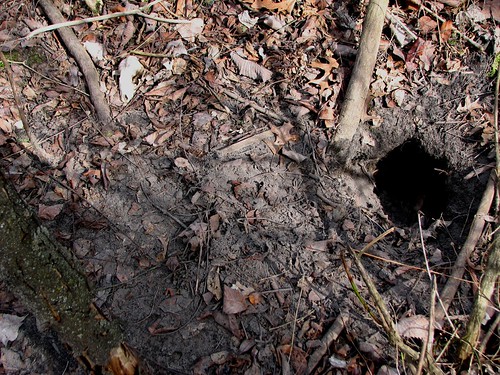
In the absence of actually seeing a live or once-live animal, a visit to your local woodchuck den will reveal whether your local population is up and Adam yet. Evidence of spring cleaning (see above) around the den entrance is a good sign (it’s a bad sign if you are a gardener, but good if your garden is located across a road from the den!). Chucks are fastidious burrow tenders and will make every effort to keep their quarters clean. Just because their homes are made of dirt doesn’t mean they have to be dirty.

A typical tunnel system will be some 25 feet long and about 5 feet underground. A side chamber, tucked well back and in along one of the corridors, serves as a nest and sleeping chamber. It is lined with dried grasses and leaves in the fall to serve as a winter coma chamber. This old laundry is the first to go out the front door come spring and it can be easily seen scattered over the soil pile.

Normal den systems have a main entrance with a conspicuous pile of dirt and a spy hole entrance/exit for subtle departures. The spy hole is usually dirt free since it is excavated from the inside. I recently came upon a pair of den entrances that both displayed evidence of cleaning. Oddly enough, both also contained raccoon remains among the stale leaves and newly dusted dirt (see below and here).

Apparently skeleton removal is a regular item on the spring woodchuck to-do list. it is not unusual to find the remains of former woodchucks cast from the burrow as well as rabbit, opossum, or other such subterranean creatures. Most of these parts are from previous occupants who died many years before in some ante-chamber – you know like the mother from the Bates Motel.

It is most likely that several raccoons had claimed these dens as winter retreats at some point but had the rudeness to die once inside.  Raccoons do that, you know. One of the skulls (see here) showed signs that it had been skinned by a trapper and displayed many fine cut lines about the snout. Another fully skinned raccoon probably dragged this carcass down into the burrow in order to feed on it. Raccoons do that also, you know.   The chucks, well, they just clean up and go about their lives.

The Elusive Lotus Jellyfish and Other Things

The American Lotus is nowhere to be seen in late winter. The Lake Erie bays and shallows where this magnificent plant will hold court in late summer are now seemingly barren of life –featureless mud flats covered by a steely gray veneer of water. A mid-March visitor to these former beds will encounter the ice shredded remains of last year’s stems and leaves lying on the muddy bottom and seemingly little else. Even now, at the lowest point in the lotus year, there are a few things worth noting under those silty debris laden sheets. There are “Lotus Jellyfish,” for instance.

It is a miracle that even after a winter’s worth of roiling waves, nor’easters, shearing ice floes, and solid ice packs there are some remnant lotus leaves remaining. These surviving structures represent the skeletal form of the leaf. Because the leaves were so large to begin with (2 feet wide and up to 6 feet tall), their spidery remnants are sizable as well. In hand the central support stalk is reduced to a hub on a wheel with the radiating veins dangling over the palm like so many tentacles on a jellyfish.  The multiple air channels that run the length of portion of the plant are clearly visible on the remains of the central stalk (see here in a closer view).

Texturally these leaf remnants are very un-jellyfish like with tough fibrous sinews holding them together. Mentally, however, they look like jellyfish and thus the reason behind my own little secret name. If one is so inclined, and one is sure no one is looking, one can “swim” them through the air and sing “Under de sea, under de ocean…” to enhance the effect (this is what winter does to some northern people). Sure, some of you dignified folk out there might consider this odd, but wait until I catch you jumping up and down like an inebriated chimp when your basketball teams advances in the march madness brackets.

Speaking of chimps, which we really weren’t but for lack of a better segue I am going to seize the opportunity, how about those “Lotus Bananas” rolling around the muddy bed, eh?  Again, I may be using a seemingly odd term here, but the name is an apt one to describe the occasional lotus tuber that pops to the surface. These things really do look like pale yellow bananas or, more properly, like those little plantains that you see next to the Ugli fruits at the grocer.

Unless you are an Asian chef or health food aficionado, there is a good chance you’ve never seen a lotus tuber. Even fewer get a chance to see an American Lotus tuber. Chinese lotus “root” has long been available as a food source and now can be purchased on-line through specialty vendors. The Asian species is nearly identical to our American plant save for the color of the blossom. The American Lotus tuber, although once enjoyed as a food resource by native tribes, does not have the market enjoyed by its eastern cousin. You also don’t see them because normally they are buried deep in the mud.

Lotus plants are perennial. They re-sprout every year from these solid starchy tubers. If you could completely strip away the muddy bottom of a lotus bed you’d see a network of these structures connected to each other like sausage links. Even though these plants produce seeds, they depend primarily upon tubers to get the job done. The seeds can lie dormant for centuries if need be so they are in no rush to sprout. Individual tubers can be up to 10 inches long and each has an “eye” from which the new sprouts and rootlets emerge.

Take a good look at this tuber I found. It had been severed by the action of the winter storms and was seeking a new place at the corner of the bed. This was only the second fresh tuber that I have found in close to two decades of looking. Like a banana, it was slightly squarish in cross section, but unlike a banana it was hard like a potato. You’ll see that the eye end has a stout pointed bud coming out along with a section of connecting stem. A patch of raised dimples just behind the eye is where the rootlets will eventually originate.

I am not about to slice this example open. There are plenty of oriental tubers out there to cut open and they can serve as proxy American lotus examples.  The interior of a fresh cut tuber is colored like old ivory and is riddled with a series of parallel air channels. When sliced in cross section, the pieces look like Swiss Cheese.  Wow, I’ve just compared an American Lotus tuber to a sausage, a banana, and a piece of European cheese without blinking an eye!

If you would like to handle one of these Swiss bananas, you can buy one of these things on eBay for $24.98 plus shipping (as long as no one else bids against you) but I wouldn’t recommend it unless you have a proper mud bed to put it in. Besides, I have a perfectly good example that I’d be willing to part with for say….$23.45 -if you are willing to sing the entire “Under de Ocean” song while holding a Lotus Jellyfish in one hand. On the other hand, recognizing that the lotus is a protected species in Michigan, I probably should put this one back “under de mud” and leave sleeping tubers lay.

Bandits in the Can

There are, according to one source, three ways to keep raccoons out of your garbage. It is difficult to narrow down the bountiful advice field in this category, but this three part plan seems to sum them all up pretty well. The first technique is to make your garbage inaccessible. The second involves making your garbage less smelly and the third is to install a latch or some sort of locking lid device on your container. That’s all there is to it.

In other words, there are ways to thwart ‘coons at their game. Suspend your trash can from a rope attached to a high limb, in the manner of keeping your goods safe when camping in bear country, and you can outwit even the wiliest of raccoons.  Use steel cable at all times. Keep your trash clean by washing every item that goes into the bag – there is nothing worse than trashy trash that smells. Don’t throw away any food, ever. Eat everything right down to the bread crust and those hardened crusty edges on baked lasagna. Lick the yogurt lids and mail all unwanted food scraps to France (simply address package to “Parlay Voo, France” and mail from a neighboring city). Just to be safe, throw a bucket of mothballs and hot pepper sauce into the trash can each week. You’ll need to be careful, however, that the can doesn’t accidentally tip and dump this hazardous mixture into your eyes as you are hoisting it into the air with your improvised pulley system.

If you use a padlock to secure your lid, make sure it is one of those explosive kinds that detonate when being picked. Finally, weld the lid of your trash container shut and move to Antarctica. If you do all of these things, you will likely win the Raccoon wars. You can, of course, just admit that raccoons are unbeatable when alive. I repeat: when alive. Country people don’t seem to have the same garbage problem that suburban folk do because they acknowledge the simple truth contained in this last phrase.  Most country people do not lick their yogurt lids and that is a fact.

In the end, Raccoons overcome all efforts to stop them – including the country method – because they are just too good at what they do. They are resourceful omnivores. This means that there are few things they won’t eat. Animal or vegetable, fresh or rotten, live or dead, it doesn’t matter.  In a natural setting this means a diet of fruits, berries, rotten fruits, bird eggs, baby birds, turtle eggs, baby mice, baby rabbits, dead baby mice, dead baby rabbits, live crayfish and even dead ones.  In un-natural settings, around human neighborhoods, this menu translates into dead Baby Ruth bars and those crusty baked lasagna edge pieces.

Raccoons are not especially intelligent, it’s just that they are naturally equipped to find food wherever it exists. These large members of the weasel family are endowed with an incredible sense of smell combined with a pair of marvelously dexterous “hands.”  In old French -Parlay Voo French -they were called “Raton Laveurs” which meant “users of little hands” (at least that’s what some country people told me).  With these hands they can pop open the tightest lids, dig into the toughest insulation, and reach into the narrowest crack to pull out whatever may lie deep within.  I recently watched a raccoon smell about a garbage bag until reaching a particular point. He bit into that one spot to tear a small hole in the plastic and then reached in with his hands to pull out a single cookie. He held that cookie and manipulated it with both hands before transferring it to his mouth and running off. He excised that prize like a surgeon removes a gall bladder.

Let’s hope and pray that raccoons don’t develop opposable thumbs. If they do, they will no longer require us to overcook their lasagna because they will do it themselves. We’ll find them breaking into our homes and, using our microwaves, preparing entire meals on their own.  They will steal our T.V. remotes and drive us mad as they click through the channels from their safe perch on the rooftop. Soon they will learn to fly small aircraft to France to get their desserts. We will soon be receiving crudely addressed packages plastered with foreign stamps. The packages will contain un-licked yogurt lids.

Meadow Mouse Mazes

As the snow slowly recedes due to the recent onslaught of warm late winter temperatures, two things start to become apparent. First of all, human folk enter into a prolonged state of clothing confusion. Not knowing what to wear on a 42 degree (Fahrenheit) day, otherwise sane people walk about in sleeves and shorts next to others garbed in winter coats and knit hats while wearing sandals. (This discussion doesn’t apply to teenagers, by the way, due to the defining word “sane”).  This seasonal dementia is often accompanied by overly hopeful proclamations about spring and greatly exaggerated stories about the death of old man winter. The second thing that happens is that those secret winter tunnel systems used by Meadow Voles are now being exposed for the world to see.  I’ve not much more to say about the first phenomenon, but we should spend some time with the second because we only have a small window of opportunity to discuss it.

Meadow Voles, or Field mice, have often been the subject of death and destruction talk on this blog. I can’t count how many times I’ve referred to them as “food”, “prey”, or “victims” because, as a species, they are collectively “born to be eaten” by predators.  Right now, however, we have an opportunity to sneak a peek at the living breathing life a vole without having pieces of a dead one in hand.  We can see evidence of their behavior written on the grass.

One of the habitual traits of these grass-eating mice is to construct so-called surface tunnels through dense grassy habitat.  These tunnels are above-ground passageways that wind through the dense stems and around the clumpy growth. The vole creates these narrow passageways by literally eating through the stems and/or pushing them aside.  As the mice zoom back and forth along these inter-grass highways their repeated use eventually tramples the floor down to a mix of bare dirt and grass clippings.  These passage routes are purposely constructed so that they are hard to see from above – they are intended to be “no prey” zones. The mice live their short little lives completely within this sealed tunnel zone like tiny little bubble children (I’m not sure what that means either, but it seemed like a strangely wise thing to say).

The density of voles within any given field area can be phenomenal and their highway building efforts can have a great impact. One small study estimated that a single acre might contain as much as 4.6 miles of tunneling. Fortunately these mice don’t mind being in the company of others of their kind and have been known to gather into communal nests in the winter.

Winter also provides Meadow Mice with an opportunity to expand their narrow home lives and exploit the lush and grassy suburbs adjacent to their weedy homelands. Under the cover of deep snow, they are able to lay out protected routes onto nearby short grass areas. These places lack cover but offer a rich harvest of tender shoots.  The markings that are revealed when the snow melts are the bottom halves of what used to be completely covered tunnels (the top half was snow, in other words).

As you can see in these views, the snow systems are very complex, indeed. These intricate paths weave around and cross each other so tightly that any individual vole is likely to run into his own butt while turning a corner.  One of the tunnel systems (see below) had a long trapezoidal run to to two distant corners and an equally long return route. I can offer no explanation for this feature other than being a jogging track of some sort.

Within the runs you can see regular latrine stations where the mice stopped to “rest” (see below).  It is worth noting that Meadow Voles don’t just crap everywhere they go – they actually restrict this activity to designated toilet rooms. Since their diet consists entirely of bulky green vegetation they need to eat up to 60% of their body weight per day in order to keep up. True, they only weight 2 ounces, but that is still a significant amount of eating and pooping to do. Put that into human terms and you’d be spending a significant amount of time on the porcelain throne trying to make room for more.  Why I’d have to eat 100 lbs. a day in …order… to …never mind, that can’t be right. No, I must have the math wrong, but my point should be well taken anyway.

Actually, the reason Meadow Mice need to eat so much is because plant fibers are notoriously hard to break down. One time through the digestive system isn’t enough to derive all the nutrients. Because of this, voles count themselves as members of the coprophage society. This means they eat their own feces and run them through again! When you think of it, this is also a great way to save on space within their living quarters – the bathroom and dining room are the same room.

Concern over people wearing sandals in late winter is obviously a minor issue when compared to things like this.

Burling for Dollars

Do you know how hard it is to write a blog about a Hickory Burl without mentioning Burl Ives? It is near, no make that – it is impossible, because you can see that I just did it. Indeed, Mr. Ives made his living as a talented performer with a home-grown persona, but he has nothing to do with those cancerous growths found on trees. He was a round fellow whose shape somewhat resembled that of a typical tree burl, but that’s about it. It’s just a word association thing. Burl: Ives – American actor and singer who….blah, blah. No, you need to get past the guy behind the snowman on the “Rudolph the Red-nosed Reindeer” Television special and start thinking “tree” when the word burl pops up.

Let me show you what a tree burl looks like (see photo above). I found this example growing on a Pignut Hickory about 15 feet up on the trunk. The thing was oval shaped and about three feet by three and a half in dimension. I had to crane my neck to get a good look at it. Fortunately, the ground around the base of the tree was still covered with a heavy layer of snow, or else I would have been forced to note the poison ivy that covers the floor of this woodlot. This would have forced me to put the words “burl” and “ivy” in the same sentence and that would have ended this blog before it began. My mind would have wandered into a rendition of “Silver and Gold.” As it is, I am able to continue this discussion by saying that burls are more typically found on oak, ash, maple, walnuts, and the like, so this example was slightly unique in terms of species.

To describe a burl as a cancerous growth is to miss the point. Trees having this kind of woody mass are normally healthy in all other regards, so it doesn’t involve an agent which spreads into the rest of the trunk or branches. The growth is basically a benign wart, in other words. As a matter of fact, scientists are not really sure what actually causes burls to grow. Some believe injuries, insects, or perhaps fungi (or a not-so-fun guys), cause the tree to react much in the same way as a gall is formed. Others point to circumstantial evidence that genetics are involved – noting clusters of burl trees within the seed range of a large parent tree.

It is known that burl growth begins when a twig bud fails to develop normally. For some reason burl- bound buds forget how to form limb tissue and start producing hog-wild woody tissue. You could say that the growth is cancerous in nature without actually being cancerous. Burls are stems that continue to grow but do not elongate (you can thank Dr. Richard Barrans Jr. for that answer, by the way). The woody structure of a burl consists of a gnarly grain and contorted growth rings that are very different from the normal ring growth of the tree. Externally this pattern is expressed by a contorted version of the tree bark. You’ll note the unusual texture of this hickory burl when compared to the normal shaggy bark of the tree (see below).  It looks like a lump of solidified cottage cheese or one of my early attempts at making a snickerdoodle cookie.

Burls, including hickory burls, are eagerly sought by woodworkers because of their unusual figuring. Since colonial times, bowls have been made out of these unique growths and artfully turned burl bowls are still being made by regional artists. Some examples can command hundreds of dollars on the craft market. Larger burls can be thinly sliced to produce an attractively marbled, and equally valuable, veneer for furniture making.

This hickory burl is safe from the bowl-maker because it grows on protected land and because it already has a hole in it. A view of the far side of this growth (see here) reveals a neat entrance hole punching through it. This opening may have started out as a woodpecker hole, but it probably serves as a Red Squirrel den for the time being. Over the years, the fashionable entrance hole has been maintained by constant chewing.  Having a distinctive burlwood door frame must make this place the envy of the woodlot.

The View From on High

For the third time in so many years, I had the opportunity to hitch a helicopter ride as part of an aerial survey of the lower Huron-Clinton Metroparks. We were looking for deer and, without getting into any particulars, we found ‘em.  But we saw lots of other things along the way and these other things are probably more noteworthy as subject fillers for this blog. There was a hefty coyote, a graceful Red Fox, and a dozens of terrified Fox Squirrels, for starters. The coyote was on the move and ducked into shelter long before I could take a photo of it. The fox provided us with only a passing glance and the squirrels, well, the squirrels showed an unusually high amount of anxiety – especially given that our copter was several hundred feet over their heads.  Yet, their bounding forms could be seen at nearly every turn in every woodlot as if we were roaring through the very trees themselves. Only the two flocks of Wild Turkeys that we spooked at Lower Huron Metropark matched the fleeing terror of the squirrels.

I was especially interested in the high view over Lake Erie Metropark because it is “my” park (actually, I am only part owner behind a whole slew of deer and nervous squirrels). As if on cue, a soaring Cooper’s hawk crossed before us just as we entered the park’s air space. The bird was at our level, or more properly, we were at her’s. She calmly descended to the earth world and angled down to perch on a large cottonwood tree 200 feet below.

Dozens of Great Blue Herons flushed from their willow perches close to the hawk’s landing site at the north end of the one of the park lagoons (see above).  From above, these large birds certainly earn their name. Their slatey gray-blue backs show up well against the snow covered ice below.   I counted about fifteen individuals in this flock. These gangly fish-eaters are a regular part of the winter bird population here along the shoreline as long as there is open water available.  Several Bald Eagles surveyed the open shoreline waters as well (see here). These birds, apparently keen on maintaining their dignity, did not flush when the copter passed overhead. On this day they simply glanced up before lowering their gaze back to the water surface. I would guess that they were looking for panicky squirrels attempting to make the swim for Canada, but that would only be a guess on my part.

I would be remiss not to at least mention a few deer related sightings. Our flight occurred at mid-morning, and most of the deer were bedded down in heavy cover.  On many occasions the creatures stuck tight to their forms as we made our initial pass and then jumped to their feet as we circled back around (see below the pair bouncing up onto their feet). Few of them actually looked up – the rotor noise alone was enough to prompt them into action. In the absence of the actual deer themselves, there was always plenty of deer evidence on the landscape.  Sleeping forms (see here the 5-6 dark oval-shaped patches in the thicket) and feeding patches (see here) were everywhere.

Although deer tracks were the most abundant non-human sign, plenty of other animal tracks were in evidence. One view (shown below and here) revealed an interesting set of prints on the shelf ice. A week’s worth of coyote tracks can be seen as linear traces in the snow along with the regular jumping track of a non-panicked Fox Squirrel near the cat-tail edge.  The rambling track originating from the lower left is that of a Canada Goose. You can see where the honker ambled up to a point, turned sharply to the right, and then launched into a take-off run. The paired tracks get farther and farther apart until disappearing altogether as the bird achieved flight.

Perhaps the most startling sight on this particular flight were the multiple beds of Phragmites reed in the park.  In places, these reed patches stretched like dirty brown shag carpeting over some of the lagoons. Ten years ago these same lagoons were vast cat-tail marshes, but they have been replaced by these nasty invaders. Reed beds are bad enough when viewed at ground level, but from above their sheer density is dishearteningly apparent. The photo (see below) shows a solid patch that was probably 5 acres in extent. Only the occasional deer path weaving through the mat of dead vegetation allowed any opportunity to judge some scale.

By far the most intriguing sight was a nice overhead look at one of our local Great-horned Owl nests (see below and here). Her platform is an old Red-tailed Hawk located on a lofty Bur oak tree located about mid-park.  Believe it or not, this bird has been dutifully sitting on her eggs since the end of January. This means that she has sheltered her charges through all that this past February has thrown at her. It takes about 33 days to incubate the eggs and it is very likely that the first chick had already hatched beneath her, but she was not about to reveal any of her secrets. This bird gave us the stink eye as we hovered past.

I passed over an old friend of mine as we concluded the survey and headed north from the owl nest.   A giant Cottonwood, once the sole master of former pastureland, poked its familiar form above the tree-tops (see beginning photo). This tree, decrepit and shedding when viewed a ground level, looked rather noble from on high. Beyond it, a wash of rouge branches marked a patch of Red Maple trees. These trees were in the process of swelling their buds with flowing sap and preparing to present the season’s first crop of flowers. Though our flight was a winter event it ended on an early spring note.

Gnat’s Not a Pine Cone

So, you’re looking at a willow shrub and you see a bunch of pine cones stuck onto some of the branches. You say to yourself, “That’s a willow shrub, so those can’t be pine cones unless somebody got all decorative-like and deliberately put them there.” You turn around and realize that you are indeed talking to yourself and, out of self respect, you carry on the rest of the conversation internally. “Who would do that? This place is miles from anywhere. However, if Martha Stewart was in the neighborhood she would do such a thing.”  The conversation betwixt the left and right brain continues.  “Look at them, those aren’t cones,” you continue silently, “they’re all fuzzy.” “Well, maybe them is cones and they is rotten and all covered with fungus.” “No, Martha Stewart never uses old cones, she…”  “You need to shut up.” “No, you shut up.”

Such a grammatically incorrect conversation could happen. Therefore, I feel it is my public duty to reveal the truth behind those willow “pine cones” as a preventive measure. I’d hate to see you lying unconscious in the snow with self-inflicted fist marks on your face. This thing is so easily solved. Martha Stewart, you see, has never walked any of the loop trails at Crosswinds Marsh where these pictures were taken. End of story.

Now, for those of you who need more, I will continue with a more better..er, a much better explanation. Those cone-like structures found on scrub willows are called Pine Cone Willow Galls. They are growths caused by tiny gnats. The story began last spring when a long-legged gnat fly called Rhabdophaga strobiloides (“stem-eater within a pine cone home”) laid her egg on the terminal (end) bud of a new willow shoot. The insect egg, and the resulting larvae, triggered a response in the willow which stunted the outward growth of the stem. In effect, the stem dedicated all its efforts into creating a solid woody chamber around the larvae and enveloping the site with wool-covered scales.  The larva overwinters within the comfy confines of this gall and emerges in the following spring.

As far as we know, the willow is tricked into making these cones via chemical inducement – once pricked, they automatically produce this wonderful little construct for the little pricker. The willows are unable to engage in self-argument or refusal to perform.  The fly slips ‘em a mickey and wham! Bob’s your Uncle!  This scenario has been going on for eons and it is for the sole benefit of the gnat. Fortunately, although the willows are un-willowing partners in this affair, they only suffer a few embarrassing and harmless growths (harmless, that is, unless someone starts up a self argument about them.)

These galls are fascinating to look at. On the outside, they are covered with approximately 70 tough woody scales. The scales are densely covered with what botanists call “pubescence.” Internally (see below), the interior larval chamber is revealed to be a long narrow space surrounded by insulating layers of dead air space. This structure provides protection from the elements but does not shield its host from external air temperatures. Like many other fleshy little winter grubs, however, willow pine cone gnats are able to resist freezing down to -80 degrees below zero (F)!

You can clearly see a fat little yellowish thing within the central chamber of this cut-away gall (see below and here). It appears to be pupae of some sort. What I can’t tell you (“Yes you can”… “No I can’t”…) is whether that fleshy little thing is actually a pine cone gall gnat pupa.  There is a very good chance that it is not. This type of gall has been found to host an incredible number of alternate occupants – 24 species in all – including 9 harmless co-habitating species and 14 parasites. The parasites, of course, are the ones who take over the body of the gnat, kill it, and themselves overwinter in the gall.

Pine Cone Willow Galls are designed from the get-go so that the emerging gnat can simply push its way out through the overlapping upper scales like a one-way door. The adult gnat has no ability to chew its way out. Because of the vast numbers of potential predators, there is no telling what kind of creature will actually emerge from these “pine cones.” O.K., I can say with absolute surety that Martha Stewart will not – and that’s the end of it.

The Middle of Nowhere

Being the first person to break a new snow cover at Pointe Mouillee on Tuesday, I was treated to a feeling of grand isolation. I was, at least for a while, the only human out there on that expansive marsh. I was not truly alone, of course. The river mouth to my north was covered with trumpeting Tundra Swans and honking Canada Geese. All were vocalizing as flock upon flock of their brethren drifted overhead and landed with a splash in the gray waters of the Huron (see here). They were flying in from feeding in the corn fields of northern Monroe County. A lone male Red-winged Blackbird, the first of the season, called from the twisted branches of an equally lonely willow.  His was a tentative call full of doubt – a spring call on day still fully dressed in winter garb.

Many other silent beings had trodden the path ahead of me. Whether they passed by the night before or perhaps earlier in the morning I couldn’t tell. Wandering coyotes, several long-distance mink, a few scattered cottontails, and host of opossums all left marks of their passage. At least one of those beings was still in the act of passing as I entered his domain, but I am getting ahead of myself.

The activities of the coyotes, as revealed in the track evidence, were especially intriguing. There were several individuals and they were engaged in mousing on the grassy dikes. A long singular line of foot marks would veer to the right or left where the sound of a meadow vole apparently caught the ear of the track-maker. Scuff marks and “nose” trenches (see below and here) showed where the predator stuck his muzzle down into the wet snow to pinpoint the location of tasty vole hidden in a grass tunnel just under the surface. At several locations a globular grass nest was uprooted and torn asunder.  It is likely that each endeavor started with the classic jump and dive approach where the coyote launched into the air and came down on the chosen spot with both front feet.

There was no evidence of actual capture, however. Coyotes tend to down their prey in a few gulps and leave little in the way of blood evidence.  For the sake of reality, it is safe to assume that the mice got away most, but not all, of the time. At one point a strategizing coyote sat down in the snow for a moment of contemplation. The creature not only left heel impressions (see here) but also shed a few stray hairs as evidence of his respite (see below & here).

As I neared the end of the Long Pond Unit, the coyotes abandoned the dike and veered off into the low grasses of the Bloody Run Unit. Several mink took up the trek at this point, although they were not in hunting mode. Their tracks ran continuously for a mile or more without deviation before jumping down the side of the dike to their destination.

It was a gray 35 degree day, warm by winter standards but still chilly as the nippy west winds chipped away at the edges. It was surprising, to say the least, to see a total of three Tiger Moth caterpillars attempting to add their tracks to the snow cover (see above). Too light to make any impression, they were slow and deliberate in their movements. They looked worse for wear (translation: looked like hell) with their spiky hair falling out in patches, but they managed to preserve some dignity and roll into a protective ball when picked up (see here). These anti-freeze pumped larvae were obviously overwintering in the grass tussocks but it is anybody’s guess why they were migrating over the snow on this particular day.  As if to show some arthropod brother ship, a lone spider was doing the same thing (see here). I believe this beast was probably ripped out of the comfy confines of a cat-tail or reed head by the wind. Finding himself exposed on the foreign surface, the sturdy traveler was trying to lay down a few snow angels before the neighborhood Horned Larks picked him up.

At the furthest point of my walk, the ground was peppered with opossum tracks. It was apparent that many of these tracks were laid down the previous night because there were multiple faint impressions made when there was still a crusty cover on the snow pack. At a point where the tracks looked especially fresh in the soft mid-afternoon snow, I looked up and found out just how fresh they were – the maker was still in them. Eying me suspiciously from the edge of the dike trail, a small dark opossum was figuratively frozen in his tracks (see below).

I instantly saw this as yet another opportunity to test the notion that these critters will drop “dead” if pressed. You may recall a similar experiment I conducted last month in which the possum remained fully in control of his dull senses. I walked toward this Mouillee ‘possum but he remained in place until I was only a few feet away. His flight, if you can call it that, took him along at a speed approximating the rate of a rising biscuit. I will say that this little marsupial deliberately stayed among the tough reed stalks so he really didn’t need to go too fast in order to elude me. I crashed along behind him, none-the-less, for another 50 feet or so in a clumsy attempt to keep up. Slow as he was, he kept just ahead of me. The chase scene reminded me of that televised slow motion O.J. chase.

Eventually he stopped to face me, and showed a slight bit of annoyance by opening his mouth but then reverted to stare-down mode (see below). We both rested for a moment. He patiently waited for the better part of two minutes as I changed the batteries in my camera, and we resumed the chase. I gave up after a quarter mile. The opossum showed no signs of fainting, slowing down, or speeding up. I, on the other hand, was close to exhibiting the first two symptoms.

So far, the score is 2 to zip in this game of man vs. opossum (if you count my earlier attempt to fritz out one of these beasts).  Out here in the middle of nowhere where coyotes are chasing mice and frozen caterpillars are chasing the season, such scores don’t really matter do they?

To a Hackmatack and Back

“Trees are always neighborly kinds of things,” according to a character in one of Arthur Conan Doyle’s Sherlock Holmes stories (The Adventure of the Yellow-faced Man). In this case, a young man was commenting about a thoughtful walk down a tree shaded lane. These particular words have nothing to do with the story and they provide no deep clue upon which the famous detective later pounces. That particular line stuck with me because it was especially poetic. Trees are indeed neighborly things and it is only neighborly to get to know them.

By way of this round-about introduction I wish to present the Tamarack, aka Hackmatack or American Larch, as yet another example of an interesting neighbor. Anyone with so many aliases might easily arouse suspicion as being a mobster or a paid informant. This guy also could also raise a few more red flags by claiming to be a coniferous tree yet shedding his needles every fall like some regular nut tree or something. Well let me tell you, this one’s on the up and up. The names, the needle-shed thing, the cones -they all make this one unique.

Tamaracks are high northern trees of the Canadian taiga whose range barely extends into the United States.  While throughout its vast range it will grow in upland areas, here in S.E. Michigan the tamarack is pretty much restricted to low boggy and wet areas. More often than not, you’ll need boots in order to get close to one, and to get back from visiting one, in the summer. It is a bit easier to call upon this tree in the wintertime thanks to the solid properties of frozen water.  From a distance their conical form betrays their relationship to other coniferous trees, such as the spruces, and they are easy to spot. In fact, they look like dead spruce trees in the winter because Tamaracks shed their short soft needles in the fall. They are deciduous conifers.

Up close, the brown flaky bark looks very much like that found on red pine trees (see here). The naked branches are covered with multiple spurs (see above and here) and clusters of tiny round cones. These woody spurs each support a dense cluster of 10-20 needles during the growing season – giving the summer branch a tufted appearance. The cones, perfect little examples of the conifer craft, are also clustered into neat bundles (see below). Each bears around twenty scales which protect an equal number of tadpole-shaped seeds. Birds such as finches and crossbills are dependent upon these winged morsels to get them through the cold season. It takes a lot of seeds to make a meal (each seed is only about 1/8 in. long) but these trees are prolific and finches have a lot of time on their hands – especially since they are not hindered by constant text messaging or i-phone “apps.” Historically, we humans have asked favors of this tree as well.

Tamarack is a native Algonquin word. The alternate name for this species, Hackmatack, originates from the Abenaki word meaning “snowshoe wood.” To these native dwellers of the forests of N.E. Canada and Maine, the tough flexible wood of the tamarack was ideal for making snowshoe frames. They, like the finches around them, depended upon this tree to get them through the snowy winters. Closer to home, the natural crooks found in the stumps and roots made for strong knee braces for wooden boat building. Nate Quillen, the Rockwood Michigan builder of legendary duck hunting boats during the late 1800’s, always used Tamarack knees to brace his craft. His use puts a whole new spin on the concept of “kneeding” Tamarack wood.

Quillen supposively obtained his Hackmatak knees from a swale just down the road from his shop along the Huron River. As far as I can tell, that stand doesn’t exist anymore but there are plenty of stands in the surrounding counties.  So, don’t you think it would be a nice thing to stop by and visit that Tamarack stand near you? Tell them you don’t want any wood or seeds at the present time, but just wanted to say “hello neighbor.”