What’s the Rush

The segmented tubular stems of the Winter Scouring Rush are one of the few plant highlights of the very early spring season. They don’t offer much in the way of “come hither” beauty but they do offer a good dose of “ain’t I nifty” appeal.  First of all, they’ve got green – a commodity not in great supply in the non-pine plant world at this time of year. As evergreens they are standouts throughout the winter months. Truth be told, however, stands of these plants remain basically unchanged throughout the year and over the eons. Rushes are not in a rush to change.

Perhaps one of the reasons these plants are unconcerned about change is because Scouring Rushes are not really rushes at all. True rushes are flowering plants with a relatively recent origin. Scouring rushes belong to a non-flowering group known as the Horsetails, or Equisetums, which have no living relatives other than ferns. Their lineage dates back over 300 million years to the dawn forests that once blanketed the continent. Long before the dinosaurs began their reign, and long long before there were horses, horsetails shared the murky soil with the likes of lycopods and cycads. Towering forests of these plants were the dominant form of life on earth for a very long time. Today, they are reduced to the small bamboo-like survivors we are now familiar with (see below). They are, in other words, a plant that has “been there and done that” many times over.

Structurally these are among the simplest of land plants with absolutely no flairs or extra details. Like representations of the “Arts and Crafts” design phase of plant design,  thier time-tested function trumps their form.  The hollow stems (see here) are segmented and sculpted with parallel ridges. Each segment fits into the other – “likened to a line of drain pipes” fitting together according to a 1905 reference. The leaves, if you want to call them that,  are reduced to a ring of pointy scales at each node. A cone structure on the shorter stalks (like that on the left stem above) expands later in the season to let loose a load of spores to the wind.

Not all horsetails are evergreens, but all are in the genus Equisetum(which means “horse bristles”). Some types sprout each year and produce a bottlebrush fringe of stout “leaves” which gives them a horsetail appearance.  The straw stemmed evergreens, like the winter rush, are more commonly called scouring rushes. As you might suspect, this refers to their traditional use as scouring implements in the old days. The term “old days” is a relative one when talking about a dawntime plant, but in the last few thousand years the plant has seen use for cleaning cooking vessels.

Silica crystals embedded in the stem give the plant a toothy ability to clean grime. There is so much silica in the structure that when the stems rot away, a ghostly crystalline structure remains in place. Over time – that last few thousandth part of time – scouring rushes, which are found throughout the world, have also been used by a variety of cultures to also clean metal and polish wood. This leaves us with a simple plant with a lot of additional names such as gunbright, pewterwort, and shave grass.

This also leaves me with the thought that the Scouring Rush will probably be around long after the human names, or the need for them,  have vanished into the ether of time.

“Croaking Voyces”

It’s hard to ignore Chorus Frogs. They are easy to overlook, but impossible to underhear. The breeding season for these diminutive frogs has begun in earnest and the males are now filling the air with their creaking calls. I was there for what I believe to be the opening salvo for this yearly ritual. I located the songsters in a flooded roadside ditch in southern Monroe County and recorded some of their voice talents (here).

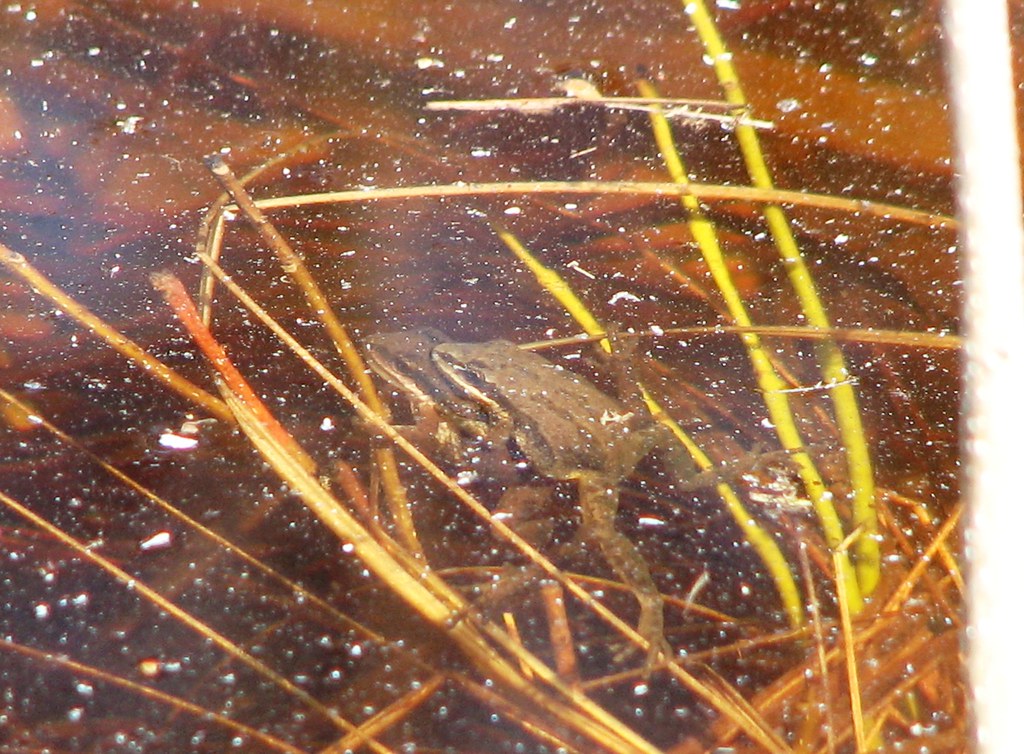
Chorus Frogs are tiny members of a group known as the New World Tree Frogs – barely reaching an inch and a quarter in length. They possess small toe pads as proof of their lineage but they rarely, if ever, climb trees. Instead they secret themselves away under the leaf litter for most of the year and only put in a public appearance during the brief breeding period. One of the identifying features of a Chorus Frog is the presence of a dark face mask and a series of three broken lines running down the tan colored back. The combination of micro size and subtle coloration makes them difficult to spot against  a backdrop of wet brown vegetation (see the calling male above). Their voice, however, is more than enough to key you in to their presence.

When I say that these frogs fill the air with sound, I really mean it.  True to their name, they sing as a group. When in full chorus, there is little room for any other sound in the aural space. The distant moan of a train whistle was about all I could hear above the fray. This particular group of frogs, perhaps a few dozen in number, were prompted  to begin their ancient rite of passage by the mild afternoon sun.   With small patches of ice still clinging to the shaded portions of the water surface, males and females alike, gathered at the temporary spring pool in obeyance to a deep instinctive drive. The sonic nails driven by Chorus Frogs are decisive blows in constructing winter’s coffin. When these soggy gathering spots explode into bustling singles bars, the action continues non-stop for weeks until Spring is well on the way.

The early activity at these ponds goes on throughout the day and into the night. Things begin to taper off into evening/cloudy day affairs as the season wanes into late April and ceases altogether by middle May.

The males do all the singing. By pumping a single mouthful of air back and forth over their vocal chords (see here in this video clip) they make a sound akin to rubbing one’s fingers along the teeth of a stiff comb. Once a female is lured to the vicinity, the crooner immediately grabs onto his potential mate and locks his arms around her body immediately behind her front legs. His duty is then to hold onto her for dear life for the next few hours. This behavior is called “amplexing”  (see the amorous pair below and here).

Eventually the female begins to lay packets of jelly covered eggs (20-300 per cluster) and the male fertilizes them as they are released. Once she is done laying her quota of up to 1500 eggs, a process normally taking less than an hour, the male releases her without even leaving his e-mail address.  The idea is, of course, for the guy to pick up another date and repeat the process. In at least one major study, however, only some 17% of any gathering of males are able to mate with a female and they do so only once. This means that most of the males are croaking blanks most of the time, but you can’t blame them for trying!

Edward Topsell in his 1658 treatise on reptiles and amphibians called “The History of Serpents” somewhat accurately explained what goes on in the world of frogs.  “When with their croaking voyces,” he writes, ” the male provoketh the female to carnal copulation, which he performeth by covering her back.”  He then attempted to explain that mating was performed under the cover of the night because of the natural understanding of the “modesty and shamefullness of this action.” Obviously, Topsell never encountered a mid-day orgy of Chorus Frogs.

A Walk by Bloody Run

Saturday was a fine time  for my annual spring excursion out on the dikes of the Pointe Mouillee Marsh.  I’d prefer it to be more like a weekly thing, but I never seem to get out on this extensive Lake Erie marsh more than a few times a year.  The early Spring season out here always holds out the promise of seeing some interesting migrant birds, picking up a few dead bodies, and enjoying a few muskrat watching opportunities.

The dead bodies? Oh, I mean animal remains of course. Even though Pointe Mouille contains ominous sounding location names such as Dead Man’s Point and Bloody Run, the place is chock full of life.  It’s only natural that a few critters end their careers there (outside of the waterfowling season). A naturalist is always on the spy for specimens. Last year at this time, the dikes were littered with the remains of dead muskrats who were the victims of starvation wrought by the tough winter. This year, I only found one skeletal ‘rat whose bones were bleached after months of exposure.

The skull of this particular muskrat (pictured here) was home to a pair of hibernating shamrock spiders (see detail here). The two chilled arachnids were firmly ensconced within the right eye socket. The location being un-occupied by an eye ball, it was a prefect fit for these rotund orbweavers.  I evicted the clumsy squatters with a gentle prod of a stick and they dropped heavily to the ground and crawled over to the pelvis bone to set up a new shop. An Asian Ladybug hid out in the brain case until I got the skull home, but it scurried out with haste when finally discovered.  Oddly enough, the eye socket of an equally bleached mallard duck skull  just a few feet away was also occupied by a Shamrock Spider. Apparently eye sockets are prime spider real estate at the Pointe.

Now, don’t get me wrong, there were plenty of live things to see. There were a numbing quantity of Canada Geese and Mute Swans noising up the neighborhood. Between the honking pairs of Canadas establishing nesting territories and the heavy wing beats of swans chasing each other about, there was little sonic room for anything else. The Red-wing Blackbirds were able to rise above the clamor and add their own “Okaleeas” to the chorus every now and then. The prime real estate for these birds was any place up high, so the marsh unit sign posts served as their sentry posts.

In the world of official signage, most of  those at Pointe Mouille adhere to the standard black & white dictums of a Michigan State Game Area. The signs lining the Bloody Run Unit are a wonderful exception, however. The name alone is chilling enough, but when executed in a runny red spray stencil style they look more like cheap Halloween horror-house signs (see here) than DNR signage. Every sign along the Bloody Run unit is done in this manner but I don’t believe it was intentional.  I personally like them because it looks like something I would do intentionally. Ironically, this diked unit functions as a no-hunting reserve within the marsh system – it is a place where animals can go not to die, rather than the other way around.

I snapped a shot of a calling Red-wing as he looked down at one of the blood red signs (see above). It looked like he was just realizing what it said and raising his tail as if to say “Holy Crap, I’d better get outta a here!” He did leave right after the shot, but it was because of me and not any new-found ability to read. Back in the early 1900’s, when this place was a private hunting reserve, it was common practice for the hunter guides to pick off as many blackbirds as they could with their trusty 22’s, but now this bird has only to fear the rigors of the mating season.

Apart from the geese, swans, and blackbirds the open water areas hosted thousands of live fowl. I’m not one for lists, but among the species spotted were Mallards, Black Ducks, Buffleheads, Bluebills, Common Mergansers, Coots, Gadwalls, Widgeons, Pintails and Shovelers. The Pintails were a nice touch because these suitably named ducks are not a common sight here in the Great Lakes area. It’s been a long time since I’ve seen any – due more to my not looking than anything else.

I do generally spot a few Shovelers every spring and this spring was no exception.  These colorful ducks with their exaggerated bills are always a sight to behold (here, behold). I can’t show you any other waterfowl pictures because most of the ducks were very very far off and I don’t do very far off shots well. So, well, I stuck to the closer stuff like the b-bird, the skull, and the sign. If I wanted to get some good close goose shots, then I could of had a field day, but frankly I found bleached bones to be more interesting.

There was one goose sight that I was tempted to record simply because it involved a muskrat. A pair of geese were perched atop a lodge as  a chosen nest site. In typical honker style, the pair went into slink mode as soon as they spotted me (it’s hard for a human to hide out on an open dike with nary a tree for miles).  In this case, the male bird hunkered down behind the lodge and froze while the female flattened out and laid her extended neck down against the lodge. This is instinctive behavior which doesn’t acknowledge that they are also out in plain view. I stopped to watch them just to see how long they would  keep up their ridiculous routine.

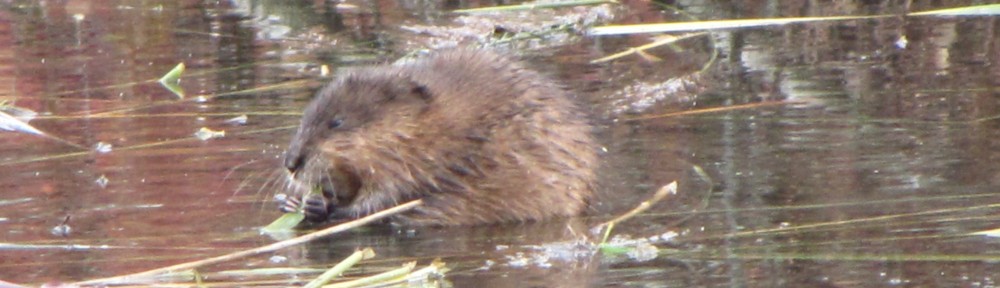
What I found interesting was that a muskrat, probably the one who owned the lodge, was placidly feeding at it’s base not a foot from the the geese. He paid no heed to them and they completely ignored him. While the ‘rat sat there munching contentedly for nearly ten minutes, the bird pair eventually gave up their ruse and climbed down into the water and swam away. I’ve often wondered what the muskrats thought about their lodges being used as nest platforms and it looks like the answer is that they could care less!

My walk along the “run” ended as the day’s temperature rose to a pleasant 45 degrees. I stooped to take in a detail shot of a goose feather be-jeweled with water droplets (see below) and pledged to return before this spring comes and goes.

Polly Wolly Doodles Underway

Spring Peepers and Chorus Frogs are traditionally the first of their kind to announce the seasonal turn from winter into spring. These diminutive amphibians often begin their vociferous breeding season well before the ice is completely off the ponds and marshes. They may be the first calling frogs of the season, but they are not the first active frogs of the season – that honor rightly goes to Bullfrogs and some Green Frogs. The adults of these two species remain in their restful hibernaculums well into the spring season, but their tadpoles remain active under the ice all winter.

Any question about the first tadpole of the season, like the equivalent question about the first Robin,  is basically unanswerable because you’d need to see the last one of the previous season before coming up with the correct answer.  They are with us through every month of the year. Because bullfrog tadpoles take multiple seasons to complete their development they have to spend at least one, and often two or three winters, in order to complete their conversion into adult frogs. Green Frogs hatched out after early July usually end up spending one winter as tadpoles before metamorphosing the following summer (earlier season hatchlings get the job done before winter just like all other local frogs).

I chalked up my first frog sighting of the season a few days ago as the ice finally released it’s prolonged grasp on the coastal marsh.  The silty bottom of the wetland teamed with wiggling Bullfrog tadpoles (see here in this video clip). I’m not sure what to call this gathering of pre-frogs  since “school” is a fish term and “pod” and “ipod” have already been taken. Given the makeup of the assemblage, I think a “herd” or a “doodle” would be appropriate. Saying that you’ve seen a doodle of pollies has a certain ring to it, don’t you think? Anyway, these pollywogs were going about their daily underwater duties as they have been doing all winter long.  Those doodle duties consist of swimming, feeding, and of course, breathing.

Structurally, Bullfrog tadpoles/pollywogs  are basically heads with tails (see above) .  As swimmers they are not quite up to fish status. Equipped with finned tails but no lateral fins or stabilizers, they are only able to propel themselves forward by vigorous undulations.  This creates a side to side rocking motion of the rotund body and head. The name pollywog, as a matter of fact,  comes from an American slang corruption of the old English term meaning “head wiggler. The mottled olive skin, large size,  and like-colored tails mark these individuals as Bull Frogs rather than the very similar looking Green Frog pollys.

The bull part of this species name refers to both the large size and the snorting call of the adults. The giant tadpoles can get to be 6 inches long, but as you can see they can be found in all stages of tadpoleness at this time of year.  All stages have equally ample appetites. Probably the best way to describe their  food habits is to call them opportunistic omnivores. Basically, this means they will eat anything from microscopic plants and diatoms, to dead animal matter and dead cousins. Zipperlike teeth enable them to scrape surfaces and even nip off live vegetation. Living under the ice through the long dark months of the cold season requires the ability to literally eat dirt at times! There’s no mystery as to why they become strict  predators upon becoming adults.

Perhaps the most remarkable thing about under-ice living is the ability to derive oxygen from the water even when the place is sealed over like a tomb. Young tadpoles are primarily gill breathers, but they can breath through their skin if need be. They also start lung breathing abut half way through the growth cycle.  One of their important adaptations consists of low or no oxygen respiration. The truth remains, however, that even in iced over marshes there are always a few air access holes provided by the friendly neighborhood muskrats! The ‘rats will enforce a fee for their services on occasion, and eat a few of the tadpoles. As a rule, Bullfrog tadpoles don’t taste very good so they are not hit hard by most predators.

One thing that remains clear as we consider these wintering pollywogs – tadpoles are neither delicate nor are they harbingers of spring. They are incredible examples of nature’s one upmanship ability over the seasons.

Nut-seeking Missiles

If you only watch them for a short time, Fox Squirrels can appear to be downright stupid.  Their random style of movement and jerky nature paints them with an appealing but buffoonish brush. These nut-munchers are not buffoons, however. Though squirreliness is not considered a positive human trait, it is a positive squirrel trait. Besides, I doubt any self respecting squirrel would ever strive to be humanly. Humans can’t climb trees and jump from limb to limb, they can’t  open a nut with their bare teeth (without permanent dental trauma, that is),  and they can’t remember things like a squirrel can. Yes, that’s right – squirrels have excellent memories. They are, in fact, nut-seeking missiles.

Everyone, well almost everyone, knows that squirrels bury nuts in the fall. The average Kindergartner would likely tell you that “the squirrlies do it so that they can dig them up in the winter for lunch.”  Your average adult Joe would even say that squirrels bury so many nuts that they forget some and that these forgotten seeds eventually become trees. Stupid squirrels plant forests, in other words.  Your average naturalist will continually say that squirrels locate their subterranean nut supplies by using their superior sense of smell alone. Well, as it turns out, those average naturalists – myself included – were  mostly wrong and those average Joes were right, but for the wrong reasons. The little kids were right, but so what, us adults are still the mostest smarter.

The trick to discovering the essentials of squirreliness is to watch them for an extended period of time. I would like you to watch this short video showing a little over a minute in the life of a Fox Squirrel. What you’ll see is a frantic mammal apparently covering a lot of  ground in a fruitless attempt to find buried walnuts. True, she doesn’t find any during the period of filming (this is the edited version) but what is important here is to watch what is really going on. The creature is creeping close to the ground with her head down and nose close to the ground. Indeed she looks like a bloodhound on the trail of a convicted nut.  But rather than taking meticulous sniffs over every inch of ground, she is very quick about it. She dashes about from point to point and then stops to scan the ground with her sniffer. Miss squirrel  is mentally putting herself into global position and then employing her smell to hone in on the target.

Squirrels, such as the Grey and the Fox kind, are scatter horders. They bury their nutty treasures over a wide area so that other nut eaters won’t find them all. They can afford to do this because they can use spatial clues (memory) and smell to re-find them. Scientists put this to the test by burying extra nuts in a plot of ground where a test squirrel had already buried a bunch. The squirrel, when released back onto the plot for some extended nutting time, ended up finding its own nuts twice as often as the new nuts. If this was a random process driven by smell alone, the squirrel would have recovered an equal number of new and old nuts. So, you see, the rodent has a sense of place after all.

If you want to see something really fascinating, take a look at this U-Tube video showing a squirrel memory test. It seems that, in this scenario anyway, the animal was relying exclusively on memory. By continually returning to the same cup position to find the hidden peanuts, this individual was completely overriding the smell game in order to play the shell game.

Other research has shown that squirrels tend to recover over 80-90% of their buried nuts if they remain alive. Squirrels rarely dig exploratory holes because they can pin point their targets with military accuracy. A frequent sight throughout the winter, and during these pre-spring times, is to find shallow excavated holes with a partially exposed walnuts at the bottom (see here).  The reason these nuts were left in place is because the squirrel was able to determine that they had gone bad using their incredible sense of smell. They left them in place without further wasted effort. The squirrel’s got both  nose and navigation knack.

Unfortunately, it is all too customary for squirrels not to remain alive over any given winter, so it is up to other opportunistic invader squirrels to try their luck at sniffing out the abandoned nut supplies. These squirrels, not familiar with the lay of the land, have to resort to smell alone and therefore  can’t find them all. It could be said, therefore, that most of the forgotten nuts aren’t really forgotten after all. They were never known of in the first place!

Herons on Ice

A show called “Herons on Ice” would never compete with the likes of something like  “Sesame Street on Ice.”  Herons, when on the ice, do a whole lot of nothing.  Any show featuring them would have the excitement level of watching a silent group of human ice fishermen. Unfortunately, these gangly birds are also prone to stage fright and will flee whenever an audience is detected. No, this production can only be designed for the parameters of your small computer screen. Watch this short clip here and you’ll witness one of these rare “Herons on Ice” performances. The sequence was filmed without their consent, but I’m sure the Herottorneys will understand (and I’ll pledge to be careful from heron in).

It was a very windy (and very cold) day when I happened upon the gang of avian fishermen working an icy section of a Lake Erie Bay. This is the excuse I’ll put forward for the very shaky camerawork – some of the gusts nearly knocked me off my feet. The out-of focus stuff, well, that was the camera’s fault and besides the sun wasn’t out and…. never mind. Anyway, deteriorating ice conditions created a shelf over the shallow bay pockmarked with several large access holes. The herons, accompanied by dozens of very active and noisy Ring-billed and Herring gulls, had claimed solitary positions over each of the holes and were engaged in ice-fishing.

Apparently, the ice holes were attracting schools of emerald and spot-tail shiners. All the herons had to do was wait them out and pick them off one by one as they approached the hole. Herons are endowed with the kind of incredible patience that is required of any ice fisherman. This technique fits them well. A normal feeding sequence begins with a prolonged motionless stare, a sudden cocking of the neck (see below) as the target is sighted, a darting grab, and then a satisfied swallow. The herons expand their throat when swallowing and this gives them a fleeting bull neck look (see here).

It wasn’t uncommon for a bird to come up with a clump of water plants along with their chosen prey. When this happened (as it did at the end of the video clip) the herons were able to demonstrate their amazing bill dexterity by simultaneously flipping the offending piece out while directing the tiny fish in.  I watched them do this several times and never saw them drop a single fish. I know the gulls were watching them too, but they did so in vain.

The gulls were mostly haggling and fishing among themselves and leaving their long necked cousins alone. The fact that a Great-Blue Heron stands four feet tall, wights 6-8 lbs., and is equipped with a spring loaded dagger probably accounts for the gull’s un-gullike show of respect.  One feature that really stands out when a large bird like the Great Blue is completely exposed out on the ice is the subtle palette of grays, purples, blacks, and chestnut exhibited in the plumage. The long filiform feathers coming off the top of the head acted as jaunty weather vanes.

About the only thing left to discuss about this situation regards how many minnows a single heron eat. In the 15 minutes I watched these birds, I’d say that each individual took in about 4 or 5 fish. As opportunists, they will eat until the cows come home because they know that those cows don’t always come home in the wintertime. Statistically, the average intake for a healthy Great Blue is about 300 grams of fish flesh per day. This figure was calculated based on warm weather consumption, however, so it is likely that the bird’s cold weather needs are far higher.

I did a little figuring, and assuming that the shiners were spot-tails or emeralds, they would weigh an average of only 15 grams a piece. This means that a self-respecting heron would need to haul in about 25 or 30 of them to make a day of it. Watching these herons perform, I have little doubt their show was well on its way to being a success.

First Up, First Down

I’ve always considered it the saddest of sights. A late winter Woodchuck laying dead on the asphalt seems to serve as an example of just how unfair nature can be . There is no rule stating that Nature must meet our human standards of fairness, but still. There is some tragic irony involved when an animal has to go through all the rigors and self discipline of hibernation – not eating or going to the bathroom for four months – only to be creamed by a passing car as it emerges from the den. To just up chuck and die like that is harsh even by nature’s rigid code. I know many of you out there would not think to shed a tear for such a destructive creature, but perhaps you can put down your coffee for a moment of reflection? O.K., how about just not laughing…that’ll do.

I encountered this roadkill chuck on a country road last week.  It was on Feb. 26, as a matter of fact, and it was my first woodchuck of the season. Apart from being dead, he looked good. The winter sleep apparently demanded little of his reserves and it emerged well fortified for the tough spring ahead.  Still enveloped in the cobwebs of hibernation, this beast was slow to cross the road and probably never knew what hit him. Why, a month earlier, while in the coma like state of deep slumber, he could have been hit by the same car and he never would have known he was dead! As it was, he might have barely registered a “What the…” expression before being sent into eternal slumber.

A late February rising date isn’t unusual among groundhogs. They are usually compelled, however, to return to their dens for a few more weeks until the real spring arrives. A friend of mine reported seeing a live woodchuck out and about on the very same day, so it seems last Thursday was a Groundhog Day of sorts. I marked on the calendar -“one chuck up, one down” on this day. This sighting is one of many records to begin my spring phenology.

Phenology, keeping track of natural and cyclic events, is a year-round thing but it is an especially vibrant way to record the transition of winter into spring. The first woodchuck sighting – alive or dead – is always a good one since these critters at least make an attempt to “leave” during the winter. They travel no more than a few feet underground but physiologically they venture into “la la land”  and back. The arrival of migrant birds provides another great source of phenological fare in which the new arrivals travel great distances.  I can cite the Sandhill Cranes and the Red-winged Blackbirds as the latest arrivals.

I spotted a trio of Sandhill Cranes at Kensington Metropark on the same day as the before mentioned chuck met his maker (or was it his dis-maker?). As it turned out, these birds (see below and here) were the first 2009 arrivals recorded for the park and were fresh off the flyway at 8:45 in the morning. Most of the local cranes fly down to east central Florida for the winter – a journey of around 1,000 miles. Their return trip usually finds the first birds back on home turf around the middle to end of February. These individuals were slightly late if  judged by previous years, but not by much.

The male Red-winged Blackbirds have been trickling in since mid-February. They are starting to stake out their territories along  the cold marshes of Lake Erie by proclaiming their preferences from atop the bordering trees. These places are still locked in the icy grip of winter, but the gurgling call of this species guarantees that things will change in a month. Never-the-less their proclamations still seem a trifle hesitant (see here ) as if showing some doubt that the time is really right. When calling, the males frequently stop to look around and listen for other males in order to confirm that they are not the only ones in on the joke – if there is one.

It’s difficult to say where these hopeful birds came from. There are always a few Red-wings that stay the winter, but research indicates that most of the migrants spend the winters in the region arcing from North Carolina to Louisiana. They shift around quite a bit over this range like restless vacationers during this time. Their winter calendar, unlike ours,  runs out around February 20th and they pack it in for the breeding grounds.  The females hang out in the sunny south a bit longer before venturing north.

In this day and age, there are ample resources for the naturalist to keep up on the northward migration of birds like the Red-winged Blackbird. One great resource is a site called the Journey North, which you can check out at( http://www.learner.org/jnorth/maps/current_spring.html?layers=rwblackbird). Take a look at the linked page and you’ll see a few dots in Michigan where the presence of the blackbirds were recorded a few weeks ago.

All of these virtual dots on the website require a set of real eyes to back them up, so it’s your turn to start keeping your eyes and ears open.   With the first vanguard entering the state it’s time to stop complaining about winter and smell the roadkill. We’ve turned the corner. There is no site to track emerging woodchucks, by the way. If there were, the dots it would likely line up very well with the roads on the map.

Pecka-dee-dee-dee

Had I come upon this hole ridden branch (pictured above) without seeing the maker, I would have declared this the product of a hungry woodpecker. When woodpeckers search for wood boring beetle larvae, they employ their chisel-like beaks to expose the hidden galleries and their barbed tongues to harpoon the soft prey within.  These birds are well adapted to this task and everything about their being has been developed towards this end. It is natural, therefore, to assume that they have the corner on this market. But, nothing in nature can be assumed – she is far too complicated a dame. No, these excavations were made by Chickadees.

Everyone loves Chickadees. Rarely are they described in anything other than glowing or anthropomorphic terms. “Beloved” and “cheerful” are two words that frequently make their way into any discussions regarding these tiny animated birds.  Now, don’t worry, I am not about to change all that  and reveal the dark side of Chickadee life. I have seen “angry” Chickadees, but that is beside the point. They are neither happy, mad, or sad but instead just “are.” They definitely are not woodpeckers…or are they?

Mostly insect eaters in the summer, Chickadees are expert foragers who increase their seed intake during the winter months. They spend nearly all their waking hours during the cold season investigating every nook, cranny, and hole for hidden food resources. I’ve been attempting to record these birds doing their thing this winter and found their high energy lifestyle was very difficult to record. Take a look at this film snippet (here) and you’ll see three-quarters of my efforts. The birds never stop moving. This hyper active creature can be found in nearly any position within a short span of time. In this knitted sequence, the birds are scrutinizing some tree bark, hanging upside down on a twig, and pulling apart a cat-tail seed head. Although I couldn’t get it on film, one of the birds was even hovering hummingbird style to sip sweet nectary water from a sugar-sickle dripping from a broken maple branch.

It has been estimated that is takes about 10 kcal of energy to keep one of these little dynamos going for a day. When the the birds find their food, they either eat it right away or carry it off to store it someplace. They remember their storage spots (called caches) and return to them when other resources are hard to find. This also means that Chickadees have good memories (or is it memoree-ree-rees?).

There is no doubt that this bird is well adapted for its lifestyle. A close up look at the tiny beak, merely 6 mm long (see below) , reveals the tool of an insect eater/ seed consumer. Just like the teapot in nursery rhyme, the appendage is short and stout. This brings us back to the earlier inference that most animals are not so locked into their structural limitations that they can’t expand their horizons a bit. There are a number of creatures that can’t flex and these are the ones currently on the endangered or threatened species list. Many of the inflexible ones are already extinct.

Life is full of examples, such as a deer that was caught eating ensnared birds out of a mist net or a Mute swan chasing down minnows, that show what seems to be an inappropriate use of God given parts. Chickadees defy the laws of tool use and frequently use their beaklets as chopping tools. A mated pair of birds are even capable of excavating their own nest cavity and often do.

I was delighted to come upon one of these birds recently that was actually staying in one place for an extended period of time (other than the  dead one that posed for the beak shot!). Take a look at this short video and you’ll see a Peckadee at work on the very stick pictured at the beginning of this column. He was expertly chiseling away at the dead wood and switching body positions in order to gain different angles.

I approached the stick after the bird flew away and could see the result of his diligent efforts. As a guy who tends to use a screwdriver as a pry bar, chisel, hammer, and wedge, I feel some kinship with the chickadee. Not that they need it, but I hope that I have given you yet another reason to like them as well.

Swanee River

I just can’t let this winter pass without some kind of comment involving Tundra Swans. I’ve called your attention to these big beautiful birds before, but they merit all the attention they can get. The swans came in with the autumn wind, have wintered here on the Lower Detroit River, and are now reaching the end of their stay. The call of the returning Red-wing Blackbirds, now echoing over the frozen marshes,  are a sure sign that the Tundras will soon be packing.

Most of the eastern population of Tundra Swans pass over our region and winter along the east coat from  Chesapeake Bay to the Carolinas.  Several thousand individuals annually decide to stick to the celery beds available at the Detroit River mouth rather than move on to the coast. As long as there is open water, they can feed and maintain appearances. Rough winters can tax the local migrants, and this year several young birds have succumbed to starvation – a “normal” but tragic occurrence that reminds us the frailty of life.

There is no more stunning scene than an early morning sunrise on a crispy winter day on the Detroit. The relatively warmer waters of the river give off a rising steam that envelops and surrounds the small groups of Tundras on the water (see photo above). These birds sleep on the water, so the sunrise is a call for them to stir and begin the necessary activities of the day. The sight of their pale forms outlined in the fog combined with the auditory experience provided by a chorus of cooing calls, creates for some hauntingly beautiful  scenes. Watch this movie sequence here and you’ll get a pretty good idea of what I’m talking about.

A typical day in the life of a winter Tundra Swan involves a wake-up bath, a bit of serenading and trumpeting along with fellow swans, some tip-up feeding on the celery beds, and an inland flight southwest to the corn fields of northern Monroe county. They are joined by other waterfowl, such as mallards, black ducks, and Canada Geese, who also take advantage of the waste grain found in these fields.  Oddly enough, the big white birds look perfectly natural in this terrestrial setting because it closely resembles their  summer tundra environs.

Late afternoon signals the return of the field foraging flocks back to the river. They arrive in small flocks of a five  or ten birds and each appearance stirs the birds already on the water to begin calling. The newcomers respond in kind, and the river once again becomes a noisy place.  By sunset, the birds are gathered together and, with heads tucked deep within the folds of their back feathers, they drift into blissful sleep.

Now that I’ve used the phrases “hauntingly beautiful” and “blissful sleep” in the same column, I can see it’s time to come back down to earth and drive a point home.  Tundra Swans, you see, are not “our” birds by any stretch of the imagination. They spend half of their time in other far places. Ours is a crucial wintering site, but every spot along their northward trek is equally as important.

When the birds take off from here, they will head northwest – a flight that will take them over Wisconsin, Minnesota, North Dakota, Manitoba, Saskatchewan, and finally to the N.W. Territories or the Nunavut Territories of the high Canadian Arctic. They will nest on the open tundra and retrace the route the following fall.

Much of the breeding population overlaps with the territories of such dignitaries as Polar Bears and their tiny white sidekicks the Arctic Foxes. Churchill, on James Bay, Canada is one such spot where all three creatures can be seen in one view.

As ambassadors of this top of the world setting, the Tundra Swans can be considered as carrier pigeons delivering a message of world interdependence.  What happens to the tundra and arctic habitat has a direct effect on our regional lifeforms down here in the lower latitudes. You could say that all nature is global – in fact, I will say it: “All nature is global”. You can tell ’em that a big bird told ya.

Hoar-ray for Frost

What is possibly one of the most beautiful creations of nature, Hoarfrost, has been given one of the worst names. Technically, hoarfrost is well named but the phonetic expression sounds like a reference to the world’s oldest profession. Sometimes “rime” or “radiation frost” is used, but these are no better. Radiation frost sounds like the effect of a nuclear winter for goodness sakes!

Hoary is classically defined as “gray or white as if with age.” It can be used, or at least it could be used at one time, to describe a white-haired old person. Today, I doubt that calling a woman hoary will get you the proper reception.  Even if we replace the word with grizzled, risen eyebrows and swinging purses will follow. No, today we use the term  “silver maned” in order to get across the point with minimal damage. Actually, it’s better not to tell anyone they look old, but that’s another point entirely.

Unfortunately, things named back in the old days still retain their original titles. Hoary, therefore,  is frequently used to describe animals. The Hoary Marmot, a high altitude cousin of the woodchuck, is grizzled with salt and pepper fur and an old dog type of whitish face. A Hoary Redpoll is a northern finch species that is basically a washed out version of a Northern Redpoll with very pale highlights. Hoarfrost, on the other hand, is neither plant nor animal, but is a temporary form of natural art resulting from a mix of moisture and temperature. No matter what it’s called, it is a stunning phenomenon on a micro scale.

Hoar…let’s just call it H-frost…forms on clear cold winter nights when radiation losses into the open air causes objects to become colder than the surrounding environs. This sets up a situation where ice crystals grow off of the atmospheric moisture or feeds off of the moisture which radiates from a plant stem. This form of frost is basically the cold weather equivalent to summer dew. In these conditions, the ice crystals are allowed a three dimensional space rather than the usual two dimensional Jack Frost patterns normally seen on icy windows. Knowing how this process happens does little to enhance the viewing experience, but it’s worth consideration.

So, this leaves us with a brief look at a few h-frost patterns and commentary which is little better than a travelogue.  Take the wonderful effect rendered on a dried Queen Anne’s Lace  seed head (above) or on the stem itself (see here). Oooh. Awww.  How about the re-flowering of a Dogwood seed head in the winter sunrise (see below). Oooh La la.

Sometimes, h-frost can produce a magical scene that with, a little imagination, can transport the viewer to distant lands. Take the northern forest scene (below) as an example. You can see a stand of snow covered spruce trees scattered over a barren landscape. The “fly-over” needed to take this shot was only a few inches off the ground and I didn’t venture more than a few feet off the trail to get the shot. This lilliputian forest was created by the growth of radiating crystals on exposed blades of grass sticking out of a frozen puddle. Individually (see here and here) the blades became stout tree trunks with graceful snow-covered boughs.

At the risk of saying too much about a good thing, I’ll stop and leave the looking to you. Take an opportunity the next frigid still morning to take in some of these sights.  Be sure to get out early before a breath of wind or a slight blush of sunlight destroys them. Be careful when you say “Ohhh” and “Ahhh” because your breath might destroy the delicate hoary thing before you.