Getting Squirrely

One thing I’ve noticed, and no doubt you have also, is that there are an incredible number of dead Fox Squirrels on the road lately. Squirrels certainly cannot be considered as brilliant when it comes to road-crossing abilities – after all, most are top graduates from the Opossum School of Roadside Ambulation (OSRA). A dead squirrel on the road is as natural as the center line itself. But, I would have to say that they are currently outdoing their marsupial teachers as pavement pancakes.

Some would say this phenomenon is due to a population explosion brought about by global warming. Polar Bears, forced by rising waters to take to the mainland, have started to munch down on the squirrels natural predators.  The squirrels have reacted to this new found freedom by making lots and lots of baby squirrels. Unleashed onto the world in prodigious numbers, the poor little things are being slaughtered by our senseless automobiles. The only way to stop this is to buy more Granola.

Well, there are several things wrong with this theory – not the least of which is that vehicular homicide is the chief cause of death among Fox Squirrels. Cars could therefore be considered as their chief predator. Polar bears have yet to be seen rampaging through car lots or destroying auto dealerships.

I have a better theory based on facts. This is Fox Squirrel mating season. Squirrels are becoming hot-blooded because of raging hormones and not due to a perceived global rise in temperature. Stupefied by lust, males charge randomly (more random than usual) across yards, woodlots, and roads while seeking dates. They don’t stop to think. My reference to increasing numbers of non-thinking squirrels who end up with “X’s” in their eyes refers only to a short term, but annular, phenomenon. By “lately,” I mean within the last few months. The same thing happened last year at this time. Life has a way of repeating itself. Life has a way of repeating itself.

It is odd that Fox Squirrels choose this time of year to “do it.”  Beginning in December, the winter breeding cycle peaks in mid-January and dies down by February. In truth, they have two mating seasons per year. The other period runs from May to June. The spring season makes more sense as a time to get frisky, but squirrels have no need for sense.

Apart from the rise in road kill levels, you’ll notice a lot of running about as an indicator of this winter love season. Several males will attempt to woo a single female. One guy will lay claim to his queen and dutifully chase off any rival princes. He will also chase his queen around until she relents to his advances. The overall result of all these shenanigans is that there are squirrels darting all over the place like animated mice. No one is sure who is chasing whom and for what reason. About the time they do figure things out, they are in the middle of the road and…well, you know what happens.

One primary feature of a squirrel love chase is the “round and round the tree we go” routine (see here). Two lovers, haters, or whatevers, will spiral around a trunk. Often one will suddenly stop and confront its pursuer. When this happens, they will spend a brief period of time signaling each other with wildly flipping tails. Oddly enough, one of the typical tail poses consists of a question mark as if to say “what gives?” (see here).

It so happens that visible talk is a key component of the winter mating rite. When it comes down to it, squirrels are only as good as their tails. The very Genus name of the group, Sciurus, means “shadow tail” in Greek. They also use their sizable appendages (see here) as umbrellas and gyroscopes, but right now they are functioning as semaphore flags. It is too bad that they can’t figure out how to use them as traffic signals as well.

Deck the Halls with Buttonwood Seed Balls…

I’ve always thought that winter Sycamore trees look like they are decorated for the Christmas season. These mosaic barked trees are currently adorned with festive arrangements of ornamental spheres dangling from long cords. Although this decor may be nothing more than a practical display of seeds, these displays present a Martha Stewart-like sense of holiday style. Even the bark has “that certain something” about it.

Perhaps I should back up a bit and introduce the Sycamore before I go any further. These stately trees stand out clearly against the naked gray backdrop of leafless trees (see here) which makes cold season identification relatively easy. The upper branches and trunk are smooth and nearly white – unlike any other tree in the surrounding woods. Further down on the trunk the bark breaks up into a random patchwork of greens, creams, and browns (see here) and settles into a even rough brown at the base. A good memory tool for remembering this tree is to think of the flaking bark as making it look “sick.”  A lot of flaking bark makes it look “sick-a-more.” Get it?

To find one in the wild you’ll need to be standing pretty close to a riverbank, which is a circuitous way to say that they prefer growing in riverine habitats. Another important Sycamore feature is the fact that they get quite big and are frequently the largest tree in sight. In the “old days”, early pioneers would record sightings of massive trees towering well over 150 feet in height and having trunks up to 13 feet or more in diameter. One hollow trunk was once used as the structure for a travelling saloon on wheels.

Most of these monster trees are long gone, but there are quite a few hefty examples in Monroe County and elsewhere in lower Michigan. I recently read that the world’s largest tree stump happens to be from a Sycamore and can be found in Kokomo, Indiana. The hollow stump is 57 feet in circumference and is now encased within a protective shelter. It once housed a telephone booth and, according to the web site,  could accommodate 13 people (all waiting for the phone I presume). While you are there, by the way, you can pay a visit to “Old Ben” – the world’s largest preserved steer – who is housed nearby.  But, I digress.

The detail of this present discussion are those interesting looking seed balls that hang from the branches. Alternate names, such as Buttonwood and Buttonball Tree, are very descriptive of this trait. Seen up close (see here and here), these structures are revealed to be spiny balls connected to the twig via a tough, flexible stalk. Hundreds of slender seeds are attached at the center to a small interior sphere about the size of a cherry pit. Each individual seed is encapsulated within a hard casing like a sunflower seed. This type of seed is called an achene among the botanically elite in case you wanted to know (they may ask you this when you go to Kokomo). Eventually the seeds slough off and fall to the ground, leaving the weathered little mini-balls to tough out the rest of the season.

There is one more Sycamore detail worth relating. The buds of this species are unique in that they develop within, and are completely surrounded by, the base of the leaf during the growing season. When the leaf falls off, the exposed winter bud is completely surrounded by the leaf scar (see here). Most plants have a leaf scar located under the bud. I will admit this fact can not match up with Kokomo’s claim to being the first place where fins were put on aerial bombs. But, considering that sycamores have been around for 100 million years, anything they do is worth paying attention to.

I did put one of these seed balls on a Christmas Tree as a way of putting my earlier statement to the test (see above).  It makes an artificial tree look a little less artificial, don’t you think?  Also, another nice thing about a Sycamore ornament is that it will fall apart after the holiday season is over. This eliminates the storage problem.

Do the Dovestep

� Yes, it’s snowing now – get over it. It snows every year. Sometimes it’s early, sometimes it’s late, but it is as it is and that’s it. At least this means that we can start talking animal tracks again. That is a good thing. I like to talk about winter tracks, so it’s good for me at least. Now normally I don’t spend too much time on bird tracks other than turkey, pheasant, grouse and the big guys.� Little birds don’t land that often and they leave little tracks that look pretty much alike when they do.� They are not exactly alike, of course, but it is exceedingly difficult to differentiate a Tree Sparrow trail from a Junco’s jaunt. There is the matter of pattern to help us out, however.

� Earth-trekking birds, I’m talking perching birds here, �fall into two basic patterns when it comes to preambulating. There are walkers and there are hoppers. Walkers put one foot in front of the other and hoppers keep their feet side by side and perform a series of short bunny hops (a cross-species term which I’m sure some birds would find offensive if they could read).� These habits are clearly reflected in the avian track record.

� In considering this fact, I am forced to draw a parallel with learning human dance steps. One way to learn a new dance is to follow the footprint diagrams from a book. I don’t dance*, but I know this is true. I view a dance floor the way some people look at a snowy pavement. I see an open floor in front of a band or a DJ as something dangerous. As Jerome Kern (actually I think it was Oscar Hammerstein) said it: “I won’t dance, don’t ask me. I won’t dance don’t ask me. I won’t dance madam with you. My heart won’t let my feet do things that they should do.”� But my point here is that in learning bird steps you can think in dance terms.

�For instance, Mourning Doves are walkers. Being pigeons, they also happen to be pigeon-toed so they walk in a line as shown in the photo above. In the proper tracking conditions, every wrinkle on every little toe shows up clearly. When performing the Dove step, the birds also happen to pump their head back and forth like a metronome. If you want to look dangerously foolish on the dance floor you can try out the Dove Step. No one will laugh because everyone looks dangerously foolish on a dance floor.

�When the Tennessee Bird walk begins to play, you can switch over to the Cardinal step. Cardinals are hoppers. In the dance book, and in nature, their tracks look like this (see here). Again, the pattern is distinctive and the especially long back toenails often leave a long drag mark.

�Cardinal tracks aren’t red (although they can be read) and Mourning Dove tracks aren’t especially sad looking, so exact identification beyond�pattern is still hard. �I must admit that I was able to identify these tracks because I saw the dancers. I guess that is how it works – first you observe the dance and then you record it so that others can appreciate it.�� Crows and blackbirds are, like the dove, walkers. Most wee birds, such as Juncos, chickadees, sparrows, and finches are hoppers.

� Some, such as the robin, do a little of both. They intersperse bouts of quick walking in-between hopping. If I were to do a bird dance, that would be my chosen style. Yes, quick walking toward the door followed by a hop into the car when the music starts.

*NOTE: I will take exception when slow dances are requested by my wife, but this is only after repeated� pleas.

Snug as a Bug

  It was early Friday morning when I ventured out to my back shed to get a reindeer antler. The morning was bright but the temperature was a crisp January-like 18 degrees. I unlocked the shed door, swung it open, and spied two large bugs hanging along the inner edge (see here and above). Although you, the reader, might rightly figure that I am about to tell you more about these bugs, you probably are still a bit puzzled over the first sentence.

  Retrieving Rudolph’s antler from the shed sounds more like a passage from Santa’s diary than a clownish naturalist’s blog. I do believe the Jolly elf does take along some spares just in case one of his reindeer blows an antler along the way – I mean, how embarrassing would it be to have a flat antler over Finland with no service stations open? My shed-ward excursion was to get an antler for presentation purposes.

  Now that this explanation is out of the way, let’s get back to the freezer bugs.  These creatures are called Leaf-footed Bugs, a name that needs no explanation once you see them close up (see here – note crab spider snuggling up). You’ll note that there is a leaf-like expansion on each of the back legs. In insect talk, this portion of the leg is called the hind tibiae. One reference even refers to this feature as a “foliaceous hind tibia” which makes the thing sound very grand indeed. As “true bugs,” these foliacious fellows are sap-suckers by trade and are related to Stink and Shield bugs. If irritated, they can flood the air with clouds of “straight chain aldehydes and keytones” – in other words: defensive stink bombs.

  These individuals are overwintering, or hibernating if you prefer (technically not true, but let’s not get our antlers out of whack here).  The season for active stinky plant juice drinking insects is over and adult female Leaf-footed Bugs seek shelter and enter into a state of deep torpor in the cold season. Charged with an ample dose of natural anti-freeze, they can sit out the coldest of weather.  They look dead when in this state but remain flexible.  If the temperature were a bit warmer, the bugs would have been able to render a weak response to my intrusion. Instead, they could be handled without prompting a release of the s-bomb.

  I needed to do a little homework in order to find out the exact species. Inverted white V markings on the back, actually looking more like a pair of conjoined lower case “h” letters, identify them as an introduced species commonly called the Conifer Seed Bug. I have several large spruce and pine trees in my yard, so this makes sense. When in large numbers, these insects can be a substantial pest, so I would be in my rights to end their kryogenic little lives with a single step (leaf-foots are also called squash bugs, so there would be some poetic justice here). But, such is not my way.  Nature, it turns out, already has a control plan in process.

  Take a close look at this one (see here). Can you see that tiny white seed on this gal’s head? That is an egg laid by a parasitic insect called a Tachinid Fly. The fly larvae has already hatched, burrowed into the bug’s body via the head, and consumed a large part of the innards. The leaf-footed bug was already running on empty by the time it entered winter shelter and the fly larvae is overwintering with it – snug as a bug in a bug! It will emerge out of the hollow shell of its host and pupate when spring comes along.

  In fact, given that the type of Tachinid Fly is apparently called a Feather-legged Fly, there certainly is some poetic language justice in this situation. It takes a hyphenated killer to take on a hyphenated pest.

A Band of Peeps

 My wife often accuses me of having only three jokes in my act. I think I actually have four, but that is beside the point. One of my favorite gags is to point out to a nature walk audience that you never see just one Common Tern. Why? they ask – expecting some pontifical answer. I answer that it is a well known fact that “one good tern deserves another.”  If, after the groans die down, we spot a solitary tern in the distance I quickly point out that the individual must be one of those bad birds – you know, the kind that have taken a tern for the worse.

  My sole reason for bringing this up is to state that there are plenty of other birds that “deserve” each other besides Terns.  This is a bad segue, I admit, but it got us to the point and it’s too late to go back now. 

  A classic example to illustrate this concept is the Chickadee (see above), that black & white little dynamo of the winter woods.  You rarely just see one Chickadee. About the time you hear one (like this one: Chickadee Call) and locate him dangling precariously from some branch, you’ll spot another one and then a third and… It doesn’t end there. Pretty soon you’ll also see a few Downy Woodpeckers (see here), a Cardinal or two, and possibly a Brown Creeper close by. Yellow-rumped Warblers and even Tree Sparrows may put in an appearance. In short, one Chickadee sighting nearly always translates into a band of assorted peeps.

 I was in the midst of just such a gathering yesterday. Beginning with a silent wood, a gathering of three or four tweeting chickadees began to fill the air and flit about me. A pair of cautious cardinals then joined into the fray as did a limb-tapping Downy Woodpecker. I managed to record some of this mingling of avian talents (listen here) before the whole troop moved deeper into the thicket and left me, once again, in silence.

  No, I don’t have a pun to go along with this phenomenon because my other two jokes happen to be about beer and geese. It would be a cardinal sin to attempt one anyway. I do have a legitimate explanation for these Chicka-gatherings,however. Small winter birds tend to forage together for the sake of mutual safety. As an assemblage of alert eyes, the gang can alert each other to the presence of a Cooper’s Hawk before things take a tern for the worse. The whole thing is mutually beneficial for all but is somewhat unintentional. Each bird watches out for itself, so it is not a true colonial thing, but they all seem to like being in each others company. Chickadees can be considered as the glue around which these wandering feeding flocks congregate.

 I know what you are thinking. “Birds of a feather flock together,” right? Here we have a band of brothers pulling together for the common good. Well, there is another way to look at this – simply stated as “the more the merrier.”  Flocking increases the chance that your neighbor will be eaten before you are. All the birds are thinking this but they have the decency not to bring it up- otherwise things would “tern” ugly.

A Stellar Fungus


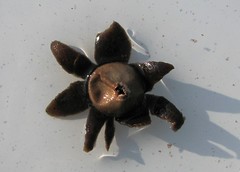
The Earth Star (see above) is a fungus but not a lowly one.  It can literally raise itself above the pack and move about in the manner of greater life forms. I recently encountered a constellation of these unique puffball relatives in a patch of barren sandy earth near Grand Rapids, Michigan (see here). I “captured” a few and brought them home in order to conduct a little…er, test of their motive skills.

  I am hesitant to say that I experimented with them.  That sounds way too much like the plot of an old science fiction film. I would be the aging scientist with a beard and spectacles who allows “something to go horribly wrong” after the radiation test. The irradiated fungi would grow into humanity-shredding monsters and knock over toy villages – spewing death spores over the innocents. I, the bespectacled aging scientist, would be left saying “What have I done. What have I done?” No, my test would involve nothing more than water and willing subjects.

  To our eyes these earth bound stars appear fixed into their position and for our immediate purposes this is just fine. One doesn’t need to sneak up on earth stars or view them though a telescope. This late in the season they are nearly as worn out as the beleaguered soil upon which they grow. But even in their cracked and weathered state, it is easy to see why they are called what they are. A central mini puffball is surrounded by a stellar arrangement of leathery “petals”  which gives them an otherworldly look.

  They begin their life like most fungi as a mass of mycelium in the dirt. This type, called the Barometer Earthstar, prefers to spread its fibers in thin soils where there is little competition. A small round, and multi-layered, fruiting body is formed and pushed up above the surface. Eventually the outer few layers peel back to expose a thin-walled puffball with a central opening (in the movie this would probably be the mouth!). All that remains is for falling raindrops to punch away at the exposed papery ball to release puffs of spores. This is where the thing gets interesting.

  Earthstars are not content with just sitting there in a state of blind mindless hopelessness for rain. They, in their blind mindlessness, actually seek to raise their puffball up into the lofty atmosphere. The “petals” absorb atmospheric water, or directly soak up the liquid element, and by so doing are compelled to curl even further back. This action propels the star’s punching ball center into the heavens where air currents can carry away the spore clouds. True, “lofty” in this case is only about a 1/4 inch off the ground, but this is enough to change the influence of air currents. When conditions dry up, the petals are pulled back into a shielding position.

  A fully elevated earthstar looks like some sort of a clumsy spider. See this side-lighted view (here) and you can see the ominous shadow.  Now, just for the heck of it, picture a tiny house engulfed in the shadow and terrified people running for safety. Once into position, the star is totally disconnected from its earthly connections – something that ordinary mushrooms and puffballs can’t do. But, it can’t move unless a hefty gust of wind propels it across the landscape. 

  The actual self-actuated motion takes place during the uncurling process.  This action is very slow, so it needs to be viewed on fungal time.  I’ve put together a few photos showing what happens during the water absorption period. The first picture shows a dried up star in “tuck position.” This is the same star pictured above, believe it or not. I added water to the container and within 3 minutes the petals had unfolded to the appearance of photo 2. One minute later, the whole thing had shifted position as in photo 3 and the star had reached full extension after 7 minutes.  Not bad, considering it takes some of us longer than that to get out of bed in the morning. 


I leave you to consider the amazing earth star. Oh no, what have I done?

That Guilty Look

 I was checking out our vehicle counter at the nature center the other day and I got a bit of a surprise. The counter is located in a small box with a hinged lid. When I flood the interior with light upon opening the top, I never know what I am going to see. During the warm season there is usually a small spider scurrying for dark cover or an occasional blinded yellow jacket perched on a beginner nest suspended from the top. I wait for the spider to seek refuge and flick away the ‘jacket before it recovers. The cold season lid lifting experience is far more mundane – the only thing I normally see inside the small box is the even smaller metal counter within. This time I was greeted by a pair of large mammalian eyes as the shaft of daylight cut into the interior. Those peepers belonged to a White-footed Mouse perched atop the metal lid of the counter.

  I was slightly taken aback, but not enough to prevent me from carefully lowering the lid, reaching for my camera, and re-enacting the opening sequence. I had my finger on the camera shutter this time and was ready to get off a quick shot before the creature darted. It was a mouse, after all, they always dart away from light and discovery.  I again lifted the lid and saw that the thing was frozen into the same exact pose as it was earlier.  It had not budged an inch or moved a whisker. I quickly snapped a shot, then another, and another. He didn’t move until I lowered my hand down to nudge him off the counter.

  The image that stared back at me, the one above, was the picture of intense guilt. It is the lot of mice that they always look guilty – even when they’ve not done anything to be guilty of. It is possible that all mice feel inherent guilt during every living moment of their lives. They are basically born to be eaten and there are no retirement homes for old White-footed Mice. Every breath they take, and they take a lot of them, is expected to be their last.  I was not a fox, hawk, mink, or a weasel but I surely was some sort of death angel come to gather a microtine soul. This stunned creature was caught off guard and instantly resigned to meeting its maker – even if this particular grim reaper was taking his sweet time documenting the event.  

  It so happens that this mouse was guilty of building a nest inside the box without permission.  Take a broader look (here) and you can see it in the upper right hand corner. The ball shaped nest was made of finely packed grasses, shredded leaves, and a liberal dose of winged maple seeds. Since the structure was crammed into a corner it was not in the way. This death angel, not being hungry or opposed to the idea, didn’t object. I simply nudged the maker and invited the guilt-ridden soul to flee, either to the comfort of its nest or up and out of the box. It did neither.

 Although I prompted it several times, he merely scooted around and over the counter box countless times. It would not leap out or nest up. No, he wasn’t sick. His movements were spritely. But, each time he stopped, he assumed “the scared snotless position” (see here). My reassurances, rendered in an unintentional God-like voice, fell upon his very large ears but had no effect.  “Kill me now,” the unblinking eyes begged, “and get it over with.” “Never mind,” impatiently boomed the big voice from above, “I’ll get the numbers and leave you alone.” 

  I got those numbers, closed the counter lid and then lowered the box lid. The last thing I saw was the twinkle of guilty eyes in the settling darkness next to the counter. 

  Mouse psychology aside, there are a few things to learn from this scenario. First of all, this creature was immediately identifiable as a White-footed Mouse by its fawn brown coat and white paws. These features are also shared by the Deer Mouse, so the only way to be sure – other than killing the beast and performing a whole host of measurements – is to look at the tail. The tail of the Deer Mouse is distinctly bi-colored and that of the White-footed Mouse is not. In other words, the Deer Mouse has a sharp delineation between the dark upper portion of the tail and the white under side. The White-foot tails, like our petrified example, gradually grade from dark into light.

    On a final note, his reluctance to enter his nest probably indicates that the structure was not done. White-footed Mice first gather the material together into a ball then proceed to chew their way in to make an internal chamber. I do believe that I interrupted the nest building process in the early stages. Knowing that he couldn’t possibly think of starting over, our mouse stuck to his guns. His guilty plan, as it turned out, worked out just fine. He will have the prolonged internal comfort of his secret lair for at least another month.

The Deer I Shot

Hey, everybody’s doing it this time of year. They’re talking about the buck they just shot, just spotted, just missed, or just saw tied onto the roof of a car. I just spotted a high six-pointer in the bed of a muddy black Ford pickup on Telegraph. The other day I parked next a Mercury sedan with a seven-pointer hanging out of the trunk (see above) and I stopped to watch an impressive – and live – ten pointer walk across the road ahead of me. I really want to show you the deer I shot, however.

  Before I reveal my prize, a little background is required. November is rut month for the White-tailed Deer. It is the time when the bucks are in prime condition and operating at prime stupidity. They are obsessed with the does and are driven exclusively by hormones. The big bucks, those endowed with sizable antlers, rule the roost. They can lay claim to any doe they wish as long as the other guys don’t have bigger antlers. If there is any question about relative size the thing is settled by locking antlers with the challenger. The winner claims his love prize and the loser looks for another doe. Because the world is over run with white-tails there is always another doe. But, like I said, I really want to show you the buck I shot.

Antlers are grown every year just for this season. A buck healthy enough to sprout a massive rack has the dance floor. A first or second year deer with spike horns becomes the equivalent of the pimply kid standing over by the punch bowl.  The big bucks tend to end up riding in the back of ford pickups, so it is left for the less endowed ones to bide their time and maybe get some action. I shot one of these small ones – I got him right between the eyes. He dropped his head and “bang.” Now you can see him (look here).

  I shot this fellow with a camera and he never knew what hit him. As you can see, it was a spike horn with just the hint of a fork at the top. What you may not have noticed are those small pieces of green bark sticking to the base of the antlers after a sapling battle. There is so much detail in this view that you can appreciate some other deer traits without looking at a head hanging out of a trunk. Note those big eyes, keen to any graceful doe entering the field, and those super long whiskers sticking out for… no particular reason.

 Deer are covered with glands and exude a musky odor similar to that pimply kid at the dance – a mix of “good” and “bad” smells. There is a gland, called the pre-orbital gland, located just in front of those eyes.  You can’t see the ones located on the forehead, on the inside of the hock, on the outside of each leg between the ankle and the hooves, and the ones between the toes.  Yes, between the big toes!

 Whitetails are toe walkers. You can plainly see this when an animal is walking on a hard surface such as this individual. There are actually four toes present. The two main toes are the “hooves” and the two minor toes become the “dew claws” positioned back up on the leg. Deer have no thumbs. If they did, they probably could avoid all those car/deer accidents and hitch a decent ride rather than smack into them.

  I think we’ve gloated enough over my trophy buck. He provided some nice little deer observation pointers but it’s time to let him return to the punchbowl. The deer I shot was taken through a plate glass window at a distance of ten feet. This less than impressive stud was biding his time at a bird feeder of all places. Take a look here and you can see him, and his little forest buddies “Charcoal” & “Foxy”, picking up some seeds at the Metrobeach Nature Center feeding station.

 You can leave all this last part out when you tell the other guys about my buck.

Behold the Weather ‘Rat


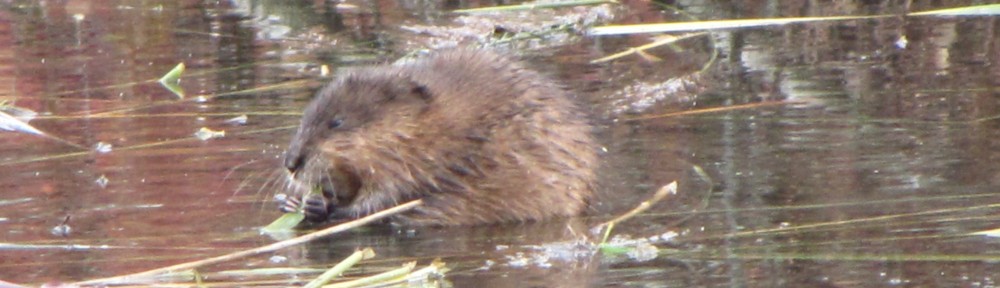
  Forget the woodchuck when it comes to weather forecasting – you’ll want to keep your eye on the lowly little muskrat for your seasonal prognostications. The ‘rat report is just as inaccurate as the ‘chuck report but it can be consulted much earlier. You can, in other words, get your mis-information much quicker on the muskrat channel.

  Face it, woodchucks are weather cowards. They dig burrows and hibernate when things get cold. The only “wisdom” they impart is when the winter will end and they are not very good at that either. Muskrats, on the other hand, tough it out. These overgrown aquatic field mice remain active all winter and do so while fully immersed in the water.  Now, tell me, which animal should you listen to when the subject of old man winter comes up?

  The real answer to this question is, of course, that neither creature can tell you a thing.  They don’t talk and don’t know how to predict anything. Humans that believe otherwise should  considered as “special” and avoided if at all possible. This didn’t stop certain 19th century naturalists since they were already considered “special” by the populous. They crowned the muskrat, not the woodchuck, as the weather wise sage.

  Of course they knew that muskrats were incapable of speech, but they claimed that the ‘rats spoke through their actions and not their words.  They stated a correlation between the size of the muskrat’s lodge and the severity of the winter that followed it. In short, this meant that larger lodges meant “larger” winters.

 November is lodge building month for most muskrats. In spite of the economy, our local muskrats have been very busy builders this November. I conducted a scientific survey of six lodges in one small section of marsh. Two were huge, two were medium, one was still under construction, and one looked like it was made by a first grader on a Sunday afternoon. Based on  this exaustive work, I’ve determined that there is a 50% chance that this coming winter will be severe. Call it guessing, but those are the numbers my friend.

  The largest lodges were made of American Lotus stems, leaves, and pods (see one of these mega-condos in the above picture). The lotus is a big-leaved plant. Big plants make for big lodges. Lotus lodges may look nice, but these houses are consistently destroyed by winter ice and wave action. they are like the proverbial house of straw versus the winter wolf. I guarantee that these constructions will be gone by mid-winter. Lotus eating muskrats thinks big, but they don’t live very long – for them all winters are bad.

  The lodge “under construction” (see here) is what I would call a medium sized structure but it is a work in progress. In this case, the lodge was made up of piled cattails stalks and bottom debris such as old water lily leaves. Muskrats habitually pile the stuff up and chew a network of tunnels and rooms through the interior as it settles. This one was only three days into the process when this picture was taken last week. It may eventually reach the huge status of the Lotus lodges, but for now it stands as a monument to a so-so winter.

  The good Lord willing and the creek don’t rise, the house will survive as a dependable shelter through the coming winter. Unfortunately, the creek does rise and fall around these parts and the Good Lord has been known to taketh as well as giveth. There is a better than even chance that this lodge will not make it either. I guess it bears repeating that, for a muskrat, all winters are bad.

  Given the above discussion it should be no surprise that most of “our” muskrats are actually “bank ‘rats.”  They live in branching tunnel systems excavated into the earthen banks next to the cattail and Lotus beds. Hmm, come to think of it woodchucks do the same thing.

 Go ahead, see if you can divine the weather ‘rat’s winter forecast this year. They may indeed have some instinctual weather wisdom which they unwittingly display in their lodge building styles. Personally, I don’t think muskrats waste much time on such nebulous things. To a muskrat, all winters are bad and all winters eventually end.

A Question of Translation


 You’ll see Karl Linneaus’ name bandied about quite a bit in this column.  The 18th century biologist is the father of our current scientific naming system. His concept was to assign a specific two-parted specific name, usually in Greek or Latin, to all the world’s lifeforms. A scientific name is universal and one understood by scientists all across the globe regardless of their native tongue. For instance, the name Melanerpes carolinus refers to, and only to, the Red-bellied Woodpecker. The Chinese scientist understands this just as well as the Peruvian, Croatian, or Haitian scientist does.

  If we relied solely on the common name, everyone – including the English speaking scientists – would be confused. For instance, this Red-bellied Woodpecker doesn’t really have an obvious red belly. I could see a Peruvian scholar raising his eyebrow at this fact. You’d think that a red belly would be it’s most prominent feature, but it’s not (see above picture to verify this fact). Now, I’ve often kidded openly about the absurdity of this fact and ridiculed the lout that came up with that common name. I may even have insinuated that Karl was to blame, but upon closer examination I find that I must eat some humble pie. Please allow me to explain.

  First of all, let me make one thing clear: the Red-bellied Woodpecker really does have red on its belly. Take a look (here) at this recent road-side specimen and you can verify this for yourself. The belly on the bird is the part located below the breast and basically between the legs. There’s not much red there, but its there sure enough. Some might call this a mere blush, but it is a red blush.

  Mr. Linnaeus described this bird in 1758 and pretty much nailed it by concisely stating that this was a “woodpecker with a red cap and nape, a back with black & white bands, central tail feathers that are white with black spots, and Ani regio rubra punctata.” That last part, the one I slipped in as Latin- sorry – translates as an “anal region spotted with red.”  My man Karl never said it that it was red-bellied, he correctly stated that the red was scattered about the anal area! The challenge was to find a common name that said this simply and decently. “Red-a _ _ed Woodpecker” would have been starkly correct but impolite when used in mixed company. “Pimple Butt Woodpecker” had the same problem! So, our anal thinker used the technically correct “Red-bellied” and so here we are today. You can’t easily see the reddish belly, but its there and I will forever point that out.

  Now that we’ve got that mess out of the way, we can take some time to admire a road specimen of this bird a little closer. Take a look here at a side study in order to take in the whole creature (see here). Note the black & white banding on the back just like Karl said it would be. The red cap running from forehead to neck on this individual identifies it as a male. Even if you don’t like looking at dead animals, I think you have to agree that this scarlet hue is spectacular.  Females, by the way, only have red on the back of their heads.  The stiff tail feathers (see here) function as props when the bird is engaged in wood peck’n.  Even though one of the central tail feathers is missing, please note that the remaining one is “white with black spots.”

  Woodpecker feet are always incredible and these two views (see here and here) will confirm that fact for you. Unlike most birds, red-bellies and their kind have a toe arrangement in which two toes point forward and two point back. This toe set-up is called a “zygodactyl” arrangement. You are invited to forget that word, but I’m willing to bet it is worth a zillion points in Scrabble.

  Our blushbelly woodpecker chat is not yet tapped out. I consider it my job to bring up something that might not be obvious when performing an on-line examination such as this. We’ve already covered the red belly part, but I also need to pull out the Red-bellied Woodpecker’s tongue (see here) to exhibit one of its most important tools.  This appendage can extend out more than twice the length the bill and is equipped with a barbed harpoon to skewer wood boring grubs. Take a second glance at the previous picture and you’ll see that there are a half a dozen barbs at the pointy business end. The tongue is so long, in fact, that the root extends around the base and over the top of the skull, continues past the eye ridge and eventually anchors inside the right nostril!

  Hopefully all your future encounters with a Red-belly will be with a live bird. Their squirrel-like call (listen here to this Red-bellied Call) is a good sign that these common birds are overhead and ready to test your observation skills. You may point it out as a Red-a _ _ed Woodpecker if you wish, but never take Karl’s name in vain.