I Am Sooooo Sorry. Really I Am.


 Every once and a great while, muskrats make the news. They normally go about their daily lives existing just under the “radar.” Give them a bed of cat-tails, some water to swim in, and at least a three month reproductive start on the trapping season, and they are good for the long run.

  If you’re from Monroe, a trapper, a regular reader of my blog, or a combination of these, the muskrat will be a bit more familiar to you. I bring the subject up all the time. Otherwise, the incidences of general muskrat fame are few and far between. You have to go back to the Captain and Tennille in the 70’s or the Cowardly Lion in 30’s to hear public mention of the creature.

  The lion conjured up notice of the muskrat’s courage while protecting his musk in the Wizard of Oz. Since Oz is one of the best movies of all time, you could say that the muskrat has made it really big. I’m pretty sure, however, most people won’t recall this part as the high point – nothing can top those creepy flying monkeys. Unfortunately it was the hit song Muskrat Love, one of the worst songs of all time, which still sticks in the modern mind whenever muskrats enter the conversation.
  Such a thing, by this I mean the public mentioning of a muskrat, just happened last week.  On June 27, 2008 most of the national news outlets led off with the following Associated Press byline: “WINFIELD, MO. – A heroic effort by hundreds of townspeople, volunteers and National Guardsmen to hold back the Mississippi River failed today – undone by a burrowing muskrat.” Yes, all the frantic efforts of the population of Winfield to hold back the surging waters of the Old Man River were undone “by an animal weighting no more than 5 pounds.” 

  The muskrat burrow riddled levee failed just before dawn and opened up a 30 foot breach where waters poured into the fields leading to the town. Nearly all the 720 residents, aided by the Guardsmen, scrambled to re-erect a four foot wall of sandbags to stop the flood waters. The breech occurred under the existing pile of sandbags already stacked onto the Pin Oak Levee.

  In the end, it looks like the town was saved, but you can imagine how folks around those parts feel about muskrats. A local is quoted in the article as saying “It’s so disappointing. With all the guns in this country, couldn’t we kill a muskrat?”

  I don’t normally do this, but I followed a few of the public comment strings that followed the article postings on the USA Today website and some other venues. The comments covered the gamut of human intellect (which is a wide range). “I did not know we had muskrats in Missouri,” one citizen wrote, but concluded “at least muskrats do not know what they are doing.”  This person pointed out that a levee was once busted by a drunken guy in a motor boat. I’m not sure that guy knew what he was doing either, but the point is valid. Others laid blame on the president for forcing the muskrats to resort to terrorist tactics. An eye winking writer hinted at a dark and secret muskrat link with the descendents of Mrs. O’Leary’s Cow and a secret animal plot to destroy all human life. 

  I found some delight in a learned comment claiming an “Ah Ha! gotcha” moment. “People don’t shoot muskrats, lady” answered one helpful opinionator in reference to the gun comment in the AP article, “You trap them.”  While this statement is mostly true within a modern context, it doesn’t hold historical water (pun intended).  The post prompted a “flood” of replies. “Yes, actually we did shoot them,” was one answer from a fellow talking about “back in the day” when they would plink muskrats off the dikes in order to keep them from doing the very thing that just happened.

  It is with a sense of historical duty that I also feel the need to add a snippet here from a much earlier newspaper article. In the Dec. 14, 1906 issue of the Monroe Democrat (maybe you still have this one in your newspaper pile?) which states: “The Monroe Yacht Club contemplates holding a muskrat hunt as soon as there is sufficient ice in the marshes, the object being both to give the boys a great days sport, as well as provide a good proportion of the muskrats for the annual banquets…”

  Muskrats do make a habit of destroying dikes and levees. It’s not that they mean to be destructive; it just that they are doing what comes natural. In the absence of cat-tails or rushes, muskrats construct earthen burrows with extensive side galleries and nest chambers. The entrances to these structures, like those of their cat-tail mound houses, are underwater and therefore invisible to the land based observer.

  Their local burrowing activities are especially evident along the control dikes at the Pointe Mouillee marsh.  I took this picture a few days ago in order to illustrate my point and to shed some light on the Missouri muskrat fiasco. You’ll see how the dike is literally honeycombed with ‘rat burrows where they are exposed due to a lowered water level. There is no sign of this above the old water level.  All it takes is for a few of these burrows to connect with the ones coming in from the other side and you have a potential disaster on your hands.

  Yes, dike-digging levee-liquidating ‘rats need to be controlled for the sake of humanity. Go for it, Winfield residents – it is your right. Muskrats always have and always will bounce back from any effort to eliminate them, so there is no danger of extinction on their part. The only danger here is an overreaction due to a small bit of bad press.  

  Let’s leave the final word to poster knitter4democracy who says “Muskrats are really cute and they do good work a lot of the time.” While I would never use those exact words I will plead, on behalf of the lowly rodent, not to be too harsh on muskrats. They are just doing what they are supposed to do in order to protect their musk. I am sure, if asked in the proper manner, they would express their sincere apologies.

Long Tongue Do See

Last time we met, I introduced you to the Flicker’s tongue.  This time I’d like to stick another tongue out at you – a much longer tongue on a much smaller critter. In this case, the tongue in question is found on a type of moth called a Laurel Sphinx.

  Although endowed with some wonderfully cryptic coloration meant to blend into a barky background, this individual stood out like a sore thumb against the pale siding shingles of my house. I decided to pluck the thing off its moorings, as a favor, mind you. I figured it was better for her to have a temporary inconvenience caused by a curious non-predator than a permanent ending caused by a real predator.

  This species of moth is relatively un-common in our neck of the woods. It was nice to get an opportunity to “collect” one via the magic of digital photography (see above).  As a group, sphinxes are sleek winged flyers that get their name from their distinctive larvae. The caterpillars are better known as horn worms (because of the pokey appendage sticking out of their hind ends). When frightened, they pull up the front half of their body and look for all the world like Egyptian sphinxes.

  All Sphinx moths are endowed with long hollow tongues that enable them to sip nectar from deep tubular flowers. The larger sphinxes, such as the Laurel, can imbibe from deeper flowers such as the Trumpet Vine.  Inch for inch, their tongue is one of the longest in nature. It extends out several inches when uncoiled – this equals the length of their body. Now that’s a tongue!  I inserted a stick into the center of the tongue coil and un-rolled it as far as the creature would allow (see here).

  Once I finished with the tongue examination I held the large moth in my hand and let it prepare for take off.  It revved up it’s engines and trembled all over as a means to warm up its flight muscles (see here). After a few minutes it was ready to go. Given the nature of this discussion, I should say that it was off in a lick (sorry, I had to say that).

Long Tongue No See

  “It was about this high,” the earnest fellow declared as he held his hands about 3 feet apart. “It was brownish and had speckles all over. The head was all red with a lighter throat. Oh yes, it had a long beak too – something like a woodpecker beak.”  For a brief moment I entertained thoughts that maybe a specimen of the incredibly rare Red-headed Pixal Crane had landed in town and that the observer had truly described to me the find of the ages.  Just in case, I probed.

  I questioned the size again and found that the bird had shrunk in size over the last few seconds. It now vacillated between 20 -24 inches high. “It was up on a hill, so it may have looked bigger than it really was,” the man admitted.  I held my hands about a foot apart and asked if it could have been that size. “I suppose,” he said.  When asked about color and anything else that might have been distinctive he repeated his “brownish and speckled” theme and emphasized the long beak. “The red was more on the back of his head, now that I think about it.”

  I asked him if it was on the ground.  He said yes, but up on a hill.  Speckled? Yes. Long beak? Yes, like a woodpecker. Red on head?  Some, a little on the back of the head. Sad that ornithological history had not been made on this day, I concluded that he saw a Northern Flicker – a large type of woodpecker. “But aren’t woodpeckers supposed to live in trees?” he asked justifiably. “Yes, but this one spends a lot of time on the ground. They like to eat ants.” I almost added that “ants live on hills and that everything looks big next to them,” but bit my lip.

  When I go into a hardware store and try to describe what I want, I bumble over the proper descriptive words – resorting to words like “thingy” and “flange” (I like the word flange because it sounds so hardwaredy). I am to the hardware guy what this visitor is to me, so it is not in my place to condemn his exaggerations and in-exactitudes.

  I am used to people coming up to me and wanting a tight identification after telling me they saw “a little brown bird with no marks.”  I may attempt an answer and ask about the presence of a flange or something, but have to admit ignorance.  In answering the Flicker question, however, I found myself shaking my head and re-analyzing my view of this common bird.  The more you think about it, it is an odd bird even when described correctly. A woodpecker that wants to be an anteater is like an elf wanting to be a dentist in an animated Christmas special. This is a woodpecker that is always looks down to earth.

  Take a look at the picture above and you’ll see the species in question. Note that it is sitting on the ground, that it is heavily speckled, that it has a long woodpecker bill, and that it is looking down. You can’t see the back of the head in this view, so take my word that it is purplish with a bright heart-shaped red spot in the middle.  On the throat you’ll see a distinctive black crescent mark that looks like a gorget worn around the neck.

  The most distinctive field mark of the Northern Flicker is a bright white rump patch. This feature shines out like a beacon when the bird is seen from behind as it flies away. When the thing is up on a hill this field mark is impossible to see (wink, wink).

  As a card carrying member of the woodpecker family the Flicker has a fine woodpecker-like chisel bill. It even uses this bill to excavate nest holes and tap out syncopated rap music. It can feed on wood boring insects, but has a decided taste for ant meat.  Most ants live on the ground, so the flicker must descend earthward for feasting. Here is where the bird actually shows some adaptive flare (or is it an adaptive flange?).

  Hidden within that impressive beak is an even more impressive tongue.  The tongue measures about 5 inches in length.  It is, according to one reference, one of the longest tongues to be found in nature. This is a proportional reference, not a literal one, but I think an inaccurate one. I happen to know of another creature with a much longer proportional tongue, but I’ll divulge that one next time. Let’s just say that the Flicker tongue is a fine piece of tonguage. This organ is so long, in fact, that it curls around the back of the head and anchors in the nostrils.

  All woodpeckers have long tongues covered with barbs in order to harpoon their tunnel dwelling prey. Flickers differ in having a smoother tongue that is covered instead with sticky saliva.  This is the same weapon of choice that is employed by mammalian anteaters such as Aardvarks, Pangolins, and Giant South American Anteaters. These guys are pros and the Flicker can keep up with the best of ‘em. Employing that long sticky tongue, the bird laps up ants like candy- angling their heads low to the ground and flicking the tongue like a snapped towel.

  As far as I know, the name Flicker stems from their maniacal laughter-like call, but once you’ve seen one flick’n away at an ant hill, you’ll be convinced that this is real reason behind the name.

A Miraculous Transformation

In the backwards world of blog posts, that which comes after precedes that which comes first. So, when I say this post is part two of our examination of baby Black Swallowtail Butterflies you’ll need to scroll down in order to review part one (“Stepp’n Out and Stink’n Up”).  In the real world, that which comes before precedes that which comes after. Caterpillars eat, grow, and eventually transform into adults.  This is the natural order of things.  Come to think of it, people do the same thing (except we go through a couch potato stage instead of a pupal stage).

  It should be no surprise, then, when I tell you that the larvae we looked at a few days ago have now taken the next big step in their brief careers. They have transformed themselves into the third metamorphic stage known as the chrysalis. 

  No matter how you look at it, this is the beginning of one of nature’s true miracles. Upon reaching their maximum size (which takes about 10 days), the caterpillars say good-bye to their Parsley eating days. They begin to wander about and look for a suitable spot to perform their miracle. In the confines of their small container home, my captives put in a mile of laps as they went around and around the perimeter. In the wild, caterpillars seek a location as far from their food plant as they can get.

  Miracle workers need to choose their spots carefully. A slanting horizontal surface is considered a prime spot – especially if it is under shelter and secreted away from the prying eyes of predators. The larvae weave a silk pad, once they are satisfied with their site selection, and advance forward to the point where they can hook their back feet firmly into the silk.

  A silken support is then woven into place like a lineman’s harness. Multiple threads are repeatedly glued to the surface, brought around behind the head, and then looped around the thorax.  After this step, the larva leans back and allows the harness to support his weight (see above).

  It takes the better part of a day and a night for it to happen, but the final act in this scenario is one where the skin on the back of the caterpillar splits open. The old skin is worked off via a series of gyrations as the newly formed chrysalid creature is slowly revealed. That chrysalis is a reformation of the caterpillar’s body -sans legs. The bright green chrysalis takes on a sleek streamlined look after an hour or two (see here).

  Inside this new hard shelled package, the larva is essentially dissolving into mush. The body is breaking down into simple cells called marginal cells. Body cells revert into simple un-committed entities -similar to stem cells -that can be reassigned to become wings, antennae, and long tubular tongues.

  The root word for chrysalis means “gold” in the ancient Greek tongue. This is an appropriate name if you consider that the chrysalis is like a precious goblet that holds the promise of a new lifestyle. In about a week and a half the miraculous transformation will be complete as the swallow-tailed adult emerges from its green-gold chalice.


Stepp’n Out and Stink’n Up

  In nature study, plant watching and butterfly watching are one in the same. Insects of the scaly winged clan are life-bound to particular plant families as their larval food.  It is almost as if they signed an exclusive contract back in the dim times in order to guarantee the mutual survival of both. This contract is honored to this day. This means that if you locate a particular type of plant you will have a good chance of locating a particular type of larval butterfly.

  The association between Monarch and Milkweed is a well known example of this principle. I’ve previously mentioned the Painted Lady / Pussy Toe connection and many gardeners are all too familiar with the Cabbage White/ Cabbage connection. The Black Swallowtail/ Parsley bond is less familiar, but is as sure-fire as these better known combinations.

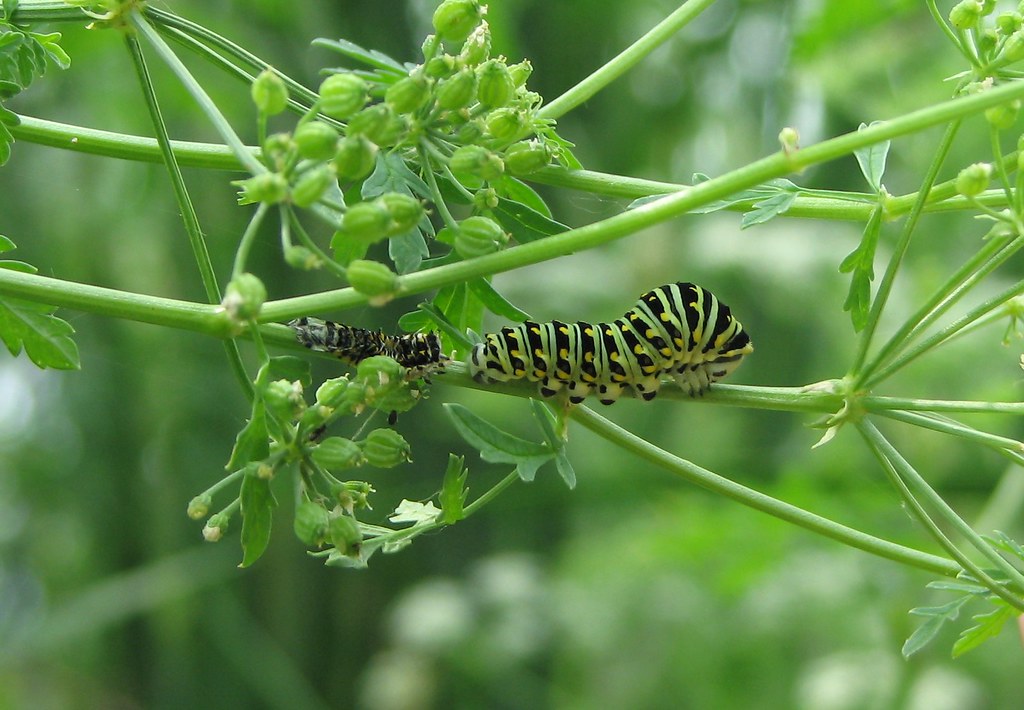
  Black Swallowtail butterflies lay their eggs on members of the parsley family such as Wild Carrot, Parsley, Dill, and Cow Parsley. Cow Parsley is a weed plant that has proven to be trouble for some members of the human clan – it has been known to cause rashes – but it can serve as a swallowtail magnet. A recent examination of a Cow Parsley specimen revealed a bunch of the multiply striped larvae feasting on the leaves. The little creatures were in all stages of growth from newly hatched to late stage “mature” larvae (like individual shown above).

  When they first hatch, they have white saddles on their dark little wrinkled bodies. This combination gives the tiny larvae the appearance of bird poop. Based on the solid ecological knowledge that birds don’t eat their own poo, being a poo mimic can keep you living into the next stage.  

  Caterpillars go through a series of growth spurts called instars. They advance to the next stage by shedding their old skins. The first few instars are crappy in nature (see here one that still has the white saddle). After a week or so, the young are ready to come into their own. 

  I located one individual that had just walked out of his old poo-mimic skin as a late stage caterpillar. Take a look here and you can see the old shriveled skin adhering to the stem behind it. In preparation for this action, the larva wove a silk pad and firmly sunk its tiny claws firmly into the weave. Once so secured, the skin then split along the back and the beastlet literally crawled out of its own skin.

  The “mature” Black Swallowtail caterpillar is a handsome looking thing. It seems funny to say that a caterpillar is “mature” – since the creature is technically still a baby.  The late stage is the “big baby stage” at the end of youthdom. The rich pattern of black & yellow against that glowing green backdrop is a definite “I am not crap” fashion statement.

  Now that the larva is not protected by the cloak of mimicry it has to fall back on another ingenious defense tactic. Should a predator get a beak hold on one, it will let loose with an organ known as a stinkhorn (see here). This bright orange horn emerges out of a pocket just behind the head capsule. Its appearance is shocking enough, but the effect is accentuated by a backward jerk of the head.

  The horn exudes a strongly scented concoction distilled from a concentration of parsley chemicals. By reeling back and swaying the caterpillar attempts to smear the liquid onto its attacker. This brew must be offensive to fur and feather predators, but I don’t think it smells all that bad. It merely stinks of over ripe vegetable juice in my humble opinion.

  I let the larvae apply a liberal dose on my fingers as I attempted to get a decent photo. It took the better part of a day for the smell to go away and this provided me an opportunity to invite a few folks to take a whiff. I didn’t ask them to pull my finger, mind you, just to sniff it.


Shades of Summer Cinnamon

  Although green is definitely THE color of the season, there is something to be said for cinnamon. I’m talking about that near-orange shade of brown usually reserved for autumn acorns and chestnuts. This is the color of June deer and field-walking summer Sandhill Cranes.

  I am not one to spend too much time talking about deer – leave alone admiring them. I have to admit, however, that it is refreshing to see a brightly clad doe in summer pelt. Warm season deer are rather bobble-headed and gawky. When chest high in a sea of green on an early morning feeding binge, they are still gawky but delightfully attired none-the-less (see here).  This one was captured in mid-chew so she looks a little odd with this open mouth attitude.

 White-tails shed their long thick gray winter coat and replace it with a summer crew cut. Deer hairs are hollow insulators, so it is best to have as little of them as possible in order to dissipate heat.  This particular doe returned a few days later with her pair of white speckled fawns attired in an even brighter shade of cinnamon.  They were almost cute enough for me to forget that deer are basically pigs with long legs – almost.

  When I spied a small flock of Sandhill Cranes working a soybean field just west of Tecumseh, I mistook them for a group of deer at first. It might be hard to believe that a big two-legged bird can pass for big four legged mammal, but it’s that cinnamon color thing (combined with a 55 mph glance). They are striking birds, standing 3-5 feet high, with a brilliant red crown atop a basically gray brown body (see here). That crown is actually a patch of bumpy scarlet skin (see this detail shot here) similar to the naked skin on a turkeys’ head.

  Sandhills are members of a unique group of large long-legged long-beaked birds called cranes. They are one of the few members of this worldwide group that are holding their own and they are a relatively common sight in mid-state.  They nest in fresh water marshes and congregate in great numbers after the nesting season ends. We are here to talk about brown, however, so let’s get back to the subject.

  These stately fowl are typically gray in color, but they have two cinnamon stages. As a youngster they are adorned in a golden roasted marshmallow colored down.  The brown feathers start to dissipate into spotty patches when the birds mature into summer. You can recognize the full sized, but immature, birds in this soybean flock (see here) as the birds with a splotchy looking wardrobe.

  Adult birds, as I mentioned, are normally attired in clean gray plumage. Their habit of preening iron rich mud into their feathers stains the feathers brown. You’ll note (in the picture above) that their heads and upper neck are gray while the rest of the body – the area reachable by beak – is stained.  It appears that only the adults can play in the mud. In the field guides, the brown birds are referred to as ‘stained adults.” In regions of the country where this mud is not available, the cranes are stainless.

  Our Michigan cranes and whitetails are both rusty creatures, but it sounds so much nicer to say that they are “cinnamon hued.”

A Love Triangle

Animal husbandry is a wonderful thing.  Although some wives out there might believe that this is a marriage reference, I am actually referring to the care and feeding of animals by humans (still the same thing according to those same wives).  Domestic animals have long been a crucial part of the human condition.  We raise sheep, cattle, pigs, and chickens and they (willingly or not) provide us with things like wool, eggs, mutton, beef, leather and “the other white meat.” It would be normal to assume that this kind of relationship is strictly confined to the human species, but such is not the case.  Ants practice husbandry also. They have, in fact, been doing it much longer than we have.

  Wood Ants, those marvelous creatures that build solar powered nest mounds, are sophisticated aphid farmers (looks like they have us beat on two counts!).  I recently came upon one of their work farms while walking a woodland trail.  The ant factory farm was being conducted on the leaves of a sapling Aspen (see here).  Near the base of each leaf -where the stem joins the flat green pasture of the blade- herds of tiny aphids were being tended by three or four ants.  The black & red farmers looked like giants compared to their miniscule charges (see above), although they are only about 10 mm in length. The aphids came in a variety of sizes ranging from pinhead proportion to about 1 mm. in length.

  The aphids act like tiny milk cows in this scenario. They suck on the juicy plant sap using straw-like mouths and eject waste fluids in the form of sweet honeydew droplets. The dairymen ants milk this sweet substance as a much needed food source. Unlike their human counterparts, wood ants need only to lightly tap their “cows” with an antenna to induce them to release their product into their open jaws. The tree farm is a constant hub of activity as ants return to, and arrive from, the ground colony and the stationary aphids keep pooping up those sugar drops.

  It’s easy to see the plus side of this relationship as far as the ants are concerned.  As omnivores that make a living foraging for all manner of plant and animal food, their only reliable carbohydrate source is honeydew. A colony can consist of up to half a million individuals – that’s a lot of mouths to feed.

  What’s in it for the aphids?  Fortunately, the ants forgo the opportunity to eat them outright and act instead to protect them from predators. By shepherding their herds, the ants keep spiders, wasps, and other ants out of the pasture tree.  Angry Wood Ants are not to be trifled with.  They have the ability to squirt formic acid onto their opponents- sometimes as much as several feet away. This talent is where the term “piss ant” comes from. As a result, the aphids can reproduce in relative peace and live long happy lives as fat sap-sucking bags of insectitude. All they need to do is act naturally while their guardians get pissed off.

   With both sides benefiting, this whole thing might be called a symbiotic relationship. There is, however, a third party in this affair as well.  The aspen tree is the unwilling third part. As the primary blood donor, you’d think the tree would suffer from this controlled aphid invasion. These are, after all, the same aphids that suck the life out of garden plants and are major pests for humans engaged in plant husbandry.  In the case of the trees, however, it has been revealed that ant farm “infested” trees tend to be a bit healthier than thier non-infested counterparts. Caterpillars and other leaf eaters are discouraged by the ant activity- a benefit to the tree that outweighs any sap loss. Colonized oak trees actually produce healthier acorns, for instance. They don’t produce more acorns, but have fewer problems with the weevils and borers who normally destroy the nuts. 

  What we have here is something called “indirect mutualism” – a love triangle in which everybody is happy in the relationship.  Humans don’t do well when love triangles are involved, so I guess the ants have us beat on all fronts.

My Little Yellow Mayfly

  ‘Tis the season for Mayfly hatches. Even though it’s not May anymore, the big Mayfly season is just underway. Perhaps it would be better to refer to these creatures by their alternate name of June bug – since it is June.  But, then things would get really confusing since some would assume I am talking Junebug Beetles which are also known as May Beetles.  Maybe it is due to this potential confusion that most folks simple call them Fishflies.

  Entomologists would remind us that the proper common term is really Mayfly and that they are members of the Ephemeroptera order. They couldn’t resist adding, however, that technically they are not flies and that different species emerge at different times of the year, so the common name is totally misleading.  They would also interject that there is another unrelated aquatic beast that already lays claim to the name of Fishfly.  These too are not really flies, but….O.K., whatever. The point is that certain members of this group- stupidly known as Mayflies – are now leaving their wingless “may” fly stage and entering their “are” flying stage.

 The Giant Burrowing Mayflies, affectionately known as the “Hexs” among fly fishermen, dominate the local hatch scene. These are the ones that come out in huge masses to cover the sides of buildings and those horrible numbers on gas station signs. Because of the overwhelming nature of this species hatch, other Mayfly species tend to get overlooked. Take this little yellow Mayfly (pictured above), for instance.

  I found this little gem mixed in with a herd of larger fishflies. Take a look here for a size comparison with one of the Burrowing Mayflies. It is a pint-sized thing whose light yellow color makes it a stand out in the dark company of greater beasts. I would like to call it a Light Cahill Mayfly and be done with it, but I can’t. When it comes to the lesser mayflies, names are used over and over again.

  Technically my butter hued friend is called Stenacron interpunctatum – a name which brings a smile to the lips of entomologists but gets stuck in the commoner’s mouth. This species requires moving water and riffles as habitat. It can tolerate warm water but can’t tolerate polluted water. It is, therefore, a harbinger of good things – as are all mayflies.  When these things emerge they do so in a sporadic manner over the summer so they don’t get noticed.  I am now serving you notice.

  I was curious about the “Cahill” name, so did a bit of investigating.  I discovered that there are four or five light colored “flies” all called Cahills. All of the mayflies in this group are very similar in appearance, even though they are completely different species. The name stems from the human end of the picture. Fly fishermen tie imitations of aquatic insects, such as mayflies, in order to lure fish to their hooks.  Using a combination of yellow thread and speckled Wood Duck flank feathers, the Cahill fly is a type of fishing fly (see here) that imitates generic small yellow mayflies such as  Stenacron interpunctatum.

  It is interesting that the artificial name eventually became the only common name available for the real insects. The artificial fly in question was invented in the 1880’s by a New York Railroad brakeman and avid trout fisher by the name of Daniel Cahill. His pattern became famous among fisher people the world ‘round. Today, the fake flies are much better known than the Little Yellow flies that inspired them. 

  It might interest you to know that during the course of my research, I came across a link on one of the fly-fishing pages that referred to a product called a “Frog Hair Supple Butt Leader.” I was tempted to order a few just to be able to tell someone I was expecting some Frog Hair Supple Butts in the mail. In any case, such a thing stands as certain confirmation that fly fisher people sure have a way with words.


When is a Green Frog not a Green Frog?

So, you’re walking along the shoreline next to a duckweed encrusted patch of water and you spot a frog. The beast is partly submerged but a significant portion of it is exposed above the water.  You can see it’s a big plain green frog. Let’s take this one step further and say you’d like to identify it. The size reference seems more important than the color observation given that a great number of our aquatic frogs are of the emerald persuasion, but actually the two facts are needed to narrow this thing down.  What I’m trying to say here is that our two largest native frogs are both green, but only one is a true Green Frog. Alright, I’ll explain.

   In the category of green frogs over 5 inches long, the Green Frog and the Bull Frog are the only two contenders. Sure, there might be a few huge Leopard Frogs out there droning Brando-like that they “coulda been-a contender” for consideration, but we are talking large green un-spotted frogs here.  If this walk had taken place somewhere in the Upper Peninsula, then the Mink Frog would need consideration. We are not in the da U.P. for this imaginary exercise in frog forensics, however, so let’s continue with the Green vs. Bull.

  How then, can the determination be made?  Green Frogs (like the example above) always have bright green upper lips and relatively pointy snouts whereas Bullfrogs have blunt snouts.  In a world of half submerged (or, optimistically half exposed!) frogs snouts are often hard to see, so one must get back to basics – the basics of the back.  It’s really just a matter of folds. Take a good close look at the exposed portion of the amphibian’s back. If there is a pair of ridges, or folds, running behind the eyes and down each side then you are looking at a green Green Frog (see here).  If there are no pinches or folds then the creature is a green Bullfrog (see here). Bullfrogs have a fold, but it curls tightly around the circular ear drum and ends at the chest. The rest of their body is an expanse of pebbly moist skin.

  There are many other ways to tell the two apart if need be, but there usually isn’t a need be. Should the green frog be the size of a honk’n huge lawn ornament, it has to be a bullfrog. Bulls get to be twice as large as Greens with snout to hind toe tip lengths of 12 inches or more. If the frog is on your plate, it has to be a Bullfrog. These are the only species locally used for frog legs.  If there is duckweed on your plate with the frog, then your frog is not dead and it could be either species.  If the frog has a fringed collar on, then it’s Kermit and he’ll explain how hard it is being green.     

  Should we allow the real frogs in question to speak up on this matter, the difference in voice quality will be very obvious.  The Bulls proclaim their masculinity with a deeply sonorous Barry White style “Jug-O-Rums” and the Greens plunk out a series of washtub bass “Klunks.” 

  Since we are sticking to visual clues for the time being, the folds are the factor.

What a Relief

  When I last introduced this Cecropia Moth to you it was mid winter and summer was but a distant hope.  She was just a pupae encased within a silken bag of her own larval construction. I, of course, didn’t know she was a “she” at the time, so introduced her as an “it” – which is better than saying “he-her” or “Pat” all the time. You might want to go back and read the entry (Sat., Jan. 5, 2008), but to save you the trouble I’ll tell you that I cut open the cocoon and removed the pupae in order to take some pictures. I put the thing back carefully and sewed the silk cover together (whip stitch, I believe). I then suspended the cocoon laden stick from a nail out in the un-heated back porch and awaited the June emergence.

  Almost from the get-go, however, I started to get some doubts about the entire affair. I’ve never done this procedure before and began to entertain feelings of guilt. Perhaps my actions destroyed some sort of a vapor barrier, or my handling introduced some hideous fungus that would slowly eat away at the precious life within. It was like taking a fetus out of the womb, I reasoned unreasonably, for the sole purpose of filling the space on my crummy little blog.

  After a short while, I began to get over these thoughts. The pupae, after all, was a tough skinned entity that was built to tolerate extreme cold and violent shaking due to hard whipping winds.  Nothing I did could be compared to the torture Ma Nature woulda-coulda done.  About the time I was re-considering the crumminess of my blog, another horrible thought struck me: What if I put the pupae in backwards?

  For the life of me I couldn’t remember what the original pupal orientation was, but I thought the head end faced upward. The emerging moth will need to spit out a silk-dissolving fluid in order to create an exit portal though the tough fibrous cocoon (they have no chewing mouthparts). The more I thought about it, I became convinced that I had returned the pupa to the cocoon with the head end facing downward!  It would have to go out the wrong end.

  What would happen, I wondered, if the thing emerged from the pupal skin and found itself facing the thick end of the cocoon?  Would it have enough spit to burn through or would it be trapped like a sausage in a wrapper – dry mouthed and unable to turn?  In the latter case, the poor thing would die in place without ever being able to spread its glorious wings. All of this because of my miserable attempt at a crummy science blog.

  As May turned into June my angst increased. By the time the middle of the month loomed, I was convinced that I had indeed killed it. I had performed a fatal pupa installation akin to a doctor putting in an upside-down heart. Most giant silk moths were out already.  My Polyphemus emerged last month and I noticed a pair of Luna Moth wings next to a porch lamp the other day (it had been eaten by a bird). Then came Father’s Day.

  On Father’s Day morning I awoke to a glorious sight. The Cecropia Moth had emerged earlier in the morning and was hanging from the now-empty cocoon. It had emerged out the normal end of the cocoon. The creature was normal in all respects – with all fingers and toes, well, all six legs anyway. It was a beautiful girl to boot. What a relief.

  This gal is worth a closer look, so take a gander here. This is our largest native moth and to see one in pristine condition is a real treat. Apart from her size (females are larger than males), there are two other features that mark this one as a female. Her featherlike antennae are narrow and her egg-filled abdomen is huge. Yes, she has a big butt that is covered with a fine wooly scales and decorated with a wonderful maroon and white pattern.

  I’ll keep her for a few days then release her to her own charge. I still had one burning question, however. Did I put her in backwards?  Did she need to turn around? I cut the cocoon suture to check out the pupa skin. The pupa was heads-up just like it was supposed to be. Still, I wonder what if?….