Along Came a Spider

   We’ve all been in the situation where we discover a Buick-sized spider in the tub or sink. Usually the spider in question is more comparable in size to a VW Beetle, but the absence of scale causes us to exaggerate a bit. My son came in from mowing the lawn the other day and bent down to wash his hands. A sizable spider, pictured above, fell off of his shoulder and landed in the sink basin before him – which elicited a gyrating dance accompanied by self flagellation.

  Had this of been my oldest son, he would have immediately washed the thing down the drain in a sudden gush of super hot water. Number two son, however, left the creature in state and informed me of a spider in the sink. “Is it a big one?” I asked. “Kinda,” he said, “but I’m not sure what kind it is.” I followed him back and when he pointed it out I blurted out “Holy Cow!” Now, I didn’t actually say those words, mind you, but expressed an emotion slightly more extreme than that sentiment.

  What I initially saw was a Buick-sized smooth bodied spider lying on its back in the middle of the basin. Large spiders are one of the only natural phobias I have, so I had to fight back the knee-jerk reaction to immediately flush it down the drain with a sudden gush of super hot water. My naturalist’s instinct took over when I realized the thing wasn’t moving at all and was very fresh and un-squished. Dead spiders curl up when dead because they are essentially fluid filled leg bags that deflate when whacked or dried up. This one was as fresh as a…a…. live spider, but without the jerky movements. It was a Sow bug Killer Spider and one of the largest I have seen.

  The thing was actually only about an inch long from leg tip to leg tip – they are much smaller without the fenders and such. I carefully picked it up, or rather, pushed the limp body over onto a napkin and then picked up the napkin (phobias have no rhyme or reason). It was only after verifying that the arachnid was not “alive” that I placed it in my hand to take some photos of the underside. I will admit that if someone had snuck up behind me while I was doing this and screamed something like “It’s moving!,” I would have thrown it into the air and squealed like a little girl. My number two son was far too respectful to engage in such foolishness (a fact that makes me somewhat ashamed because I would have done it to him).

  Anyway, looking at the still spider in hand gave me an opportunity to examine it in some detail and admire its brick red cephalo-thorax (literally “head-body”) and silky textured abdomen (butt). Sow bug Killers are equipped with an incredible set of long fangs which they use to pierce the tough outer shell of their namesake prey – sow bugs (a.k.a. rolly pollies, pill bugs, or woodlice). They are pouncing predators which do not make webs to ensnare their prey. You’ll also notice the slit-like book lungs that can be seen at the front end of the abdomen.

  On the topside (another view here) you can appreciate- or not- the same color features mentioned before and the feminine lines of this specimen which is a female. Male spiders are nearly always smaller than the females. These European immigrants defy the usual spider tradition by having only six rather than eight eyes. The eyes are arranged in a semi-circle at the head end of the “head-body.”

  The question came up as to how this thing ended up on my son’s shoulder in the first place. S.B.K’s are ground dwelling spiders which lurk about under logs or around damp garage spaces where sow bugs live. They can climb well enough, but their chosen lifestyle doesn’t require it, so how did it end up six feet off the ground?  This one was paralyzed as well, which is why it offered no resistance and why it flopped off his shoulder like a rag doll into the sink. There is only one answer that satisfies these two riddles: wasps.

  Many wasp species, such as Mud Daubers, feed their young exclusively on spiders. They paralyze their victims and seal them up in mud chambers so their larvae can feast on their freshly preserved flesh. I believe this spider was in the process of being flown to its grim destiny when the wasp carrying it accidently dropped it onto my son’s shoulder – probably frightened by the sudden motion beneath it.

  Instead of ending up as maggot food, it became a subject of timid study.  I have to admit that I found the Sow bug Killer to be an impressive beast and have to give credit to that nameless wasp for rendering it into a state which I felt almost safe handling it. These things are not dangerous to people whatsoever, but you know what I mean. Finally, thanks to my son for having the presence of mind to resist the urge to flush it down the drain with a sudden gush of super hot water. I will award him six “son points” and allow him to pay for my ticket to the new Indiana Jones movie.

Mr. Four Eyes


  As a kid who grew up wearing glasses, I never took great offense at the term “Four Eyes.”  When I later had to switch to bifocals I became slightly more worried about what that term really meant.  I was faced with the prospect of literally looking at the world through two sets of eyes and became worried that it would hinder my view of the world.  As it turned out, there was no need to worry because it actually enhanced my view of the natural world (and shortened my arms considerably!).

  With this background explained, perhaps you’ll understand why I have something in common with Whirligig Beetles. These common water beetles are also endowed with “four” eyes and they benefit greatly from them.   

  Just in case you have never heard of a Whirligig Beetle, let me remind you that these are those random little swimming things that you see on the surface of a pond (see above).  Looking like so many bumper cars at a carnival, these shiny black bugs gather into large social groups and appear to spend a lot of time swirling around in random confusion. I too spend an inordinate amount of time doing random things, so I see yet another parallel between our worlds.

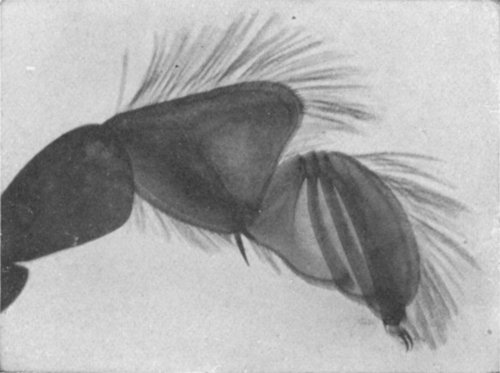
  “Gigs” are members of the beetle clan. As card carrying members of God’s favorite type of insect, they have a set of hard exterior wing covers called elytra (see here). They are exceedingly streamlined for their aquatic lifestyle with a body shaped like a black metal pumpkinseed (and about the same size as one also.)  These beetles can dive – holding a bubble under their wing covers for an air supply – and fly great distances from water if the need arises. Their front legs are modified as long grabbing appendages and their third set of legs are converted into oar-like paddles for swimming (see here). They are best known, however, for their whirling behavior.

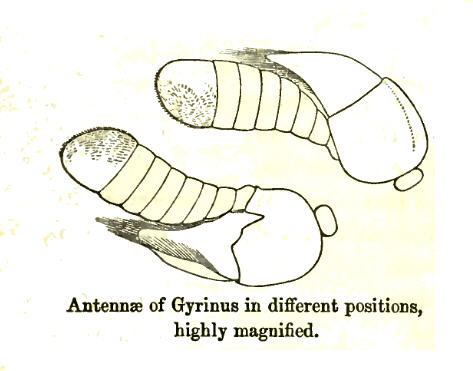
  The aquatic world is already chock full of fully aquatic beetles and the aerial world has an ample share of insects also.  Whirligigs, therefore, are specialized to live at the interface of these two worlds. They whirl about on the surface film and keep in constant vibratory touch with each other using wavelets to communicate. Take a look at this picture and you’ll see the pattern of vibrations emanating from each ‘gig expressed as a shadowy pattern on the bottom.  Their short stubby antennae have 2 scoop-like segments at their bases which pick up the surface vibrations (see here). This telecommunication behavior alerts them to danger and to the presence of food – they scavenge anything that falls onto the surface of the water.

  Aside from the fact that Whirligigs smell like apples when handled (I just had to throw that in somewhere), perhaps the single most unique feature is their divided eye. Gigs have only two large compound eyes, but a face plate separates each one into an upward facing “sky eye” and a downward facing “water eye.” They have bifocals, in other words.  They keep an eye on both worlds at the same time with the waterline always at mid-level.

  There are hundreds of species of Whirligig beetles in the world and all pretty much do the four eye thing. Recently, that species list was bolstered by the discovery of a new type in India. This new bug was named after legendary Rocker Roy Orbison, believe it or not – one of the more famous four-eyes in music history.

Why I Hate Raccoons


 While I really really dislike cats, I don’t hate them.  I understand that cats could care less that I dislike them – which is one of the reasons I dislike them. I do hate raccoons, however. O.K, hate is such a strong word, but let’s just say that I really really really dislike them.  I do not deliberately swerve to hit them while driving or attempt to re-run them over after they are already dead, but I have thought about it.

  Perhaps the best way to explain “why” I feel negative about raccoons is to say that I’ve seen how destructive these bandits can be to their fellow earth mates. Allow me to present you with an example.

  Take a look at the picture above.  This is a cluster of eggs from a mallard duck nest – a regular discovery this time of year. This nest was worthy of closer investigation because this particular hen decided to lay her eggs in an eagle nest (see here). The nest is actually a demonstration nest that we built at the Lake Erie Marshlands Museum so that kids could climb into it. It has the size and grandeur of a Bald Eagle Aerie without the tremendous height (and insurance needs).

  About a week ago, a curious visitor stopped by to ask whether those eggs in the eagle nest were real. We said “what eggs?” and immediately assumed someone had tossed in some of the plastic Easter variety. Imagine our surprise upon discovering that the eggs were real and that they were Mallard Duck eggs. About the size of small chicken eggs, Mallard eggs are light buffy green and relatively oval in outline. The hen was nowhere to be seen, but there was no doubt about it.

  Ducks are not fancy nest makers. They usually scrape a shallow depression into the ground, but occasionally find a place high off the ground such as a rooftop or the top of a broken tree trunk. This female had neatly arranged a few plumes of Phragmite Reed (another thing I hate) and some bark chips to create her nest within a nest.

  I decided to track her progress and found that she had added an egg a day for the next two days. The female would be on the nest every morning but leave it by mid-day. Mallard females don’t start the incubation process until the entire clutch is laid, so they leave them exposed during this time.  Our female started to incubate her eggs the day before yesterday after laying 5 eggs.

  I think you know the rest of this story.  Here’s what the nest looked like today (see here). The hen was gone. A raider had paid the nest a destructive overnight visit and destroyed all the eggs. Four of the eggs were obliterated outright, but one remained whole. This one was punctured at one end with a half moon pattern of tooth marks that matched those of a raccoon – the yolk had drained out and soaked the bottom of the nest depression.

  Need I say more? This incident is not unique. Raccoons have become the second most destructive agent of duck nests in the country. Although Mallards are holding their own, many other ground nesting duck species are suffering due to the effects of bandit raiding. In some years, a local population is unable to successfully produce any ducklings due to the overpopulation of raccoons. Turtle nests suffer the same fate at the paws of these nest robbers. This is why I hate raccoons.

  Should I happen upon this eagle nest robber when I’m behind the wheel next time I will swerve toward it.  I will not carry it further than that because I can’t blame the raccoon. I can hate ‘em, but I can’t blame ‘em. People, you see, are the single most destructive agent when it comes to duck nest destruction. We have destroyed so much native nesting habitat over the decades that it makes the exploits of one raccoon pale in significance. 

  I would be running over myself if I carried out that vehicular varmiticide. How about that for self psycho analysis!

Single Female Seeks Male Companion

   You might recall my discussion of a cocoon from an earlier Naturespeak (see Polyphemus Awaits).  When I brought it in from the snowy woods a few months ago I had no way of knowing it was the residence of a sleeping cyclopean queen.

  The distinctive oval shape defined it as belonging to a member of the giant silk moth clan known as Polyphemus – named after that sharp-stick-in-the-eye giant Cyclops of Homerian myth – but it’s gender was to remain a mystery until it emerged. I took the promising package home and kept it in my unheated back porch to await the advent of spring.

  The moth emerged a week ago and I’m proud to announce that it’s a girl! I discovered the moth late in the afternoon when I returned home from work.  It had been my habit to check up on the cocoon everyday since the beginning of May like an expectant father (awkward, especially given the fact that my wife wasn’t the mother). My new “child” had scrambled up the side of a plastic milk crate and was hanging languidly off the side (see above). She appeared quite fresh and her wings were still slightly wrinkled with excess moisture.  I don’t think I missed the event by more than an hour.

  I really wanted to see the so-called “eclosure” to verify that these moths use wing spurs to tear through the tough silken webbing of the cocoon, but C’est la Vie. All giant silk moths use caustic spit (not an official term) to soften the fibers so they can push through, but there is evidence that some actually rasp their way through with spurs. The empty cocoon sat on the table with a neat circular opening in one end. The borders of the hole were pushed out from the action of the fat little body passing through on its way to a new life (see above).

  A newly emerged Polyphemus Moth is a thing of beauty.  Take a nice close look at her picture and you’ll delight in her fine fuzzy coat of tawny scales. Note how her wing windows are subtly frosted and her antennae combs are modestly spaced.  She can’t smile, because she has no mouth, but that demure look from those beautiful compound eyes says it all. Her only job now is to find a male. She will accomplish this task without going anywhere. The guys are supposed to come to her.

  To accomplish this, she releases a continual plume of scented molecules as a signal for all willing males to home in on the love target. These sex pheromones will ride the wind for miles until they are snagged by a male’s antennae. The suitors are guided in like fat boys to a barbecue. I, therefore, wasted no time in putting her outside so that she could put her alluring charms to work (here she is in the open mesh bag I suspended from the picnic table).

  Unfortunately her chosen emergence week has consisted of nothing but a string of cold and rainy nights. All those fat boys – if there are any out there – are hang’n tight.  Every morning before breakfast and work, I run (actually walk slowly and somewhat unsurely) to the back window to peer outside at her mesh enclosure to see if Mr. Right has arrived. Normally, the males will hang about the place until given access. 

  No one has shown up yet and I’m getting worried. It’s going on a week now and still she waits in vain. My little charge will be dead within a week (remember, she can’t eat) and she, well, deserves the best of everything during her short life. I’m thinking of putting out a personal ad to help her out, but need to word it tastefully: “Single Female Seeks Male Companion for One Night Stand.” Does that sound too blunt?


Mudbug on the Move

  You never know what an overnight spring rain will bring out.  “Things” come up out of the ground into the moist night air and are there in the morning for the curious to find. Worms are the most obvious of the rain flushed sort. What would a springy wet morning be without that wormy smell in the air?

  Morel mushrooms are the most desirable of such finds, but I have not been lucky enough to find any this year. A friend of mine recently gathered several hat-fulls of these delectable mushrooms and informed me that he got slightly sick by eating too many of them. “I have never had the opportunity to get overfull on morels,” I informed him and elaborated on the thought by mentioning that I would be more than happy to take these burdensome fungi off his hands next time. Of course, there may not be a next time this year. They say worms are good when fried up, but I do not anticipate getting stuffed on them any time soon.

  Another friend gave me the opportunity to pick up her post rain find. Her discovery could also be considered edible, but only in certain parts of the country. Edible or not, she didn’t want to touch it and knew that I would pick up just about anything – dead or alive. The thing was a mudbug, also known as a crayfish. This beast was completing a wet night stroll across a parking lot and was confronted with a formidable barrier in the form of a curb. I plucked it from the wet pavement and plunked it into a jar for later observation.

  It might seem odd that a crayfish would be out wandering on terra firma, but this particular voyager was a Burrowing Crayfish (see above). These crustaceans are capable of extended journeys into the upper world as long as they can return to the water on a regular basis. Rainy or moist nights beckon them out to feed on rotting vegetation, worms and other such delicacies and daylight prompts them to return to the sanctuary of their muddy water filled holes (see here). 

  In hand, crayfish look like miniature lobsters. Take a look at this view and you can see the claws (called chelicerae), body (carapace) and tail section (tail section). Burrowing Crayfish have fairly small claws when compared to others of their kind, but otherwise are typical in all regards.

  Their beady eyes are actually compound eyes much like those of an insect. The individual eye facets are sensitive to movement. Collectively they form an un-focused pixilated image of the world which means this poor guy was forced to look at a thousand fuzzy views of my face as I examined it. For a higher life form such an image would be nightmarish. Fortunately, crayfish are endowed with only simple nerve swellings for a brain, so they are unburdened with any emotion.

  An underside view (see here) reveals some of the hidden aspects of crayfish existence. There are five pairs of swimmerets under the tail section. This specimen was a female as evidenced by the fact that the first pair are not modified into sperm transfer “arms.” She will eventually carry her eggs within the protective envelope of these swimmerets should she be lucky enough to find a boy crayfish. All of the legs are attached to the main body under the carapace. You’ve probably noticed that the first several sets just behind the main claws end in a pair of tiny pincers while the rest are reserved for walking purposes.

  Before I put this wanderer back into her element, I want to point out one more thing. Take a good look at this underside view and you’ll notice those two pearl-like spots located just ahead of the multiple mouth parts. Structures such as these are firm proof that we are dealing with a creature that is very different from us. These things are called Green Glands Pores. They connect to internal green glands (really?) which function as kidneys.

  If you consider that these excretory pores are outlets for the liquid waste produced by the green glands, you’ll realize that the burrowing crayfish is a potty mouth. Yes, they pee out of an opening located right next to their mouth!  Aren’t you glad to know that?

Living on Oak Time

   It wasn’t so long ago that farmers timed their annual planting and harvest cycles on seasonal phenology. They didn’t call it that, but they were practicing an age old recognition that certain natural things happened at certain times of the year – every year. Calendar dates weren’t as important as naturally observed events.

  Corn planting time around these parts has always been from late April through the first week of May, but old time farmers simply looked to their local oak trees for the go ahead.  “Plant corn when the oak leaves are as big as a squirrel’s ear,” they’d say.  They didn’t need to worry about the soil temperature getting up over 50 degrees or fret a whole lot about fancy hybrid growing needs. The oaks were good enough to determine the relatively short optimum planting time. Oak trees are among the last trees to commit their greenery to the whims of spring, so their decision implies that the warm season has really begun.

  This week, our oak trees are leafing out so I sampled a few budding clusters to see what stage they were at.  Indeed they are at the squirrel ear stage right now. The large white oak tree pictured above arrived at squirrel ear stage earlier this week and was already surrounded by freshly tilled ground by the time I photographed it. Here is a scene as old as farming itself.

  With the emergence of the leaflets, the trees also send out their clusters of dangling flower catkins. Take a look here at this cluster of Burr Oak leaves and you’ll see that each catkin has 30-35 beadlike floral clusters strung along its length.  These are the pollen producing male flowers that will soon fall off.  This discussion isn’t about the flowers, however, it’s all about the leaves and the squirrels. (You may find it interesting to know that the leaf sample I am holding in the picture was provided to me by a Fox Squirrel. The creature nipped it off and dropped it to the ground in front of me.) Notice that these perfect little baby leaves are about an 1- 1 ½ inch long. In order to determine if this particular tree (and this particular squirrel) was telling me to plant corn, I needed to establish the dimension of an average squirrel’s ear.

  There is no such thing as a plain “squirrel,” but for the sake of simplicity and in the interest of keeping this thing in line with folk wisdom, I decided that the familiar Fox Squirrel will be the designated “squirrel” in question. This is the woodland squirrel that associates with the oak woodlots and the one that brought the subject down to my level.  According to the Mammals of Michigan book, a classic tome by Dr. Roland Baker, the ear measurement of Sciurus niger (aka Fox Squirrel) is ¾ -1 ½ inch from notch to tip. The leaves and the ears are a match. It is time to poke the ground with yellow seeds.

  Of course, today corn planting is neatly done with mega machinery, but back in the old days the corn was planted in mounds. The same farmers that cited squirrel ear lore also took pains to plant seven kernels in each mound to honor the age old tradition that acknowledges: “One for the blackbird, one for the crow, three for the cutworm, and two to grow.”  Even if the seeds were planted at the correct time, the farmer had to heed the other realities of nature.

A Face Only a Mother Could Love

  My earlier entry regarding my day out on the Detroit River focused on the sturgeon work aboard the U.S.F.W.S. research boat Sentinel. This was the main reason for the trip – the headline material, so to speak. Our trip out into the mid-section of the stream brought us in contact with many other sights worth noting, however, and I’d like to bring a few of these to your attention as well.  First, allow me to complete a few “left over” sturgeon observations.

  The water was still quite cold this time of year. The temperature hovered around 52 degrees Fahrenheit when measured at each of the sturgeon sets. I asked Dr. Manny if there was any indication that the sturgeons were spawning yet and he shook his head in negative response. “No. it’s still a little too cold, but it’s getting there,” he answered. “The suckers are starting to spawn, though, and that means the time is getting close.” By suckers, he meant fish like the Golden Redhorse Sucker and White Sucker and was not referring to “those suckers” – as in sturgeon. You must be careful about this fisheries language where a big sucker is literally a big Sucker and a female walleye with eggs is called a hen.

  A large man made rock reef was recently laid on the bottom of the river just off the east shore of Belle Isle – at the head of the river. Scientists such as Bruce are eagerly awaiting the advent of this years breeding season to see if any sturgeon will make use of this area to lay eggs. The fish are regularly spawning on the Canadian side of the river, but need some help in returning to old sites closer to the Michigan shore.

  Out on the boat, I looked closely at one of our captured fish and suggested that she might try out this new spawning site. Her expression was unreadable, however (Here, take a look for yourself). Sturgeons don’t have ears, but do have four extremely sensitive barbels on their snout. I was hoping these appendages might pick up some sense of my message just like they sense food items on the bottom.  After all, I told her, there were plenty of other critters doing the “spring thing” out here on the river and it was time to get going.

  We passed an active Bald Eagle nest about mid-way down on the east side of Fighting Island. An adult bird was standing on the edge of the nest next to a large chick (see here).  There are at least four active nests on the Detroit this year and eagles are a regular and year-round sight.

  Down at the south end of the island there was a large Ring-billed Gull colony extending for hundreds of feet along the high bank from the top of the grassy ridge down to the limestone rubble rock (see here and here). It looked like most of the birds were sitting on eggs while the rest were flying overhead in all directions. Even though the whole place looked chaotic, there was some order within the apparent dis-order since each nest was located within a beak’s reach away from the nearest neighbor. From a distance you could hear the constant cackle of the noisy birds drift over the water as we worked the third set.

  While drifting opposite the gull colony, we pulled up a thieving Mudpuppy on one of the hooks. A series of a dozen empty hooks betrayed the presence of this giant aquatic salamander who had obviously helped himself to the feast. His last bite proved that there was no such thing as a free meal and he ended up getting snagged through the lip.

  I unhooked this wriggling beast and held him out for a portrait before tossing him back (see above and here). If the puppy looks uncomfortable, he was.  Being one of the slimiest creatures on earth (surpassing even the sturgeon in this regard) it was all I could do to keep a grip with one hand while taking a photo with the other. I was almost squeezing his innards out in order to maintain a grip. It was like holding a rotten pickle – a moving rotten pickle.   

  You are in the presence of true ugliness when you are staring at the face of a mudpuppy. Michigan’s largest salamander has a mug that only a mother could love. The large red feathery gills coming out of each side of the head only add to the unworldly nature of this beast. I wanted to get an angle that showed off the wide fin-like tail, but the thing protested so much that I was finally forced to let it drop back into the chilly depths. It was time to get back to helping Jim and Bruce with the sturgeon work, anyway.

  My left glove was covered with the snotty slime residue from my recent captive.  There was so much, as a matter of fact, that it created filmy webs between my fingers when I spread them out. The webs would dissolve into sheety dollops of goo and peel off in the wind.  Yes, admiring snotty slime from a rotten pickle was all part of a great day on the Dee-troit.

A Sturgeon in Time


I just completed my third shift as a crew member aboard the good ship Sentinal and I enjoyed every minute of it.  Well, alright, not every single minute – there was the time when an extreme series of waves brought the starboard gunwale within inches of the water surface. As a landlubber I was a tiny bit horrified by this, but it was of no consequence to my shipmates Dr. Bruce Manny and Jim McFee. Bruce and Jim are fisheries biologists working with the U.S. Fish and Wildlife Service on a sturgeon monitoring program. The waves, as a matter of fact, were caused by our own wake as Bruce veered toward an orange buoy off of West Hennipen Point.

  On this particular day, the Detroit River around Fighting Island and the northern end of Grosse Ile was calm and only slightly cool. The buoy marked the southern anchoring point of a 250 foot trot line positioned to catch Lake Sturgeon from near the hard clay bottom.  On this particular pull, we ended up getting two of these magnificent fish on the line. The first was 4.2 feet long and weighed 26.4 pounds and the second was slightly longer and four pounds heavier. Both were measured, weighed and tagged before being released back into the cold emerald green water. By general fish standards these would be considered behemoths but by sturgeon standards they were completely average.

  Allow me to back up a moment and explain a few things. You may remember, if you are a regular reader, that I’ve taken you out on this trip before. If so, feel free to ignore the following details. Every year for the past few years, the USFWS crew has been out catching and tagging sturgeon on the big Detroit. They are monitoring the population and trying to build up a data base of information so that they can understand what makes this ancient fish tick. To catch these bottom feeders, the biologists put out six set lines each about 30 feet deep and equipped with 25 huge baited hooks spaced at 10 foot intervals. The bait consists of Round Gobies, those alien invaders who are abundantly available for just such a purpose. “This is the best use I can think of for these fish,” blurts out Dr. Manny. I agree with him. We both see the poetic justice of using a pesky alien to help out a rare native.

  The procedure is to hook the set line buoy, pull up the double pronged anchor, and slowly pull the line onto the deck. Each hook is detached from the line via a metal spring hook. It was my primary job to grab these hook-lines as they were pulled and keep them in a neat row along the edge of a big blue plastic barrel (here’s my work – nice eh?). When Jim returned the line to the water – after assuring the hooks are sufficiently baited – I handed them back to him one by one.  When a sturgeon came up on one of the hooks, of course, the real work began.

  We pulled up a total of six sturgeons- one each on the first two sets, and two each on the last two sets.  Each time the documentation procedure was the same. I was able to get a better view than previous trips because I was part of the process. 

  The first order of business is to lift the fish into a net cradle and weigh it. During this time, Bruce is writing down the numbers as Jim calls them out. “15.5” indicates a weight of 15 and a half kilograms. There are 2.2 pounds per kg, if you want to do the math. Our weights ranged between 6 ½ and 37 pounds. The total length was taken in millimeters from the tip of the snout to the tip of the upper lobe of the shark-like tail (which translated to a range from 35 inches to 55 inches). A shorter fork length is taken from the snout to the inside of the tail notch and then a “commercial” length from the back of the gill opening to the back of the anal fin. The girth was measured just behind the pectoral fins and ran from a mere 12 inches up to 22 inches.

  A uniquely numbered six digit tag called a Floy tag is inserted into the trailing edge of the dorsal fin – the small triangular fin just ahead of the tail. Accompanied by slight gristly sound, the tag is punctured through (with what looks to be a carpet needle!) and secured like a zip tag (see here). A radio tag, the size of a small pill, is then carefully inserted just behind the first back scute using a hollow syringe. The needle tip is daubed with a dollop of anti-biotic to make sure the small puncture heals properly.

  I thought my role significant when I was given the charge of reading off the frequency code that was called up on the hand held reader when it was passed over the post-implanted fish.  I enunciated every digit with professional clarity so that Dr. Manny could record it properly. I later found out that he already had these numbers on his sheets, having passed the reader over the electronic pills before they were inserted. My dramatic reading served only to confirm what was already known, but what the hey.

  The last part of the process involved cutting off the first spine of the left pectoral fin. By using a hack saw and a honking big knife, Jim was able to remove this 3 inch piece of fin with a minimum of blood. I will admit that the sound of saw rasping on hard cartilage does create a wince effect. This portion will be microscopically examined in the lab for a count of the annual rings that will provide an accurate age estimate. The severed spine is sealed into a small envelope upon which all the individual fish data is recorded (see here – note the super long number on the bottom line that I was responsible for reading).

  We slipped each fish back into the water within a few minutes of its capture – holding it captive on the steel deck only long enough to reap a harvest of valuable data from it.  Jim would gently lower the beast into the water and hold on for a while until it recovered sufficiently for release. Sometimes this took a minute or two, while other times the victimized fish broke free as soon as it hit the water.

  After the last set was complete, the Sentinel returned to the Wyandotte municipal dock and the gear was hauled ashore. We talked about the success of the day and the promise offered by the following morning.

  “You shoulda seen the fish we caught last week,” said Bruce when I expressed amazement at the 37 pounder. “That fish was so heavy,” he delivered like a set up line, “that it exceeded the capacity of our scale.” I glanced down at the scale to see that it was a 50 kg. unit, so I figured out and verbalized that it was over 110 pounds.  “Well over,” he added. “The snout hung out about this far over the front of the sling,” he said holding his hands about 18 inches apart, “and the tail hung out the same distance out the back. The girth was something like a meter.”  Given these dimensions, this sturgeon was one of those old school giants in the six foot plus category. Unfortunately Jim forgot his camera on that day, so the fish remains only as a statistical record.

“Sure,” I said in mock disbelief. “No picture, eh?”  “No, really,” they both retorted. Given the absence of eye winks, I was force to believe what they said was actually the truth.

  The potential of pulling up another one of these giants, or even re-capturing last week’s animal, will keep me coming back to the sturgeon boat year after year.

  Although the big fish are always the primary thrill, the other sights along the big river were satisfying as well. I’ll introduce a few of these in the next installment.

Worms for Lunch

Today, while eating my lunch, I was given over to pondering a question. I’ve always known that the early bird gets the worm (I mean, it’s a fact of life right?), but how is it that the late bird also gets the worm?   You see, birds – especially those of the robin ilk – need to eat morning, noon, and evening and can’t afford to stop at the early worm.  They engage in worm hunting throughout the mid day, when the worms themselves aren’t active, and yet they still are successful.

  It is not my current intention to go in-depth into the subject of how robins find worms.  I do not know the whole answer, nor does anyone else apparently. Type the phrase “how robins find worms” into your search engine and you’ll come up with some conflicting answers. That they see ‘em is the primary answer, but the jury is out as to whether they hear ‘em as well. You’ve seen the birds perform the ritual a million times: a quick head down run ending in an erect pose, a pause followed by a tilt of the head, a jab or two, and up comes a worm held firmly in the beak.

  As a creature with oppositely facing eyes, the robin has to tilt its head sideways in order to get a vision fix on a close object such as a worm. It has little binocular vision capability and must rely on the high resolution sharpness provided by a single eye for detail work. This head tilt has also been construed to mean that the bird is directing an ear opening toward the ground and using sensitive hearing abilities to pinpoint prey location. There has been at least one experiment that seems to bear this out this latter theory. In that situation a robin was able to locate some mealworms without any visual clues. 

  Earthworms are covered with fine bristles and they do make somewhat of a quiet racket when pushing up against dry leaves.  It is entirely possible that the keen-eared robin is capable of hearing these sounds, but the head tilt is definitely a vision related posture.  The overall answer is probably a combination of visual clues and auditory clues. Either way, the worm is history.

  My lunchtime question was prompted by an opportunity to watch a robin work the bark chip mulch around some shadbush plantings. I was taking a break from presenting a whole slew of nature programs as part of the annual River Rouge Water Festival on the campus of the University of Michigan at Dearborn. My lunch break was 25 minutes long, so I had the time to sit outside on a picnic table while consuming my complimentary turkey wrap (I only do this program because of the free food). 

   Apart from watching the masses of 4th and 5th graders and their befuddled teacher escorts walk across campus, my attention was drawn to a single male robin about ten feet in front of me. I fixed my gaze upon the fowl as a way to occupy my time. At first I perceived this activity akin to being forced to read a copy of Redbook magazine in the doctor’s waiting room because all the Outdoor Life mags are gone, but this view soon changed.

  This bird seemed to be having extraordinary luck.  He kept returning to a patch near the base of one of the plantings. With each bite of my wrap, this efficient hunter was downing a worm – about one every ten seconds for a short period. Usually it took a few side swipes of the beak to clear away a piece of bark before the prize was secured. I watched the ground in front of him very closely to see if I could detect any worm motion but was unsuccessful. The robin flew off each time a passing clan of noisy children walked by, but it invariably returned to the same spot.

  It was a cool dry day and I couldn’t imagine why a bunch of worms would expose themselves in the noon hour sun – especially in the presence of killer. There were none in the bark closest to me.  I discovered the secret about the time I was tearing into my huge Macadamia nut cookie and confirmed it by the time I ripped into a bag of Doritos (I told you the free food was crucial here). The robin had an underground partner.

  Every now and then, a section of bark would push up from the ground at the exact point where the bird was operating. A mole was working the soil beneath the bark layer and causing the worms to issue up out of the ground as if they were being electrocuted.  The mole never broke the surface. I can’t confirm that the robin knew what was going on, but then again, I don’t think he cared. There were lots of worms and that’s all that mattered.

  I’ve seen this mole-induced worm terror before. Since earthworms are very sensitive to ground vibrations, the digging action of a mole – a worm predator- will alert a vibratory sense within all worms in the immediate vicinity to seek the safety of the surface. The escaping worms look like they are jumping out of a fire. Once I followed the course of a tunneling mole for several feet by watching the fleeing horde of worms that surfaced just ahead of it.

  Worm hunters – human worm hunters that is – have long employed this trick to get worms up and out. By sticking a rod into the ground and tapping it lightly, they imitate the mole’s digging sounds and fill up their bait containers in no time.

  Today was the first time that I saw a non-human bait collector take advantage of this effect. I enjoyed this bit of unexpected dinner theatre. It goes to prove that even mundane observations can reap some reward. One has to feel a little bit sorry for the worms in this case. Normally the surface provides them temporary safety until the danger passes. But when sandwiched between two predators, well, it’s like jumping from the frying pan in to the fire.  Fried worms anyone?

Of Bee Hills and Buttermoths


  Every now and then I like to turn things upside down in order to see them from a different angle. They say that such a thing actually puts the right side of your brain to work and, incidentally, causes a lot of things to spill (never look at the bottom of a glass when it is half full, for instance).

  Nature delights in turning things around as well. I suppose she does this to give us a different view of life and confirm that we should never assume anything when it comes to the natural world.  It would be natural to assume that a tiny sand hill with hole in the center is an anthill or that a colorful winged insect flying at mid-day is a butterfly. As a small way of turning your world upside down, allow me to introduce the exceptions to these examples.

  First of all, what about those anthills?  Yes, some ants do make sand hills. These hill-lets are possessed of a central entrance for ingress and egress, but I digress. Should you come across a sandy spot with a cluster of apparent anthills where the central holes are about ¼ inch wide and open slightly off to the side, you are actually looking at bee hills.  If you stick around a minute or two you’ll spot the specific bees belonging to these structures as they return to the surface and poke their heads out.  Take a look at the picture above and you’ll see two of these Solitary Bees guarding their burrow entrances.

  Solitary bees are members of a group of bees called mining bees (see a close-up here). There are some 1,200 species in North America, so I can’t tell you the exact species of the ones I encountered.  These insects produce neither honey nor beeswax. Oddly enough, most wild bees are of solitary persuasion and only a few form genuine colonies such as the caste-forming Honey Bees. This means that, although the honey/wax making species get all the glory, the vast tribes of solitary bees perform a great deal of the pollination work going on out there.

  It appears to be another turn-around of ideas to state that these so-called “solitary” bees nest in groups.  They do find some comfort being in the company of similar bees, but are not social insects in the true sense of the word. They do not co-operate or assist each other in any way – it’s a “you don’t borrow my tools and I won’t borrow yours” neighborhood thing.

  Each one of the separate but equal burrows is independently excavated by a female Solitary Bee. The main tunnel extends down into the sandy soil for a few inches. Brood chambers, or cells, are carved off to the side and at right angles to the main tunnel (here’s a cutaway view of a tunnel with a few side chambers exposed). These chambers are created and waterproofed with a waxy secretion. The female collects pollen (using special brushes called scopae on her hind legs) and rolls it into a ¼ inch ball. A liberal application of nectar provides sufficient moisture to hold it together and provide a bit of sweetener for the kids.  She then lays a single egg on the pollen ball (look here – both this and the previous shot were taken by Dennis Briggs of the University of California), and then seals up the chamber for good.

  She works on one cell at a time and eventually seals off the whole set after she’s laid eight or so eggs.  Her life work is done after several more burrows are completed.  Solitary bees do not provide any other parental care other than this initial set-up. The child bees are solo from here on out. They will hatch out later in the summer, eat up their pollen snack, pupate, and await the following spring to emerge as adults. They do all of this on their own. No bee is an island, but these come close.

  As if a community of solitary bees living in ant hills isn’t enough, I’d like to add one more contradictory insect to this essay. There is a flashy little moth out there called a Grapevine Epimenis (see here) that flies by day.  I encountered several of these on a recent walk and they all were seeking to suck up minerals from the trail limestone.

  A majority of moths are night fliers and all butterflies are day fliers. There are some significant exceptions to the moth rule. Some, such as the diminutive Epimenis, find the full light of day to their liking and shun the night. In the field guides, this black, white and red moth is listed as an early spring woodland creature that “is often mistaken for a butterfly.”  Trembling with energy, the pictured moth was difficult to approach because it would dart off as if driven by butterfly reflexes. Scientifically this species is called Psychomorpha epimenis which gives a hint at the crazy behavior of this day moth. I prefer to give it the previously unpublished title of “buttermoth.”

  If there is any lesson to be drawn from looking at bee hills and pseudo butterflies, it is that few things are as they initially appear.