A Duck of Goodwill

  I am soft believer that nothing happens by chance. Please note that I am not firm in this belief, but a solid non-committalist that certain things can happen contrary to mere randomness. Take, for instance, yesterday afternoon when my camera went on the fritz after taking one lousy picture.  Well, O.K., my batteries went dead in spite of the fact I checked them before heading out.  No problem, I bought some new AA’s and was ready to continue. In the process of putting the new batteries in, a tiny little piece of plastic fell out of the battery cover door onto the car floor.  I’d forgotten about that little broken piece – without it, the camera won’t turn on no matter how factory fresh the batteries are. Remarkably, I found the errant keystone fragment next to the accelerator pedal and continued the process. Unfortunately, I couldn’t remember how the miracle piece fit back in. I tried it every conceivable (and a few in-conceivable) ways until finally admitting defeat and heading home. I was unable to shoot the cannons with my Cannon!

  The thing is- I was on a deadline.  The magazine editor wanted some crisp high-resolution pics of a cannon monument to accompany an up-coming article. She had to have them NOW.  My high res. camera was on the fritz NOW and I …never mind.  I had one crummy high resolution, but poorly lit, cloudy photo and that would have to do.  I would send it in, they would use it, and I’d have to stare at it the rest of my life.

  Just after resolving to forget the whole thing, the sun burst out and it became a beautiful sunny afternoon.  The crisp sunshine streaming through the window mocked me.  I snatched up the camera and that dog-goned fractured piece of cheap technology and resumed my attempts.  Suddenly, (by this I mean 15 minutes of frustrated manipulating) the piece slipped into place and stayed there. I closed the battery cover and the camera turned on. I was in business. There was still time to make the journey back to the cannons, so I went.

  An hour later, I had taken a whole host of high resolution cannon shots and was re-tracing my homeward route. As I crossed over the Swan Creek Bridge, just before St. Charles Church, I noticed that the creek was frozen solid and that a lone duck was sitting out on the ice.   It was a drake Redhead. The fowl was resting with its head tucked back between its shoulders. Thinking that perhaps it was frozen into the newly formed ice, I curled around into the church parking lot and inched my way along the shoreline up to the bird’s position.

  I admit that I was starting to think that maybe I was meant to see this bird – either to save it or to get a really good picture of it, or something.  I wouldn’t have seen it had I been successful on my earlier trip. As fate would have it (or was it?) the duck stayed firmly in place as I approached over the snow bank.  I adjusted the lens, peeped over the rise, took a blurry shot, and fumbled with the viewfinder while the bird erected its head to full attention.  It shifted around and immediately displayed that it was not frozen into place.  I had one more chance so I took the shot.

  No sooner had the artificial shutter sound completed its tone than the Redhead rose to his feet, skittered over the ice a few yards, and launched into the air. It headed directly east toward the creek mouth and Lake Erie – leaving a few piles of droppings to mark its former position.

  Only upon looking at my resulting picture did I whoop with joy.  I got it! Finally, I have a good picture of a duck to offer you, dear reader.  My previous attempts have been of less than stellar quality.  The Redheaded Duck of Happiness erased all traces of the “plastic incident.” Here’s the picture.  Nice eh? 

  Redheads are medium sized diving ducks on the order of canvasbacks, bluebills and the like. They don’t show up in our area in the huge numbers typical of those other species, but they are always mixed in with their fellow divers. It was unusual that this particular bird chose a solitary roosting spot on the creek ice. It may have been out of sorts, but certainly mustered enough energy to make its hasty escape. Whatever the reason, he waited there for some time until I came along to disturb him.

  This male exhibited the stunningly bright nutmeg-red head that gives these ducks their common name. The intense gaze of the orange eye fully displays a certain indignant sense of at being flushed. This is a bird in full breeding plumage that’ll soon be impressing the chicks out there in the prairie pothole country with his dashing good looks.

  There is one more twist of life affirming irony in this situation. Aside from the cannon monument article, I am also currently working on a piece about an old time decoy carver by the name of Fred Plichta.  One of the nicest examples I have of his work is a 1930 carving of a perky Redhead drake. I’ve been going over it for the last few days in hopes that it would speak to me about the man and his time.

  Here’s a picture of the decoy taken with that same wonderfully flawed camera that occupied so much of my day yesterday. I guess it would be a stretch to say that the spirit of that wooden bird came to life for me out there on Swan Creek, but I’m here to stretch that truth.  The real bird reminded me that they are the vital life force behind the fake ones. The duck came first, then the man, then the decoy (the editor and the cannon monument came somewhere in the middle of that sequence).

Ducks in a Row

 When ducks of a feather gather together, it is certainly a sight to behold.  Whether the gathering is a gaggle of geese, a bolt of canvasbacks, or a quack of mallards the overall effect is a treat for the eyes and ears.  I say this because of the winter swarms of waterfowl that are presently collecting about the immediate area.  They are spilling out from the waters of Lake Erie onto the shoreline ice and adjacent corn fields.

  The big waters of the Detroit River and Lac Erie du Chat (that’s the early name of Lake Erie, by the way) are teeming with rafts of Canvasbacks (see here).  It has been stated that nearly 10% of the North American population of these diving ducks winter in our regional waters – a figure I can neither affirm nor deny, but find impressive. This view was taken just off the eastern side of Grosse Ile, the nine mile island that is fetched up smack in the middle of the lower river. The birds were part of a flock of a thousand actively feeding around the edge of the ice shelf not twenty feet from shore.

  Cans, as they are affectionately known by those unwilling or unable to pronounce multi-syllabic words, are chunky medium-sized ducks with impressive royal snoots. Their black beaks are large and sloping like a gentle ski hill that continues the angle of the forehead all the way to the tip. These birds are mostly males with red eyes, deep chestnut-colored heads, black breast and rump, and white midbody. Often called “Bullnecks” by those who refuse to relegate such a magnificent little beast to a one syllable name, male Canvasbacks indeed appear to have a robust neck when viewed head on. A single female bird, identifiable by her dingier white midbody and brownish dark parts, was resting on the ice (see here near the center) with her head tucked back coyly between her shoulders. For the time I watched them, the “guys” were going at it in the celery beds below.

  As divers, they propelled themselves under the surface with a quick porpoise move and slipped into the current.  I assume that after a few seconds, they would return to the surface slurping a water celery leaf noodle or crunching a zebra mussel. I say assume, because it was impossible to track the motion of any one bird due to the boiling activity of the flock. There was always one diving and one returning, one swimming and one preening at any given time. A few were unsurely attempting to walk over the ice on ill balanced feet. All of this activity was done in silence on the fowl’s part.  The water was continually squishing and splashing like agitated bathwater, but the ducks were mum.

  In stark contrast to this silent aggregation, or “group” if you are syllabically challenged, a north Monroe County corn field was the scene of a cacophonous gathering (see here) a few days later. Here hundreds of Mallard Ducks and Canada Geese were grain-gathering far from the waterfront. These birds were talking all the time. The Canadas were, of course, honking in mock alarm, but not at my presence. I don’t like these critters very much and try not to call attention to them, but I felt obligated to pass on this particular scene because of the swan in the center.  To say that the Tundra Swan stood out like a sore thumb in such company would be an understatement. These birds (which I do like a whole lot) are foragers in their own right who frequent our grain fields in late winter and spend the nights out on the open water.  This swan didn’t say or do much. I imagine he felt somewhat intimidated by the noisy hordes about him. Perhaps he was wondering where all of “his kind” were – like a person discovering that he was at the wrong party pensively standing by the peanut bowl planning a graceful exit.

  Meanwhile, at the other end of the field, a bunch’o mallards were standing in the rows (see here). This was another loud gang of corn feeders that quacked and chortled constantly. They were a nervous bunch which retreated back into the stubble with every passing car.  My stationary car really set them on edge and their necks were craning nearly to goose length to get a fix on my position.  You’ll note that there appears to be an equal mix of hens and drakes – the drakes being the green-headed ones. Their bright orange feet stand out like beacons against the snowy backdrop. Although my photo does not show them very well, there were a number of Black Ducks in the group as well.  Look for the really dark birds with red legs and you’ll see why they are called black ducks.

  This past week I went past the same cornfield and saw that the waterfowl party spot was now populated with a teeming school of blackbirds- mostly red-wing blackbirds. Their arrival signals the eminent loss of our temporary population of canvasbacks and tundra swans as they return to their spring breeding grounds.  The mallards will begin to pair up and distribute out. Unfortunately, the geese aren’t going anywhere.

Hot Blooded Cabbages

 Out there in those cold snowy woods, smelly cabbages are breaking the laws of normal life.  They are doing so with impungentcy,…er, I mean impunity. Animals, specifically mammals and birds, are supposed to be the only warm-blooded life forms on earth. That certainty is called into question by the very presence of a plant called the Skunk Cabbage. This is a non-sentient being that has the ability to generate heat and create its own weather systems. Come March time, it joins the hot-blooded ranks.

  Skunk cabbages grow in the marshy bottomlands adjacent to woodland streams throughout N.E. North America.  Under the cover of late winter snow this feisty plant takes control of the situation.  While regular plants have to wait months for the weather to break, the “skunk” proceeds to melt its way through the surrounding prison of snow and ice like a light saber through a metal door. Therefore, your first seasonal encounter with this plant will look like this (take a gander). You’ll see what looks like a purplish green speckled elf cap sticking up out of the frozen stuff.  This hood is called a spathe and it envelops a flowering spike within called the spadix (which you can see in this view).

  Beneath the mucky ground, a thick stem – or rhizome – supports the fleshy growth.  Through a process officially called “cyanide resistant cellular respiration” the starchy stem provides backup for its un-worldly flower in the form of heat generation. This un-plantlike behavior produces a core temperature around 60 degrees – a level typically 30 to 40 degrees above the air temperature.  Just in case you are wondering how this cyanide what-ever thermogenesis works, I looked it up and found out that it occurs through “uncoupling oxidative phosphorylation from the electron transport system.”  In other words, the thing heats up through some magical process whose explanation takes all the fun out of it (just like trying to explain how a fictional light saber works). Suffice it to say, these little cabbages begin to boil.

  The hot little flowers are then able to burn through the season and corner the extreme early season pollination market.  Believe it or not, there are some hardy flies, bees, and wasps that fly in late winter and they are lured to the promise of a hot meal.   But, all insect comers are left disappointed as they discover that the “rotten meat” is only a sweaty plant. One could say that skunk cabbages engage in the ultimate form of vertebrate mockery by imitating rotten animals.

   There is also evidence, however, that skunk cabbages may actually depend more on wind pollination than mis-guided insect pollination.  They create their own air currents as hot air rising out of the spathe is constantly replaced by a stream of cooler air.  This incoming air potentially contains pollen from nearby “skunks.”

  No matter how you look at them, Skunk Cabbages are not your run of the mill plants.   Despite both their common and scientific names (Symplocarpus foetidus –which means “stinky plant with the connected fruit”) they don’t really smell that bad on the outside. The leaves give off a pungent skunky odor when snapped and a patch of “skunks’ will emit a musty odor, but people do that too.  The leaves look like cabbage leaves, but are far from edible because they contain nasty vertebrate unfriendly crystals of calcium oxalate. 

    As if to defy all norms, skunk cabbages grow downward to boot.  Sure, they produce upward pointing flowers and a short-lived crop of large spring leaves, but the stem itself is pulled down into the muck by the roots.  The roots probe into the soil and contract, thus keeping all permanent parts of the plant below the surface.

   There is nothing really normal about this plant, but then again what is normal?

To Boldly Go…

 Yesterday I walked down a snowy backwoods trail only to discover that I was not the first to pass this way.  The morning was still crisp and new, yet someone had beaten me to the spot and was waiting there for me. He was small, white, and scantily – yet appropriately – clad. He had no eyes or legs but stood there staring forward and posed slightly askew.  Though equipped with only frail buckthorn arms, the tiny snow-being employed them with great effect. “This way,” he declared with a certainty unusual for one so young and temporary, “this is the pathway you must follow.”  His left stick arm was held out at a right angle and showed no signs of tiring. Frozen deodorant no doubt aided in this endeavor, but the friendly mini-man was there to help and guide.

  I silently took his advice and continued down the path in the indicated direction. I arrived in a snowy clearing under a bright blue sky, but noticed nothing out of the ordinary at first. Soon, however, the wind carried the “Ook-a’leah” sound of a Red-wing Blackbird newly arrived from the south.  It carried the rich bubbly notes of a Carolina Wren, the “reality” call of a male cardinal, and the rain song of a Robin. In the distance a Killdeer repeated its name a few times and ceased.

  A bit further on, I spotted a sugar sickle – frozen sap dripping out of a slight break on a maple branch. Here was proof that the trees were starting to re-call their lifeblood from the roots below the ground.  Thousands of gallons were coursing through their veins and bringing liquid renewal to the buds above. This river of life would go un-noticed were it not for the wounds through which it leaked.

  Overhead flocks of crows were flying westward – an age-old sign to us humans that the syruping season has begun.  An overly fat Fox Squirrel, perched precariously on the maple twigs, was harvesting the freshly sweetened buds above.  He paid no heed to the flocks of passing black birds nor made any sound other than contented munching.  

  I tasted the mild sweetness captured in the sugar sickle and continued on my way. I fully intended to thank my little trailside snow elf for his direction.  After all, he had guided me to a world full of early spring indicators in a landscape still gripped in winter.  Here was a creature of ice pointing the way to a world that he could never live in. This was a noble act. He could have pointed back toward the frosty wood, but chose not to. Carelessly, I got caught up in the morning stroll and made my way back via a different trail and therefore missed the chance to express my appreciation.

  This morning, I rushed to the snow man spot in order to explain myself and apologize for my inconsiderate act of the day before. Overnight temperatures had soared and it was already reaching the upper 40’s by the time I reached my tiny guide. But, I was too late. His top two thirds had tumbled to the ground and his butt flesh was misshapen and pitted. The pointing arm was still in position but was now parallel to the ground and non-directional. His long stickish nose barely maintained position on the reduced eyeless face.  A large part of my friend had passed – from ice into water. 

  A slight feeling of remorse overcame me as I contemplated my insensitivity. I never even thanked him. This guilt feeling was quickly replaced by mild rage as I perceived numerous deer tracks about the location. It became shockingly obvious that some oaf of a deer had clutsed into my snow elf. One careless swipe of a hoof had prematurely ended my friend’s career by severing him in two. He might have survived another hour or two if that pin-headed hoof bearer hadn’t come along.

  Two nearby deer approached me with feigned innocence.  They no doubt were watching me and reveling at my reaction.  Deer will do that, you know. I re-formed the remaining stuff of my deceased pal and hurled it at them. They remained motionless and were un-moved both physically and mentally. Deer will do that, you know. I left them to their own as they mocked the icy humanity they had just snuffed.

  I regained my composure by the time I reached home. I realized that deer are just stupid children of the woods and that they have no real sense of esthetics. I also realized that snow men, just like the winters that spawn them, are not meant to last forever.  This winter is on the flip side and my friend boldly went where snowman had gone before.

The Eagle has Landed…Again

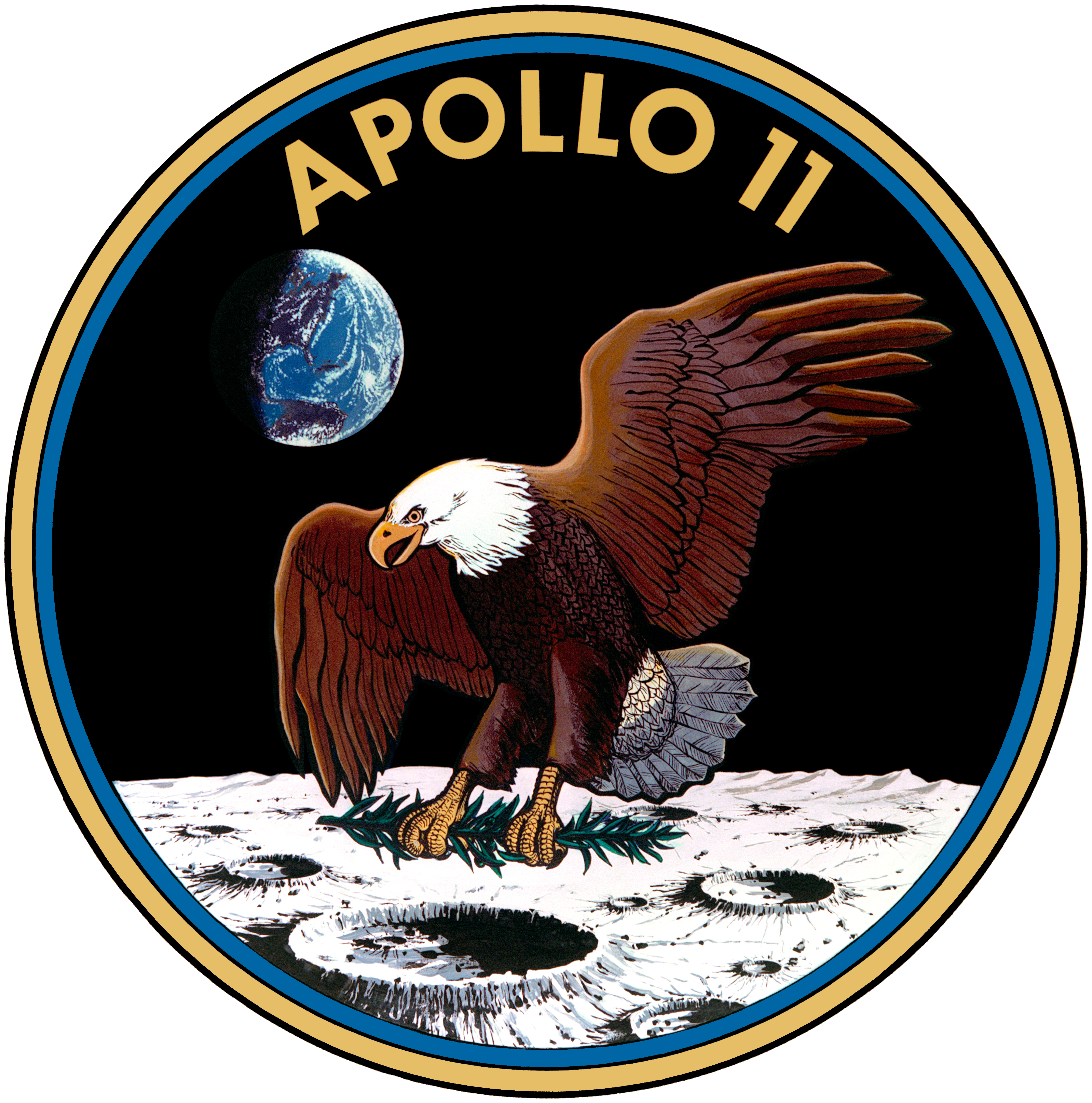
When the Eagle landed on Tranquility Base so many years ago, the eyes of a nation were looking up. The 1969 Apollo 11 mission resulted in the first human footprints on the moon and the launching of a new era of spaceflight. “Eagle” was the name of the lunar module and the mission patch reflected that with an image of an adult Bald Eagle descending down to the moon surface (see here).

  America has always been proud of her earthbound eagles since the birth of the country, but as a human species we have admired eagles for thousands of years. These were the spirit beings able to touch the sun. In giving this honored name to the Apollo lander, NASA has allowed the bird to break the bounds of gravity and touch an extra-terrestrial body. The Bald Eagle is our chosen symbol and therefore an icon that tugs at our very soul. Anything bearing its name or image is held above the fray and human contact with the real bird has always been perceived as a nearly spiritual event. 

  Unfortunately, the uniqueness of such a contact here in the lower 48 has been the result of our own carelessness.  We tried to poison the real thing out of existence.  We tried to destroy the watery habitat required by the bird. We, unwittingly, tried as a society to make this bird only a symbol and not a reality.  Fortunately in this particular mission we failed. The Bald Eagle is back and it is landing daily, thank you very much.

  Seeing a Bald Eagle is now a regular event in S.E. Michigan and such a thing is no longer unusual. Nationwide the species has been de-listed from both the endangered and the threatened species list and is returning to haunts vacated a lifetime ago. Take a trip to Lake Erie Metropark and you will see eagles – lots of them. This winter alone, for instance, there are at least 49 eagles wintering along the lower Detroit River. This resurgence means that we can now go beyond the fawning hero worship stage and appreciate them for what they are.

  It is o.k. to admit that the birds are kleptoparasites – which is a nice way to say that they are thieves.  This is how they make their living as real animals and, despite what Ben Franklin says,   this has nothing to do with their symbolic nature. The over wintering birds gather at the river mouth to feed on the abundant duck and fish life and will obtain them by any means possible.

  Earlier in the winter, an observer spotted an immature Baldie swooping down to make a catch.  It hoisted its sizable prey up out of the water and was immediately attacked by another immature bird (so immature!).  The second bird forced the first to drop the fish and retrieved it as its own.  No sooner had the second bird made head way towards the shoreline than an adult eagle entered the scene and harassed the second bird.  You guessed it; the second thief yielded to the persuasions of the third and was forced to drop its ill-gotten fish onto the ice.  The adult bird circled back and dipped down to pick up the newly won meal. This bird had the final say in this energy transfer and ended up eating the fish.

  The major difference between an immature and an adult bird is not size. We are not talking about a big bully bird picking on a meek little weakling.  Immature eagles are fully as large and powerful as the adults, but are classified as such if they are under five years old. A first year bird is dark brown all over, with a sprinkling of white.  A second or third year eagle has a progressively higher concentration of white speckling (especially on the belly), but still no white head or tail. By the time the fourth winter rolls around, the sub-adult is endowed with a dirty white head and tail that almost makes it look like an adult.  These white areas will clarify into the classic pattern upon obtaining the fifth year of plumage.

 Take a look at this shot, and you’ll see a picture of a four year old making off with a large fish (My friend Rodney Laura took the picture through a high power telephoto).  Note the line running through the eye of the bird and the brownish tinge to the “bald” head. Even from this distance it is apparent that it is carting away a large Gizzard Shad. 

  Please don’t call me un-American if I say that getting a shad is not a great feat of aerial fishing. Shad are weak mouthed filter feeders that are highly susceptible to late winter ice and temperature changes. If you re-examine the picture, you’ll see that the silvery fish is blotched with red – this is not blood incurred from the predatory attack but skin hemorrhaging resulting from its weakened state.  In other words, the fish was floundering, or already dead, before the eagle took it for lunch.

  You see, it doesn’t matter that our eagles are less than pure red-blooded honorable predators. Oh sure, they do their share of clean dead-aim fishing, but not all the time. They are living up to their own species doctrine and have no need to meet our artificial human standards. Theft and scavenging are honorable in the eyes of an eagle.

  Last week, I had my own eagle encounter as I watched a two year bird engage in a series of low lazy spirals over a field. This behavior caught my attention because it looked like it was going to land on the open ground – an unusual behavior.  Sure enough, it came to a halt out in the middle of a windswept open space.  I glassed it through my binoculars, expecting to see a dead animal or dropped fish at the location, but there was no such thing (not even the promise of a meadow vole). The bird started to take an awkward stroll over the grass and occasionally looked down at its feet. It frequently stopped to look skyward as if slightly embarrassed.

  After walking about ten feet the bird looked skyward and fixed his gaze on another young eagle that passed overhead. This prompted the walker to launch back into the air and the two sailed off toward the river.

  The question as to why this eagle chose to land and walk remains unanswered, but I have a theory. Here was an individual that was venturing onto an exploratory mission of discovery.  It seemed to have given in to an innate curiosity regarding the feel of this piece of strange terra-firma. It broke the bounds of airspace and came to earth strictly because it could. Once on the spot, it walked in the manner of other two legged critters before launching back into the realm of the sun. It was an awkward endeavor, but could be defined as “one small step for an eagle, and one giant step for eaglekind.” 

  Sorry, for that.  It looks like I got caught up in that mystic eaglespeak again.

From Here They All Look Like Ants

Before today, I would have thought that a “Raven 44” flying machine was one of Harry Potter’s broomsticks. Now I know that this species of Raven is a whirly bird – a sleek deep maroon helicopter that seats four.  I know that because I was one of the four seat occupants that rode in one this morning.

  When I stumbled into the hanger at the Oakland County International Airport off of M-59, the other three guys were already there.  They eyed me up as I walked across the echoing concrete floor. Mark and John, fellow Metropark employees, immediately engaged in a bout of weight guessing. Mark declared “he looks like a 190,” as he slapped me on the back in greeting. The pilot, Chuck Blaylock of Magnum Helicopter Services, declared that would be o.k. and went on to tell me that he had estimated our combined weights in order to determine fuel use. I protested slightly that I wasn’t quite 190 pounds- more like 185 or 6-, but that my puffy coat made me look fat. He simply glanced over his paperwork and said “let’s go.”

  The huge hanger door was lifted, the copter shuttled out on a hand cart (I’m not kidding), and we bundled into the cockpit.  Since my coat was so puffy, you understand, I had a hard time packing myself in and finding the seat belt latch.

  The reason for this helicopter ride was to conduct a portion of our annual Metropark deer survey. Since today’s flight was scheduled to go over my domain at Lake Erie Metropark, I claimed naturalist rights for a seat. We’ve been surveying deer numbers for years, but up until now I was never one of the flyboy “we” folk.  My job today was as a secondary spotter and data tabulator. In other words I was to write down the numbers on an aerial photo as the animals were sighted. John and Mark were seated in back in order to look out their respective sides. Chuck, well, he was supposed to fly the thing.

  Without going on too much about the ride itself, let me say that one of the best parts, besides sitting in front next to the pilot, was wearing a headset. Once the props get whirling, it gets pretty noisy in the cabin, so we had to communicate with each other via headset microphones.  All of us sounded just like those air traffic controller people except that we said stupid things (like “Oh, look at that bright yellow house” or “This is cool”). Chuck sounded appropriately official as he announced that “Helicopter 141 Delta Charley” was underway and requesting permission to enter the air space around Detroit Metro Airport.

 The latest coating of fresh snow turned even the suburban portions of the landscape into winter wonderlands.  Backyards were pristine with only a few tracks leading to the bare spot in the driveways were the cars were parked overnight.  Matchbox cars whirred along on their appointed tasks and even a local junkyard looked magical from 400 feet up. 

  Frozen lakes were criss-crossed with linear snowmobile tracings and peculiar pock mark tracks led to dark holes in the ice where fishermen had augured their lucky holes (fortunately these tracks led away from the holes as well!).

    Our trip initially took us over the wooded terrain of Lower Huron, Willow and Oakwoods Metropark.  These are long narrow parks bordering the winding course of the Huron River. Chuck brought us down to about 100 feet as we entered park airspace. Four pairs of eyes then began to scan the ground beneath the skeletal trees. 

  Almost immediately, four deer were spotted at the north end of Lower Huron. I dutifully marked them down on the map and peered down at the tiny deer running beneath my feet. The second one in this initial group was a buck still bearing antlers, but it proved to be the only antlered buck we spotted all morning (not surprising since most have dropped their armament by now). On a cold morning like this (it was a negative “niner” degrees Celsius according to the weather voice that occasionally drifted through our headsets) the deer were bedded down.  The passing and re-passing of the copter inspired them to stand up and be counted. This shot gives you an idea of what four deer look like from our perspective. 

  Even though the clear blue day and bright white background helped out tremendously, deer counting is a challenging eyeball exercise.  None of us are under the illusion that we see every animal, but these counts are for relative and not absolute numbers.  By the time we reached the southern end of Oakwoods Metropark, at Flat Rock, we had tallied about 150 deer (I never did get time to tally these numbers up). The biggest single gathering was a herd of 17 individuals. Most were in herdlets of 3 to 5 head. Along the way, several hundred geese, a dozen Red-tailed hawks, and one lone coyote presented themselves for non-mathematical observation.

  The final approach to Lake Erie Metropark was signaled by the bright slate blue surface of the Detroit River ahead.  There is no finer vista than that offered by the curve of the earth horizon over the waters of Lake Erie at the river mouth (see the Detroit River lighthouse and the expansive Pte. Mouillee marshes south of the park in this photo). At this point I was busily snapping pictures, recording data, and directing Chuck over the marshlands and scrub areas– multitasking to be sure. A flock of 15 wintering Great Blue Herons flew across the reed bed below us.  Three immature Bald Eagles flushed from their roost at the south end of the park and headed out over the river mouth to the refuge of Celeron Island.  Hundreds of coot and large white Tundra Swans dotted the near shore waters.

  Our first pass over didn’t produce too many deer sightings.  Their trails and bedding spots were very apparent from the air – as were the distinctive scraping areas where they pawed the snow to get at the grass.  On the second crossover, however, the critters began to move. During one period, when we were barely 85 feet from the ground, I was able to snap this picture of a befuddled doe.  Although many of the animals eventually looked up, she was still searching the surrounding woods for the cause of our whirring noise. I felt like opening the door and yelling down to give her a heads up, but resisted the temptation (and my fellow crew’s wrath).

  In all, we recorded some 42 deer at “my” park along with two stationary ice fishermen on the ice shelf. “Look how close they are to the open water,” John piped through the headset. “Yeah,” let’s hope we don’t scare ‘em off into the lake,” somebody else said.  With that, the count was done and N141-DC headed back towards Pontiac.

  On the ground, all those tiny deer gain quite a bit in relative body size. Of course, they gain that size by feasting on the native vegetation. The purpose behind our survey was to monitor the deer population and keep a management check on that very vegetation. Our numbers will be crunched and incorporated into a larger management plan, but for now the benefit was strictly personal.  I got a chance to picture myself, eyes fixed in a pensive gaze, with those cool headsets on.

Slip Slid’n Away

  You have to admit that it is funny to see someone trip or slip. Call it human nature, call it sadistic pleasure, call it what you will – our taking pleasure in someone else’s sudden lack of control is a very human thing. Of course, our better nature immediately takes over if the slip or the trip results in injury, but luckily we humans are made of fairly durable stuff (so we bounce rather than break).  What would “America’s Funniest Videos” be, after all, without the forces of gravity and the people who manage to film others in the act of being defeated by it?

  On this note, can you honestly tell me that the only reason you watch Olympic ice skating events is strictly to marvel at athletic or artistic prowess? No, you expect to see someone take the plunge – to end up ingloriously sprawled and spinning out of control into the side boards. Seeing such a thing is comforting to those of us who have no athletic skill. It is a chance to see a world class athlete assume a familiar greenhorn position. It confirms that ice is indeed slippery.

  Winter, of course, offers daily opportunities for blundering on natural ice. Trekking over glaze ice is a tenuous thing for us bipeds, but I’d like to switch gears to the animal world for a moment (this is a nature column). We might mistakenly believe that quadrupeds – four legged critters – are much surer footed on such medium. I would like to present a few case studies to prove that such is not the necessarily the case.

  Last week, I came across abundant track evidence of animal slippage on the ice. A light dusting of snow covered the hard icy patches and any critter passing over them was duly recorded.  Many of those animals slipped. You didn’t have to be there to witness the events since they were recorded in crisp clarity.  

  Take this set of Fox Squirrel tracks, for instance. Let’s hang the scientific stuff for a moment and just look at the story this set of prints can tell. The squirrel was headed toward the left of the photo when it was suddenly compelled put on the brakes.  As you can see, it had no ability to stop its forward momentum and slid for some distance. At the end of the slide, it was able to make a right angle turn and jump off into the sheltering woods.

  I can only surmise that an approaching car or predator was cause for the action, but the tracks are silent on this aspect of the story.

  Deer, equipped as they are with hard pointed toes, are especially prone to slipping.  They have an extremely hard time maintaining balance when on ice. Take a look here and you can see ample proof of this. One can almost hear the “oops,” or “whoas” as the less than sure footed critters attempt to recover their dignity. Here’s another set with a few “leg swing outs” and “toe pirouettes.”  This small patch of ice (see here) proved to be a completely un-nerving experience for an entire herd of toe-walkers (I believe pandemonium would be the word here)!

  It is amazing that none of the deer in this case ever fell on their bums. That all apparently recovered their balance with cat-like agility is credit to their remarkable physical abilities. Still, it gave me small pleasure to know that these graceful animals can be just as incredibly awkward as we are on ice. Call me human, but I find that fact strangely comforting.

Death at a Feeder

Today an older couple from Trenton stopped in to satisfy their curiosity about a recent sighting.  Their names will remain unstated because, frankly, I never got their names! “Are there Martens here?” she asked with slightly squinting eyes indicating her expectation of a negative answer. She had just taken off her tight knit cap so that her silvery hair was matted down tight to her head– making her eyes and nose look larger than normal. Upon receiving my expected negative answer, she shook her head and began to describe a furry chocolate brown creature with a long tail – in other words a perfect description of a mink. She retorted that it was “quite big (holding her hands about 24 inches apart) and that it had a wide head (forming a triangle with her hands about the size of a large snapping turtle head).” It couldn’t be a mink, according to her, “that’s why I was looking on the internet to find out what it was.” A picture of a Pine Marten was the only thing she saw, though she didn’t elaborate on the details of her Google search. Given the exchange, I felt her search criterion was probably something like a “hairy brown animal larger than a mink even though I don’t know how big a mink is.”

  I assured her that by all accounts, they had seen a male mink and that the creatures are relatively common, though rarely seen due to nocturnal habits. Martens have large ears, are lighter grayish brown and, most importantly, are not found anywhere near southern Michigan. I even showed them (really her, because he said little the whole time) a study skin mount of several mink as well as a marten mount for comparison. She reluctantly agreed to the mink I.D. but was obviously flummoxed by the size.  Her husband piped in with a verbal agreement that my larger mount was pretty close to the actual size of the mystery critter. It took another explanation that a living animal looks a whole lot fluffier and robust than a dried out, artificially positioned, ten year old mount before she submitted.

  Hoping to God that I hadn’t just un-convinced somebody out of a rare marten sighting, I asked about the circumstances of the encounter. “It came to our bird feeder,” she said. “There were some squirrels and a couple of muskrats feeding there.”  “Muskrats?” I interjected in an obviously confused manner. “Yes, there were two muskrats. Anyway, this mink ran up to the feeder and chased the squirrels off – well, he chased them up to the base of a tree, but looked more like he was chasing them off rather than, you know, chasing them.”  “Have you seen muskrats at your feeder before?” I continued on point. “No, and there isn’t really any water nearby, but anyway…the mink even put his paws up on the tree and looked up as if it was going to go after those squirrels. But, it turned and ran back over to the muskrats.”

  Apparently anticipating my next question, she went on without pause and said, “and no, the muskrats didn’t try to run away or anything. Then,” holding her hat in hand and leaning over into my face (her hair was fluffing out by now so that her eyes didn’t seem quite so bulging nor her warmed up nose quite so big) she whispered “and then, the mink went up to the muskrat and looked it right in the eye, like this.  It was only a few inches away (which she demonstrated with uncomfortable effect).  “Did either ‘rat move or try to run?” I asked while backing away. “No. Both of them just sat there. Suddenly the mink jumped at the nearest muskrat just like that!  It grabbed it by the back of the head – by the neck- and held on.  The muskrat couldn’t do a thing and couldn’t turn around.  It flailed around but not much else.  The mink wrapped its front legs around the muskrat from behind and just held on and would not let go as they rolled around.”

  Her account had unexpectedly turned into a riveting tale of predator vs. prey, so I pressed for details. “What did the other ‘rat do. Did it run away? Did the attacked ‘rat rear up or bear its teeth or anything?”  “The other one just walked away, it didn’t run – it just kinda walked off.  The first one might have reared up but it happened so quick that it really didn’t have a chance.  Pretty soon it was dead and the mink dragged it off.”

  “We were so shocked,” she said, “that we didn’t have time to take any pictures. We tried, but they came out really blurry. Do mink normally do that kind of thing?”  I assured them that they had witnessed an event that normally occurs under the cover of darkness or behind the thick veil of cat-tails. Mink are muskrat predators.

  There were two things (perhaps three if you count two muskrats at a bird feeder) that were odd about this encounter. First of all, the whole thing happened out in the full sun of mid day. Secondly, the muskrat pair made no attempt to clear the premises when the mink appeared on the scene.  They had plenty of opportunity, given the squirrel chase and all. Even when face to face with their ancestral enemy, their demeanor remained calm (perhaps stupefied would be a better description).

 Apparently these ‘rats were a set of fringe animals struggling to survive.  Their judgment clouded by hunger, the exposed promise of bird seed proved irresistible to them. I have seen several similar muskrats as of late that are living out of culverts like so many homeless people. Late winter population pressures have forced them out of prime habitat and into the hinterlands. These ‘rats are extremely vulnerable to predation, disease, exposure, or the sudden finality of tire death.

  Our mink, ever the opportunist and perhaps a bit on the fringe himself, took advantage of the situation and elected to go for the kill. Normally a healthy muskrat is more than a match for a mink. They will do everything possible to avoid an encounter, but when cornered they can duke it out with great effect. In a contest of mink vs. muskrat, there is no guarantee that the mink will come out on top. Unless they have the advantage of surprise, the well advised mink will avoid any direct attack on an adult ‘rat. 

    In this case, the muskrats were weak and the mink immediately perceived it.  There was no surprise attack, it was direct and frontal. I am satisfied with the graphic portrayal given me by the intense visitor, but selfishly wish that I could have witnessed this scene myself. I am slightly haunted by her description of that moment when the mink approached the ‘rat and gazed directly into its inner being. She was looking direct into my eyes and I was rendered momentarily uneasy at the invasion of my personal space. This, however, heightened my perception of what transpired between those two creatures.

   They say that the predator and the prey are linked at a level above mere sustenance and that they are mutually dependent – each upon the other. Both are subject to the whims of weather and hard times. It’s all there in some ancient unspoken contract. I suppose it’s possible that in that brief pre-attack moment the gift of life was willingly passed according to the demands spelled out in the fine print.

  I also know that what started out as a teaching moment for me became one in which I became the pupil.

Arakun’s Up and Out

  This winter has been a doozey in many respects.  Although punctuated with warm days and periods of snowlessness (is that a word?) there have been equally long sessions of bitter cold and snow to balance them out.  Members of the Arakun tribe long ago adopted a wait and see strategy to deal with winters such as these.  In other words, they wait out the cold snaps and come out during the late winter warm spells.  This last bout of warmth (a relative term used by us northerners) has encouraged the Arukuns to spill out over the countryside.  The critters look out of place in a snowy setting – something like your hairy neighbor walking out to get the Sunday paper in his bathrobe and bare feet. The fact is that you don’t usually see either of them. The track evidence is enough to decipher both Arakun activity and the actions of your neighborhood Yeti.

  The Arakun critters we are talking about here are Raccoons.  Like our Coyotl discussion earlier, the name of this familiar bandit derives from a slight slander of their Indian name. In this case, the original name was bestowed upon them by the Algonquin speaking peoples of North America. Say “Arakun” enough and you will find yourself saying “A Raccoon.” Drop the “A” and you have the present name, although many simplify that to plain old “coon.”

  Raccoons are basically southern beasts that have learned to tolerate northern winters by getting fat (perhaps your neighbor does the same thing?). Healthy early winter coons can pinch nearly an inch of the life saving flab which accounts for well over 1/3 of their total body weight. They retire to denning sites, such as abandoned woodchuck burrows and hollow trees, when the snow begins to fly.  The first few months are spent in a drowsy sleeping state.  This is not hibernation, but an effective way to conserve energy that allows their bodies to maintain heat by burning off the fat reserves.

  By the time the late winter thaws arrive, the coons are starting to feel the need to begin re-stocking their internal cupboards. They pepper the snowy landscape with their prints as they wander far and wide foraging for food.  

  Here is a typical set of raccoon tracks.  The one thing you’ll notice on this set is their resemblance to tiny human hands. Each foot leaves an impression with five finger-like toes. The hind foot is larger -2 inches or so -and leaves a full sole impression (raccoons, like bears, skunks, and your neighbor, are so-called plantigrade walkers that put full weight on their soles when walking).

  In cases where the critter walks in deeper snow (see here) the toes are harder to see. There are swish marks made by the tail in this last example, but normally that kind of thing doesn’t show up. What you will notice on any set of coon tracks is that they are laid down in pairs with the front and hind feet marking the snow right next to each other (see here).

  Today I followed an extensive set of raccoon tracks that bounded back and forth along a creek. At many points, the tracks ventured out onto the ice or ended at the open water. It was apparent that this animal was searching in the stream for victuals. The creek was flush and the rushing cold water was not very conducive for the usual Arakun hand fishing method. After a quarter mile, though, I did find the remains of a very large crayfish pulled out onto the bank (see here). It was “rent asunder” by the coon and no doubt provided a nice seafood entrée.

  The fishercoon was long gone by the time I arrived on the scene this afternoon, but there was enough evidence before me to reconstruct a potentially mesmerizing picture. Last night there was a total eclipse of the moon.  By 11 pm, the earth’s shadow enveloped the lunar face and the full moon glowed with a deep copper radiance.  I can picture our coon as a ghostly form moving about the snowscape – his nightshine temporarily removed. A few crisp splashes and the crunching of crawdad shell would have cut through the still night air as he made his find.

  This night of the blood moon was bitter cold, so the coon – his hunger temporarily satisfied – hurried back over the flats and entered his cozy den.  By the time the moon was restored to its full face in the wee hours, our raccoon was sound asleep and dreaming of the next thaw. 

The Passing of a Song Dog

The passing of a song dog occurs more frequently than we might be aware of. Song dogs are out and about during the full extent of the cold season and leave evidence of their wanderings in the form of crisp snow tracks.

  You may have guessed that I am about to embark on another track treatise and that I have introduced the subject in my usually obtuse manner. Song Dog is a euphonic name for the coyote, by the way. This nick name came from their propensity to yip and yap at the full moon, but their common name derives from a corruption of their original Native American label. The coyote name, in fact, came from the same Central American folks who brought us the word tomato. Tomato was “tumatl” and coyote was “Coyotl.” Don’t ask me how the “l” graduated down the alphabetic line to “o” in the first case, but I suspect the “l” in coyotl caused too many tongue injuries in frustrated Europeans trying to pronounce it.  The “e” ending simply made things easier to say – just like it made chocolatl easier to eat.

  While keeping track of name origins is important, knowing the track at hand is even more important in this case. Earlier in the winter I spied a lone coyote loping along the edge of a corn field. As is usual among this species, it appeared to be self absorbed and laid down his feet in a mantra-like beat pattern. It was a good half mile away and I initially felt that I was unobserved, but the wily beast stopped every 10 yards to throw a glance over in my direction to prove me wrong. Only smart coyotes survive in this area and so they must be constantly aware of all that is near and far. Most eastern coyotes have turned to nocturnal habits and so they stay out of our way for the most part. We must rely on their track evidence to give testimony to their abundance.

  I spotted this set of coyote tracks last week on a morning after a nice overnight snowfall. At first glance you’ll probably remark that they appear very dog-like (as the animal itself does). As fellow members of the canine corps, coyotes and dogs share many traits – not the least of which is a four-toed foot with a central pad.  There are a few particular differences that can help separate their tracks, however.

  First of all, the average coyote track is about 2 ½ inches long, while dog tracks can vary from glorified rat-sized Chihuahua prints to cattle sized Great Dane spoor. A German Shepherd would leave a track similar in size to that of a coyote, but it will reveal its “dogginess” by the fact that the paw print is nearly round in outline.  If you draw an imaginary line outlining the borders of a dog track you will trace out a fairly circular shape. A similar exercise with a coyote track will reveal a narrow oval. The coyote track is more pointed and is narrower than a dog’s print.

  Both dogs and coyotes set down their feet in a repetitious pattern which leaves a single hind foot mark adjacent to a front foot. The larger of the set is the front foot in both cases. If you take a look at how these multiple tracks line up, you will see another coyote sign marker. Coyotes pretty much keep in a relatively straight line when they walk, while dogs will veer and angle about (especially in the presence of hydrants). This dotted line trait is also indicative of foxes, but they have much smaller feet. 

  Now that you know what to look for in a coyotl trackl, it’s time to go in pursuit of the story behind a set of rare winter Arakun prints. But, that will have to wait until next time.