I was going to title this entry something like “Pigeons Suck,” or “Pigeons Have Bad Taste,” but I didn’t because that would have conveyed the wrong message. Both of these statements are true, but not for the reasons you think. You see, almost everyone views the lowly pigeon through a looking glass darkly.  They are widely held in disregard as art critics, beggars, or flying rats except by fanciers, of course.  I am neither a fancier nor a hater of these birds, but the sight of a dead pigeon along a city street yesterday ignited an odd feeling within.

  For some reason I felt that the forgotten bird deserved some recognition.  It looked so abandoned laying there on the frigid blacktop. Though the flow of traffic moved me well beyond the scene, I eventually was able to turn my car around.  I pulled into the parking lot closest to the curbside where it lay and walked over to retrieve it. A lone bundled bike rider pedaled down the walk just as I picked the stiff little feather bundle up. “Aw, that’s too bad,” his muffled voice cooed, “it’s a pretty thing.”  I agreed with a semi-embarrassed nod. At least here was a person who thought my act somewhat sensible and possibly slightly nobler than just a guy picking up just any old dead bird. I don’t know what the passing motorists thought.

 It was a really pretty bird.  I took the casualty home, propped it into a semi upright position and proceeded to draw its portrait in color pencil.  My primary mission immediately became one of capturing the subtleties of feather iridescence and intricacies of beak detail.  My secondary task was to document the unique form of this one particular individual. Take a look at my finished product and give me the satisfaction of knowing that this pigeon didn’t die in vain.

  You might like to know that the bird was 12 inches in length, had a wingspan of 25 inches, and weighted 11 ounces.  There were 11 tail feathers arranged five to each side and one down the middle. The bright reddish pink feet were tipped with two inner black toenails and two outer white toenails and the wings each had ten primaries (those stiff outer wing feathers).  I guess it’s worth noting that the first four feathers on each set of primaries were solid white. These are rather dry stats, aren’t they? Well, let’s put this bird into wider perspective then.

  Up until 2004, the scientific world dubbed these city dwellers as “Rock Doves” but has since switched to the more proper sounding name of “Rock Pigeon.” This is, of course, one of many names proffered over the 5,000 plus years we have been associated with them.  The original birds were native to the cliffs and rock faces of Europe, North Africa and Southern Asia but the domesticated ones have spread across the planet.  It is believed they arrived here in the New World sometime in the 1600’s. Leaving the issue of caged fancy pigeons aside (I believe I said I’m not a fancier), the feral birds have developed some fairly consistent color patterns, or color morphs over the years. This is akin to the color variety you see in farm ducks, domestic dogs, or-God forbid -cats. I believe domestic chinchillas also come in different flavors, but don’t quote me on that. Anyway, the noble pavement pigeon in my possession could aptly be called a representative of the “Pied” morph style of avian couture.

  Please believe me when I say this, but according to a group called Project Pigeonwatch (an international group dedicated to the study of feral pigeon colors) there are 28 different color morphs found among wild pigeons. For the sake of humankind, the group has boiled this variety of choices down to 7 primary color schemes, but the terminology is a bit confusing. First there is the “blue bar”, which is the original gray with black wing bars; the “red bar” where the blue, which is really black, is replaced by rusty brown, which is not really red; “checker” with speckles all over the body; “red” which is where the body is mostly brown (hmmm); “spread” which rhymes with red but means solid black for some reason; “white” which means white, oddly enough; “pied” which means endowed with patches of white.

  My bird is “pied” (in reality this is short for the term pie-bald – really it is) due to the white wing feathers, white eye spot, and four white toes. You could say the rest of his body is basically “blue bar” but I don’t know why you’d say that other than to sound like a fancier. The single most distinctive trait on any dark colored pigeon is the wonderfully iridescent set of feathers surrounding the neck – a region called the hackle. Male birds proudly display these shimmering feathers for the adoration of the females while cooing.  The Cornell Laboratory of Ornithology, the same folks who sponsor Pigeonwatch, authoritatively state that this breeding sound is “coo, rooc’too- coo.”  I for one will not refute this, although I believe the spelling might change from bird to bird.

  I trust I have at least done some justice to this anonymous dead dove. There is far too little space to get into family history, some of which is pretty noble. I’ll leave it up to you to probe the story behind a hastily scrawled note which read: “Our artillery is dropping a barrage on us. For heaven’s sake, stop it!” (Hint: “Cher Ami”).

  There is really nothing else to say about this pigeon except to note the bright white “cere” or fleshy area around its nostrils.  This is a feature found on all members of the pigeon family – including Mourning Doves. Another unique thing possessed by all those of pigeon persuasion is their ability to suck water. Most birds are required to throw back their heads in order to down a gulp of water, but pigeons can use their beak like a straw. Now you know why I say that pigeons suck. 

  On this note, I came across another totally useless fact regarding pigeon taste buds.  I can’t vouch for the authenticity of this, but apparently pigeons have only 37 taste buds in their mouth.  We have 9,000 taste buds.  This is the reason pigeons eat dry corn while we feast on roast pigeon squabs. Who says pigeons have bad taste.

Coo, roo c?too-coo Mrs. Robinson

? I was going to title this entry something like ?Pigeons Suck,? or ?Pigeons Have Bad Taste,? but I didn?t because that would have conveyed the wrong message. Both of these statements are true, but not for the reasons you think. You see, almost everyone views the lowly pigeon through a looking glass darkly.? They are widely held in disregard as art critics, beggars, or flying rats except by fanciers, of course.? I am neither a fancier nor a hater of these birds, but the sight of a dead pigeon along a city street yesterday ignited an odd feeling within.

? For some reason I felt that the forgotten bird deserved some recognition.? It looked so abandoned laying there on the frigid blacktop. Though the flow of traffic moved me well beyond the scene, I eventually was able to turn my car around.? I pulled into the parking lot closest to the curbside where it lay and walked over to retrieve it. A lone bundled bike rider pedaled down the walk just as I picked the stiff little feather bundle up. ?Aw, that?s too bad,? his muffled voice cooed, ?it?s a pretty thing.?? I agreed with a semi-embarrassed nod. At least here was a person who thought my act somewhat sensible and possibly slightly nobler than just a guy picking up just any old dead bird. I don?t know what the passing motorists thought.

?It was a really pretty bird.? I took the casualty home, propped it into a semi upright position and proceeded to draw its portrait in color pencil.? My primary mission immediately became one of capturing the subtleties of feather iridescence and intricacies of beak detail. ?My secondary task was to document the unique form of this one particular individual. Take a look at my finished product and give me the satisfaction of knowing that this pigeon didn?t die in vain.

? You might like to know that the bird was 12 inches in length, had a wingspan of 25 inches, and weighted 11 ounces.? There were 11 tail feathers arranged five to each side and one down the middle. The bright reddish pink feet were tipped with two inner black toenails and two outer white toenails and the wings each had ten primaries (those stiff outer wing feathers).? I guess it?s worth noting that the first four feathers on each set of primaries were solid white. These are rather dry stats, aren?t they? Well, let?s put this bird into wider perspective then.

? Up until 2004, the scientific world dubbed these city dwellers as ?Rock Doves? but has since switched to the more proper sounding name of ?Rock Pigeon.? This is, of course, one of many names proffered over the 5,000 plus years we have been associated with them.? The original birds were native to the cliffs and rock faces of Europe, North Africa and Southern Asia but the domesticated ones have spread across the planet.? It is believed they arrived here in the New World sometime in the 1600?s. Leaving the issue of caged fancy pigeons aside (I believe I said I?m not a fancier), the feral birds have developed some fairly consistent color patterns, or color morphs over the years. This is akin to the color variety you see in farm ducks, domestic dogs, or-God forbid -cats. I believe domestic chinchillas also come in different flavors, but don?t quote me on that. Anyway, the noble pavement pigeon in my possession could aptly be called a representative of the ?Pied? morph style of avian couture.

? Please believe me when I say this, but according to a group called Project Pigeonwatch (an international group dedicated to the study of feral pigeon colors) there are 28 different color morphs found among wild pigeons. For the sake of humankind, the group has boiled this variety of choices down to 7 primary color schemes, but the terminology is a bit confusing. First there is the ?blue bar?, which is the original gray with black wing bars; the ?red bar? where the blue, which is really black, is replaced by rusty brown, which is not really red; ?checker? with speckles all over the body; ?red? which is where the body is mostly brown (hmmm); ?spread? which rhymes with red but means solid black for some reason; ?white? which means white, oddly enough; ?pied? which means endowed with patches of white.

? My bird is ?pied? (in reality this is short for the term pie-bald ? really it is) due to the white wing feathers, white eye spot, and four white toes. You could say the rest of his body is basically ?blue bar? but I don?t know why you?d say that other than to sound like a fancier. The single most distinctive trait on any dark colored pigeon is the wonderfully iridescent set of feathers surrounding the neck ? a region called the hackle. Male birds proudly display these shimmering feathers for the adoration of the females while cooing.? The Cornell Laboratory of Ornithology, the same folks who sponsor Pigeonwatch, authoritatively state that this breeding sound is ?coo, rooc?too- coo.?? I for one will not refute this, although I believe the spelling might change from bird to bird.

? I trust I have at least done some justice to this anonymous dead dove. There is far too little space to get into family history, some of which is pretty noble. I?ll leave it up to you to probe the story behind a hastily scrawled note which read: ?Our artillery is dropping a barrage on us. For heaven?s sake, stop it!? (Hint: ?Cher Ami?).

? There is really nothing else to say about this pigeon except to note the bright white ?cere? or fleshy area around its nostrils.? This is a feature found on all members of the pigeon family ? including Mourning Doves. Another unique thing possessed by all those of pigeon persuasion is their ability to suck water. Most birds are required to throw back their heads in order to down a gulp of water, but pigeons can use their beak like a straw. Now you know why I say that pigeons suck.?

? On this note, I came across another totally useless fact regarding pigeon taste buds.? I can?t vouch for the authenticity of this, but apparently pigeons have only 37 taste buds in their mouth.? We have 9,000 taste buds.? This is the reason pigeons eat dry corn while we feast on roast pigeon squabs. Who says pigeons have bad taste.

Pfield of Pfheasants

  Today began with the kind of cold winter morning which drives home the point that we are in the depth of the season. Gray skies matched the color of the solid ice in the roadside ditches along the stretch of the east county country road called the U.S. turnpike.  The closely cropped and stubbled expanse of the corn fields offered little resistance to the stiff western breeze. Wisps of blowing snow flowed over the hard frozen ground and the road surface like running water. Almost as if they were expressions of the wind itself, a moderate sized flock of Snow Buntings rose and fell over the distant landscape. No doubt these spritely birds enjoyed the scene as it reminded them of their Arctic homeland.

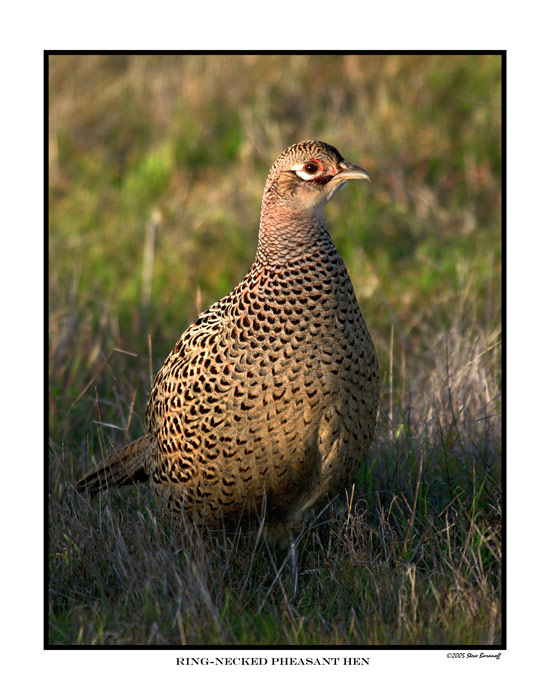
   I sped past the buntings and spotted a flock of larger earthbound birds in the field ahead and to my left. It was a group of seven Ring-necked Pheasants -totally exposed to the elements yet oblivious to it. Like the buntings, they were searching for waste grain. The road being totally devoid of traffic, I slowed down to get a better look. 

  This hardy gang consisted of six roosters and one hen.  All had their heads down and were engrossed in scratching away the light snow cover while selecting precious corn kernels with their beaks. Every time they turned away from the wind, their long tail feathers would raise up and flap like grass stems. Every time they faced into it their tails became quivering streamers that trailed behind. I had time to snap a hasty photo before an approaching traveler required me to push on past the scene. The remainder of my journey allowed me time to ponder the plight of the pheasant in these parts.

  In another month or so, the ratio of this group would completely flip flop to something more like one rooster with a harem of up to twelve hens.  The males will aggressively eliminate each other with challenges and brief cock fights and vie for the attentions of multiple females. For now, however, the breeding season is far off.  Today survival is the main event and small mixed flocks like this are the norm.

  Pheasants are durable northern birds.  This fact may seem somewhat surprising when you consider that they are descended from the jungle fowl of Asia.  One look at their splendid coloration (especially the males) betrays this exotic origin. The females are elegant in their own brown way as well. The pheasant species stock was hardened in the temperate conditions of Manchuria, Korea and Siberia. They diverged into 30 some varieties micro adapted to varying conditions across the European continent. In their native land they are found in the same latitudes as they now occupy in North America, so they were pre-made for our occasionally harsh winter conditions.  

  The bird that was eventually introduced here, the Ring-necked Pheasant, is a hybrid combination of English, Mongolian, Chinese and Japanese varieties. Although first brought over nearly 200 years ago, the species didn’t become established until successful plants in the mid 1800s. It probably wasn’t a part of our Michigan fauna until the late 1800’s.  Now it is an established game bird – probably the most sought after game bird in the country. It is hard to imagine a country field without one or two of them strutting about.

  In most cases, an introduced species has a devastating impact on the native landscape. It is a singular fact that pheasants didn’t really replace any native bird because they live and thrive in the artificially made world of agriculture. Reaching their population peak in the 1950’s, the general number of pheasants has declined dramatically over the years – leveling off in the early 80’s.  The main reason for the drop was the advent of clean farming, larger fields, and fewer hedgerows.

  Winter is the great equalizer among these birds. In the best of worlds, only 3 % of young pheasants can only expect to see their third birthday.  Winter losses of adult birds can be as great as 66% of the population in bad year. Considering those odds, I believe each fowl enters the cold season with a feeling of dread and foreboding.  Fortunately there is not much room in that tiny brain for such thoughts so they stick to the basic living plan without any insurance.

  In order to survive the slim season, pheasants require a healthy mix of available scrub growth, such as a brushy woodlot, for cover against cold winds, along with some open field areas swept clear of snow accumulation.  Add a few corridors, like those presented by a cat-tail marsh or long hedgerow, and you have an ideal habitat that allows safe passage between fields. 

  The small flock of birds that I observed were placing themselves at some risk by venturing so far out into the open. Red-tailed Hawks or Coyotes are more than willing to contribute to their famously high fatality rate. There is method in the apparent madness. In order to reach the rich food resource offered by spilt corn, they move as a group equipped with fourteen eyes. Any thing that moves is quickly spotted by at least one or two sentinel birds at a time. 

  Yes, the birds noticed me, but knew I posed little or no threat from my position.  Should I have exited the car and shortened the distance between me and them, the entire group could have launched into a swift galloping retreat to the scrub line (these guys can cover 18-24 inches per stride when running at full tilt). As a last resort, they would fly off with a series of powerful explosive wing beats and glide into cover.

  As it was, I left these birds to go about their business out there in the open field – a field temporarily transformed into a survival lesson.

Annuder Gall?

  Yes, just when you thought it was safe, I have the outright gall to present you with yet another type of goldenrod gall. I’ve already directed your gaze to the likes of the Goldenrod Bunch Gall and the Goldenrod Ball Gall. You may recall that these structures are essentially plant growths caused by the activities of an insect. Goldenrods, those yellow fall flowering field flowers (say that three times in a row) are host to a wide variety of gall creating insects. Those first two, one of which caused a ball shaped swelling and the other a bunched-up cluster of stunted leaves, were members of the fly clan.  The new gall in question is called an Elliptical Goldenrod Gall and it is the work of a tiny moth.

  As you might have suspected, the Elliptical Goldenrod Gall is an elliptically shaped gall found on the stem of goldenrods.  Another shape-related name for this thing is the Spindle Gall, but if you don’t know what a spindle is this is of little help (this is a wool spindle).  Insects are usually very particular about their plant hosts and the elliptical gall maker deliberately selects Canada, Late, and Giant Goldenrods.

  You’ll note that there is a hole located at the very top of the swelling (if you didn’t, look again). This hole is a key feature in understanding this gall and its creator.  The moth responsible for the whole affair is a tiny thing with the incredible scientific name of Gnorimoscherma gallaesolidaginis (say that one times fast and you are doing good). The common, and pronounceable, name of this insect is the Goldenrod Gall Maker Moth.  Like all moths, it starts as an egg which hatches out as a larva.  The larva, a.k.a. caterpillar, crawls up the stem and burrows in. This incites the stem to swell and entomb the happy little caterpillar which blissfully eats away at the nutritious walls of its cell. About mid July, the fat sassy ‘pillar has had enough and is ready to become a moth. Before pupating, it chews a tunnel up through the gall wall and promptly fills it with silk and debris. Then it retreats back into the chamber and converts into a pupa. This last step is especially important because the adult moth has no chewing mouth parts so would be unable to get out of the gall once it emerged from the pupa.

  It takes about a month before the adult moth emerges from its pupal skin, forces it’s way up through the silk blocked tunnel, and punches though the opening. If you’ve been keeping up with the chronology of this life cycle, you’ll correctly figure that the adults come out in late September.  They lay their eggs in the leaf litter and die long before the gales of November bring in the cold season. This logically means that those elliptical galls, like the one pictured, are actually empty by the time you find them in mid-winter. Logic can only go so far in the world of nature, however.

  If you chose to investigate you will find that many of the elliptical galls will contain life in January. The life form within will not be the original occupant, however.  It is a stark fact of life that such inconsequential beasts as gall moths have even more inconsequentialer life forms that take advantage of them. There are at least four parasitic wasps that can lay their eggs in the moth caterpillar and develop inside the larvae’s body.  They eventually kill their host and complete their development on their own time – often staying throughout the winter.

  Whether a moth or a murderous stranger emerges from the hole atop the gall has already been settled by the time the snow flies.  Most of the time it is a moth that exits the port and the gall sits empty.  Those other times are not galling or appalling, but simply nature’s calling.

Muskrat Burps

In this, the third and final (for now) installment of the muskrat trilogy, I would like to call your attention to the subject of bubbles – muskrat bubbles to be precise. I’ve been keeping an eye on a group of local ‘rats and have recorded their antics for several years now. Even when their world is locked in the frigid grip of winter, I still stop by to check up on things every now and then. These active rodents still keep up a hectic schedule under the ice. Their movements can be harder to track under these circumstances, but in some ways this task is actually made easier. In order to explain this, I’ll need to call up some trapper wisdom.

  Muskrat trappers have to do most of their work in the dead of winter – which means working the marsh when it is sealed in ice and snow. The most essential piece of knowledge is to determine whether muskrats are active in any given area. Fresh cuttings from cat-tail roots, floating mounds of vegetation (sometimes called feeding “bogs”), and piles of fresh muskrat doo deposited as scent posts are all open water signs of muskrat. All these signs are covered once the ice sets in. It was veteran trapper Dave Venier that showed me how to inventory the whereabouts of winter muskrats.  “You look for the open water in front of the lodges,” he says. “The ‘rats keep moving around and they keep the water from freezing up. This shows where they are going into and outta their lodges.” Dave also pointed out the plentiful bubble trails, evident under the patches of clear ice, which mark the muskrat subway routes.

  Once glance at this view of one of “my” muskrat lodges certainly proves this out.  The recent cover of ice captured this bubble trail leading to and from the main entrance of this particular lodge. Earlier in the winter, I was able to record an even clearer bubble effect at the same lodge (see here) and after a healthy fall of snow an open water spot still remained (see here).  

  Even though the evidence of activity was sufficient to notify me of their presence, I was delighted with the opportunity to follow the course of an individual ‘rat one day as it left the lodge and took the standard route to a feeding area. The creature was reduced to a golden brown blob when viewed through the frosty ice pane, and was easily tracked as it plowed through the bubbles like an amoeba pushing through glassy sand grains.  It shifted about amorphously under the ice at a spot located some 50 feet away– its tail pressing up against the glassy ceiling as it dug though the bottom mud for cat-tail rhizomes. Once the prize was secured, the ‘rat returned to the lodge along the same bubble highway. It never once broke surface – even in the open water next to the entrance.

  This foraging ‘rat stayed submerged for one minute while so engaged in his under-ice pursuit. For an animal that can stay under (on a single breath) for as long as 15 minutes during the warm season this kind of thing is the norm. During a hard freeze, however, a winter muskrat is sometimes forced to rely solely upon the stale air within the lodge. This supply of trapped air is saturated with near fatal Carbon Dioxide levels. On top of this, the muskrats rest and eat in complete darkness when in the tight confines of the shelter. Only the pale reflected light from the entry tunnel softens the blackness and only momentary gulps of fresh air relieve the staleness.

  Muskrats are able to cope with, and even thrive, in these conditions.  Dave, the trapper notes that animals forced to endure ice conditions for a long time start to exhibit what he calls “kidney spots.” These are marks that become evident on the hide once it is processed.  There probably is a physiological reason for this, but I’ve not taken that investigative route yet.

  I pointed out the ice bubble trails to a friend of mind and joked that they were “muskrat burps” ejected as the critters exited the lodge. Dennis, an inquisitive sort of fellow, gazed back at me with a pondering look and calmly asked if I wasn’t sure that they came out of the other end, “you know like bubbles in the bath tub!”  “Dennis, “I said, “I guess you’ll just have to walk out there and smell one of those bubbles as it melts out of the ice. Let me know if it smells like cat-tail root.”

More Mushrat Musings

  There are many native legends surrounding the muskrat.  I was introduced to a new one while attending that VFW muskrat dinner I wrote about the other day.  In the packet of ‘rat recipes given me by John Pastor, the cook, was a heavily Xeroxed cutout from an unknown source. A short paragraph under the title of “Muskrat (Marsh Rabbit)” related the story of how “the marsh-rabbit was to be rewarded by Nanabojou.”

  Nanabojou is, by the way, the trickster spirit of the Anishnabe Indians and you’ll recall from our earlier discussion that “marsh-rabbit” is a euphemism for muskrat.  Anyway, in this tale the great spirit was compelled to offer the muskrat “any part of the country to live in that he pleased.” The muskrat promptly picked the deep blue lake but changed his mind the next day and asked for the grassy banks so he could eat. The very next day, muskrat changed his mind and asked for the deep blue lake to swim in but changed his mind again the following day and asked to be returned to the grassy bank.  Nanabojou scolded the little beast and said “you change your mind daily. I will decide. You shall live in the between-land of the marsh- neither land nor water- where there is grass on land and water to swim in.” And so, it was.

  You might wonder why a notorious trickster would even bother with the concerns of an indecisive rodent. Mr. Pastor’s copy sheet didn’t go into this aspect, but I can shed some light here. The answer lies in the fact that the muskrat had just saved the world. You see Nana, as we shall call him, had earlier infuriated the great serpents and they retaliated by flooding the earth. Forced to climb to the highest branch of the highest tree to avoid drowning, he appealed to several animals to dive down and bring up a piece of mud from the bottom.  With that mud he could re-build the earth, but without it he was “up a creek without a paddle” – so to speak.

  Several beasts, including the loon, tried but failed. It was the brave little muskrat who managed to touch bottom and return to the surface with a few grains of soil.  Thus the world was re-created and Nana’s bozo was saved.  There is one small detail of this story that doesn’t segue easily into the earlier one: the original muskrat died in his attempt. His lifeless body bobbed to the surface with the precious mud wedged between his toes. I can only imagine that some type of divine intervention occurred or that some time-space continuum effect got involved in the process.

  Last week, I encountered the lifeless body of a modern day muskrat alongside the road. Trusting that divine intervention would not intercede in his case, I picked it up for “processing.” The unfortunate little beast had apparently exhibited his classic indecisiveness while crossing the road which skirted the Mouillee Marsh and a passing car made the decision for him. It was in great shape – aside from the fact that his head was somewhat uni-dimensional. I took some detail shots of the critter in order to share a few of its unique traits with you.

  For starters, let’s take a gander at those marvelous world-saving feet.  Take a look here at two views of the huge hind feet (here and here). These oversized paddles are equipped with a stiff fringe of hair lining the five toes and the sole. This hairline functions as a web. When the foot is pushed against the water it rigidly stands up to provide a wide surface area for propulsion then neatly folds back when the foot is brought forward.  Here is a water animal that doesn’t have fleshy webs between his toes. It is worth noting, by the way, that there was some mud clinging to these feet (he says with a knowing look in his eye).

  The tiny front feet (see here), like the back ones, are endowed with beautiful pink nails.  Unlike the hind feet, however, they are not fringed and only have four toes (the fifth nail is attached to a stub).  Ridiculously small, these front paws are effectively used to manipulate food and guide it to the food-processing mouth. They are not used for swimming or counting.

  To behold the tail of the ‘rat is to witness the very essence of this water creature (see here). There is another Indian story about how he got that tail, but I won’t go into that now.  In black scaled texture, it looks very much like a beaver’s tail but is long and narrow – like a belt. This appendage is waved back and forth in the water to aide in swimming. It is powerfully lined with heavy tendons that link to the animal’s muscular little frame. The tail on this particular ‘rat is somewhat blunted at the end by an old healed injury.

  I might have mentioned in the earlier essay that we are in the midst of muskrat trapping season.  Aside from the likes of Dave Pastor, Dave Venior and a half dozen other trappers are currently working the Mouillee marsh (as least they were before the ice went out). Although the meats are a delicacy (unless you are female) these gentlemen are capturing the ‘rats primarily for their fur.    

There is nothing quite so inviting to the touch as a muskrat pelt and my expired Mouillee fugitive provided us with a chance to do just that. 

  Here, take a look and you’ll see what I mean. Underneath the golden brown outer fur, called guard hair, is a dense silky layer of gray fur called underfur. I’ve parted the guard hairs in my picture to give you glimpse of the wooly inner layer. This inner coat is so dense that it traps a layer of air – a bubble – that surrounds the muskrat when he dives.  The critter never gets soaked and water never comes in contact with the bare body skin.

  This double layer of fur renders a plump profile onto a healthy mid-winter ‘rat and is the object of desire for their human harvesters. My examination complete, I decided to skin out my muskrat and stretch the pelt in honor of the fur trapper’s tradition. An accomplished trapper can do this operation in a minute or so, but it took me closer to ten minutes.  Once the skin was off, it was pulled inside out onto a wire frame, or stretcher, for drying.

  I did not take a picture of this inside-out ‘rat skin – figuring my earlier shot of a pile of cooked ‘rat was enough.  There were two more features that became evident on the skin and I’d like to point these out before we let this thing go. 

  First of all, my road kill marsh rabbit was a very large individual. The pelt stretched out to 14 ½ inches.  In the “trade” this would be considered an X-Large ‘rat and would command $4.50 in the current market – if it were prime (meaning perfect and big).  This pelt was not perfect.  There were a few holes in hide near the rump indicating that this old warrior had recently engaged in combat with another ‘rat or a hawk before the losing battle with the automobile.

  The second feature was the most fascinating.  The presence of nipple scars indicated that my subject was a female and, I’m not quite sure how to say this, but she was well endowed.  Muskrats normally have three or four pair of nipples.  On rare occasion they have five pairs and this female happened to be one of those super females! I have no idea what I – or you – can do with this information, but there it is.

 O.K., I realize that I’ve probably taken you a little too far into the realm of ‘rats at this point, so I’ll give you a break. Go ahead, take a few days off. When you return, I’d like to address the subject of muskrat bubbles.

Mushrat Love

  Meet John Pastor. The spry 82 year old is a member of the “Rock of Gibraltar” VFW Post 4230, Rockwood, MI.  I met up with Mr. Pastor last night at the Muskrat Dinner hosted by the post and asked him to pose next to one of his creations.  As a self-proclaimed lover of muskrats – alive and dead – I was attracted to the bright neon orange sign along Jefferson advertising a “Cajun Style” muskrat dinner. Between the sign and the building, by the way, is THE rock of Gibraltar for which the post is named (actually it is named for the close vicinity to the little town of Gibraltar which is named after the THE THE original rock guarding the Mediterranean).  

 I arranged to have my name placed on the guest list and showed up, in the company of fellow muskrat Frenchman Ralph Naveaux, with an appetite. Neither of us had experienced Cajun style ‘rat before.  There are a million traditional ways to serve up muskrat – nearly all involve parboiling in water with a variety of spices first.  The treatment of the meats upon the second cooking usually involves corn and onions, but can run the gamut of culinary endeavors. I don’t think anyone has had the audacity to make it into a fashionable or high class dish, since that would ruin the whole thing.  

  Ralph can claim an extensive range of experience in such muskrat eating matters, and I’ve been playing catch-up for the last 27 years. I am not going to explain (at this time) why Downriver and Monroe folks eat muskrats, only that they do it and that they do it with gusto.  

  After paying our fare and helping ourselves to a heap of creamy Cole slaw doled out with an ice cream scoop, our dinner plates arrived at our table.  The boys in kitchen served out the helpings from a large warming pan and a friendly member of the woman’s auxiliary brought it over to table no. 3. We uncased the plastic silverware and dove in – ignoring the heavy cloud of cigarette smoke drifting over from the bar.

  Cajun muskrat is served over noodles and looks like beef stroganoff. The only thing that betrays the real animal behind the feast was the presence of numerous limb bones that had to be worked out via intricate lip manipulations. The taste was very mild and roast beef-like on the palate with just enough spiciness to give it personality. Apparently part of the deal with serving up “marsh rabbit” (a euphemism for muskrat) in this manner is to completely disjoint the meats so that the legs are separated from the body. Normally the bodies are kept pretty well intact. I called over John, the cook, to get his perspective.

  “I’ve cooked muskrat every way possible,” he said, “and I just didn’t like it.  So, I got this recipe out of a book and thought I’d try it.”  He handed me the recipe from a Wild Game cookbook.  The “New Orleans Style Marsh Rabbit” was listed just above the “Braised Muskrat.” It called for muskrats that were de-glanded, disjointed, and floured along with a ton of spices such as garlic, cayenne, bay leaves, thyme and some red wine. He also handed me a packet of collected recipes with titles like “Ecorse Marsh Hare,” “Batter-Fried Muskrat,” and “Muskrat A’ La Duke Underhill.”  I could see that I had barely scratched the surface when it came to sampling different ‘rat dishes – even Ralph saw a few he hadn’t tried.

  Of course, the one ingredient all these recipes have in common is the lowly rodent itself.  John’s son Dave is an avid trapper and one of the few remaining genuine marsh rats around (calling someone that name is a good thing around these parts, in case you were wondering). All of the ‘rats for this dinner came directly from Dave’s trap line in the Pointe Mouillee Marsh. The Mouillee Marsh is literally next door to the VFW, so these muskrat meats were as fresh as you could get.

  The official muskrat trapping season in southern Michigan begins in early December and runs through the end of January. Sometimes the season is extended at Mouillee in an effort to control the over population of the fertile little beasts (they don’t call ‘em marsh rabbits for nothing). The major reason behind muskrat trapping is to harvest the furs, but the meats are a commodity in themselves and a traditional seasonal favorite of long standing.

  Now, I know what some of you are thinking and it’s O.K. to think that. As we approach the Lenten season, there will be many opportunities for you to savor muskrat meat at a variety of church, rotary, and hunt club venues.  One thing that is standard at all muskrat dinners is that they never just serve muskrat.  The VFW meal also featured spaghetti while others serve roast beef.  This is because not everyone likes the idea of muskrat as food. 

  I taunted a friend who was sitting up at the bar for not sampling the muskrat. Mike was nurturing a glass of beer and was in the process of solving all the problems of the world with a fellow patron. He said he’ll eat the stuff but finds it so rich that one bite fills him up.  “It’s amazing to me,” he said “that some folks will ask for another take out meal after they’ve finished this one. How can they do that?” Robin, one of the gals serving the floor, declared that she wouldn’t even think of touching one.  She laughed with a smoky gurgle when I offered her a piece. “It tastes just like smooth beef,” I said, but her return glance – accompanied by a wave-away hand motion – said in no uncertain terms that this meat was from a rat. She was helping herself to the spaghetti.

  It is fairly safe to say that women do not generally like muskrat and that the alternate dishes are for them.  I’ll even admit that a lot of men don’t like it either, but feel compelled to eat it out of duty to God and country. Neither of these statements are proven fact, but I pledge to conduct further research into the matter.

  It is a fact that this particular day began and ended in the vicinity of a muskrat.  In the morning I worked with a fresh road kill ‘rat – also a Mouillee ‘rat – and decided to document a few of its features. I’d like to share some of those morning muskrat observations with you, but this will have to wait until the next entry.

Asclepius Incarnate

   In another time or reality, I might have styled myself as the “Flesh-colored God of Medicine” (an FcGM for short). I would have been a great healer adorned with a panther robe and wielding some kind of large stick topped with a Dik-dik skull. My pale white skin would have channeled the northern lights and reflected all the bad stuff back into space. I would employ magic herbs for the benefit of humankind and never kill mice.

  Fortunately, that frightening alternate universe will never be a reality. I am stuck with the simple self applied label of “Fleshy Northern Guy.”   A “F.N.G.” has no special powers other than the ability to summon goose bumps on my skin when I am cold and the skill to recommend Tylenol for headaches. I will continue to kill bad mice when needed.

  Even though I may not be sure how to employ them properly, I do have the ability to locate magic plants.  One of these plants is commonly called the White Indian Hemp, but is better known as the Swamp Milkweed. It may not look like much on a frosty mid-winter morning, but is easily identified by the numerous clusters of upward pointing pods (here it is).  Back in September, these pods were exploding with silky down (see here) but are now void of their cargo. The empty seed heads retain a graceful form and add a subtle freckled beauty to the cold landscape.

  Swamp Milkweeds are the slender wetland cousins of the more robust Common Milkweeds. The entire family is named after Aesulapius, the Greek God of medicine, and all the individual members have the tribal name of Asclepius.  In the case of our Indian Hemp, the species is called Asclepius incarnata – meaning “the flesh colored god of medicine.” You’ve got to admit that’s a pretty impressive title (and thus the reason for my earlier flight of fancy).  Imagine that on a name tag: Hello, my name is…”

  The healing properties attributed to this plant are found in the milky white sap. I am not actually a great healer (although I play one in a parallel universe), so I won’t launch into a list of benefits. Let’s just say that the list is a long one and leave it at that. I’d like to direct your attention to the dead winter stems instead. Though drained of their precious blood, these woody skeletons also have something to offer in the form of strong fibers for rope making.

  If you attempt to snap the stem in two, it will not break cleanly. The two sections will be linked by dozens of fine silky threads in the outer layer.  These fibers have been utilized by Native Americans for making a stout twine which was used in woven bags and fishing nets. In 1850, a western traveler recorded in his observations that the “Ottoes and Omahas (Indians) make lariats of the bark which are said to be stronger than those made of hide.”

  It is necessary to beat the living tar out of the stems in order to separate the glossy white fibers from the rest of the plant tissues.  I’ve done it before, but my efforts did not result in anything resembling a lariat.  My pitiful F.N.G. twine product would have better served as a lariat for roping bad mice out of a herd of “mouses” or leashing in a wild Dik-dik.

Kestrel of Many Colors

  An un-announced guest dropped by Jeff Read’s Gibraltar house the other day. The well dressed visitor stopped in for lunch and while delivering a poorly aimed stab at his food, was propelled into the porch window with near fatal force. Fortunately, he survived his experience -and in spite of it -will likely return to sample the fare.

  The house crasher was an American Kestrel bent on nabbing a sparrow. His intended prey veered off just shy of the window and left the pursuer little time for course correction.  The predator and the pane were introduced to each other in short order. This could have been the high impact end of a wonderful career. Many other bird eating raptors, such as the larger Cooper’s and Sharp-shinned Hawks, suffer this fate while pursuing their trade in the close vicinity of houses. This ill fated hunter struck with a glancing blow that knocked him for a loop but apparently didn’t break anything.  After a few minutes of counting stars he shook off the cobwebs and flew off.

  Mr. Read took full advantage of the opportunity to click off a few splendid images of this splendid visitor (You know what they say about opportunity knocking!) I would like to share them with you. His detailed shots capture the incredible beauty of the bird in crisp detail (here, take a look).

  The dazed bird in question is properly known as a Kestrel, but they are often referred to as Sparrow Hawks. Considering that the species is not a hawk or a sparrow specialist, this latter name can lead to some confusion. These robin-sized raptors are card carrying members of the Falcon family – a group typified by sickle shaped wings and side burns.  Kestrels are, in fact, the smallest falcon in North America so their prey selection is limited to the likes of grasshoppers, mice and an occasional sparrow (when they can catch ‘em, that is). Besides, the name Sparrowhawk is already taken by a European bird that eats sparrows and is a true hawk (see one here).

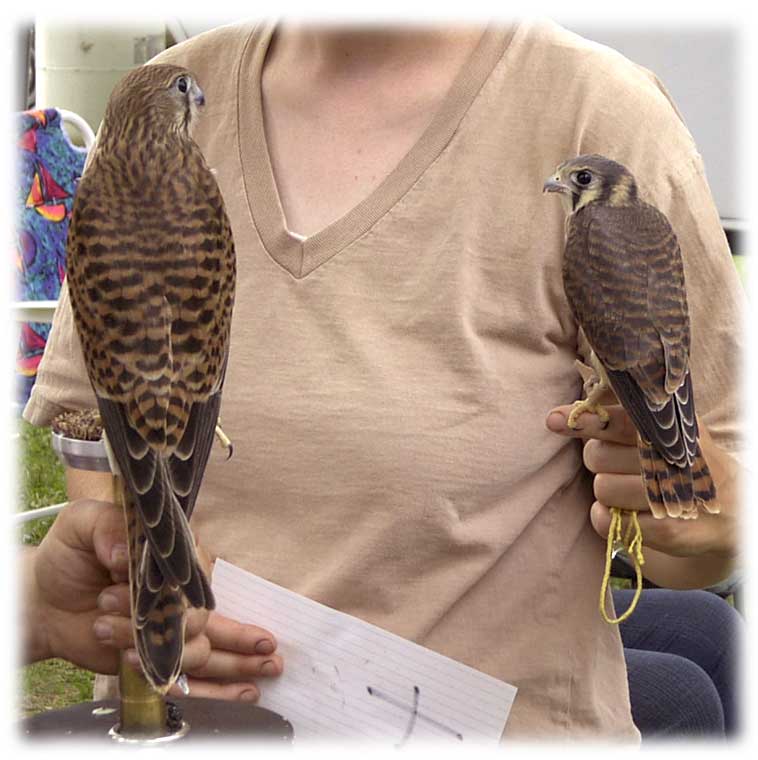
  To be completely official, we need to call this one an American Kestrel because there is another European bird also called a Kestrel.  Take a look at this photo and you can compare the much larger Kestrel on the left with an American Kestrel on the right. All of this muddling of names happened because many of our birds were originally named by homesick Europeans. If one of our North American critters kinda looked like one of the neighborhood residents from across the pond, then it was dubbed with the old name.

  One thing that probably everyone in the world agrees to is that the American Kestrel is the prettiest falcon in the world (although I’m sure the French would disagree). The male bird is the boldest of the bunch. The distinctive male features on this pictured bird are the wonderful pastel blue shoulders and crown, speckled peach breast and solid brick red tail. Females lack the blue coloration and have a heavily barred tail. 

  Both sexes have paired black sideburns (called malar stripes by those folks looking to come up with specific terms where none are needed) and prominent spots on the back of their head (called ocelli by those same folks). Take a look at this view and you can get some sense that those spots take on the appearance of a pair of eyes on a fake face – a trait accentuated by a pointed  black “beak” coming down off the top of the head. Why, you might ask, would a bird need a fake face? Kestrels are frequently attacked by larger birds of prey, and they are able to keep these potential predators off guard by tricking them into thinking that they are being watched even when the potential prey is looking away. This, of course, works only some of the time.

  If you look carefully at both photos of this little dandy, you’ll note some dried blood on the beak and on the right foot (the other foot is pulled up out of view). This is sparrow blood spilt from an earlier kill. There is likely to be a spattering of fresher blood by days end.

Sleeping Beauty

  Perhaps the last thing you’d expect to come across on a sloppy gray January day is a sleeping god.  Gods are omnipotent, so you’d think it would be a nearly impossible task to sneak up on one –at the very least these deity types should have guard godlets or twelve-headed mythical doglike things to warn them of approaching visitors, right?  I guess not.

  Well, I just walked up to the ancient king of Athens today and peered right into his secret chamber without being smit (or is it smote, or smotted?).  I was smitten, however. Cecropia’s winter lair turned out to be a silken cocoon and like all royal homes, this one was certainly worth a second look

   The earthly personification of the ancient ruler was a Cecropia Moth – a species of moth named after the mythical figure. Why this impressive insect is named after a half man/ half snake fish is beyond me, but it is a member of a group known as the giant silk moths.  All the members of this robust family are named after Greek and Roman gods, so it’s a clan thing.  Even the family name itself, Saturnidae, is in honor of the child-eating god Saturn.  It happened to be Saturn’s day when I discovered the cocoon – coincidence? Maybe.

   The tough woven cocoon was adhered to a leafless silver maple branch. It was within easy mortal’s reach so I pulled it down for closer examination. The impressive larvae of this species make their over-wintering home in late summer/early fall and then pupate within a protective casing of their own making. (Here’s a picture of the caterpillar as it is about to sip from a caffeine free Pepsi can).  After a long winter’s rest, the adults emerge early the following summer.  Sporting a wingspan of 6 inches, these beautiful beasts are the largest moths in North America (look here and you’ll see what I mean).

  For the time being, this potential summer beauty was hidden within a silk purse. I thought you’d like to get a glimpse of the resting king, so I broke off the branch and carried it home in order to peek inside.  I made a careful incision through the papery tough outer layer to reveal an inner chamber of steel wool consistency. Both cocoon layers were woven by the caterpillar to create a weather and predator proof package. 

  A final cut into the inner sanctum exposed the pupae (look here) hidden deep within this multilayered sleeping bag. A wadded dry skin – the last shed of the caterpillar – lays crumpled off to one side.  I gingerly removed the pupae and took several shots of it before quickly returning it to its original location. Close scrutiny of this marvelous entity (see here) provides an image more akin to a pharaoh’s casket than to a Grecian urn.

  The dark leathery skin is sculpted with all the features the insect will exhibit as an adult. From the front (see here) the folded wings are evident. Two ear-like antennae curve down from the head and give the pupae a peculiar rabbitish look. A side view (see here) clearly shows the prominent segments of the abdomen and the breathing holes called spiracles that will provide the future moth with life giving air. Inside this casing, the caterpillar has already made the miraculous transformation from land based slug to aerial acrobat, but it needs to wait until the world is ready for its summer revelation.

  I carefully sutured the cocoon back together (see here) so that the creature can emerge in natural style when the time is right.  I’ll keep it in my un-heated back porch to insure that it doesn’t dry out and protect it from the legions that would delight in the destruction of Cecropius Rex. Rest easy my noble sir.