Finchfest 2007

  The winter finches are here and they are hungry.  The northern U.S. states are currently experiencing a mass visitation of tiny seed eating birds looking to satisfy their collective need for feed.  Thousands of Common Redpolls and Pine Siskins have moved south from their Canadian homeland to invade our border states.  Unlike their human counterparts who are here to spend their precious Loonies, these feathered Canadians are here for our Alders. 

  You could say they are refugees of a sort. The food resources in their native haunts have run short and they have made the southern run out of necessity. This “migration of necessity,” which occurs only on an irregular basis, is properly termed an “irruption.”  As a whole these little invaders are therefore called “irruptive winter finches.”  Repeat after me: volcanoes erupt, finches irrupt, and small impatient children interrupt.

  Although there are other irruptive birds, such as the snowy owls (one of which is currently hanging around the Lost Peninsula by Toledo, Ohio), the Redpoll and Siskin are the most common of the winter visitors.  Pine Siskins (see here) are easily identified by their heavily streaked brown and cream decor. The Common Redpolls sport little black trumpet player’s beards and rosy forehead patches (see here).

  Both birds are about the same size – which equates to around 10 grams. It might help you to picture a stack of four pennies as a way to judge what 10 grams feels like. Unfortunately, this demonstration depends upon which year those pennies represent – the post 1982 pennies weight 2.5 grams while the earlier ones weight 3.1 grams. Canadian pennies, which would be more appropriate in this case, run the gamut from 3.24 grams to the present 2.35 grams. In this scenario we could say they weight as much as four post 1982 U.S. coppers or about three 1978 Canadian pennies or….let’s just forget it.  Suffice it to say these birds are lightweight little balls of down that need lots of food to get them through a tough winter.

  One study estimated that a redpoll can eat up to 40% of its body weight (in Canadian coinage, of course) daily. While the Siskin just gobbles its food straight, the Redpoll has the ability to temporarily store seeds in a throat pouch called a divercula.  It then can leisurely swallow the seeds at a later time and in a predator free place. Clever little Canadians, eh?

  The abundant crop offered by a tree known as the Alder is the freezer meal of choice around these parts. European Alders, or Black Alders, are introduced members of the birch family which bear pine-like cones (strobiles). They prefer wet areas and are often found bordering marshes or rivers. The tree is deciduous and dutifully drops its leaves each fall, but they retain a heavy crop of ¾ inch cones which gives them the winter appearance of full foliage.

  The finches go bonkers on these alder cones and pry out the tiny seeds from between the scales.  Many of the seeds fall to the ground and the birds spend a good part of their day picking them off the snow as well.  As long as the alder crop holds out, they will stick around.

  If you don’t have an Alder tree, there’s still a pretty good chance that you’ll spot these fascinating frigid finches if you maintain a bird feeder. They love to eat out.

Quoth the Night Raven: “Maybe”

 December may seem like an unusual time to talk about a summer bird like the Black-crowned Night Heron. The sight of one of these sulking water birds silhouetted against an evening sky, while perched atop a dockside post, is a common warm weather sight.  True to their name, they are creatures of the post sunset world. Often their belch-like squawk is the only thing that betrays their otherwise shadowy presence.   It is worth noting that their scientific name Nycticorax nycticorax, literally means “Night Raven” (something that is apparently worth saying saying twice twice).

  Since most of them migrate to the southern U.S. or Central America in the fall, the question still remains as to why I bring them up in a winter context. The simple answer is that not all of them migrate south.  Every year, a gang of 15-20 hearty Night Herons elect to stay all winter in the sleepy little burg of Gibraltar, MI.  Presently, there are about 17 of these birds roosting in the canal-side trees visible along Pointe Dr. & Stoflet Dr. in that riverside village. At this time of year, the aerial Heron herd is easily seen – something nearly impossible to do when the trees are fully clothed.

 From a distance, you’ll see a collection of brooding shapes – like so many, well, disgruntled ravens – scattered among the branches.  The shapes are about two feet long with a sizable wingspan measuring just under four feet. Long legs testify to their wading habits and long beaks exhibit the tools of a fish eating bird. As herons, they have fairly long necks as well, but choose to hide them between hunched shoulders while perching. Gibraltar resident Ron DeWalt has been living with these wintering birds for some time now. He is one of the homeowners whose yard trees serve as daily perches. Ron was able to take a few terrific pictures of some of the birds roosting in his yard trees. His images were taken a month ago just before the last Silver Maple leaves were shed. The first picture is of an immature bird (brown with white speckles) and the second is of a mature individual (white chest, black crown and gray back).

  Black-crowns don’t become black crowned until their third year out of the egg.  While the younger birds have a great look, the stark adult coloring is classic. Mature birds have a set of long feathers – like long thin white ponytails – trailing from the back of their heads. When landing, or taking off, this feature becomes evident.  “They look kinda like a Bird of Paradise,” says Ron, “with those long feathers coming out.”

  So, what is it that prompts a normally migratory bird into a non-migratory lifestyle?  I can’t tell you what goes on under those little black crowns, but it comes down to a question of gas.  As long as the food reserves are there in the form of abundant shiners and minnows and the water remains open, the birds can re-fuel their tanks and live a relatively good life.  Cold temperatures have very little to do with anything. Most large bodied birds can tolerate cold weather.  They are possessed of nice down filled vests after all.  Migration is a dangerous thing to do, so in this case these home bodies are simply playing the odds. 

  It’s worth noting that other herons, such as the Great Blue, do the same thing.  Often 50 or more of these birds over winter on the shores of the Detroit River.  The larger herons can’t stand people, however, so they don’t roost near houses and generally stay out of camera range.

  If Dame Nature should decide to inflict an extremely harsh winter upon us this year, there’s a distinct chance that the brave black-capped mini-herons might be forced to re-think their tactic and move south.  They all run the risk of death due to over exposure and starvation if temperatures plunge into sub zero and all available water freezes solid (thus closing access to the gas stations). As it is, the herons have not been put to the task and they continue each year as snowbirds.

  Just across the creek from where the herons are roosting there is another bird “pushing the winter envelope,” so to speak.  A female Scarlet Tanager has opted, for whatever reason, to remain at Lake Erie Metropark this winter. She is possibly the only one of her kind in the entire northern hemisphere.  All others of her ilk have migrated to South America. It is a fact of nature that tanagers in general are basically a tropical species. Sure, they visit the northern climes to enjoy the brief summer, but they quickly return to their tropical homeland in the fall.  In order to re-enforce this rain forest origin one only need look at the name “tanager” to find that it stems from a mispronunciation of the “tangaras” designation given them by the Tupi Indians of the Amazon.

  The last time I saw the misplaced tanager, she was plucking a frozen grape from a meager cluster hanging on a wild vine. She looked good and appeared to be doing well so far. Unfortunately, the cards in this case are stacked against her.  As a small bodied bird scarfing out a living in an unfamiliar time setting, she will be fighting an uphill battle. 

  I’m fairly confident that the Black-crowned Night Herons would publically root for the brave little tanager’s cause, but privately might express a harsher take.  When asked about her odds in this affair they would shrug their shoulders and give a one word reply. Quoth the Night Raven: “Maybe.”

A Silent Snowy Morning

  As Decembers go, this one is more wintery than usual.  Sub-freezing nighttime temperatures and crisp gray days have given the landscape a January like demeanor. My mid-week, mid- morning walk took me along familiar paths but brought me into some unfamiliar settings. The place seemed brand new.  First of all, the light dusting of snow from the previous night had transformed everything.  Every abandoned goldfinch nest was converted into a bowl of mounded sugar and each bright red Highbush Cranberry fruit was topped with a white dunce cap.  The neutral backdrop focused attention onto the intense red panicles of the Gray Dogwood, the subtle purples of the Blackberry stems, and the dead greens of the limp frozen Honeysuckle leaves.

  Each individual field plant now stood out as an individual. The dry winter remains of the Goldenrod and Queen Anne’s Lace each sported a personal snowcap.  If I wanted to, I could have counted the exact number of these plants in the small field adjacent to the trail – an impossible feat without their snow markers.  I continued on past with a renewed awareness that a field is a collection of individuals as opposed to an amorphous collection of stems.

 Strangely quiet, nothing stirred during the first ¼ mile.  The only sound was that of a distant train and the very faint wind-carried “cooing” of Tundra Swans out on the Detroit River. A fine cold snow was falling. Millions of the nearly invisible flakes were simultaneously striking dead leaves and twigs to create a barely audible hiss. The sound could be heard only when you stopped and held your breath for a moment.

  During one of these breathless times, another light sound was permitted into my ears.  A wispy “Ti-seep, ti-seep” betrayed the presence of two Golden-crowned Kinglets foraging in the hawthorn next to me.  These mouse-sized birds brought a startling dash of golden-yellow to the picture when they presented themselves a few feet away. A plump gray Chickadee was accompanying the kinglets and added in a repetitious “Chick-ka-dee-dee-dee” chorus to their “Ti-seep” verse.  Soon the trio worked its way past my space and was enveloped back into the snow clad shrubbery.  I was left with the hissing silence once again.

  Fresh snow not only highlights individual things but it also permits the casual observer to see things that are no longer there.  For instance, a mink had passed under the boardwalk sometime within the previous hour – his tracks were still cleanly apparent in the snow.  Last night a muskrat struggled through the forming slush ice as he worked his way along the marsh shoreline.  The ice was not sturdy enough to walk on but the water was too shallow to allow passage under it, so the ‘rat was reduced to a combination of plowing and slogging to get to his destination.  His wandering slush trail records his torturous route (here you can see the mark of his tail and his pathway as he broke through and pushed on).

  The solidifying slush ice was well compacted by the time I came upon it, but it was still in the process of crystallizing.  Intricate fissures radiated through the thickening ice at various points where the water was resisting the effects of freezing.  The dendritic patterns reminded me of cosmic gas clouds or cave art renderings of deer antlers. I took a photo of this abstract display as an excuse to get an “art shot”.  I think I’ll call it “Slush Ice Pattern No. 1.” 

  My walk had no particular destination, but the constraints of human time required me to stop at some point and return.  I elected to halt at the lotus beds opposite the low offshore island called Sturgeon Bar. I should say that I halted at what used to be the lotus bed, because the plants are long gone save for the dried broken seed pod stalks. I elected to frame another art shot and pointed my instrument of digitalization at a near shore section of the late lotus bed. I’ll call this one “Lotus Bed Pattern No. 1.”  In looking at the stark beauty of the shot- rendering what was previously a muddy brown scene into a carpet of textures -I felt no need to take no. 2. 

A Christmas Tree Story

  Here’s the situation.  I was driving down east bound I-96, O.K?  Minding my own business, I might add – so I will, add it that is.  Well, anyway, out of the blue this, this……person…..a person in a car suddenly comes in from no-wheresville and cuts me off like BAM!  I swerve like, BAM, to keep him from crumpling my left front fender.  So, while I’m attempting to stay in my lane and not hybridize with the big yellow truck next to me, I yell something.  I think I said “Merry Christmas” or “God loves you more than you can know!” or something like that.

  I happen to have my camera in the seat next to me, so I balance it on the steering wheel, center his car in the viewfinder and shoot – all this while regaining control of my vehicle.  I’ll teach him, or them, or whoever it was behind the wheel.  I’ll post their image on the internet and shame them into…well, something.  People will talk, yeah, they’ll talk and, and they’ll say things.  Justice will be mine.  I’ll file a police report. It’ll say “Subject nearly sideswiped by an unidentified driver carrying a Picea alba on the roof of a small late model vehicle.” 

    Here’s the revealing photo.  Now that a picture of this so-called driver is out there for everyone to see, I hope they realize what a b-i-g mistake they made.  You don’t cut a naturalist off and expect to get off scot free.  No siree bob.  The Christmas tree attached to that car roof, ladies and gentlemen, is none other than a White Spruce.  Spruce trees have poor needle retention. Do you think the driver knows that? Are they aware of the fact that the crushed needles on this species have an unpleasant smell?  Do they even have the faintest idea of the botany behind Christmas trees? I think not. 

  The first thing I’ll do, when my opportunity finally comes to face the offender in person, will be to sit them down in a tiny little room with a huge chart showing the different kinds of Christmas trees.  I’ll show them the basic line up of trees available to the S.E. Michigan public. 

  Michigan ranks as one of the top Christmas tree producers in the country with over 130,000 acres dedicated solely for that purpose. Most of these are sold out of state, but I will point out to the offender that people like themselves are responsible for keeping the remaining 25% of the trees instate. “Do you feel the burden of this responsibility?” I will ask. “Unsafe driving while in possession of a Christmas Tree could be a capital offense,” I’ll add with a knowing smirk. “Let’s find out what your evergreen of choice was and fit the punishment to the crime.”  At this point, I’ll point to the blank screen at the front of the room like Scrooge’s ghost. “Pay heed.”

  Although there are many different kinds of holiday evergreens, there are three basic types to focus on.  First of all, there are the pines.  Pines have long stiff needles which are clustered in bunches called Fascicles. This is the PowerPoint slide I’ll show them- it is a branchlet from a Red Pine. You can identify the different species of pine by the length and number of needles in each bundle. The Red Pine has two five inch long needles per bundle.  The Scotch Pine, the most common Christmas tree of all, also has two needles per cluster but they are only an inch or so in length.  White Pines have five needles, but they are rarely used as Christmas Trees.

  The next slide I’ll show will be of a typical spruce tree branch.  Spruces have single stout needles which are attached directly to the branch.  I’ll focus in this slide very slowly to reveal the image of a Blue Spruce.  This common Christmas tree is easily identified by its bluish cast and ¾” – 1 ½” needles when compared to the ½”- ¾” plain green needles of the White Spruce.  Both species look good on the lot, but they can quickly shed their needles upon entering a dry house environment.

  Since I don’t have a slide of a Fir branch, I’m planning on turning off all the lights at this point and whispering into their left ear the fact that the Balsam Fir is the most common representative of this last group. Like spruces, they have single needles but they are flattened, curved upward, somewhat softer, and are not as densely spaced.

  Creating a sudden blinding flash in the darkened room, I’ll flick the lights back on and demand that they repeat the implied question “Pine, spruce, or fir?  Pine, spruce or fir?” I want them to think about their choice of tree.

  “Before answering that question, you need to know one more thing,” I’ll cleverly interject. The PowerPoint will come to life once more and a microscopic image of an individual spruce needle will project onto the screen. I will point out that evergreen needles are actually leaves.  With this 200X image you can see the hundreds of tiny white pores that dot the surface.  These are the breathing pores called stomata.  “Did you know that all evergreen needles can stay active all winter long? They respire through these pores and can perform photosynthesis on warm winter days?”

  “You can’t see this micro feature on a tree that is in motion, can you? Species identification is especially difficult when the tree in question is going 150 mph” I’ll say with a wink. After a momentary pause to let that insanely satisfying statement sink in, I will bend down and inch my face close to the perpetrator’s nose and with clear enunciation of each word say, “but I managed to do it.” With a pound of the fist on the table my voice will rise in tempo. “You sir, had a white spruce, I know it to be a fact. You are the driver in this photo are you not?” The car photo will return to the screen as naked testimony.

  After I receive the necessary apology for careless tree transportation and identification from the now exposed reckless driver, my gentle nature will kick in and I’ll place my hand softly on his shoulder. “I’ll forgive you this one offense on the grounds that you chose a real tree to celebrate a real season.  In so doing you are righting the ancient tradition handed down by our 17th and 18th century Germanic cousins who hung their trees upside-down in the corner of their living rooms.  They decorated their trees with apples, nuts and strips of red paper, while you my friend are decorating yours with L-O-V-E.  Merry Christmas.”

  With that, a tiny bell will ring and my new friend and I will join together in a rousing verse of “Oh Christmas Tree, Oh Christmas Tree.”

The Owl is a Pussycat

  As you probably know by now, I try not to bring up the subject of cats unless I can point out something negative about them.  I acknowledge that this is a bad habit and I promise to work on it.  So, when I title this piece “The Owl is a Pussycat” I am making a dual feeble attempt at some wordplay in honor of the story of the “Owl and the Pussycat” (as in pea green boat fame) and to place the word “cat” in a positive manner without derisive comment.  There, I’ve done it.  I truly believe everyone should love their cat to death.

  Now, I need to explain how an owl can actually be a pussycat, because I want to write about owls – not cats.   In order to explain this phenomenon, I need only take you on a short field trip to show you a few Long-eared Owls roosting in a dense thicket at Lake Erie Metropark.  These precise little owls overwinter in the park every year, but finding them is not an easy task. Take a look here and you’ll see one of the owls perching close to the gnarled trunk of a hawthorn tree. O.K., you probably can’t see it very well – even though it is dead center in the picture. Try this shot. That should be a bit better.

  There are actually two owls in this view (there were three birds altogether).  The one thing that is apparent (or not) on the bird on the middle right branch are its prominent ear tufts.  These so-called ears are located close together and are held bolt upright when these owls are at rest – giving them the appearance of a cat and the common name of “cat owl.”  Some folks refer to these birds as “lesser horned owls” in order to contrast them with the much bigger great horned owls (which are appropriately named “flying tigers” after that much bigger member of the cat clan).  Even though they bark like little dogs and “who-who” like miniature great-horned owls, I have to admit I like the name cat owl as a descriptive name. The reference to ears and horns is misplaced, as I’ll explain in a moment.

   Although it’s hard to tell from my photos, Long-eared Owls are only about 13-14 inches in length.  They have rusty orange facial discs with a white feathered “X” separating two intense yellow eyes. The cream colored breast is heavily streaked and the light brown back is speckled with a confusing array of spots.  One thing you can tell from my photos is that these stationary birds are masters of camouflage. Their subtle coloration and habit of roosting bolt upright enables them to blend into their surroundings.

  Long-eared owls are uncommon but regular visitors to our part of the state.  The species is found all over the world from northern Europe and Asia to North America. They are known to nest in western and northern Michigan, but only show up in the S.E. part of the state during the winter.  These three birds showed up in late November and have been seen off and on for a week or so. Overwintering long-ears tend to roost together in groups of 3 to 15 birds or more and rarely sit it out alone. There is no socializing when in this daytime mode, just a mutual lethargic togetherness.

  Cat owls are strict adherents to the night-hunters code and are the most nocturnal of our regional owls. Although they roost in thickets, they hunt exclusively over open areas and old-field habitats. Long pointed wings, spreading half a hoot over three feet, are marks of an open air flyer.  Employing their excellent night vision and hearing, these birds seek their quarry by flying moth-like just over the weed tops.  The “horns” or “long-ears” in question are simply feather tufts and play no role in hearing.  The real ears are located alongside the facial discs – in about the same location as your ears are.  As in all owls, one ear opening is shaped differently than the other so as to respond to slight differences in sound direction – producing an effect that has been described as binocular hearing.

  Long-eared Owls simply love Meadow Voles and Deer Mice to death. The proof of their proficiency in this regard is expressed in the contents of their pellets.  While roosting, the owls cough up pellets consisting of the bones and compacted hair of their prey.  I once collected a season’s worth of pellets from one roosting site and examined the skeletal evidence of over 50 mice.  The mix of long bones, tiny toe nails and even whiskers was peppered with larger skulls (see the carnage here).  A closer look revealed mostly Meadow Vole skulls, but there are also quite a few Deer Mice and a token Short-tailed Shrew. I’ve taken a moment to pose three of these skulls together, tooth side up, to give you an idea how these things are identified.  In this picture, the shrew is on the left, the vole in the middle and the deer mouse on the right (note the difference in the teeth and the fact that the meat eating shrew has a lot more of them).

  This trio of Saturday owls only stayed one day at the location where I took their portrait and left no fresh pellets, but I know their stay here will result in a similar harvest of rodent death. As mousers, long-eared owls best cats by a factor of ten.  And cat hairballs – and I say this only as a statement of fact and not as a negative statement – aren’t nearly as educational as those of the cat owl.

Buck vs. Bush

  A few weeks ago I spotted a high four point buck crossing the parkway ahead of me. Seeing an antlered Whitetail deer in the middle of a Michigan November is not a newsworthy event, but it can be a form of religious experience for those who consider Nov. 15 a holiday.  I’m not a hunter (nor do I play one on T.V.), but I still experience the slight rise in respiration rate that usually occurs in such a situation. The bucks tend to be a secretive bunch and they limit their human exposure time.  One has to make a concerted effort not to see -or run into -antlerless deer and does, but catching a glimpse of one of these crowned autumn beasts is not an everyday event.

 The peculiar thing that really caught my eye was that the four point was dragging a ten foot section of Phragmites reed from its antlers. Actually the reed was artfully laid across his back with the dangling end arced down over his rump. The overall effect was quite graceful as the plumed deer hoofed across the road.  He stopped briefly to give me an over-the-back glance and then vaporized into the brush with his décor in tow. 

  It was apparent that this buck had just been slogging through the wetland muck before his road crossing. His legs were coated with black mud nearly up to the belly line. I assumed that he had inadvertently snagged the reed while taking a shortcut (bucks almost always take the “back way” whenever possible.)  Reed thickets are very dense.  If I had antlers strapped to my head I know my tines would accumulate a veritable haymow full of the stuff.  I, of course, am not a deer nor would I attempt the suicidal act of running through the wild with antlers during deer season. Well, as it turns out, my initial assumption in this regard was altered by an observation I made yesterday.

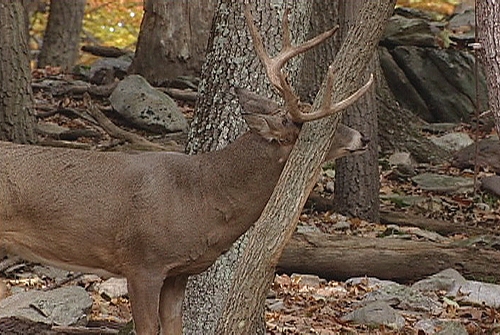
  Bucks have only one thing on their mind during the rut– that thing would be the feminine does. The males spend all summer regrowing their antlers with the goal of producing the biggest pair possible.  Does don’t pay too much attention to the individual antlers sported by their suitors, but the bucks themselves use the visual signal presented by a large rack to assert dominance over other bucks and to engage them in battle if necessary. Big antlers, in other words, clear away the dating competition.  It takes a lot of energy to grow these things.  Antler tissue grows very rapidly and the forked bony structures bloom by several inches a week.  By the time fall rolls around the antlers are at full size and their owners go into an anti-bush phase.  No, I don’t mean anti-presidential, I mean that they begin to attack shrubbery, small trees and even a few large ones (here’s a buck challenging a tree).

 The initial idea for vegetative aggression is to knock off all the dried “velvet” skin that coated the antler as it grew, but eventually the activity becomes a one-sided sparring match of bone against bark. Like a boxer training for the big fight, the bucks are able to hone their left hooks and build up their neck muscles. Flora that has been attacked by a testosterone soaked warrior will bear the mark of combat in the form of shredded bark and exposed strips of inner wood (see here).  Individual bucks will return to the same tree time after time and the damage becomes extensive. Such a damage mark is called a “buck rub” for obvious reasons.

  Because rubs expose light colored inner layers of the stem, they can be spotted from quite a distance and apparently this is the idea.  Each rub is also coated with an invisible layer of scent that comes from glands on the forehead of the rub maker.  They act as both visual and smelly signposts to mark out the territory of a particular buck.  

  Yesterday I stopped to investigate one of these buck rub sites along the parkway. At this spot there are three red pines.  Each tree bears the distinctive marks of Cervid abuse on their southeast side (see here).  Take a look at this wider view of one of the trees (here) and you’ll notice some large reed stems lying on the ground at the base. Upon closer examination I found that each reed was bent at the center and in beat up condition.

  Since there are no reed patches within 500 yards of this location, the combination of reed and rut site leads me to one conclusion:  here is the rubbing site for my Phragmite clad buck. There are a half dozen reeds laying about, so apparently this animal makes a habit of snagging reeds before beating the snot out of them against these trees.  His adornment is apparently no accident.

  The only thing I can say is that maybe this buck, a mere four pointer, perceives that he has little chance of competing with the big boys so he employs a bit of theatre in order to enhance his image.  

An Immigrant Returns Home

 Dr. Eduard Dorsch was one of the so-called “German 48ers” who left Bavaria due to the 1848 war ravaging his native country.  He immigrated to the United States and eventually set up a new life in Monroe County, Michigan as a physician serving the needs of the local German population. The good doctor built a solid Italianate brick house near the public square, fulfilled his career, authored a scholarly work on bullet wounds during the Civil War and engaged in his artistic pursuits as a skilled botanical artist.

  Dorsch was gifted a Ginkgo tree from the Chinese Ambassador to the U.S. in 1865 and planted it in a prominent location in his front yard.  Both the doctor and his tree have since become an indelible part of local history.  Today, some 140 plus years later, the doctor’s house serves as part of the Monroe County Library system and his tree still stands in the front yard. A well oxidized brass plaque, situated on a stone at the base of the Ginkgo tree, provides a birth certificate for the tree in question.

  The other half of this immigrant story is the tree itself.  While the Chinese ambassador brought it from the other side of the world, he was actually returning it to its original home. Ginkgos once grew in the lush forests of ancient North America and their branches were parted by passing dinosaurs over 250 million years ago.  In the modern age, these trees were only known as fossils (see here a leaf from an Eocene shale deposit) and believed extinct.  When wild trees were found alive and well in the Chinese hinterlands, their discovery was as significant as that of the Coelacanth. Not only did the modern representatives appear related to their ancient fossil counterparts, they appeared identical.  In all that time they had not diversified or changed one iota. The tree had not risen from the dead – it never died to begin with.

  Although it may have started out as a loner in the new world, the Dorsch Gingko is not the only example of its kind in the region.  Ginkgos are now widely planted as ornamental trees.  They are slow growing, sparsely branched and somewhat pyramidal in shape. One of the easy ways to identify this tree is by looking at their wedge shaped leaves.  In the textbooks this living fossil is called simply Ginkgo biloba because many of the leaves are nearly divided into two lobes by a deep center groove. In honor of Dr. Dorsch’s artistic endeavors, I will provide you a drawing of a fairly typical, although undivided, gingko leaf.  I think you’ll agree that these leaves possess a perfect form and a linear simplicity that defies imitation. This design has stood the test of time and reflects the simple strength of the species over time.  Even when they fall to the ground, they are stunning (see here – looks like one of those art shots you see on the walls of corporate offices doesn’t it?). 

  It is distinctly possible that the Dorsch tree will outlast both the library building and even the city in which it sits. Gingkos can live over 2,500 years, making our stately old oaks look like preschoolers. Like any old timer, these ancient survivors do have their peculiar habits.  The female trees produce the most god-awful smelling pus filled fruit imaginable. When these crabapple sized berries fall, they produce a gelatinous mass of foul goo that happily wedges into every cavity of your shoe sole. The Dorsch tree is a female, unfortunately, and it is far too old to have a sex change operation.  As you can imagine, many ornamental trees are grafted with male branches. Apparently the term gingko means “silver apricot” in Japanese and they view it as a food item in that island nation.  It is strangely appropriate that this tree has medicinal properties that include potential use for treating Alzheimer’s victims, so there might be something to this. I personally think that something is lost in translation, but will leave stinking fruit lie.

  The other odd thing about Ginkgos is that they tend to drop all their leaves at once in the fall.  This characteristic has fueled the annual Dorsch Ginkgo Festival contest in which folks try to pick the exact date when this occurs. Winners receive prizes and all the fruit they can eat. You’re too late to enter this year, but next year could be your chance to achieve long life and prosperity.

Do U See ‘der Waxwings

As far as anyone knows, Icarus was the first and last human waxwing.  There’s a pretty good chance that his first flight would have ended differently had he elected to wait until a cold, cloudy day.  As it turned out, the wax holding his arm feathers in place melted in the bright sun and he tumbled to earth. On a cool cloudy day the wax might have stayed firm and the feathers remained in place.  The poor guy ended up discovering gravity instead. Reportedly, the name inscribed on his tombstone was “Icahhhhhhhhhhhhhhhhhhhhhhhhhhhhhhhhhhhhhhhhus”  in honor of his tumble, but was returned to its original length at the request of his family.

  Icarus, even though he was a fictional failure, still influenced the history of aviation.  No one ever tried the waxwing approach ever again. It would be the lot of a couple of bike mechanics to finally defeat gravity with wings of canvas and wood many years later. Orville and Wilber never wasted any time on wax and real bird feathers.  Those brothers from Dayton did get their adjustable wing idea by watching real birds, however.  In retrospect, I believe Icarus was simply watching the wrong birds.  He was probably using Cedar Waxwings for his model, and he paid the price.

  It’s true that Cedar Waxwings aren’t found in the Mediterranean, where that sky tumbling myth man performed his ill-fated experiment, but I consider that a minor detail.  The cedar birds are found in our neck of the woods and they are a common sight this time of year. Although these beautiful little cinnamon hued birds do hang around cedar trees a lot, they are far more common around berry bushes in the wintertime. If you have fruiting ornamentals such as Mountain Ash or Flowering Crab in your yard, chances are pretty good you’ve hosted a waxwing feast or two. Here’s a single bird in the process of downing a frozen crabapple on a recent crispy morning.   

  True to the second half of their name, Waxwings do have bright red “waxy” structures on their wings, but the “wax” is at the tip of the feathers and does not act to hold them in place. The structures are only found on the inner, or secondary, feathers of the wing. Take a look here at this detail drawing to see what I’m talking about. I’ve seen everything from “red secretions” to “wax droplets” used to describe these things, but secreted wax has nothing to do with it.  In reality, these structures are flattened extensions of the main feather shaft. They are so brightly hued and so shiny smooth that they do look like the waxed surface of a Corvette or a set of well manicured nails.

   The coloration of the feather “fingernails” comes from the carotenoid pigments found in the food they eat.  Cedar Waxwings eat a lot of orangish and red fruit (Henry David Thoreau called them cherry birds because of their fondness for that fruit). Scientists have determined that these wing projections come into play during the mating season.  Since older birds have more of these than the younger birds, they believe waxwings pair up based on the number of these decorations. Both male and female birds have them, so they seek partners showing the mark of experience – which means having the maximum number of decorative wing ornaments.

  Another distinctive trait of the Cedar Waxwing, aside from the crest and black face mask, is the yellow tipped tail.  These tail feathers also have small flattened shaft extensions on them.  In the 1960’s, researchers started noticing a few waxwings showing up in the Northeast which had bright orange instead of yellow on the tail (see here). They believe this is the result of eating the red berries from a newly introduced species of Honeysuckle.  You know what they say, you are what you eat.

  As fruit eating birds, Waxwings will occasionally indulge in fermented berries and they have been known to get a bit wobbly – in other words, drunk. Many a waxwing has tumbled out of the sky in Icarusian fashion, not from melting wing wax but as the result of being plastered.

John McMaster’s Ink

 Although it seemed to take longer than usual, the terminal stage of autumn has finally gripped the landscape. A majority of the deciduous country trees have converted to their sparse gray winter persona – leaving the evergreens to liven up the scene. As deciduous trees, the oaks should be shedding their leaves as well, but even a cursory look at any local woodlot will reveal that they are stubborn in this regard. The oaks, represented by many different species, now stand out against the woodland profile as the trees clothed in ruddy foliage. As you drive past newly cut cornfields and gaze across the distance at the passing woodlots, the members of the oak clan are easily spotted. Now, more than ever, you can gain an appreciation of just how “ubique gentium” – widespread or universal – they are.

  Being surrounded by oaks is a good thing, by the way, and I have often waxed poetic on their qualities (using dead languages in the process). The distinctive color of their tenacious November leaves is an additional praise-worthy feature. If it hasn’t been done already, I’d like to name a paint color called “toasted oak leaf” in honor of the dead oak leaf. If the Crayola Company wants to add this shade to their new line of crayons, I’ll not stand in their way (although I might ask for a free box of crayons as payment).  This is what “Toasted Oak Leaf,” copyright 2007, looks like.  I’m talking about the hearty nutmeg leaf shade that takes on the appearance of the well cooked edges of a pumpkin pie. In part, this strong oaky color is imparted by a chemical known as tannin.  While the tannin found in oak bark has long been a crucial element in animal hide processing (thus the use of the word “tanning”), the brown leaf tannin has worked itself into another essential part of our past lives. Allow me to explain.

  I recently picked up a copy of “The Rudiments of the Latin Tongue” by Thomas Ruddiman.  This weathered little tome was published in Philadelphia in 1798 and was originally owned by somebody named John McMaster of Canonsburg, Pennsylvania.   John was apparently very proud of his name because he wrote it dozens of times throughout the book.  I know that he bought the book on January 2nd, 1802 because he wrote that down multiple times as well.  I even know that he paid 50 cents for it and that January 6, 1803 was part of a “cold winter”– he only wrote these things once.  Neatly written across the bottom of two pages, our repetitious name dropper penned the words “John McMaster – Aug. 10th, 1805- wrote this with ink of the ink ball” (see here).   This last phrase returns us to the subject of oak leaves.

  Later on in the book, Mr. McMaster awkwardly repeated the same claim at the bottom of the page with “This is the ink of the Ink Ball which this is wrote with” (See here). Somehow I believe that phrase would have looked better in Latin, but I something tells me that John wasn’t paying too much attention to his subject. The point here, and there is one, is that the ink used to deface this book with gentle brown scribbles is derived from oak leaves.  

 From the Late Middle Ages through the mid 19th century, the best quality writing ink was the so-called iron gall ink.  It was made using the concentrated tannin found in Ink Balls, better known as Ink Galls or Oak Apple galls, which are only found on oak tree leaves. In North America these structures are usually found on members of the Black Oak family. A tiny wasp (see here) begins the process in the summer by laying her eggs on the mid rib of the developing oak leaf.  The egg laying location swells up to form a round apple-like gall about 2 inches in diameter (see here) and the grub lives within a capsule at the very center of the gall (see here). Eventually the grub burrows his way out and the gall lies empty by the time fall comes around. As a reaction to the presence of this invader, the leaf concentrates bitter tannins into the structure.

   The old time ink makers gathered these galls and pulverized them. Fermentation or boiling was used to produce the best quality inks. The tannin rich powder was mixed with iron sulfate and Gum Arabic and dissolved in water. The result was a permanent ink that flowed neatly off the end of a quill into such words as “We the People” or “John McMaster, His Book.”

  The gall ink writing that survives to the present day appears brown – just like the new trademarked “toasted” color of the oak leaves, but it was originally black.  John liked his name in black, not subtle brown. Oak gall ink fades to brown over time and slowly absorbs into the paper to form a halo.  Often the acid content actually eats away at the paper and has to be neutralized by museum curators.

  All of this leads us back to the temporary nature of nature itself. Now is the time to appreciate the November oak leaves before they bleach into March blandness. Perhaps this will lead to a small bit of thinking about how different our written history would have been without them. Finally, the sight of these oaks should cause us to cringe as we recall the inane graffiti that we put into our own schoolbooks with fountain, ball point or glitter pen.  Let’s hope you wrote something other than “I’m bored.”

A Home for the Holidays

  One thing I am thankful for this Thanksgiving season is the fact that I played absolutely no part in constructing the dwelling place I currently call home. If I had, my roof would surely have collapsed by now or the bathroom light switch would somehow be needed to operate the kitchen toaster.  No, somebody else put the finishing touches on my place back in 1951 and for the past twenty years all major work has been done by professional hands. I know I could never build any kind of life-sustaining structural element from scratch without using wood glue, duct tape or twist ties. There is no instinctual nest building skill within my persona.

  My thoughts ventured to this topic while visiting my brother-in-law’s house on Thanksgiving Day. As the family gathered around the television to watch the Detroit Lions complete their traditional holiday defeat, my eyes wandered to the back yard and fixed on a squirrel at the 10 yard line (ten yards from the window, that is).  A team of three fox squirrels had been coming and going all afternoon, but my interest was directed at one individual stuffing white oak leaves into his mouth.  After folding over the edges to create a leafy envelope, he scurried up the smooth gray trunk of a beech tree and out of immediate sight.  He appeared moments later and repeated the effort. I stepped outside to follow his route this time and saw that he was adding to a substantial leaf nest about 50 ft from the ground. 

  There was a scattering of snow on the ground and the daytime temperature hovered below freezing.  It would be tempting to assume that the recent influx of winter weather prompted him to create a snug winter retreat, but that would be wrong. Truth is, this squirrel began work on his winter home much earlier in the season. He heeds the heralding call issued by shortening daylight, not ambient temperatures.

  These arboreal rodents do most of their nest building during the summer when the little squirrlets are expected. The warm season nests are the direct instinctual result of long days and short nights inoculated with a fair amount of hormones.  They are loosely constructed affairs, often built far out on the branches to allow for free air flow and ventilation.

    Late in the summer, tighter ball-shaped structures are constructed closer to the trunk or within grape vine tangles. Given the option, most Fox Squirrels will switch to tree cavities as their winter retreat.  A cultured suburban environment offers little in this category, so leaf nests are the norm. These late season affairs adhere to a different set of building codes.  They are typically made of interwoven twigs and leaves with a soft inner liner of dog hair, moss, bark or grasses.  My busy builder was merely adding to his winter home- like putting up the storm windows or changing the furnace filter – the insulated walls were already well done. Unlike the Lion defense against the Packers, this squirrel was performing his home duty with practiced precision.

  In the interest of providing a bit of useless trivia, it might interest you to know that a squirrel nest is officially called a “drey.” This knowledge will come in handy on your next crossword puzzle. The overwintering home of another rodent, the muskrat, has no official name and can be properly called a lodge, a cabin, a den, or a house. These structures are far more impressive than the aerial nests of their furry tailed kin. (O.K., not a great segue, but it was the only way I could get to this next part of the discussion within this limited space).    

  The day before leaving for our Thanksgiving visit, I paid a visit to a little town just south of Monroe – near the mouth of Otter Creek where I-75 crosses it.  Here a muskrat village of impressive proportions has risen from the dead lotus bed there. Take a look here and you’ll see no fewer than nineteen muskrat houses pimpling the shallows within an area of an acre or so.  

  As seen from the vantage point of the South Otter Creek overpass, each lodge is centered in a circle of cleared lotus. They look like meteors lodged within their impact craters.  It is quite obvious that each furry engineer used the plants that were immediately adjacent to their individual construction sites.  They were, in other words, using common -albeit instinctual -sense.

  Muskrats begin building their new houses in mid October and they continue to pile on new layers well into November. They build several kinds of structures, but their winter cabins are the largest and most dramatic. A freshly made lodge often towers four or five feet over the water.  The entire structure is made of alternating layers of muddy bottom debris and cut sections of cat-tail, or in this case, lotus stems and leaves.

  Several entrances are cut into the mass from under the water level and they lead to a series of tunnels and snug chambers within.  A dozen or more ‘rats may take up winter residence in one lodge apartment as long as tempers allow.  These homes will continue to provide solid shelters for a year or more – often far longer than the life of the occupants themselves.

  I’m pretty sure my Fox Squirrel will be secure in his single winter drey and will pass the cold season comfortably on stored acorns and bird feed.

  The Otter Creek Muskrat subdivision, however, is an example of a development doomed to failure. It is the result of too many ‘rats attempting to scratch out a living on too little real estate. Nature’s strict building codes of will be harshly enforced by famine, disease and predation. The ‘rats will be forced into a hardscrabble existence as they compete for limited winter food resources.  A nice warm house for the holidays is one thing, but putting enough turkey on the table is quite another.