From Poo to Purse

  They are a fact of life.  It rains down from above upon our newly washed cars, lawn chairs, and occasionally on us. The “it” is bird poo – or “droppings” as they are euphemistically referred to.  Although we try to avoid looking at them or discussing them, avian poo can offer up some particularity peculiar participles of purposeful perambulation. In other words, they can lead us down a purposeful path on our peregrinations of perception. To put it simply, poo can teach.

  It is a fact of life that much of what goes into a bird must come out. As highly active warm-blooded vertebrates, birds are constantly going to the bathroom.  A small bird deposits a dropping every 30 minutes or so, while a larger crow sized bird meets nature’s call on an hourly basis.

  A close examination, provided for instance by the glorious view imparted by a large dropping on your car windshield, reveals three components to a poo packet. (Here’s a picture of a neat little purple poo packet just to remind you of what we are talking about). Birds evacuate their wastes out of a single opening called the cloaca, so everything is wrapped into one little gift. The dark portion is made up of solid waste. This is the actual feces of the species.  The off white portion is composed of Urates resulting from protein digestion and the watery part is Urine. There, now that wasn’t so bad was it?

  Just for the sake of expanding this discussion, you should be aware that there are many animals that mimic bi-colored bird droppings. They “know” that other animals tend to have the same reaction to poo as you do, so by pretending to be poo they are safe from predators. The Giant Swallowtail Caterpillar and the Pearly Wood Nymph Moth are two examples such craptic…er, I mean, cryptic coloration.

  Dried bird droppings are tough to get rid of.  It’s almost like they are sticking around and begging us to pay more attention to them. Recently, the astronauts aboard the space shuttle Atlantis detected several white spots on the leading edge of their right wing while checking for potential damage after launch. NASA determined that the mystery spots were bird poo. These droppings survived the launch procedure which includes 300,000 gallons of sprayed cooling water and a 0 to 17,500 mph in nine minute acceleration!

  While the shuttle wing deposits will burn up upon atmospheric re-entry, those on your picnic table still await your prying eyes.  O.K., let’s take a look to learn more. (If you didn’t take a look at the purple poo picture previously posted, you might want to peek posthaste.)  The cluster of droppings on my picnic table are all colored purple – like the photo example – and are the product of Robins. It is of absolutely no coincidence that the scientific name of Robin is Turdus, by the way. The robins are eating the fruit of the White Mulberries that are now ripening.

  You might want to take a minute to look at this site detailing a few facts about Mulberry trees.  The important thing to note are the clusters of fruit which look like elongated raspberries.  These are simply irresistible to the fruit eating robins, so they devour them with gusto and pass ‘em through with equal speed.  Mulberries depend upon birds such as the robin to distribute their seeds.  The quick passage through the digestive system insures a safe landing far from the parent tree.

  There are currently twelve bird droppings on my picnic table and each is loaded with tiny cream colored seeds (5 -16 seeds per). This averages about 10 seeds per dropping. Given the size of my picnic table, it looks like there are about 7 seeds per square foot. That, my friend is the reason Mulberry trees are so successful at getting around.

  Now, you’ve no doubt heard the phrase about making a silk purse from a sow’s ear, so it’s time to find the silk lining in these mulberry-stained bird droppings and get this thing done. The reason robins have Mulberries to eat is because of silk.  White Mulberries are the food plant of the oriental silkworm. The plant originates from China where silk production began thousands of years ago.

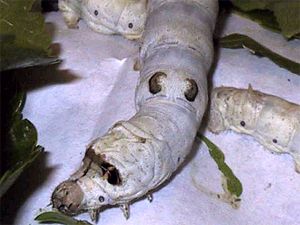
  Silkworms (take a look at one here) feed only on White Mulberry leaves.  As a domestic animal, they are fed until they reach a few inches in length.  Once at full size, the caterpillars weave a peanut shaped cocoon (see here) and pupate within.  The cocoons consist of a mile or so of continuous fine silk, so it is at this stage that they are boiled (killing the pupae, of course) and unraveled to produce commercial silk. Natural silk production is still practiced today, so silk purses are still available as far as I know.

  We have journeyed from a Monroe bird’s digestive tract to China, so I guess need to bring us back home.  Mulberries were deliberately brought to Michigan because settlers wanted to raise silkworms alongside their sows. For a brief period 1820’s – 1850’s farmers attempted to establish a silkworm industry right here on home ground. Take a look at this page from a southern Michigan farmer detailing several silkworm egg transactions. The lower entry states “Received of O. Randall said to be seventeen thousand and five hundred silkworm eggs for Esq. Beach and others. J.R. Hall.”

  The date of the above entry is July 16th, 1841 – exactly 166 years and a day ago. The silkworm experiment failed, but the Mulberry trees survived as seed escapees.  Fruit eating birds continue to spread Mulberries and therefore our windshields continue to get plastered with history.

Lov’n the Water Lily Life

  After a long hot summer day, the marsh rebounds with new life. While the windy mid-day marsh is a hot bed of dragonfly activity, swaying cat-tails and blooming flowers, the setting sun prompts a change in décor and clientele. The large white flowers of the Water Lily conceal their petals and the third day blossoms are drawn back underwater. Their leathery pads seem to unfurl and relax under the caress of the gentle twilight breezes. Deprived of their solar power, Blue Dasher dragonflies retreat to nighttime shelters and yield the insect air space to the clouds of emerging caddisflies.

  Now is the time for the muskrats to venture out to do what they do best – eat.   It is no secret that muskrats get sick and tired of eating cat-tail shoots every day. They are restrained from going completely bonkers from the monotony of their diet because they have very tiny brains with little room for emotion. Cat-tails are the staff of life, but for a lowly mushrat the quality of life sometimes demands something more than quantity. The choice salad offering presented by a bed of lily pads is nothing short of heaven sent sanity.

  Seeing a muskrat rip into a lily leaf betrays this cat-tail dementia. All professional restraint is abandoned when scarfing down early summer pads. By late season, the allure will wear off, but for now the first and last thing on the menu is water lily. The leaves are right at mouth level, so it is only necessary to approach and inhale. There are different styles of consumption, however.  Some hold the leaf like a cinnamon covered Elephant Ear and take bites while rotating the edge around.  Others roll the leaf over into a taco shell and eat it like one. On this evening, I was witness to a third style akin to a contestant at a hot dog eating contest.

  I did a sketch of this gluttonous performance just to document it for the sake of posterity.  My frantic little ‘rat was rolling the leaves into a cone and literally shoving them down his throat like a tree chipper.  He took no pause in the chewing process.  Engrossed in the dining experience, he often drifted beyond vertical and leaned back in Sea Otter fashion. I’ve never seen one, but I would guess this is what an aquatic circus barker would look like while eating his bullhorn.

  Next to this display of sheer eating mastery, few could compare. Though the evening light was fading, I did spot a competitor on the lily eating stage. A rock and a head had surfaced nearby.  The head repeatedly shot out in a clumsy attempt to grab the exposed edge of a lily pad and the rock rippled the water with each effort. This new contestant was a sizable snapping turtle and the rock was his shell.

  There is probably no creature on earth less known for its plant-eating abilities than the Common Snapper. In the dimming twilight the creature was free to pursue some fresh greens without tarnishing its killer reputation.  Up to one third of this carnivorous turtle’s diet is made up of water plants. Al Capone probably ate bean sprouts, but no one – and I mean no one – would ever mention such a thing.  Here I was witnessing a rare thing indeed.

  The turtle finally nipped off a chunk of leaf after a half a dozen tries and swallowed it without fanfare. His next bite was landed with swift completion after a slow start. Not surprisingly, he looked more like his passive cousin the Box Turtle munching on a strawberry, than a flesh eating monster.

  In terms of reputation, it is equally odd to learn that Muskrats will eat flesh on occasion. Fish, baby turtles, mussels, and each other will find their way onto the menu. Tonight, the muskrat was boldly proclaiming his vegetarian side and the turtle was exercising his freedom of choice.

  I’m sure the ‘rat and the ‘snap continued their feasting into the night, but as a daytime critter I was forced to retreat from the lily loving scene with a taste for some salad.

Steward Little

  As far as I know, Johann Christian Polycarp Erxleben never visited “Amerika.” He was far too busy becoming the father of veterinary science and it probably took a large part of his daily life just to write out his monumental name on horse pill prescriptions. In the true tradition of 18th century medical men, he was also a naturalist.  Using specimens, the German scientist described many species of mammals from the exotic Spotted Hyena and Harp Seal to the Chital Deer and the Indian Giant Squirrel.

  When a tiny speck of a squirrel reached his desk in 1777, he looked it over and decided to call it Tamiasciurus – “the Shade-tailed Steward who takes care of provisions.” Since the specimen hailed from the Hudson’s Bay area of Nord Amerika, he gave it the species name of hudsonicus.  He dubbed it with the common name of Red Squirrel and declared “Mein Gott das iz Goot,” to his assistant, “let’s get a beer.”

  O.K., I admit that I made up that very last part just for the dramatic flare, but actually Erxleben’s squirrel doesn’t need any dramatic license to spice it up.  The Red Squirrel is a power packed mini dynamo. One of our smallest native squirrels, this sprite barely tops 12 inches in length (4 inches of which is tail). Take a look at this photo, and you’ll see why it’s called a red squirrel.  The red-brown body is accentuated by a white belly and a flashy little white eye ring. An appropriate black racing stripe divides the belly white from the red sides to add a touch of pizzazz. All this décor is usually reduced to a blur as the animal streaks about on its daily rounds.

  You will rarely see a Red Squirrel at rest, which means you rarely get a good look at one. When not engaged in gathering food, they are engaged in storing it or running about between the place where the food was and where it will be. The designation as a “caretaker of provisions” is an extremely appropriate moniker.  Red Squirrels horde pine and spruce cones (their favorite food) as well as mushrooms and walnuts. These hordes can be in the form of burrow stashes or items carefully wedged into limb crotches. Here’s a picture of a walnut stored in my front yard Holly bush. Also, I’ve seen apples stored in the same way.

  Another common sign that pointing to the presence of these Steward Littles are the distinctive feeding remains.  Look at this photo and you’ll see a Blue Spruce cone and a Walnut that have suffered the onslaught of a Red Squirrel’s incisors. The scales of Evergreen cones are systematically plucked off in order to get at the seeds – leaving only the core and a few top scales in place. Tough shelled walnuts pose another eating challenge. Lacking the heavier nipping equipment of larger squirrels, our diminutive friend has to open up four small holes to get at the nut meat chambers found within. (Big squirrels tend to leave a walnut with two large holes.)

  Yesterday afternoon, I followed – or attempted to follow – the antics of an individual Red Squirrel in my back yard.  He worked his way out on a walnut limb and cut off one of the developing green husked nuts.  With the nubile nut in his mouth, he turned and took a circuitous route though the branches. He went from limb to limb and spanned the gap between trees with effortless leaps and monkeylike precision.

  On the fifth tree over, a projecting twig caught his attention and he decided to place his find in the small angle under it.  Several unsuccessful attempts to wedge the prize into place were followed by a re-positioning of the nut and a new effort. I watched this procedure from below and thought that I was undetected.  This proved to be a faulty assumption, for suddenly the squirrel disappeared around the trunk and temporarily placed the nut in a knothole.  He swiftly returned to my side of the tree and proceeded to deliver an agitated verbal blast in my direction to tell me that my presence was not appreciated.

  In the North Country, the Red Squirrel is better known as the Chickaree.  This name literates the agitated sound made by these self sure rodents. My squirrel started his tirade in usual fashion with a series of high “Chicks” in regular sequence. Each “chick” racked his tiny body with a convulsion and changed the position of his tail. While in voice delivery mode, his front feet were not even in contact with the bark, so they were held straight out as if casting a hex upon me. Eventually, the string of “chicks” was accented by guttural “chucks” as things accelerated. Finally, all restraint lost, the creature exploded into an extended “rheeeeeeeeeeeeeeeeeeeeeeeeeeeeeeeeeeeeeeeeeeeeeeeeeeee” and bounded off.

  With that stream of blue air I was put into my place. The Red Squirrel may be small, but he can swear like a sailor.

Mr. Sparklebottom’s Night Club

  There’s nothing quite like the resulting action when Mr. Sparkle Bottom stimulates Acetyl Choline to open up with a jazzy lick. This encourages Pyro Phosphate to pull the normally inhibited Luciferase out onto the dance floor which prompts Luciferin to “cut the rug” with Oxygen. When the Lucifers hit the ground the whole place lights up and things get real cool.  Yeah man, cool. By the time Miss Sparkle Bottom gets involved, there ain’t no turning back.

  The Torchbearer Night Club begins to swing at sun down and things don’t slow down until dawn’s early light. It’s safe to say that the energy level at this joint is nothing short of 98% efficient.  Don’t bother Googling this Night Spot. You won’t need directions. It’s right around the corner, across the street, or even in your own back yard – wherever the Sparkle Bottoms hang out.  Although known as the “Sparkles” to their fellow folk, they are better known to you and me as the Fireflies.

  Fireflies, or Lightening Bugs, are such a common feature of the summer night around these parts that we could easily take them for granted. Their glowing abilities are so remarkably complex that scientists are still trying to figure out exactly what happens.  I described it as best I could in the first few paragraphs, but the essence of the process involves a chemical called Luciferin, mixed with a catalyst called Luciferase, to produce a burst of cool light.

  Lucifer himself can’t do what the chemicals named after him can. When the horn man makes fire, there’s a whole lot of heat produced.  Heat is a wasteful byproduct of light production. Even when we humans make light with an incandescent bulb, 90% goes to heat and only 10% to light. Firefly light, on the other hand, is produced using an extremely efficient process which wastes but a few percentage points on heat. 

  Needless to say, the whole process is of great human and firefly interest. Luciferin and its catalyst are widely used in the medical research world as tracer tools for gene research. Cool light is essential to firefly bioluminescence because without it they would burn their butt off every time they lit up!

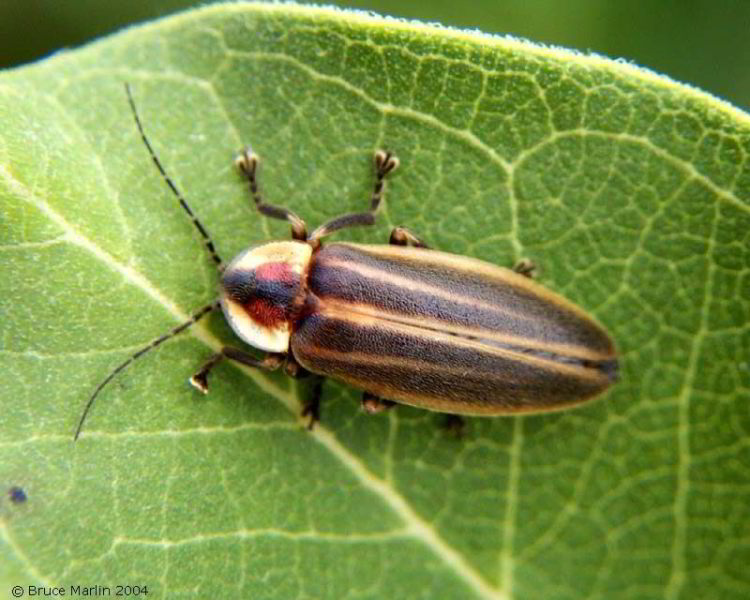
 To get Luciferin and ‘ase, one needs to juice up a few thousand Photonis pyralis – the Common Firefly.  There are 125 species of Lightening Bugs (Lampyridae – “torchbearers” in Latin) in North America, but this familiar species is the one you’ll encounter at your backyard night club.  Take a look here at a top view.  The most notable feature of this view angle is that the head is shielded by a thorax shield. While you are at it, get a load of those neat little feet equipped with dual deer like toes. Examining the underside (see here –thanks to this Christopher Hawkins photo. ) will reveal the buggy eyed head and light organ are visible.

 You’ll notice that the last few segments of the abdomen are pale, waxy smooth, and yellow. This is the light organ area.  Just underneath a clear outer layer is a layer of yellow photocytes where the magic mix takes place. Behind them is a reflective layer which bounces the light outward (like the silver backing on a headlight or flashlight). Since oxygen drives the process, there are two easily seen pores on each segment to control air intake.

  During the day, one Lightening Bug pretty muck looks like another.  The pattern and length of nighttime flashing is what separates species and gets like species together. It is the lot of the males to do most of the flashing. They flash and wait for an appropriate response from a female. He flies while flashing – she stays on the ground while answering.

  Some fireflies perform a single flash every few seconds, while others do a burst of six pulses every five seconds.  Each female displays a bit of feminine coquetry by delaying her response before flashing back an acceptance blink.  How long that delay is depends on the species. We reap the benefits of this Morse Code romance by enjoying the light show. 

  I followed the antics of a few fireflies last night just to see if I could confirm that my backyard fireworks is courtesy of the Common Lightening Bugs of pyralis fame. These common torchbearers are said to flash for one half a second every 5-7 seconds while performing an upward flight sweep.  

  At 9:00 pm it was still light enough to follow the flight path of individual fireflies.  I timed and measured the antics of several and found them engaged in a very consistent flight pattern.  Fireflies fly with their abdomen dangling down and their light organs facing forward.  These guys were flying about 12 inches off the ground for about four seconds before dropping down to within a few inches of the grass and releasing a half second flash of greenish yellow light. During the brief duration of the flash, they would suddenly dart upward to create a “J” shaped light signature (you know, like writing your name with sparklers during the Fourth of July).  The whole effect was a series of J’s executed like clockwork every 6 seconds.

 There was little doubt that these were pyralis fireflies.

  It didn’t take long before I spotted a solitary answer flash from the grass from a pyralis female. She’d respond a few seconds after the male finished his flash.  After a few more give and take messages, the particular male I was watching landed next to the lady and bought her a drink.

   Things were just heating up – or is it cooling down? – at the Torchbearers Night Club.

Lost in Translation

  The Milkweed is a plant with a story to tell.  Like an excited professor, it can offer up a dizzying diatribe of facts delivered during a heavily accented stream of consciousness. Occasionally it shifts tone and beckons you with a mysterious, but equally perplexing, purr. It pulls you up to the table over a hard drink and drops references to a shady past and lapses into a few dead languages.  It takes a bit of translation to decipher the story, but it is well worth it.

  To attempt comprehension of the entire tale at one time and in one place isn’t recommended, but we can pull out a few tidbits from the narrative. The scientific name of the Common Milkweed is a good place to start.

  The Latin designation of Asclepius syriaca is a reference to both godliness and humanness. Asclepius or Askelpios was an ancient Greek doctor who took his powers of healing one step further than the local Gods saw fit. “Skep,” as we’ll call him, discovered the secrets of bringing dead patients back to life. In a fit of jealousy, Hades directed Zeus to lay a lightning bolt on him and thus the doctor was fried. No sooner had the smoke cleared, however, than the other Gods took pity on the poor physician and they placed him in the starry night sky and hired him as the “God of Healing.” (Zeus was steamed. He was quoted in the Temple Times as telling “Skep” to “Go to Hades”).

  Although the white milky sap of the milkweed contains alkaloid poisons (and the reason for the common name) it can provide a cure for warts – thus the healing reference. The relationship between Milkweed and the Monarch Butterfly is due to this magical sap, but that is a well known story.  Let’s stick to the obscure for now.

  The “syriaca” part of the name is, to put it bluntly, a mistake. Originally the plant was believed to be a native of Syria.  Later it was discovered that it is a native of North America and that the Syrian plants were transplanted there as alien imports. The name was never changed (some say due to the backhanded influences of Hades who wished the misnomer to remain attached to “that pseudo God Asklepios”). 

  In a straight forward, one could say Godlike, fashion the Milkweed offers up a selection of explosive flower clusters this time of year.  There is no need for translation. The deep pink pom poms emitting their heady perfume are nothing short of fantastic (see here). Close examination of the individual flowers (see here) reveals a stunning little ringlet of cuplike hoods.  Each hood has a horn sticking out of its center.  The collective hoods, called the crown, are backed with reclining petals.

  Milkweed flowers offer a high sugar nectar which insects find irresistible. They are attracted to it in droves.  Insect activity results in pollination and pollination should result in seed development. It is odd, then, that the milkweed begins to mumble a bit when discussing this part of its life. Given all those customers, it is strange that only one or two flowers are actually pollinated and result in a seed pod. The problem is that the milkweed demands a bit too much of its visitors.

  The milkweed flower is an insect trap. In the narrow space between each hood is a pair of pollen sacs arranged like a saddlebag or an upside-down “Y.” A dark sticky gland, called the translator, joins them at the center. (You can see this gland as a dark spot between the hoods if you go back to the detail picture). When an insect steps onto the flower, the smooth hoods cause them to slip about and their hairy little feet end up getting wedged in those narrow slits.  As the insect struggles to eradicate itself, the translator and its pair of pollen sacs hitch on for a ride. Take a look at this incredible photo of a pollen sac pair – the translator gland is the vicious looking thing in the middle that hooks onto the leg.

  Gifted with a short-term memory (and a nectar induced stupor), the insect forgives the trauma and continues to feed and get trapped.  Take close look at this photo and you’ll see a pollen bag attached to the foot of a large fly (look dead center at the extended leg). When a foot with a pollen sac already in tow slips down into a slit, it has the potential to leave this old sac in place while picking up a new one. Each time this takes place, the insect is presented with a risk to life and limb. Sometimes the leg is held so firmly that the appendage is ripped off in the ensuing struggle. Small weak insects are often unable to break free and die in place. 

  The odd thing about this whole scenario is that the pollen sacs rarely find their final mark. Only a few are plunged deep enough into a flower to stay and contact the tiny female pore within.  The milkweed has set up a cascading succession of demanding events to produce its seed pods. It is a complicated plant which depends on a translator to communicate.

Hairbreadth Escape

  It is the sacred duty of every prey species to make the predator’s job as difficult as possible. To achieve this, there is no honor bound code of ethics – use what works and use it as often as it takes. Aggressive defense is not an option for an ephemeral creature such as a butterfly or moth.  They do not have jaws, but instead are equipped with party favor straws for lapping up nectar. Their wings are papery works of design and their bodies are delicately made, so any contact with a predator can be akin to a Chinese lantern resisting the swipe of a sword. Their anti-predator options, then, are narrowed down to speed, poison, avoidance, and visual trickery.

  The lepidopteron world (the scale-winged set) is full of fascinating examples of all the above tactics, from special bat sensitive ears and false sonar to leaf mimicry and poisonous flesh. Some tricks are so subtle that their simplicity borders on the remarkable. I came upon just such an example while observing a cluster of milkweed flowers the other day.

  Banded Hairstreaks are common milkweed imbibers. On this particular sunny afternoon, several individuals were darting about from bloom to bloom.  The crowds tend to get thick at such a popular eatery, so my little Hairstreaks were competing with a jumbling host of flies, bees, bumblebees, longhorn beetles and the like.

  These tiny butterflies (see here) enjoy only a brief late June to early August flight season so don’t have much time to fool around. Not flashy when compared to other butterflies, hairstreaks have brown upper wing surfaces and nicely patterned under wing surfaces. Since they perch with their wings up, this underside pattern is the part we can appreciate. Of special note is the tiny tail – the “hair” in hairstreak – projecting out from the lower wing.  There are a few powder blue and orange patches prominently placed ahead of this feature. 

  One of the individuals that landed in front of my lens was missing the entire back half of her wings (see here).  The hair tails and color patches had been ripped away, but there was plenty of wing surface left for normal flight.  The important part about this observation is that, while the butterfly was tattered, it was still in possession of its life. She had played her cards against a predator and won the game. Her tail feature was the ace in the deck.

  The tails are meant to imitate antennae and the colors to draw attention to them.  Together they function as a false head. When perched, the Hairstreak rubs its wings slowly up and down in order to put these pseudo antennae into motion. While the real head and antennae are busy with life at one end, the fake head is serving the role as decoy.  You could say that the Hairstreak is a much more practical version of Dr. Doolittle’s “Push-me-pull-you.”

  When a predator, such as a Kingbird, launches a surprise attack, it has a 50/50 chance of grabbing the right end.  A hit on the right end will result in a bird meal. A hit on the wrong end will harmlessly tear the wing and allow the butterfly to hairstreak away. By adding a dash of make-up to the false head, the chances are tipped in the butterflies favor since the attacker is prompted into a strike at the bright spot.

  Many large and showy butterflies, most notably the Swallowtails, employ this same tactic, but my little damaged Hairstreak provides us with an alternate interpretation of the notion of beauty. Compare the photos of the whole Hairstreak with the damaged one and you’ll appreciate the “tale” of an assault gone awry and the beauty of simplicity.

Justice to Chicory

  The flower of the Chicory is truly a fleeting thing – firm and resplendent in the morning and a limp dirty rag by late afternoon. Sunrise calls forth a sparse assortment of stunning baby blue blooms from this common roadside plant (see here). A circular array of toothed petals surrounds a cluster of deep blue floral parts.  These center parts are the actual flowers themselves – the “petals” are simply window dressing to attract pollinating insects to the nectary heart. 

  By mid day, the color begins to drain from the flowers (see here) and their intensity is diminished. Things are pretty well done by late afternoon as the petals take on the appearance of used paper towels.  In a world of transitory flowers, the Chicory’s transition is the most dramatic. Take a look at a side by side comparison photo I took this morning, showing a new flower next to the remains of yesterday’s effort. The reality of the Chicory is that the blossoms are the only delicate thing about this plant.

  Chicories are legal immigrants which arrived on our shore centuries ago.  Here in the New World, it found wild roothold in the harsh conditions offered by our roadsides and parking lots – hard packed, sun baked ground. The plant itself is barely more than a cluster of relatively bare thickened stems with very few leaves, so is not especially attractive. The leaves that are present look very much like those of a dandelion and serve to remind us of the family relationship with that plant.

  Such a conservative approach to growth above the ground is countered by an exceptionally robust taproot below.  This white root gathers in what little moisture is available and the sparse leaves keep that water from evaporating off. Even the bloom schedule is right wing, since it invests a small daily dose of excitement in the form of those terrific little flowers.  

   The hardscrabble way of life exhibited by this hardy plant has an Oliver Twist type of flare, and so it seems appropriate that Charles Dickens himself once wrote about the Chicory.  He approached the subject not on a fictional basis, but instead as an article in his “Household Words: A Weekly Journal” published in 1853.  In an article entitled “Justice to Chicory,” Dickens writes: “Because we do not like to receive chicory under the name of coffee, it by no means follows that we object to receive chicory in it’s own name, or that we consider it wrong to marry chicory and coffee to each other…only let it not be a secret.”  So, what in the Dickens is he talking about?  Well, he’s referring to the primary use of the Chicory as a coffee additive and the shady practice of using it as filler or labeling it as pure coffee.

  As “Poor Man’s Coffee”, or “Coffeeweed,” the chicory has long been grown for its beverage potential. This is probably why it made it “over the pond” in the first place.  The root is ground and roasted to make an infusion or drink. Such a drink can stand on its own merit, but ground chicory is usually added to coffee as a flavor enhancer. Dickens goes on to say that, “by combining of a little chicory with coffee, the flavour of the coffee is not destroyed, but there is added to the infusion a richness of flavour, and a depth of colour – a body which renders it…much more welcome as a beverage.” In other words, it makes coffee taste gooder (but how can you improve on Dicken’s prose.)

  Our scraggly escapee bears little resemblance to the cultivated plant – of which there are several varieties.  While our wild plant can be rendered into “coffee,” the result may leave you wanting for a rich foster parent who can afford the real thing.  

Conradulations

My spell check went into conniptions when I typed in the title “Conradulations” for this piece. I chose to ignore the wiggly red error line in this case because I meant what I wrote. It is not my intention to send Congratulations (although I do wish that to all those high school grads out there), but instead to call attention to a snail’s tongue known as a radula.  This being the case, any discussion about a radula could be considered as a “radulation” and acknowledgement of a radula job well done would be a Conradulation.

  It so happens that I was watching a Mystery snail crawl up my aquarium glass and marveling at it’s constantly moving tongue. Take a look at my drawing and you’ll see what I saw (look here). The most notable feature is the expansive foot pad, but it is the long snout, protruding out from between the tentacles, that gives the animal its personality.  At the end of this snout, or proboscis, is the mouth opening is pressed up against the glass like the end of a vacuum hose. Inside the mouth is a tiny pink tongue called a radula. This tongue is in constant back and forth motion and is the key to snail feeding behavior.

  Most snails, like this giant Mystery variety, live by grazing on microscopic plant life such as diatoms and algae.  Grazers need teeth, and there are hundreds (sometimes thousands) of them arranged row upon row on the tongue.  The snail tongue term of Radula is based on the latin word for scraper, which is an apt description of this file-like appendage. Take a look here at this detailed view showing the rows of sharp microscopic hooks.  Snails got teeth – lot’s of ‘em.

  In technical terms, the toothed structure is called as “chitinous ribbon,” but let’s just keep on calling it a tongue. By moving the whole tongue forward and back, the critter rasps off the algae strands and then pushes them forward where they are sucked down into the throat. Our mystery snail moves his snout from side to side in order to graze a pathway across the glass. Each species has a very specific arrangement and number of teeth, but only people with too much time on their hands spend that time counting snail teeth.

   As would be expected, this dental tool set is constantly wearing down.  New teeth are produced from the back of the tongue as quickly as those in the front wear out.  Tongue tooth production is constant and rapid. Basically we have a tooth conveyer belt going on here.  

  I sense at this point that you may be reaching the tolerance limit for snail tooth talk, so I will leave the subject for you to mull over (or bring up at the breakfast table). Just in case you’ve got some unsatisfied curiosity about Mystery Snails, here’s a great site to view. There are over 36 different species found across the world (another thing to bring up during lunchtime discussion). The individual that I was lip-reading appears to be the Oriental Mystery Snail – an introduced species from S.E. Asia, but there are some 17 native types in North America. To complete your meal discussion list, perhaps you can also bring up the fact over dinner that Mystery Snail males have a right eye stalk that is modified as a…well, let’s just say… as a “reproductive organ.” Now there’s some food for thought.

 Whether or not you want to think about such nasty reproductive details, Mystery snails are members of a family that actually bear their young live. In other words, they do not lay eggs, but pop out complete little snailets ready to enter the big wide world as fully equipped tongue eaters. To those new graduates I say “Conradulations.”

Go Out There and Break a Wing

  Everybody knows the Killdeer.  This bird “…is too well known to merit any extended notice,” according to Michigan Bird Life (1912) author William Barrows.  “It has the exasperating habit of signaling the approach of a stranger,” he goes on to say, “…and is more likely to rush into danger than to avoid it.”  Barrows observes that the Killdeer is “not a good table bird, and the few that are killed by gunners are shot commonly in anger…”

  So, what is it about this bird that elicited such a colorful response from an otherwise staid and professional observer of bird life? Killdeers are a loud in-your-face kind of bird that defy the basic laws of natural behavior and share our love of open ground. They follow us into our plowed fields, gravel parking lots, and barren sand pits and show no timidity when it comes to balling us out. Their incessant calling can be irritating and they do tend to take us on, rather than flee our presence. My encounter with one yesterday brought all these bold traits to mind (although I wasn’t tempted into killdeercide).

  I nearly ran over a nesting female who was sheltering her clutch just inches from the edge of a dirt service road. The location was a quintessential Killdeer spot – being out in the middle of a searing hot short grass field. Her clutch of four speckled eggs were neatly arranged within a shallow bowl of scooped out gravel which served as a nest. There was absolutely no cover at the location and the mid-afternoon ground temperature was well over 100 degrees.

  As I approached the nest, this bird let out a staccato trill and began to display her oscar winning talents. (Take a look here and here to see her performance). She stepped away from her clutch, but immediately turned toward me to display her apparently broken right wing. She dragged the appendage on the ground and flared her chestnut brown tail as if favoring her left leg.  I ignored her and bent down to observe the beautiful eggs.  This prompted her to begin anew with a dramatic reenactment. This time she threw in a freshly broken left wing and increased the intensity of the trill.  To a potential nest predator, this would have been an offer too good to resist – why eat a few eggs when you can feast on a wounded parent bird instead?  Not being a nest predator, I indulged her anyway and took a few steps in her direction. As expected, she mustered her strength and was able to keep just out of my reach.  She would have kept this up until I was lured far away from the nest – at which point she’d take to the air and return to the nest.

  There is something admirable about a bird that would throw down its own life to protect her precious brood. I might suggest, however, that all this drama would be unnecessary if only a proper nest location had been chosen in the first place.  This is not the Killdeer way, however, and I was not around when the scripts were being passed out.

 Because many of you have probably witnessed this display before and are very familiar with the Killdeer, I guess it is my job to point out a few new observations.

  Of course, the common name comes from the common call of this bird: “Kill-dee, kill-dee, kill-dee,” but listen here and you’ll see that this animal exhibits a wide variety of noise making abilities that earned it the scientific name of Charadrius vociferous – the Noisy Plover.  While the bold black neck rings are a distinctive visual trait, it is also worth your time to take a close look at the startlingly bright scarlet eye ring surrounding the huge eyes (look here). The phrase “jeepers creepers where’d you get those peepers” will come to mind if you chance to view one of these birds through a pair of binoculars.

  While in the process of eyeballing one of these loquacious plovers, take a look at their feet. Unlike most birds, Killdeers have only three toes per foot (lacking the backward pointing fourth toe).  The triad of toes originates from a thickly padded heel. This arrangement represents an adaptation to a running lifestyle. It is a general trend of functionality that running animals tend to reduce their number of toes over time. The Killdeer has taken the first step on this evolutionary racetrack and the horse has taken this trend to its fullest extent with only one toe per foot.

  I eventually returned to my car and waited around for the anxious female Killdeer to return to her eggs. Mr. Barrows states it well when he writes that the eggs are “surprisingly large” for a robin-sized bird.  At about 1 ½ inches by 1 inch, the speckled marvels beg the question as to how such a small bird can manage such a packet and live to tell about it. The eggs (see here) blend in well against their barren background.

  The female arrived over the eggs in a very short time and resumed her calm motherhood role. Her primary goal today was to shade the eggs from the intense heat of the sun. To achieve this, she squatted over them like a parasol – allowing the slight breeze to circulate beneath her. As she patiently stood, she opened her mouth and panted.

  Both parents maintain this routine for 24-28 days until the little ones hatch out.  Through selected employment of their acting and parenting skills, they will insure that another generation of thespians will carry on the odd Killdeer way.

An Explosion of Life

  Repeat after me: “Mayflies are good, Fishflies are Mayflies, Mayflies are Juneflies,  Juneflies are Goodflies.”  This message needs to be preached from the pulpits of life and the altars of everyday life. The annual hatch of these aquatic insects presents a story of eternal redemption. Yes, my brothers and sisters, Mayflies are harbingers of hope.  Alleluia, alleluia.

  Many of you probably already have “religion” when it comes to mayflies, but at the risk of preaching to the choir, it is important to embrace the subject.

  The first obstacle to overcome is what name to use when referring to “them.” Technically, I am referring to the species Hexagenia limbata, the Burrowing Mayfly (see here).  This is the species that emerges from Lake Erie in biblical numbers to cover every vertical surface within flight distance of the water. Although Mayfly is the proper name, they are better known as Fishflies.  Because this type emerges in June, and not May, they are also justifiably called Juneflies.  Our Canadian neighbors have been known to refer to them as British Soldiers and Fly Fisherfolk call them Golden or Michigan Mayflies. Our present concern is that far too many people call them a “nuisance.”

  The burrowing mayfly is the largest member of its clan – a collective of over 600 North American species in the order “Emphemeroptera.”  This order name literally means “wing for a day,” because mayflies “fly” for only a day or two out of their lives. Many of our kind only see them during this brief flight stage, so assume they are a short-lived creature whose sole purpose is to foul up our daily life. Actually our giant fishflies count their age in years, rather than the monthly or daily system used by most insects.

  The life cycle from egg to adult can take up to three years.  Burrowing Mayflies spend their developing years as aquatic nymphs.  The young are equipped with formidable tusks and powerful digging claws to construct “U” shaped burrows in the lake bottom. From the protection of this den they eat detritus and grow until they are about 2 inches long.  After a year or two (depending on the water temperature and habitat quality) the burrow gets to be a tight fit.  In late spring/ early summer, the fat nymphs wiggle to the surface, shed their old skin (and their gill breathing ways) to live their last 48 hours as an air breathing air flying adult.

  This aquatic life stage holds the key to their redemptive message. Mayfly nymphs can not live in polluted water.  Not so long ago, Lake Erie and the Detroit River were cesspools of pollution. Mayflies could not tolerate these conditions and virtually became extinct in the Western basin.  Fortunately, things changed for the better and by the 1990’s the insects began a dramatic comeback. Between 1991 and the current day, the Burrowing Mayfly population has grown at an exponential rate. The ever increasing hatches of these tiny messengers serve as an environmental indicator of improving water quality.

  A mayfly emergence can be a dramatic thing. It is not unusual to have a density 500 larvae per square meter of lake bottom, so you can imagine what it’s like when they come to the surface all at once. Take a look at this Doppler radar image of a large mayfly hatch coming out of the upper Mississippi River a year or two ago – it is a veritable explosion of life. Warm, muggy conditions will signal a communal night hatch. As the nymphs rise to the surface, they shed their old skin and fly to the shelter of shoreline trees or buildings.  This newly emerged individual is called a sub-imago or dun.  After resting over the course of the day, the sub-imago sheds its skin one more time to achieve the golden brown imago or spinner stage (see the cast off skin here).   At this point the adult is locked and loaded for mating.

  The setting sun at the end of the first (and only) day signals the final act.  Adult mayflies gather into huge hovering swarms near the waters edge. Individual flies commence to dance like tiny puppets pulled by invisible strings. They rise up several feet and then freefall the same distance. Two long “tail” streamers accentuate the motion and add to the dramatic presentation. Soon, a male and a female find each other and they join their abdomens in mid air. Locked in a mating embrace, the pair employs their duel wing power to journey over the open water.  The female then distributes her eggs over the surface and both of the lovers die.  It is in death that the cycle is completed.

  Many of the mayflies never make it to the Promised Land.  Instead, their lifeless bodies pile up in windrows at the Service Station – lured by the irresistible appeal of the bright lights. Since they have no mouths and can’t eat, they simply waste away their brief time.  Even in this seemingly hopeless situation, mayflies serve their most crucial role – they are food to innumerable birds and spiders.  In the water, they are the mainstay of the seasonal diet of fish as both nymphs and adults.

  Many Monroe old-timers will recall the phenomenal mayfly hatches they experienced prior to the mid-1940’s. They may not consider it a good memory, but at least it was part of everyday life. A generation has now grown up without that experience. Let’s hope that our present generation can view the current mayfly comeback as a signal of the redemption of a once broken lake. Spread the good word.