Thirteen-lined Seed Lover: Part 13

No, this isn’t really part 13 –it is only part 2 and the final in a two part posting on the 13 lined Ground Squirrel (It just sounded good).  If I was a squirrel researcher I suppose I could have written a 13 part “War and Peace” version and it would have been riveting, let me tell you. But my scope and my knowledge  is much more limited in this case. That is not to say that this topic doesn’t deserve a few more words.

We’ve already spent time on the naming issue and established visually, and textually, that the bold patterning of the 13 liner acts as a perfect camouflage. For an animal that lives in open spaces this is a crucial feature since it is always subject to predation from coyotes, foxes, hawks and a whole host of Thirteen-lined Seed Lover Lovers. The chosen habitat consists of low grass fields located in sandy and well-drained soils. In nature such locations are called prairies and the original range of this squirrel was limited to the great central prairies and oak openings of the Midwest. The farming and mowing habits of humans have extended the animal’s range by carving ideal habitats out of the eastern woodlands.

Ground Squirrels, true to their name (yet again) are diggers. They perforate their chosen home space with a variety of burrows. Some are shallow escape tunnels while others lead to deeper nesting and storage chambers. The soil around a burrow entrance is fanned out so as not to stand out above the grass level. When constructed, these ground squirrels employ feet and even head tamping to pack and spread the soil – creating meandering furrows leading away from the entrance. My Wisconsin squirrels rarely ventured far from their burrows and were always within a body length of escape.

Surprisingly, however, they were not timid – allowing me to approach within a few feet before dashing into their refuge of safety.  Although it may be that they were frozen in fear, I believe part of this boldness stems from the fact that they know what is coming from a long way off and are rarely surprised.  Like tiny Meerkats, they will stand bolt upright to survey their environs.  Bulging eyes allow a somewhat panoramic view with a limited piece of vision behind their heads.

In this stance, and when examined close up, they look very much like Prairie Dogs (except in body décor, of course). They are related to them, so this is to be expected. Unlike “dogs” which are colonial town-dwelling beasts, thirteen-liners are basically solitary in habit. They will be found in groups only because they are mutually attracted to the same habitat (kinda like suburbanites who live in closely packed houses but rarely know their neighbor two doors down). Within their small family groups they will deliver Prairie Dog kisses to each other by touching noses.


Also like their Prairie Dog cousins TLGS have very small ears. For comparison, compare them with tree squirrels and chipmunks which have prominent “sticky outty” ears. For lack of a better word, I would venture to say that these ground squirrels have Cauliflower ears in the tradition of LaMancha goats. Having already stated that they have Prairie Dog ears it probably wasn’t necessary to bring up the goat comparison as well, but I’ve always liked LaMancha Goats and this was the first time in my blog that I had an opportunity to incorporate them.

In order to conclude this tome I’ll have to bring up that naming thing one more time. Even though Thirteen-lined Ground Squirrels are truly “seed lovers” they actually trend toward the carnivorous side of the plate and are considered to be the most carnivorous of their clan. They frequently nab grasshoppers, eggs, or even flesh if it is available. So, after all this we must consider Carnophilus as yet another suitable genus name for the thirteen-lin……… I am getting tired of typing that name and trying to come up with suitable synonyms. In fact, I suspect you are getting a bit tired of reading about these Thirtee……things as well. So, let’s conclude while we can and retire in the knowledge that these…thir….er, little seed/meat lovers are fine little beasts. I will still, and always, call them Spermophilus tridecemlineatus no matter what the scientists say.

Thirteen-lined Seed Lover: Part One

Alas, I just found out that one of my favorite scientific names of all time may have been yanked from the biological lexicon.  Spermophilus tridecemlineatus , which can literally be translated into “thirteen-lined seed lover” has been the long standing scientific name of the Thirteen-lined Ground Squirrel. The name is so clearly descriptive and wonderfully Latin that I can scarcely think of another more perfect example. Being a simple, if often overly descriptive type of Naturalist, I employed it ad-nauseum over the years (almost as often as I used the phrase ad-nauseum). Today the creature’s name is frequently reported as Ictidomys tridecemlineatus – making it sound more like a disease than a rodent.

Up until a few weeks ago, before my trip to Wisconsin, I was still blissfully ignorant about this change. So, I could blame Wisconsin for my loss. The picnic grounds around Ottawa Lake in Wisconsin’s Kettle Moraine State Forest were crawling with these striped rodents.  But blame is not the proper word here.  I should praise them (whoever them is..er, are) for pulling the blinders off mine…er, my eyes. After photographing and observing these little creatures ad-nauseum I hit the “books” to find out something more about them beyond my favorite Latin name factoid.

Imagine my horror upon discovering that someone had re-examined the whole ground squirrel classification system a while back and decided to make the change based on genetic reality.  No one told me about this and thus I was a bit miffed. My hurt translated into a Corn Nut eating binge which ended in a chipped tooth. Thank you Wisconsin, Corn Nuts, and you, you meddling taxonomists you.

The selected genus name- Ictidomys – actually predates Spermophilus name. It first appeared in an 1821 work by naturalist S.L. Mitchell which was called, in part, “A Description of Two Mammaliferous Animals.” You should have seen my spell check react when I typed in that title! My initial loss of a tooth and a name may have been replaced by a new favorite title. Well, anyway, one of the two mammaliferous types described was the Thirteen-lined Ground Squirrel. The seed-lover designation has since been shifted over to a gang of closely related European ground squirrels (Mein Gott!).

The good thing about all this is that the animal itself has not changed one iota in spite of its many name changes. You know what they say about “a rose is a rose.”  J.J. Audubon called it the Thirteen-lined Spermophile, some call it the Leopard Ground Squirrel, and the Minnesotans supposively used this creature as the model for their “Golden Gopher” name. Gophers, as found in office place settings and across the Great Plains, are totally apart from ground squirrels but that is grist for another day. For the most part the common name of our subject has remained fairly consistent over the years.

Now that I’ve wasted sufficient screen space on Corn Nuts and naming notes, it is time to turn our attention to the ground squirrel in question.At this point it may border on the ridiculous to say that Thirteen-lined Ground Squirrels are small ground dwelling members of the squirrel clan which have thirteen stripes running down their backs. Oh, yes, they also love seeds by the way.

Let’s go back to the stripe thing if we may. Mammals, at least our North American Mammaliferous types, tend to be rather boring when it comes to color and patterning. Chipmunks, other ground squirrels, the Wisconsin badger, and at least one bat do their part but the bold linear pattern of the T.L.G.S. tops them all.  An alternating set of seven dark brown and six cream colored stripes run down the entire length of their backs. The dark brown stripes are perforated with cream spots – starbursts really – prompting some to call this the “Star-spangled Banner Ground Squirrel.” In fact, probably only a few inebriated picnickers actually call it by that nom de plume but sometimes drunk people can be incredibly witty just before they toss their cookies.

The true meaning of this whole thirteen line thing becomes immediately apparent when you see this ground squirrel in its native haunts. It’s not about being different or flashy, quite the opposite.  It is all about blending in. The stripes offer a perfect camouflage against a grassy backdrop. I leave you with a photo to demonstrate this fact.

Sure twelve lines, even ten, would probably do the same job but in this case thirteen is not just an odd number, it is a perfect number.

Bundling Humblebees

As the sun lowered on the horizon at Kettle Moraine State Forest (Wisconsin) it cast a level light into the vegetation and exposed the normally shadowed portions. Thanks to this new look on life, I spotted an unusual “nut” dangling from the branches of a Black Walnut tree. Instead of the expected fruit, this formation was a lumpy formation of yellow and black fuzz suspended off a leaf.  Initially it appeared to be a giant bumblebee. Closer inspection, however, revealed it to be a conglomeration of bees– a bundle of bumblebees, if you please.

To put this into musical terms, this unusual clump consisted of a B major surrounded by a half dozen B minors (Bm). To put this into natural terms (which I should have done in the first place) this appeared to be a Queen Bumble and her court of drones. In bee societies drones are male bees whose sole job is to impregnate the queen and die – preferably in that order. By all appearances this was a gang of hormonally enriched drones all sleeping with the queen and all hoping for a genetic chance to contribute to the betterment of beedom. Upon further research, this interpretation turns slightly suspect.

Bumblebees (known as Humble bees in Europe) are not cast in the same mold as the more familiar Honeybees. The Honeys form complex mega societies with well-defined caste roles and brooding structure (aka combs). Colonies can consist of thousands of individuals and last over several years. Bumblebees, on the other hand, create small colonies consisting of only a few hundred individuals who join together to make a ramshackle cluster of honey pots inside an abandoned animal burrow or an old birdhouse.  Every single worker, drone, and even the aging queen dies off every fall and the colony must be re-established annually by a new queen.

It would be easy to say “humbles bumble and honeys hum” in terms of their respective seasonal progressions, but that would be unfair. Both do what they have evolved to do and obviously the native Bumblebees are into the peasant mode of insect existence. The role of the queen and drone in Bumblebee society is a departure from the honeybee pattern. In late summer, the newly made queens and the drones fly away from the colony, but the queens will only mate with drones from other colonies.

So, you (and I) say the bumblebee cluster I observed must be a mating swarm, of sorts, consisting of a native queen and a court of un-related suitors. This activity does occur in late summer, but the problem lies in the manner. It seems that bumbles don’t “swarm” but instead mate individually with individual drones. I have yet to find a record of clustering such as I record here. Instead of declaring this unique or earth-shattering, I will simply repeat my earlier phrase “I have yet to find record” and bow to ignorance. Hopefully someone who got an A in B class will C this post and place a D on my B knowledge and provide the missing record.

As a parting thought, I believe the female had settled in for the cool evening and that the drones, also seeking night shelter, simply hung on for the night. The group was inactive when discovered – another reason to believe they were settling in for the night. By dawn’s light the next day, the group was gone. I imagine a bit of arguing and jostling occurred before things were resolved and the genetic intention of the gathering was completed.

It is worth noting that once a new queen has mated, she will return to the old colony and proceed to pig out on the stored honey. She fills her so-called “honey stomach” and then hibernates through the winter as a lone fat bee in small hole somewhere. As I mentioned before, all the other bees in the old colony die of starvation while the corpulent queen snores in comfort.

The haphazard and somewhat random nature of this posting stems from the fact that I am writing this while on the road. Do you have any idea how demanding it is to type, scroll , and formulate meaningful thoughts with one hand on the wheel, the other on the keyboard and the third on a cup of coffee…er, I meant the second on the cup and the… see what I mean? Watch out for that deer. OMG it’s so small and…it…it’s not a deer it’s a lawn statue. O.K., where were we? Oh, yes…the blog. I have a collection of thoughts based on a few photos.

My road trip took place during an especially hot weekend towards the end of August. The thermometer was edging past 95 degrees in spite of the fact I was in northern Michigan.  There was a vigorous wind blowing but it wasn’t refreshing in the slightest – more like a blast from Hades (aka a Beazulbub blow). Nature is used to such events by this point in the summer and the deep leathery green of the leaves attests to many such scorchings.

I stopped at a roadside park and watched as a black Grey Squirrel sauntered across the path in front of me. It did not bound, but instead snuck across in that weasel-like way often associated with these weasely squirrels. The beast ignored my presence completely and plopped itself belly down on a cross rail of a split cedar fence. Pressing his tummy directly against the shade-cooled wood of the rail, it allowed one foot to dangle lazily down and leaned its chin on a pair of pensively folded front paws. It looked and acted hot. What a bummer, I thought, to be a long-haired jet black creature on a hot day.

This thought prompted a memory of an earlier conversation I had about black phase Grey Squirrels. A random color variation of the Grey, black varieties become much more common the further north you go in the squirrels range. In some places, even though the melanistic (black pigment) gene is supposively recessive, the black phase dominates (three out of the four Grey Squirrels I ran over on this trip, for instance, were of the black type). I’m not sure anyone really knows why this is so. Some have theorized that it is due to the colder nature of the climate in northern areas. Because black absorbs heat, ergo, blacker beasts stay warmer in northern climes. Indeed this may be true to some extent, but upon analysis this fails to hold any water (or heat).

Northern animals tend toward whiteness as a matter of fact. Some, like snowshoe hares and some weasels, even convert from dark to white as the seasons progress into coldness. Polar Bears do have black skin, but are covered head to toe with white fur and they live in the Arctic.  Skunks are black but they are also nocturnal. Large Black Bears are diurnal and they are just as black in the steamy environs of Louisiana as they are in chillier climes of northern Michigan. No, there must be some other hidden selective force at work and I am not smart enough to figure it out… at least for today.

Now that I think of it, perhaps the effect is the opposite. The black squirrels are the “normal” ones and the grey varieties are the odd ones. The gray Greys predominate in the southern population where long hot summers prevail. Northern black Greys cook in the southern sun and tend to melt away like tiny Wizard of Oz witches. Yes, that might be it. I will accept my genius award at the next rest stop.

A stopover at a shallow cedar lined pond revealed several freshwater mussels on the silty bottom. Their shells were gaped and they were feeding. The warmth of the day probably had little effect upon them and they may have been enjoying the rays of the late day sun (you know what they say about happy clams).

A feeding clam is a fascinating creature. The tiger-striped folds of the fleshy mantle are exposed and constricted to form a small intake siphon tube and a larger outflow siphon tube. Sediment/detritus rich water is sucked into the intake and blown out the outflow.  This is what a mussel does all day with little thought for black squirrels or lawn deer. Suck in –blow out. Easy.

These particular mussels also revealed a great pile of stringy poop piling up aft of their outflow siphons. Lack of current, or movement, on their part has enabled a sizable pile to accumulate. I realize that such an observation may not be especially pleasing to the reader, but it affords an opportunity to fully appreciate mussel anatomy. It also allows us to realize that even clams are smart enough to direct their poo away from their intake.

As cool weather approaches the clams will shut down and burrow into the muck to wait out the winter. The black squirrels will stand out like sore thumbs as the winter snow flies but at least they’ll be slightly warmer by the time they are grabbed by a passing hawk.

And now, let’s end with a shot of a bountiful crop of wild grapes and move on down the road.

Keeping One’s Nuts in a Row

I guess it’s about time to do another update on my Red Squirrels. I, of course, say “my” squirrels with the full knowledge that they are the actual owners of the yard and that my wife and I are the lowly residents within their space.  In the season following their destruction of my riding mower and trashing my shed, they have dedicated themselves towards the filling of every available container or hollow space with old walnut shells. They raised a disgustingly adorable crop of baby Reds in the front yard tree and now the place is brimming with semi-well behaved squirrels.

So as not to completely deny their mischievous nature, a few of them have taken upon themselves to repeatedly bite into the plastic table covering on our small outside setting (leaving dozens of paired rips). I have no doubt that they will eventually shred this thing, but for now – and I mean the immediate now of late August and the early fall season – they are totally, absolutely, un-erringly occupied by the walnut crop.  The table cloth and the mower can wait for another time.

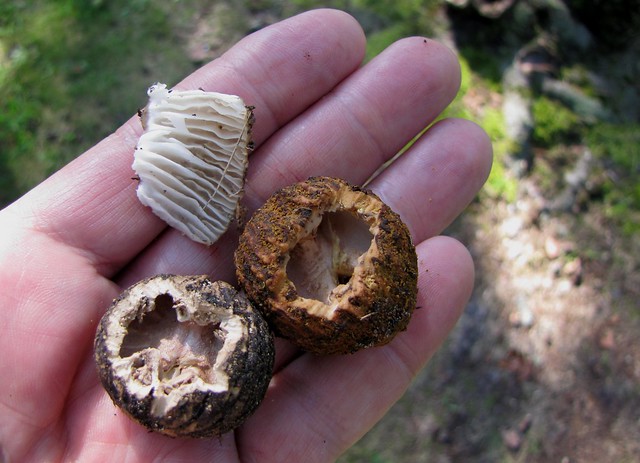
There is a bounteous crop of walnuts hanging from the yard trees this season and the Reds are determined to harvest and consume every single one.  Since Red Squirrels are passionate about everything it is needless to say that they are passionate about this particular mission. These bi-colored dynamos eat all manner of food – both animal and vegetable (they do not actually eat plastic table cloths or lawn mower wiring). When conifers are available, pine and spruce cones are targeted. Mushrooms are always on the list, whenever and wherever found, and are harvested at every opportunity. Evidence recovered from around the yard revealed a few fragments of torn mushroom caps. I caught one of the younger ones nibbling on just such a fungal favorite (see below) the other day. But the stains around his little lips, as well as the abundant presence of gnawed shells scattered about, betray the species-defining love of walnuts.

Black Walnuts are covered with thick florescent green husks this time of year. The husk covering enlarges the diameter of some of the nut packages to something just shy of tennis ball size. The Reds spend a great deal of time cutting the nuts free from their lofty origins (see above) and watch them crash through the foliage down to the ground. The next step involves collecting these earthbound tennis balls and running to one of two favorite dining trees. Some nuts are stored under the hood of my mower or eaten outright, but most are placed in temporary storage.

The sight of a tiny Red Squirrel bounding across the lawn with a tennis ball – something larger than its head – is a ridiculous scene. Looking more like a cat toy, they are pulled to the intended location as if a magnet were implanted in the nut and the tree was metallic. Several of the lower horizontal branches on my Red Maples have odd scabby growths shaped very much like small wooden bowls. The squirrels use these as short-term nut holders. On any given day every available nut bowl contains a squirrel harvested nut.

One branch has several of these depressions in a row and, when fully loaded, looks as if one of the squirrels has arranged for a breakfast, lunch, dinner, and snack nut.

After a prolonged session of nut harvesting, the Reds begin to chow down. Piece by piece they remove the husk and proceed to gnaw deeply into the nut (from two sides) to extract the meat. As most folks know, the green husk flesh quickly turns brown upon exposure to air and it will stain everything it touches. Every single Red Squirrel in my…er, their yard… is marked with a dark brown mouth ring. Like face paint on a stadium football fan this is the mark of a real nut!

That is the Question

Nature is often all about split second decisions. It is both efficient  and “smart” to look like something else without actually being that something else (take for example of the effectiveness of photo cardboard cut-out cops used to “patrol” some potential crime spots – no donuts required). Predators and prey usually only get glimpses of each other before making their move to grab or go. With that in mind, collective evolutionary trends dictate that appearances really do count and that it is o.k. to fake it as long as it improves survival odds. It is hard to tell what is real in nature.

Although there are examples of mimicry in every layer of the natural world, insects really have this gig perfected. Countless species of Insects mimic everything from harmless poo to venomous beasts and they do so from both sides of the fence, and often on both sides at once (what?).  I put before you two examples from the realms of my back yard – a fly and a moth that pretend to be bee-like. Thus the question “A bee or not a bee.”

The first faker comes in the form of a bumblebee. It is a hairy thing adorned in black and yellow and from a short distance looks very bumbly indeed. It is, of course, not a bee at all but a type of Robber Fly of the genus Laphria. A close look will reveal that the resemblance is only fleeting.

Robber Flies are robust predators that aggressively pursue, and suck dry, all manner of insects. They are the dragonflies of the fly world – perching in open sunny spots and flying out to grab passing prey. As a group they tend to be rather slender and this Bee-mimic Robber is much skinnier than your average (healthy) bumblebee. Flies only have one pair of wings while bumblebees have two pair. The imitation sports short spikey antennae as opposed to the bent appendages of the real bee. The face is long and mustached and the facial fuzz covers up the deep divide between the two huge compound eyes (bumbles have rounded heads).

It is also worth noting the large pad-equipped feet with large hooked claws on the Robber fly in question. This is a decidedly un-bumblelike trait that the fly uses to secure prey.

The benefit incurred by being a bee imposter is that it might deter other predators from tackling what they perceive as a sting- laden beast. This is the “sheep in wolf’s clothing” scenario. Because the Bee mimic Robber Fly is a wolf, however, it also probably benefits from the “wolf in sheep’s clothing” scenario as well.  The extensive prey list of this fly includes a hefty dose of real bees and bumblebees. There is the possibility that looking like a bumble helps this predator get closer to its intended prey. “Hey,” the surprised bumblebee screamed in horror, “you’re an imposter, you, you… (end of conversation punctuated by sucking sounds).

The second mimicking insect I will present comes from the moth world (see below and here). It is a stem borer that comes from a group of moths known as the Wasp Moths.  These guys employ slender partially transparent wings, long slender abdomens and enhanced yellow antennae.  They even fly about in the bright sun of daytime (there would be no need for such a cover if it retained nocturnal habits.) Over all this dark species is mimicking a metallic black paper wasp. Not exactly an academy award winning performance but enough to warrant a role as a character player.

The Wasp mimic Borer is strictly in the realm of “sheep in wolf’s clothing” mode. As a nectar feeder it seeks flowers and cannot defend itself. By looking like a wasp, it is given a degree of protection by signaling “I’m packing a powerful sting.”

Of course, this threat would not deter a Bee-mimicking Robber Fly one wit. So, even though I was not witness to such a meeting, it is very likely that these two cross-dressing insects met and that the fake bee won out over the fake wasp. Real life can be a grand illusion.

Little Green Contortionist

My usual relationship with Green Herons can be categorized into two types: fleeting glimpses as the bird flushes out of the cattails or distant glimpses as it squawks overhead during the breeding season. These little herons are secretive and cautious creatures.  Needless to say, this limits one to remote observation. The Green tends to spend a whole lot of time doing nothing between those bouts of fleeing and squawk flying because they are stealth hunters. Watching one through a pair of binoculars can be like watching corn grow because they play statue all the time.

Recently I was able to approach a Green Heron and actually watch it do something other than the above described behavior.  The bird was in a heavily used public park (Elizabeth Park in Trenton) and obviously desensitized to human presence. We were together in the full sunlight of late afternoon and the observee was well aware of the observer.

Yes, it did play extended bouts of statue.  In typical Green Heron style the bird selected a low Black Willow branch about a foot above the water and, leaning slightly forward, stared intently at the surface.  After what seemed like 24 hours, the heron lunged forward with a lightening motion of its neck and nearly fell off the perch.  An extended bout of lip smacking indicated that it had nailed some small unseen tidbit.

Apparently satisfied for the moment, the small heron re-positioned itself further up on the branch and entered into a series of stretching and preening moves. Like a baseball player contorting in the batter box in preparation for his time at bat, it engaged every possible muscle and pose.  In so doing it demonstrated a few key heron traits.

The bird in question was probably an independent juvenile entering into adult plumage. The back feathers still retained the brownish scalloped look of a younger bird. There was none of the greenish iridescence displayed by the adult. Granted, the species is never really “green” enough to justify the name but to be fair; the original given name was Green-backed Heron. This referred to the reflected color of the bird’s back in the light of a full sun.  Rufous Heron might better name due to the bright red-brown neck coloration, but no one asked me (for good reason- I once had a pet rabbit named Grange and a Hamster called Twirly, so my naming ability is definitely suspect).

This non-green Green Heron began by aligning a few lower neck feathers with its beak. Then, it fanned its left wing in full extension over the back and paralled by an out-stretched left leg. The backward pointing toe (the anisodactyl toe, if you want a “word for the day”) was brought forward. The right wing and leg were exercised in a mirror manner.

The effort to scratch the back of his head caused the bird to flare a prominent crest – giving it a much more heron-like appearance.  The middle toe of all herons is equipped with a neat little comb consisting of a notched toenail.  Our little Green Heron was putting this so-called pectinate claw (another “word of the day” to use tomorrow) into action to neaten and de-louse the hard-to-reach head feathers.

Another very heron-like thing exhibited by this bird was revealed by the distinctive crooked neck. Green Herons have very long necks but they are rarely seen with them fully up unless flustered (such as in the above photo). Otherwise they fold them back into an “s” shape and, because the bend is covered by long neck feathers, they can virtually appear as no-necked. This neck crook, or kink, is located above the center point. Internally it consists of a few elongated neck vertebrae (the 5th, 6th, and 7th for you chiropractors out there) and a network of supporting tendons. With such an adaptation the Green can propel the folded neck into rapid act by using this as a pivot point.

As if to punctuate the whole yoga session, the heron finally performed the “neck out and low followed by an upward get-up-in-the morning bringing together of the elbows while held over the back.”  This was by far the most satisfying move and one which insured that the bird’s day would be pain free from heron in.

The Red’s Higher Up This Time

Instead of sitting out on the front porch, as per usual custom, I sipped my early morning coffee at Dollar Lake from inside the cabin. I was awkwardly perched on the edge of the couch arm in a “half-cheek” manner and craned to get a good view out the window towards the lake. A hawk was perched on a side branch of the scraggly Black Willow next to the shoreline cattails. Any attempt on my part to open the door would have frightened the thing for sure. The door sticks mightily, you see, and opens with a pistol-shot crack every time it is un-sealed for the day.

This hawk was well worth the discomfort. Instead of being the usual Red-tailed variety the red on this bird was higher up – it was a much rarer Red-shouldered Hawk. He was in “my” yard and in hunting mode.

A century ago I could have expected such a sight even from my Monroe home in S.E. Michigan. I and my yard, of course, weren’t around then but at that time the Red-shouldered Hawk was the most common buteo (larger bodied hawks) in Michigan. Their southern Michigan population was nearly wiped out, however (95% reduction according to some estimates). Being creatures of mature woodlands and water, they did not respond well to the intensive agriculture which cleared the woodlands and pushed the bulk of the population northward. Today they are un-common residents of the forested reaches of the northern Lower Peninsula and eastern U.P.  and are listed as a State Threatened bird.

So, you can see why I was interested in observing this fellow close-up. I often hear the familiar “Kee rah” call echoing over the lake from the State Land on the opposite shore but for all (my) practical purposes these are ghost birds.

The bird was presenting his back side to the gawker in the window at first glance. From this perspective the most distinguishing characters, apart from the obvious crow sized body (much smaller than any Red-tail), were the checkered wing feathers and the black and white banded tail. The tail bands consisted of three or four wide black ones separated by thin white stripes.  A sharply hooked, rather small, beak was framed by a bright yellow cere (the fleshy part where beak meets face).

In the early morning light it was near impossible to detect the “red” shoulders but they expressed themselves in the rufous red-brown shading of the upper wing coverts and back if you looked hard enough.  This is not a character that defines the bird in spite of the name.

As the hawk surveyed his surroundings he divided his attention between the cattail patch immediately under him and the mowed portion of my yard behind him. He spent much of his time peering over his shoulder. I was hoping he would make a dive at something and he eventually did make an attempt in the mowed grass. Whatever his intended victim was it got away. After a few probing grabs with his talon he flew up and perched on a Maple limb over our firepit.  There he resumed his vigil with an eye towards the corner of the yard and his belly facing the porch.

The chest/belly of a mature Red-shouldered Hawk is covered with reddish brown striping – the effect of which is to make the bird look robin-breasted.  From this angle, the bright yellow legs and intensive yellow eyes were also very apparent.  About the only hawk you could confuse it with at this point would be an over-inflated Cooper’s Hawk with a tail problem.

The rufous bellied bird made one more unsuccessful attempt at predation from this location.  As to what he was not catching I can only guess, but that corner of the yard is ripe with leopard frogs, garter snakes, and more than a few skinks.  Over half of the diet of a typical Red-shoulder consists of rodents, but reptiles and amphibians make up nearly a third of the fare, so I suspect it was one of these cold-blooded options that frustrated him.

Red finally left the place after about 40 minutes or so. His departure was certainly stimulated by the lack of success but finalized by an entourage of angry local birds which persistently hovered near him like a cloud of mosquitoes.  Robins, red-winged blackbirds, some titmice, nuthatches, and a very bold hummingbird buzzed the hawk on a regular basis. The hummingbird returned several times to make a statement against the much larger bird (no doubt humming a verse from “Hit the Road Jack.”). Finally, it was all too much and the harassed hawk took wing with two robins in pursuit.

I also arose from my precarious (and painful) perch to allow the feeling to return to my hinder parts. I poured a new cup of Joe, walked out onto the porch, and waited for the next installment of the Dollar Lake Nature Theatre.

Funky Robin Talk

O.K. I am going to blow my horn just a little bit – a toot if you will. I was a winner in the recent Cornell Laboratory of Ornithology “Funky Nests in Funky Places” online contest. I submitted a pair of photos, a ditty, and a cartoon and won a fairly expensive pair of binoculars for my effort.  Let’s not dwell on the fact that there were lots of winners or that I probably beat out some very sad little grade schooler who spent weeks crying over her loss and vowing to give up on art for the rest of her life because of it. I say, get used to it kid – been there, done that.

The purpose of the contest, with a focus on urbanized birds, was to record some ridiculous, unusual, funny or otherwise inappropriate nesting spots. As you might expect, a majority of the entries featured American Robins. After all, there are very few Bald Eagles that will be found nesting in a mailbox and even fewer Loons that will choose to nest atop a concrete frog in a garden pond. Either case would produce a sure contest winner.  Fortunately, Robins do the “funky thing” so well that this contest could re-titled as “Funky Robin nests in Funky Places” and the entries would still pour in by the hundreds.

My entry was sent in on the last possible day. I wasn’t procrastinating, however. I just didn’t have any funkiness to report. When I encountered two Robin nests built within the house gutters right next to the downspout – not in the usual spot underneath the gutter, but actually in the gutter trough itself- I thought to myself “Hey, that’s funky…and timely!”

Bad Decisions 1 & 2

The funny thing about these nests is that they are probably placed in the worst of all possible places. Sure, during dry weather the spot is ready made but, like an arroyo in the desert, it fills with rushing water after the first rainstorm.  The first nest had already been long been flooded over by the time I discovered it. The second nest was fresher and was located in an identical situation at the end of the garage gutter. This structure had survived long enough for the bird to place one egg into it before the next rain took its watery toll.

Due to the similarity and proximity of the two nests I believe they were built by the same bird-brained individual. Hopefully this double failure knocked some sense into the builder. Common sense and instinct don’t always converge when it comes to robins.

For those robins who do build in more sensible locations, few will re-use a nest after it has completed its purpose. Some may raise a second brood in the same structure if time and hormones permit, but for the most part nests are “one off” creations. An old nest becomes an unrecognizable part of the landscape the second the last nestling flies the coop. Still, you’d think that birds would adapt old nests or even recycle material and save energy every time they raise a new brood. You’d think wrong, grasshopper.


The cross beam supporting my Dollar Lake cabin porch is a favorite for the local robins.  The spot is well protected from the elements and the nests will not come down unless physically removed by moi. The current robin has just added a 6th nest to the scene. In the space between a particular pair of roof joists which already sported three nests, she added a fourth. It is nestled tightly in the perfectly sized vacancy between two old nests.

From a human perspective this situation looks ridiculous – like building a house right next to a row of perfectly good, identical, and free homes. From the bird’s perspective it all makes perfect sense. The old nests are not recognized as nests because the female did not build them. They might as well be lawn statuary as far as she is concerned. It is the process of nest building that completes the mental necessity of the breeding cycle.

It’s all about being in the mood – being funky, I guess you could say. It so happens that robins are in the right mood at the wrong place more than any other common species.

A Carnivorous Butterfly

It was attached to the hood of my truck, on the driver’s side, and hanging on for dear life. I’m not sure when it arrived at that spot but because it was soon to depart I pulled into a parking place and rushed out to get a few pictures before the thing was swept away. The temperature was already soaring into the 80’s and the wind was gusting hard. Each blow caught the wings and laid the delicate creature on its side. Yet, it held onto the slick surface as if glued.  Oh, I forgot to mention that the “it” was an unfamiliar butterfly of small stature displaying some fascinating underwing décor.

I leaned awkwardly over the hood and attempted to capture a portrait of the butterfly as best I could. A pair of folks entering the nearby store looked over just long enough to make sure that I wasn’t having some sort of seizure there on the car hood. They could not have seen the tiny subject before my lens. Detecting no drool from my tortured frame, they probably chose to leave me to my own. Fortunately they did not ask what I was doing. I would have been forced to tell them I didn’t know the exact identity of the insect I was so earnestly examining.   Afterward I pegged the creature as a Harvester Butterfly – or, as it is often written: “The Harvester” (as in THE Ohio State University”).

Harvesters are not your run of mill flower-sucking butterflies. Harvesters are carnivorous. Well, to be precise, their larvae are the predatory ones. They are the ONLY predatory butterfly or moth larvae in North America – a single species within a single genus.  Considering that every other God-fearing caterpillar on the continent is a strict vegetarian, this represents quite a departure from the norm. The chosen Big Mac for Harvester larvae are rather unappetizing looking creatures called Wooly Aphids (Woolly Maple, Alder, and Beech Aphids).

Beech Blight Woolly Aphid Colony

Harvester caterpillars live amongst the slow moving woollies and eat them at their leisure. Four sharp teeth on their mandibles facilitate their predatory pursuits. The larvae sometimes decorate their bodies with the hollow corpses of their victims and because they exude aphid odor they are unmolested by the ants that often tend the aphid colonies.

I’m not sure there is a lesson here for you vegetarians out there, but meat-eating Harvester larvae grow much quicker than their vegetarian cousins. Instead of the usual 5 stages, or instars, they complete their growth with only 4 instar stages and  do it in as little as 8 days.  Their final shedding produces a pupa which looks like a monkey face mask. Odd? Yes, they are.

The adult Harvesters, in spite of their bloody childhood, look like normal butterflies. The underside of the wings is delicately speckled with burnt sienna spots outlined with cream borders. I wasn’t able to convince my semi-captive butterfly to reveal the upper side of its wings. In fact, when I tried to pry them open it took great exception to my intrusion and flew off. As a matter of record, they were deep orange with a broad black border pattern.

The only thing that defines the adult insects as “being different” from other butterflies is the presence of a very short tongue or proboscis. Harvesters abandon their predatory ways and resort to sucking nutrients from sap, mud, carcasses, and – no surprise here- aphid honey dew (aphid doo).  This short tongue is an adaptation towards this goal. Flower-feeding butterflies require long tongues for probing flowers. Licking doo from the rear end of an aphid only requires a short straw.

In looking over my photos after my Harvester encounter, I did notice that I was apparently parking in the Handicap spot at the store. Take a good look at the photo and you’ll see the blue sign clearly reflected on the hood of my truck. Ah, so that’s why those people were looking at me so oddly!