
Theres nothing quite like the resulting action when Mr. Sparkle Bottom stimulates Acetyl Choline to open up with a jazzy lick. This encourages Pyro Phosphate to pull the normally inhibited Luciferase out onto the dance floor which prompts Luciferin to cut the rug with Oxygen. When the Lucifers hit the ground the whole place lights up and things get real cool. Yeah man, cool. By the time Miss Sparkle Bottom gets involved, there aint no turning back.
The Torchbearer Night Club begins to swing at sun down and things dont slow down until dawns early light. Its safe to say that the energy level at this joint is nothing short of 98% efficient. Dont bother Googling this Night Spot. You wont need directions. Its right around the corner, across the street, or even in your own back yard wherever the Sparkle Bottoms hang out. Although known as the Sparkles to their fellow folk, they are better known to you and me as the Fireflies.
Fireflies, or Lightening Bugs, are such a common feature of the summer night around these parts that we could easily take them for granted. Their glowing abilities are so remarkably complex that scientists are still trying to figure out exactly what happens. I described it as best I could in the first few paragraphs, but the essence of the process involves a chemical called Luciferin, mixed with a catalyst called Luciferase, to produce a burst of cool light.
Lucifer himself cant do what the chemicals named after him can. When the horn man makes fire, theres a whole lot of heat produced. Heat is a wasteful byproduct of light production. Even when we humans make light with an incandescent bulb, 90% goes to heat and only 10% to light. Firefly light, on the other hand, is produced using an extremely efficient process which wastes but a few percentage points on heat.
Needless to say, the whole process is of great human and firefly interest. Luciferin and its catalyst are widely used in the medical research world as tracer tools for gene research. Cool light is essential to firefly bioluminescence because without it they would burn their butt off every time they lit up!
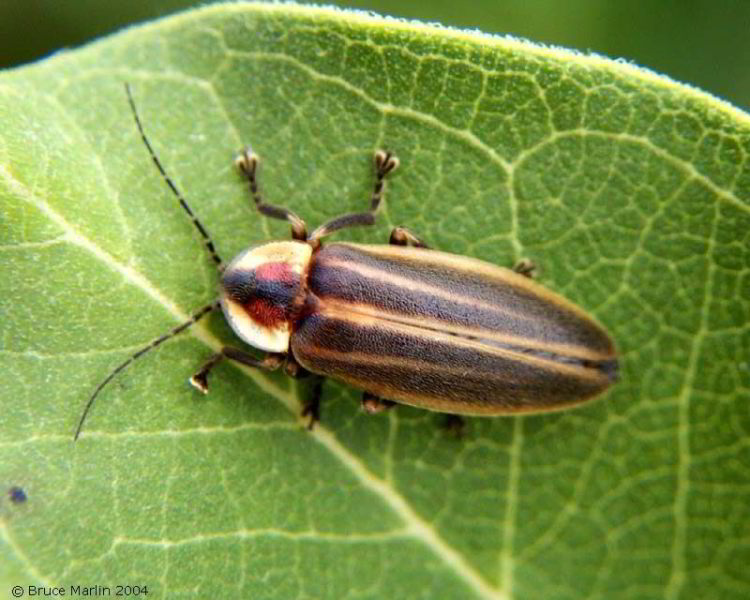
To get Luciferin and ase, one needs to juice up a few thousand Photonis pyralis the Common Firefly. There are 125 species of Lightening Bugs (Lampyridae torchbearers in Latin) in North America, but this familiar species is the one youll encounter at your backyard night club. Take a look here at a top view. The most notable feature of this view angle is that the head is shielded by a thorax shield. While you are at it, get a load of those neat little feet equipped with dual deer like toes. Examining the underside (see here –thanks to this Christopher Hawkins photo. ) will reveal the buggy eyed head and light organ are visible.
Youll notice that the last few segments of the abdomen are pale, waxy smooth, and yellow. This is the light organ area. Just underneath a clear outer layer is a layer of yellow photocytes where the magic mix takes place. Behind them is a reflective layer which bounces the light outward (like the silver backing on a headlight or flashlight). Since oxygen drives the process, there are two easily seen pores on each segment to control air intake.
During the day, one Lightening Bug pretty muck looks like another. The pattern and length of nighttime flashing is what separates species and gets like species together. It is the lot of the males to do most of the flashing. They flash and wait for an appropriate response from a female. He flies while flashing she stays on the ground while answering.
Some fireflies perform a single flash every few seconds, while others do a burst of six pulses every five seconds. Each female displays a bit of feminine coquetry by delaying her response before flashing back an acceptance blink. How long that delay is depends on the species. We reap the benefits of this Morse Code romance by enjoying the light show.
I followed the antics of a few fireflies last night just to see if I could confirm that my backyard fireworks is courtesy of the Common Lightening Bugs of pyralis fame. These common torchbearers are said to flash for one half a second every 5-7 seconds while performing an upward flight sweep.
At 9:00 pm it was still light enough to follow the flight path of individual fireflies. I timed and measured the antics of several and found them engaged in a very consistent flight pattern. Fireflies fly with their abdomen dangling down and their light organs facing forward. These guys were flying about 12 inches off the ground for about four seconds before dropping down to within a few inches of the grass and releasing a half second flash of greenish yellow light. During the brief duration of the flash, they would suddenly dart upward to create a J shaped light signature (you know, like writing your name with sparklers during the Fourth of July). The whole effect was a series of Js executed like clockwork every 6 seconds.
There was little doubt that these were pyralis fireflies.
It didnt take long before I spotted a solitary answer flash from the grass from a pyralis female. Shed respond a few seconds after the male finished his flash. After a few more give and take messages, the particular male I was watching landed next to the lady and bought her a drink.
Things were just heating up or is it cooling down? at the Torchbearers Night Club.
 Once Upon A Michigan

Gerry,
Thanks for this amusing – yet scientifically correct – rendition of firefly dating. What amazing creatures they are! I didn’t even realize what they looked like until I linked to the first photo. I’ve seen them during the day and thought, “Ew!”. Little did I know they created such beauty!
Thanks!
Your Big Sis’
Incandescent light bulbs will soon be phased out because they waste a lot of energy.::.
I’m stopping by to show some school pride! Dude! We are sooo cool!