
An un-announced guest dropped by Jeff Reads Gibraltar house the other day. The well dressed visitor stopped in for lunch and while delivering a poorly aimed stab at his food, was propelled into the porch window with near fatal force. Fortunately, he survived his experience -and in spite of it -will likely return to sample the fare.
The house crasher was an American Kestrel bent on nabbing a sparrow. His intended prey veered off just shy of the window and left the pursuer little time for course correction. The predator and the pane were introduced to each other in short order. This could have been the high impact end of a wonderful career. Many other bird eating raptors, such as the larger Coopers and Sharp-shinned Hawks, suffer this fate while pursuing their trade in the close vicinity of houses. This ill fated hunter struck with a glancing blow that knocked him for a loop but apparently didnt break anything. After a few minutes of counting stars he shook off the cobwebs and flew off.
Mr. Read took full advantage of the opportunity to click off a few splendid images of this splendid visitor (You know what they say about opportunity knocking!) I would like to share them with you. His detailed shots capture the incredible beauty of the bird in crisp detail (here, take a look).
The dazed bird in question is properly known as a Kestrel, but they are often referred to as Sparrow Hawks. Considering that the species is not a hawk or a sparrow specialist, this latter name can lead to some confusion. These robin-sized raptors are card carrying members of the Falcon family a group typified by sickle shaped wings and side burns. Kestrels are, in fact, the smallest falcon in North America so their prey selection is limited to the likes of grasshoppers, mice and an occasional sparrow (when they can catch em, that is). Besides, the name Sparrowhawk is already taken by a European bird that eats sparrows and is a true hawk (see one here).
To be completely official, we need to call this one an American Kestrel because there is another European bird also called a Kestrel. Take a look at this photo and you can compare the much larger Kestrel on the left with an American Kestrel on the right. All of this muddling of names happened because many of our birds were originally named by homesick Europeans. If one of our North American critters kinda looked like one of the neighborhood residents from across the pond, then it was dubbed with the old name.
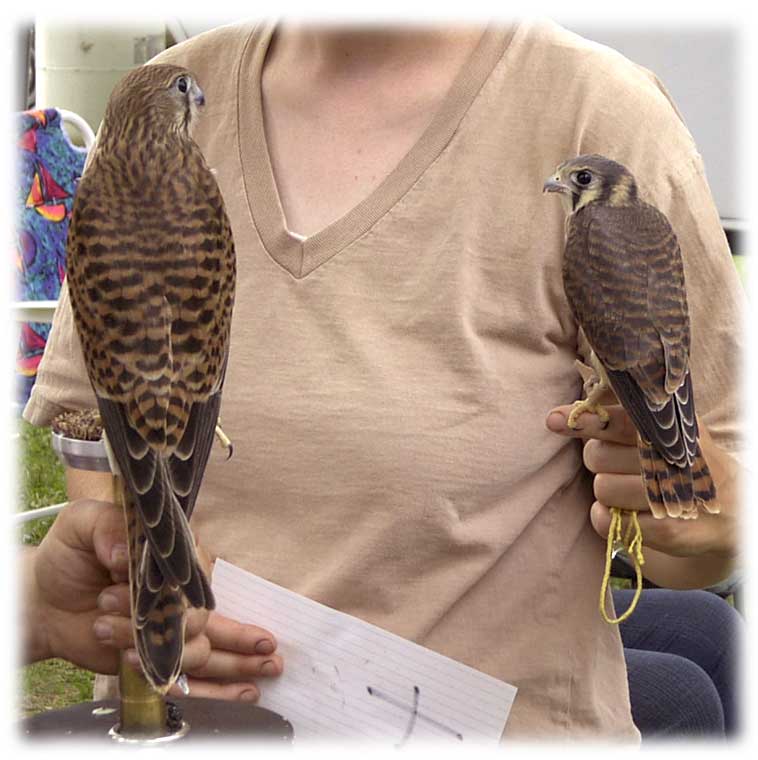
One thing that probably everyone in the world agrees to is that the American Kestrel is the prettiest falcon in the world (although Im sure the French would disagree). The male bird is the boldest of the bunch. The distinctive male features on this pictured bird are the wonderful pastel blue shoulders and crown, speckled peach breast and solid brick red tail. Females lack the blue coloration and have a heavily barred tail.
Both sexes have paired black sideburns (called malar stripes by those folks looking to come up with specific terms where none are needed) and prominent spots on the back of their head (called ocelli by those same folks). Take a look at this view and you can get some sense that those spots take on the appearance of a pair of eyes on a fake face a trait accentuated by a pointed black beak coming down off the top of the head. Why, you might ask, would a bird need a fake face? Kestrels are frequently attacked by larger birds of prey, and they are able to keep these potential predators off guard by tricking them into thinking that they are being watched even when the potential prey is looking away. This, of course, works only some of the time.
If you look carefully at both photos of this little dandy, youll note some dried blood on the beak and on the right foot (the other foot is pulled up out of view). This is sparrow blood spilt from an earlier kill. There is likely to be a spattering of fresher blood by days end.
 Once Upon A Michigan


I AM 11 I SAW TODAY A